Perspective was more than geometry. It became a new invitation to enter the life of a city.
A street you can enter
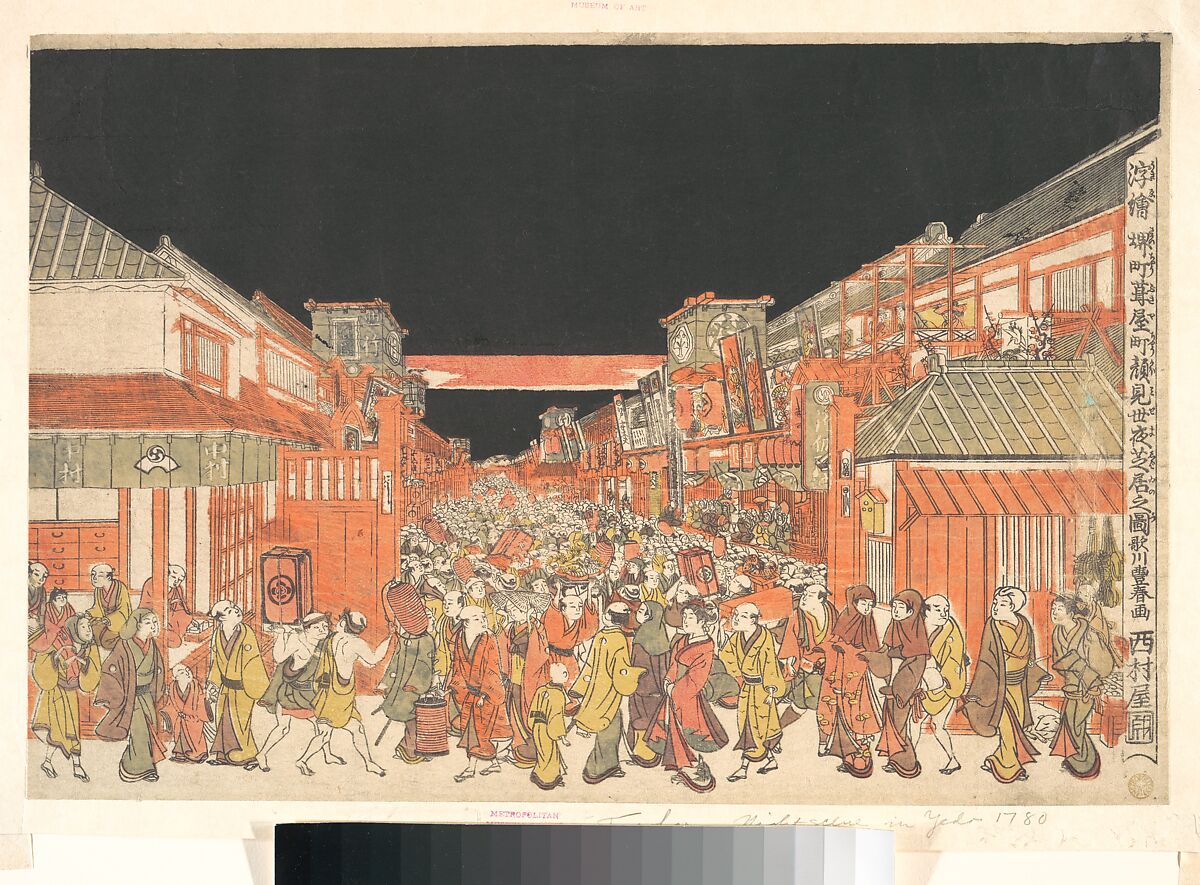
Look at the street in Utagawa Toyoharu’s print of Edo’s theater quarter. Rooflines converge, figures recede, buildings seem to pull the eye inward, and the city offers something rare in an eighteenth-century image: the feeling that the viewer might step into it. The Metropolitan Museum of Art dates Perspective Print (Uki-e) of the Theaters in Sakaichō and Fukiyachō on Opening Night to about 1780. It records a world of public spectacle while making a quiet argument about how pictures can organize space.
The excitement of a kabuki opening
Sakaichō and Fukiyachō were important theater streets in Edo, the city now called Tokyo. The annual kaomise presentations introduced the season’s kabuki performers, drawing crowds into the entertainment district. The picture gathers people, shops and theaters into a remarkably coherent street scene. Yet it is still an artwork, not a photograph or a measured historical survey. Its architectural forms and crowds are selected, arranged and translated into the vocabulary of popular printmaking.
A new way of directing the eye
Toyoharu (1735–1814) became an outstanding practitioner of uki-e, literally “floating pictures,” a form of Japanese pictorial perspective that borrowed strategies associated with European linear perspective. Instead of allowing background structures to remain largely decorative, he organized roads, roofs and façades to create an inviting depth. The lines lead inward; the foreground seems to project forward. The effect is particularly striking when the subject is neither a legendary hero nor an aristocratic interior, but a recognizably bustling urban place.
Not the inventor of Japanese perspective
It would be misleading to announce that Toyoharu invented one-point perspective in Japan. The Met credits Okumura Masanobu (1686–1764) as an early creator of one-point-perspective prints depicting interiors. Toyoharu’s contribution lay especially in his confident adaptation of the device to outdoor subjects. Ideas circulated across artists, workshops, imported images and customers. What matters is not the claim of an isolated first, but the sophistication with which he made a busy Japanese streetscape appear spatially continuous.
The unexpected international story
Japan’s Edo-period cultural world was not sealed off from foreign images. European engravings and the perspective-view pictures known in Japan through circulating copies became sources of pictorial experimentation. The Shimane Art Museum discusses Toyoharu’s Perspective Picture of the Southeast Port in Netherland as a work believed to draw on a European optical print. Its fine hatch marks and unfamiliar architecture appealed, the museum explains, to a curiosity about distant places. Here, visual technology crosses a border and becomes something different through Japanese color-print production.
How perspective became an experience
The geometry is only the beginning. In the theater print, the distant street is not empty: tiny pedestrians make it worth exploring. Foreground figures anchor the scene, while architecture gives it rhythm. The image belongs to the everyday culture of leisure and commerce as much as to a history of optics. Toyoharu could incorporate a spatial technique associated with foreign imagery while retaining the narrative movement and attention to human life that characterized much Japanese visual storytelling.
The workshop behind the illusion
A colorful woodblock print was the product of a skilled collective. The designer devised the image; carvers translated it into printing blocks; printers registered and layered the colors; publishers financed and sold the edition. Toyoharu’s picture survives not merely as evidence of one gifted artist, but as a trace of an urban media economy capable of producing and circulating sophisticated images. Technical innovation mattered because there was already an audience, a distribution network and a production system to carry it.
Founder of an artistic dynasty
Toyoharu founded the Utagawa school, whose reach would become enormous in nineteenth-century ukiyo-e. Among its early masters were Utagawa Toyokuni and Utagawa Toyohiro. The latter trained Hiroshige, whose landscapes became internationally familiar. Later artists including Kunisada and Kuniyoshi extended the school in quite different directions. A neat story in which Toyoharu directly determined every later Utagawa image would distort this branching history. His enduring contribution was the foundation of a network of artists and visual practices, not a single uniform style.
A landscape can command attention
Landscapes existed before Toyoharu, and other artists had long represented buildings and distance. Nevertheless, his particularly assured perspective scenes helped open up possibilities that later generations exploited. The British Museum notes the importance of his 1760s and 1770s perspective designs, while museum accounts connect them with the subsequent growth of landscape printmaking. His achievement can be understood as a shift in emphasis: the street or distant view is no longer merely a stage behind the people; it can become part of the central drama.
An artist with unresolved beginnings
Museum biographies agree on Toyoharu’s lifespan and his founding role, but some particulars of his birthplace, education and early career remain subject to scholarly discussion. A study published by the Ōita Prefectural Art Museum specifically flags uncertainty around those biographical details. This feature therefore avoids turning plausible but disputed stories of his training into settled historical fact. It is entirely possible to appreciate what a surviving artwork demonstrates without pretending every year of its maker’s life is known.
The object in New York
The Met identifies the featured print as a horizontal ōban nishiki-e, ink and color on paper, 25.4 by 37.5 centimeters. It bears accession number JP192 and was acquired through the Rogers Fund in 1914. The catalog currently lists it as not on view. Those museum details matter because public-domain art is most useful when its attribution and provenance can be traced, not when the image travels online without its name, date or source.
The public-domain distinction
The Met explicitly labels this artwork public domain and provides open-access collection material. Toyoharu died in 1814, well outside Japan’s usual copyright term. Ownership of a physical object, copyright in an artwork and the terms attached to individual digital reproductions should nevertheless be considered separately. For this Art Choice, the appropriate image is the unaltered historical print from a verified open-access museum source—not a newly generated approximation, a colored reconstruction or an illustration with fabricated inscriptions.
A different way to look at Japan
It is tempting to treat tradition as a fixed collection of native forms. Toyoharu suggests something more interesting: a culture can adopt a device from elsewhere and make it unmistakably its own. His converging streets do not erase Edo; they allow a viewer to encounter the city afresh. Nearly two and a half centuries later, the printed street still invites a simple experiment. Follow the rooflines toward the distance, then return to the people in the foreground. You have traveled without leaving the page.
Artwork information
Artist: Utagawa Toyoharu. Title: Perspective Print (Uki-e) of the Theaters in Sakaichō and Fukiyachō on Opening Night. Date: circa 1780. Medium: woodblock print (nishiki-e), ink and color on paper. Dimensions: 25.4 × 37.5 cm. Collection: The Metropolitan Museum of Art. Accession: JP192.
Sources and reporting notes
This feature relies on collection catalogs and art-historical studies, not an original curator interview. Details of birthplace and early training remain debated. Check the museum for current display information.
- The Metropolitan Museum of Art: Perspective Print, object JP192
- Shimane Art Museum: 歌川豊春《浮絵阿蘭陀国東南湊図》
- The British Museum: Utagawa Toyoharu biography
- Ōita Prefectural Art Museum research bulletin (study of Toyoharu)
- Bates College Museum of Art: Utagawa school history
- The Met: Shinobazu Pond by Toyoharu
- The Met: A Beauty Looking Down upon a Young Man Reading a Love Letter