The skeleton does not merely enter the room. It tears the room open. Its skull hangs above two armed men; its fingers part the ruined blinds; its rib cage spans the seams of three sheets of paper. At the left, Princess Takiyasha reads an incantation. At the right, the hero Ōya no Mitsukuni refuses to collapse in fear. Nearly two centuries before the cinema close-up, Utagawa Kuniyoshi made the spectator feel that a monster had crossed the border of the frame.
That triptych, generally known as Takiyasha the Witch and the Skeleton Spectre or Sōma no furudairi, is the gravitational centre of UTAGAWA KUNIYOSHI – the Super Creator of Ukiyo-e!, newly opened at the Kyoto City KYOCERA Museum of Art. The exhibition runs from July 18 through September 23, 2026, in the first-floor North Wing of the Main Building. Organizers say it brings together approximately 200 works, arranged to reveal six fields of invention, and includes a separate digital environment made from more than 50 Kuniyoshi images.
It is tempting to advertise Kuniyoshi with a roll call of things: samurai, tattooed outlaws, whales, octopuses, women in patterned kimono, Kabuki actors, tanuki, goldfish, cats, composite faces, ghosts. The exhibition does offer that abundance. But lists conceal the unity of his imagination. Again and again, Kuniyoshi asks the same thrilling question: what else can this rectangle of paper become? A battlefield seen at the instant of impact. A stage. A riddle. A forbidden actor portrait wearing an animal mask. A landscape with Western depth. A joke whose answer is another picture.
The exhibition, without the fog of promotion
The verified essentials are straightforward. The venue is Kyoto City KYOCERA Museum of Art, Main Building, North Wing, first floor, at 124 Okazaki Enshoji-cho in Sakyo Ward. Galleries open from 10 a.m. to 6 p.m.; last admission is 5:30 p.m. The museum is closed on Mondays except the public-holiday Mondays of July 20 and September 21. Full-price admission is ¥1,900 for adults, ¥1,400 for high-school and university students, and ¥700 for elementary and junior-high students. Preschool children enter free; documented disability admission covers the holder and one attendant. The nearest subway access is Higashiyama Station on the Tōzai Line.
The show is organized by Kansai Television, the Sankei Shimbun, the Kyoto Shimbun and the City of Kyoto, with planning cooperation from Art One. Its official Japanese title, Ukiyo-e Super Creator Utagawa Kuniyoshi, uses contemporary language deliberately. “Super creator” is not an Edo-period rank or a scholarly school. It is an invitation to look beyond the narrower label “master of warrior prints.” The approximately 200 objects move among warrior pictures, caricature and play, beautiful women, Kabuki actors, landscapes, animals and supernatural spectacle; the organizers describe the arrangement as six genres, even when individual works mischievously occupy several at once.
There is no announced requirement to reserve a timed slot, although the ticket office warns that entry may be controlled when galleries are crowded. A useful visit therefore has two speeds. First, stand back from the triptychs until their three sheets fuse into a single event. Then move close enough to see woodgrain, registration, embossed surfaces, fading and the hairline decisions of the block cutter. Kuniyoshi supplies spectacle, but the surviving impressions also record labour.
| Visit | Confirmed information |
|---|---|
| Exhibition | UTAGAWA KUNIYOSHI – the Super Creator of Ukiyo-e! |
| Dates | July 18–September 23, 2026 |
| Hours | 10:00–18:00; last admission 17:30 |
| Closed | Mondays, except July 20 and September 21 |
| Venue | Main Building, North Wing 1F, Kyoto City KYOCERA Museum of Art |
| Admission | Adults ¥1,900; high school/university ¥1,400; elementary/junior high ¥700 |
| Scale | About 200 prints in six genres; immersive installation based on more than 50 works |
The monster made by three pieces of paper
Sōma no furudairi, made around the mid-1840s, draws from a literary legend around Takiyasha, the daughter of the tenth-century rebel Taira no Masakado. In the tale, Mitsukuni enters the ruined Sōma palace to confront surviving conspiracy and sorcery. Kuniyoshi’s decisive transformation was one of scale and concentration. Instead of illustrating a crowd of ordinary skeletons, he made one anatomically attentive impossibility loom across an entire ōban triptych.
Three vertical sheets were a practical product format. Each could be carved and printed separately. Kuniyoshi treated the seams not as defects but as hinges in a panoramic machine. The skull commands the central sheet; a bony hand reaches into the right; Takiyasha’s quiet spell occupies the left. Tatters of fabric repeat the skeleton’s diagonals. Human figures lean against its pressure. The empty black behind the bones is not empty at all—it is the visual force that pushes them forward.
Reproductions on screens often erase the triptych’s material intelligence. In a digital image, the skeleton appears to inhabit one seamless rectangle. In the gallery, three physical papers keep reminding the viewer that the giant was assembled. Kuniyoshi lets the mind perform the final join. That is one reason the work feels modern: not because it predicts a particular comic-book panel or film effect, but because it makes the medium’s construction part of the drama.
The cat road from Edo to Kyoto
The great skeleton frightens by becoming too large. Kuniyoshi’s cats delight by becoming language. In Puns Just Like This: The Fifty-three Cats of the Ailurophile—better known by the Japanese title Sono mama jiguchi myōkaikō gojūsan biki—cats act out verbal jokes for the 53 stations of the Tōkaidō, plus the cities at either end. The old highway ran between Edo and Kyoto; the print converts geography into feline rebus theatre.
A station name might be suggested by a cat’s pose, an object or a phrase that sounds similar. The viewer must speak, inspect and solve. Fat cats, thin cats, kittens, mousers and magical animals turn a celebrated travel itinerary into a sheet of jokes. The triptych works for someone who simply enjoys cats, but its full energy belongs to a linguistically alert Edo audience accustomed to puns, actor references and borrowed cultural formats.
Kuniyoshi’s reputation as a cat lover is supported by many images and later anecdotes, but the art matters more than the biography. He drew feline weight: the elastic spine, the tucked paw, the irritated tail, the collapse into sleep. He also understood cats as substitute performers. During restrictions on images of actors and courtesans, an animal body could preserve a recognizable gesture, costume or face while introducing comic deniability. A cat is adorable; a cat can also smuggle a theatre poster past a censor.
The exhibition includes other forms of visual language, including Catfish from the “cat characters” series and the celebrated composite picture At First Glance He Looks Very Fierce, but He Is Actually a Kind Person. Step close to that face and its eyes, nose, cheeks and mouth dissolve into entangled human bodies. Step back and the face returns. The joke is optical, social and philosophical at once: an identity that looks singular is a crowd.
Before the fame: a dyer’s son in the Utagawa machine
Kuniyoshi was born in Edo’s Nihonbashi district in the Japanese year 1797, corresponding to January 1, 1798 in the Gregorian calendar—a conversion that explains why English-language sources alternate between 1797 and 1798. His family worked in dyeing. It is plausible that a childhood around patterned cloth sharpened his later feeling for textiles, though the connection should be treated as an inference rather than a documented curriculum.
Around 1811, when he was about 14 or 15, he entered the studio of Utagawa Toyokuni I. The “Utagawa” in his professional name identified a lineage, not a family surname in the modern celebrity sense. Toyokuni’s shop trained designers inside what was becoming the dominant network of nineteenth-century popular printing. Kuniyoshi received the “kuni” element of his art name from his master and learned a marketplace in which a successful visual idea could become a series, and a series could turn an apprentice into a brand.
Success was slow. Early book illustrations and actor or warrior designs did not lift him to the level enjoyed by his fellow pupil Kunisada. The reversal began around 1827 with One of the 108 Heroes of the Popular Water Margin, a series based on the Chinese outlaw epic Shuihu zhuan, known in Japan as Suikoden. Kuniyoshi’s heroes twist through storms and combat, their muscles and patterned garments filling the sheet. Many display extravagant full-body tattoos. They are not quiet moral exemplars; they are outlaw charisma manufactured in colour.
The series was a commercial breakthrough and helped fix the phrase “Kuniyoshi of the warrior pictures.” It also shows how international Edo culture could be without modern borders: a Chinese novel moved through Japanese translation and adaptation, then became mass-produced images whose tattoo designs entered another living visual tradition. The warrior genre gave Kuniyoshi a reputation. He spent the rest of his career proving that it could not contain him.
1797 / Jan. 1, 1798: Born in Edo; the date differs by calendar convention.
About 1811: Enters Utagawa Toyokuni I’s studio.
1814 onward: Begins publishing under the name Kuniyoshi.
About 1827: The Popular Water Margin hero series begins his breakthrough.
1830s: Expands warrior imagery and experiments with landscape and Western-derived depth.
1841–43: Tenpō Reform restrictions reshape the market for actor and courtesan prints.
Mid-to-late 1840s: Creates giant triptychs, cat puns, composite figures and some of his most famous visual inventions.
1861: Dies in Edo, leaving a large studio lineage.
2026: Kyoto presents about 200 works alongside an immersive digital installation.
Ukiyo-e was a team sport
A museum label puts “Utagawa Kuniyoshi” at the top, correctly identifying the designer. But a commercial colour woodblock print was normally a collaboration. A publisher financed and managed the project, selected or negotiated subjects and brought the object to market. The artist supplied the preparatory drawing. A specialist block cutter pasted the final drawing face-down on cherry wood and cut away everything that would not print, sacrificing the drawing while creating the key block. Printers registered paper against the blocks and applied colour in repeated impressions. Makers of paper and pigments stood behind them all.
Each colour generally required a separate block or block face. Minute registration marks kept the impressions aligned. Gradation, blind embossing, mica and overprinting could add atmosphere or luxury. Later impressions might use altered colours, show wear or omit expensive effects. That means “the same Kuniyoshi” can look substantially different from one collection to another. Condition is not a footnote: light-sensitive pigments fade, paper tones change, sheets are trimmed, triptychs become separated and albums are rebound.
This production system explains the speed and responsiveness of ukiyo-e. It was not a solitary painter waiting for inspiration in front of a unique canvas. It was urban publishing. Kabuki casting, popular novels, fashion, disaster, gossip and government rules could generate new imagery. Kuniyoshi’s genius lay partly in drawing; it also lay in designing ideas robust enough to survive carving, printing, retail display and repeated handling.
“Super creator” becomes useful only if it does not erase those collaborators. Kuniyoshi was an extraordinary visual director inside a sophisticated media industry. The signature belongs to him. The printed surface belongs to many hands.
Censorship, camouflage and the dangerous joke
The Tenpō Reforms of the early 1840s tried to impose frugality and moral order on urban life. Regulations constrained luxury publishing and restricted popular images of Kabuki actors and high-ranking courtesans. The result was not silence. It was substitution. Artists and publishers changed titles, hid identities, displaced current personalities into old stories, and transformed performers into animals, shadows or seemingly innocent puzzles.
Kuniyoshi was especially equipped for that environment. Anthropomorphic cats, sparrows, fish and monsters could reproduce the energy of the licensed quarters or Kabuki stage without stating the prohibited subject directly. Historical scenes could carry contemporary echoes. In Minamoto no Yorimitsu’s Residence, Haunted by the Earth Spider, sleeping power and a procession of apparitions invited viewers to search for political counterparts. Authorities treated some designs as politically allusive or improper, stopped publication and questioned Kuniyoshi.
Yet it is easy for a modern viewer to turn every comic print into a coded manifesto. Edo satire operated through shared allusion, gossip and plausible deniability; meanings changed with the audience. Some jokes mocked policy. Some evaded commercial restrictions. Some were simply exuberant. Responsible looking preserves ambiguity where evidence does. Kuniyoshi’s achievement was not that every cat was a revolutionary. It was that a cat could support several readings at the same time.
Warriors that move, landscapes that recede
In Miyamoto Musashi and the Giant Whale, around 1847, the legendary swordsman appears almost absurdly small against a dark, arching animal. The composition does not describe a measured zoological encounter. It manufactures scale by opposition: curved whale against diagonal weapon, dense body against agitated water, tiny hero against an arena too large for the page. Like the skeleton triptych, the image recruits all three sheets into one cinematic pressure field.
Kuniyoshi’s warriors often occupy the split second before or after impact. Rain slants; ropes pull; garments flare; tattooed torsos torque. Text and cartouches are not external captions but shapes within the action. The eye does not proceed politely from foreground to background. It is knocked sideways, then sent back to collect clues. That directed confusion is part of his narrative craft.
His landscapes reveal a different appetite. Imported European prints and optical ideas circulated in Japan despite restrictions on foreign exchange. Kuniyoshi experimented with cast shadows, low horizons, recession and cloud structures derived from Western pictures, then combined them with Japanese formats and subjects. He was not “becoming Western.” He was treating foreign perspective as another device in a crowded toolkit.
The same versatility enters pictures of fashionable women and actors. A beauty print becomes an archive of cloth, hairstyle, gesture and urban aspiration. An actor likeness translates a public performance into a purchasable sheet. Works such as Ten Wise Women: Gion Kaji show why reducing Kuniyoshi to monsters distorts him. His women are not pauses between battles; their alert bodies and layered textiles carry their own modern urban force.
What the immersive room adds—and what paper keeps
KUNIYOSHI IMMERSIVE ART is presented as a component of the exhibition and a spin-off from the travelling “Ukiyo-e Immersive Art” format. Its creators have drawn on more than 50 Kuniyoshi works, including the whale and the Sōma skeleton, to build a three-dimensional projected environment with 3DCG animation and projection mapping. Images expand across walls; figures move; the spectator is surrounded rather than standing before a sheet.
That approach is unusually compatible with an artist who already made things burst across boundaries. Motion can expose the sequence latent in a sword stroke or a cat’s pose. Enlargement can make a room feel the pressure of the skeleton that Kuniyoshi simulated on three sheets. It can also welcome visitors who have not learned the codes of actor prints, classical legend or mitate parody.
But immersion is interpretation, not resurrection. The historical print does not move, glow from within or arrive with a soundtrack. Its pace belongs to the viewer. Its colour is pigment carried by paper fibre; its scale is human and handheld; its seams are real. Projection can dramatize content while flattening the evidence of manufacture. The best way to use the Kyoto installation is therefore comparative: experience the animated world, then return to the print and ask what the digital artists added, removed, accelerated or made seamless.
Why Kyoto is more than a backdrop
The exhibition occupies a building with its own argument between inheritance and reinvention. The museum opened in 1933 as the Dairei Memorial Kyoto Museum of Art in Okazaki, a district shaped by Kyoto’s modern cultural institutions. Its main structure is the oldest surviving public art-museum building of its kind in Japan. Architects Jun Aoki and Tezzo Nishizawa led a major renovation that retained the monumental historical exterior while inserting new circulation, galleries and a lowered glass entrance; the museum reopened in 2020 under its present commonly used name.
That setting suits Kuniyoshi. A 1930s civic monument houses cheap, reproducible papers from the 1830s to 1850s; twenty-first-century projection moves inside both. Kyoto was also the western terminus of the Tōkaidō that Kuniyoshi converted into cat puns. The exhibition’s journey from an Edo publishing culture to a Kyoto museum is therefore not simply geographical. It traces a shift in status: objects once sold as entertainment, news, fashion and fandom now protected behind glass as art history.
The shift gives viewers access and demands caution. Museum lighting protects vulnerable colour but can make prints appear subdued. Mounting restores triptychs, yet may obscure how individual sheets circulated. A dignified gallery can make every joke solemn. The cure is not to deny artistic greatness, but to remember the market noise around the image: the publisher’s calculation, the shopper’s recognition, the friend explaining the pun.
A school that outlived its master
Kuniyoshi’s studio trained artists who carried his visual energy across the collapse of the shogunate and into the Meiji period. Tsukioka Yoshitoshi transformed warrior and supernatural imagery with a darker psychological pressure. Ochiai Yoshiiku worked in actor prints, satire and the new world of illustrated news. Yoshitora, Yoshifuji, Yoshikazu and other pupils extended the school into pictures of foreigners, toys, battles and modernizing cities.
The legacy is not a straight line to manga, anime or tattoos, and the convenient claim that Kuniyoshi “invented comics” erases many histories. The more defensible connection lies in visual strategies: elastic scale, serial characters, dramatic cropping, word-image jokes, successive instants compressed into one frame and the use of a page seam as action. Modern artists recognize a fellow problem-solver, even when their production systems are entirely different.
His global reputation also depends on collecting. Ukiyo-e sheets left Japan in large numbers, entered European and American museums, and participated in nineteenth-century Japonisme. Later scholarship and exhibitions reconstructed series from dispersed impressions. What now looks like an inevitable canon was shaped by survival, export taste, condition and the choices of collectors. Cats and skeletons travel brilliantly online; quieter actor prints and book illustrations need curators to restore the breadth.
Why Kuniyoshi is the visual language of today’s edition
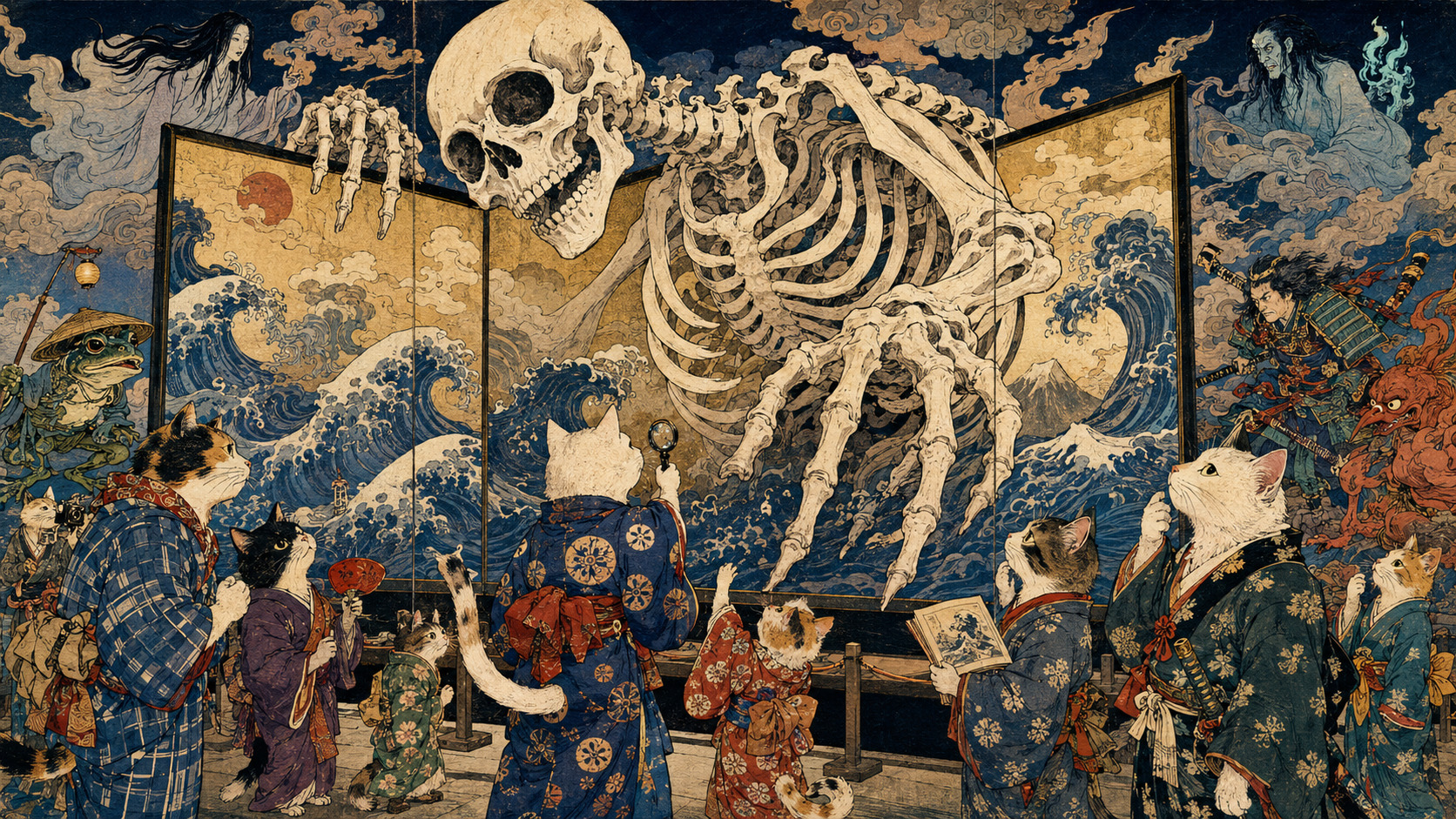
Japan.co.jp selected Kuniyoshi as the art reference for all sixteen illustrations in the July 23 edition. The choice is not a claim that he depicted yen intervention, maglev construction, programmable heat, dialysis research, Russian bombers or a future transplant. He did not. Each image is newly made editorial art that borrows high-level visual grammar—diagonal action, triptych-like staging, patterned waves, theatrical monsters, emphatic outlines and the collision of the comic with the grave.
That disclosure matters. “Inspired by Kuniyoshi” must not be confused with “by Kuniyoshi,” “after a specific Kuniyoshi print,” an exhibition photograph or a documentary reconstruction of Edo. The hero image above deliberately gathers his familiar skeleton, cats, warriors and supernatural cast, but it does not copy one historical composition. Captions across the edition identify the images as symbolic where the scene contains metaphor, compression or imagined figures.
The deeper reason for the choice is editorial. Kuniyoshi could make systems visible by turning them into conflict: a warrior against a whale, a body assembled from bodies, a road translated into cats. Today’s news likewise contains forces too abstract to photograph directly—exchange rates, industrial clusters, thermal radiation, mortality associations, strategic signalling. His example encourages an image to explain through transformation, provided the transformation is honestly labelled.
How to look: six questions for one print
- What happens first? Trace the diagonals, glances and gestures that determine narrative order.
- Where are the seams? In a diptych or triptych, notice what crosses sheets and what each sheet could do alone.
- What must be spoken? Titles, puns and actor allusions may turn an image into a verbal game.
- Who made the surface? Look for carving precision, registration, gradation, embossing and signs of block wear.
- What could not be named? Consider censorship and camouflage without assuming every disguise has one fixed political key.
- What has time changed? Fading, trimming, mounting and separated sheets shape the image now seen.
Begin with pleasure. Kuniyoshi designed for it. Let the skeleton startle, the whale overwhelm and the cat make the bad pun. Then look a second time, because the first impact is only the sales pitch. Under it sits an exact construction of bodies, words, paper and shared knowledge.
The exhibition title calls him a super creator. A better historical description might be a super collaborator, super reader and super editor: someone who absorbed novels, theatre, current affairs, foreign pictures, censorship rules and the habits of animals, then recombined them for an impatient city. His prints did not escape commerce. They became great through commerce—through the need to stop a passer-by, survive a censor, reward a fan and make another sheet worth buying.
In Kyoto, the giant skeleton rises again, first from three modest papers and then from projected light. The two apparitions are not competitors. Together they reveal the durability of Kuniyoshi’s central trick. He makes a viewer see the mechanism and believe the impossible anyway.
Sources, labels and evidence notes
Exhibition numbers, dates, venue, admission and organizers follow official museum and ticket information current on July 22, 2026. “About 200” and “more than 50” are organizer descriptions, not an independently audited checklist count. Historical dates can vary by calendar conversion; this article follows the exhibition’s 1797–1861 form while explaining the Gregorian 1798 birth date. Today’s newspaper illustrations are contemporary editorial works and are not included in, endorsed by or documentary records of the Kyoto exhibition.
- Kyoto City KYOCERA Museum of Art: official English exhibition overview and visitor information
- Kyoto City KYOCERA Museum of Art: official Japanese overview, featured works and organizers
- Kansai Television: exhibition statement, six-genre plan and ticket information
- Hitohata: immersive installation, 50-plus source works, 3DCG and projection-mapping description
- Official online ticket service: sale window and visitor conditions
- Ota Memorial Museum of Art: Kuniyoshi’s career, Water Margin breakthrough, censorship and giant triptychs
- Ota Memorial Museum of Art: cats as pets, performers, monsters and subjects of toy prints
- RISD Museum: Kuniyoshi’s childhood, apprenticeship and artistic influence
- Library of Congress: Kuniyoshi’s Suikoden imagery and literary sources
- Brooklyn Museum: the Utagawa school’s market dominance, popular audience and regulation
- Metropolitan Museum of Art: history and method of ukiyo-e woodblock printing
- British Museum: the collaborative roles of designer, block cutter and printer
- Museum of Fine Arts, Boston: the 53 station puns plus Edo and Kyoto in Kuniyoshi’s cat triptych
- Kyoto City KYOCERA Museum of Art: 1933 building and the Aoki–Nishizawa renovation
- Ota Memorial Museum of Art: Kuniyoshi’s pupils and the continuation of his cat imagery