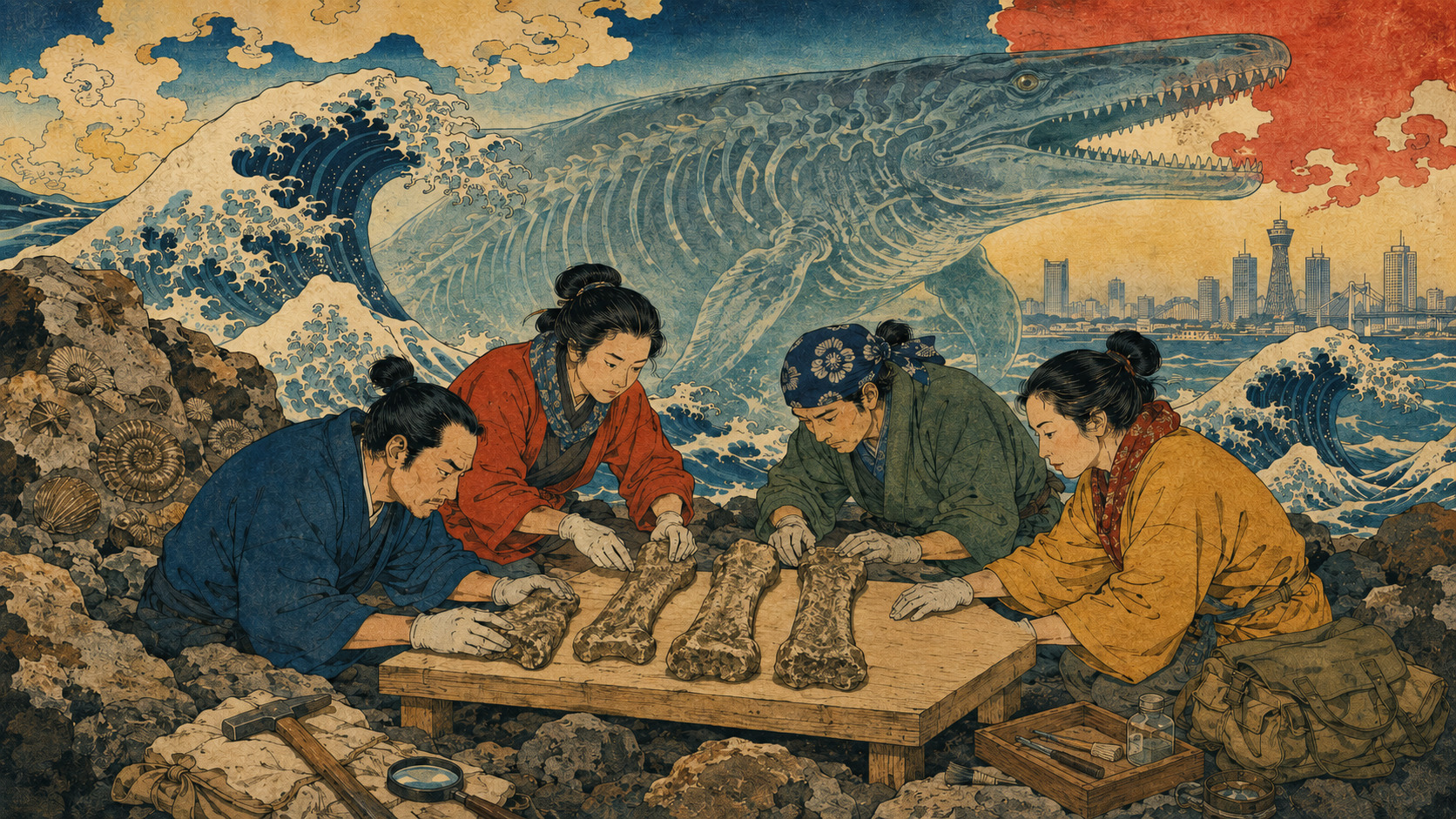
The discovery did not begin with a hammer blow in 2026. It began when researchers returned to stone that had already been kept for more than thirty years. Between the end of 1990 and 1992, fossil bones of a mosasaur were collected at Sobura, a mountain district of Kaizuka City in southern Osaka Prefecture. The material entered the collection of the Natural History Museum, Kishiwada. Some of the surrounding rock remained unprepared, holding whatever evidence could not yet be seen.
This year, that rock yielded four more bones. A joint team from Okayama University of Science, Tokyo City University, the Kishiwada museum and other institutions announced the result on July 1 after presenting it at the 177th regular meeting of the Palaeontological Society of Japan on June 27. The pieces are similar in size and come from the same locality, so the team considers them likely to belong to the same individual as the previously known material. On comparison with other mosasaurs, the animal’s total length is estimated at about six metres.
The headline finding is easy to compress and easy to overstate. The researchers have recognized Japan’s first confirmed mosasaur premaxilla—the bone at the very front of the upper jaw—and a basisphenoid from the floor of the braincase with a combination of traits they say differs from known forms. That makes an unknown species a serious possibility. It does not yet make “the Osaka mosasaur” a formally established new species.
What the four bones establish—and what they do not
- Established: four additional fossil bones were recovered by preparing old matrix from the Sobura mosasaur material.
- Established: one bone is a premaxilla, the frontmost element of the upper jaw; the team identifies it as the first confirmed mosasaur premaxilla from Japan.
- Observed: the basisphenoid has short, horn-like lateral projections extending horizontally and lacks a groove normally present on its underside.
- Inferred: size and locality indicate that the new pieces probably come from one individual, associated with the older Sobura material.
- Possible: the unusual braincase anatomy may distinguish a species not yet known to science.
- Not yet known: no new genus or species has been formally described or named, and the animal’s exact position on the mosasaur family tree remains under study.
The distinction matters because bones carry different kinds of information. Finding the premaxilla is important largely because a previously missing part of the Japanese fossil record is now available for comparison. The suggestion of a new species comes more directly from the basisphenoid. That bone lies near the brain and contributes to the underside of the braincase. It is not a dramatic tooth or a giant vertebra; it is a compact architectural element whose processes, grooves and contacts can preserve evolutionary history.
In the Osaka bone, the short projections spread sideways rather than taking the more familiar form, and the ordinary ventral median groove is absent. A single feature can vary for many reasons. The force lies in a combination of characters that survives careful comparison. Researchers must still ask whether the form reflects species, growth stage, individual variation, deformation during burial, damage during preservation, or an incomplete comparison with known material.
Why “possible new species” is the scientifically strong wording
Taxonomy is not a naming ceremony held at a press conference. For a modern zoological name to become available under the International Code of Zoological Nomenclature, the authors must publish a work intended as a permanent scientific record, state the characters that purportedly distinguish the animal, explicitly indicate that the name is new, and fix a name-bearing type specimen. For species named after 1999, the publication must also state where an existing type will be deposited.
The Osaka result is currently a conference presentation and institutional announcement. Those are legitimate ways to share an important finding, but the team has not proposed a Latin binomial. A formal paper would need a detailed description, measurements and images, comparisons with relevant mosasaurs, a diagnosis, and an analysis of evolutionary relationships. Other specialists would then be able to test the argument against the physical specimen in Kishiwada.
Even publication does not make taxonomy motionless. Later discoveries can move a species to another genus, reveal that two names refer to one animal, or show that differences once treated as diagnostic fall within normal variation. A scientific name is a durable reference point, not a promise that interpretation will never change.
The sea beneath the Osaka mountains
Sobura is inland and elevated today. Its marine reptile is therefore also a geological message. Roughly seventy million years ago, near the end of the Cretaceous Period, the rocks of this part of the Izumi Group were accumulating in the sea along the northwestern Pacific margin. Sand and mud moved downslope in sediment-laden currents and settled in repeated layers. A carcass, disarticulated bones or material carried along the sea floor could be buried in that system and protected from complete destruction.
The Izumi Group is a thick belt of marine deposits dominated by alternating conglomerate, sandstone and mudstone, much of it formed by turbidity currents. It extends for roughly 300 kilometres from western Shikoku through Awaji Island to the Izumi Mountains. In broad terms its rocks become younger eastward: Campanian in the west, with Maastrichtian strata in the Osaka–Wakayama end of the belt. The Sobura material belongs to that younger, latest-Cretaceous history.
Japan did not yet have its modern outline. These sediments formed on the edge of East Asia long before the opening of the Japan Sea completed the archipelago’s later separation and rotation. Mountain building and erosion eventually lifted ancient seabed into the landscape where the fossil was found. The schoolbook puzzle—why is a sea creature in a mountain?—has a precise answer: the mountain is made partly from a former sea floor.
A fossil record assembled piece by piece
The newly prepared bones do not replace thirty years of work. They clarify it. The Sobura occurrence was reported in scientific literature in the 1990s, and later studies treated parts of the lower jaw, teeth and vertebrae. Masahiro Tanimoto’s 2005 review of mosasaur remains from the Izumi Group summarized the locality as unusually notable for the quality and number of specimens, while also showing how difficult assignment could be when fossils were scattered and comparative material was limited.
Late 1990–1992: mosasaur material is collected at Sobura, Kaizuka City.
1993–1994: the occurrence enters the research record; cranial, jaw and vertebral material is reported from the Maastrichtian Mutsuo Formation.
1990s–2000s: teeth, a cervical vertebra, a phalanx, a dentary and lower-jaw material from Sobura and the wider Izumi Group are studied and reconsidered.
2005: a regional review places the Osaka fossils within a diverse but fragmentary Izumi Group mosasaur record.
2026: preparation of retained matrix reveals four more bones, including the premaxilla and unusual basisphenoid.
Older reports used provisional comparisons such as Mosasaurus sp., and one specimen had at times been compared with Prognathodon. Such labels are working hypotheses, not permanent identities. The 2026 university announcement prudently avoids assigning the animal to a genus. That caution is especially important when the very bones now being added could change the comparison.
The history exposes a common misconception: fossils are not exhausted at the moment of collection. A block in a museum can contain visible bones, hidden bones, sedimentary evidence and an unasked question. Preparation is not housekeeping. It is a slow form of observation, because every removal of matrix changes what can be seen and must be documented without damaging what has survived.
The rise of the mosasaurs
Mosasaurs were not dinosaurs, and they were not marine mammals. They were squamates—the great reptile group that contains living lizards and snakes—whose ancestors returned to the water. Their exact relationship within Squamata remains debated, so simple claims that they were merely “giant monitor lizards” go beyond the settled evidence.
Early mosasauroids retained more land-capable proportions. During the Late Cretaceous, the lineage diversified into fully marine forms with paddle-like limbs, elongated bodies and tails specialized for propulsion. Exceptionally preserved soft-tissue evidence from Platecarpus demonstrated a streamlined outline and a crescent-shaped tail fin much earlier in mosasaur evolution than older, eel-like reconstructions had assumed. Fossil evidence also supports live birth in mosasauroids, an adaptation that freed fully aquatic animals from returning to shore to lay eggs.
They were carnivores, but “sea monster” conceals ecological variety. Tooth shape ranges from slender piercing forms suited to seizing fish and cephalopods to robust crushing or cutting forms capable of handling tougher prey. Body size and swimming anatomy also varied. Some mosasaurs occupied top-predator roles; others pursued smaller prey or used different parts of the marine food web. They spread through the world’s Late Cretaceous seas and disappeared in the end-Cretaceous mass extinction about 66 million years ago.
The Osaka individual lived late in that history. At roughly six metres, it was substantial but not among the most enormous members of the family. The body-length estimate is a reconstruction from bone size and comparisons, not a tape measurement of a complete skeleton. Without enough of the skull, limbs and vertebral series, its precise diet, swimming style, sex and age cannot responsibly be declared.
Japan’s northern Pacific mosasaur archive
The Osaka fossil belongs to a national record built from Hokkaido to southwest Japan. The first Japanese—and Asian—mosasaur report appeared from Hokkaido in 1972. Subsequent finds showed that the waters along the northwestern Pacific margin held more than one kind of mosasaur, although early names and assignments have sometimes been revised as methods and comparisons improved.
A particularly instructive example is Phosphorosaurus ponpetelegans, described in 2015 from Hokkaido. Its well-preserved skull helped establish a western-Pacific record for its group and suggested forward-overlapping vision. It demonstrated how a skull can reveal an ecological experiment very different from the generic image of a giant, indiscriminate hunter.
Then came the Wakayama “blue dragon.” Discovered in Aridagawa in 2006 and formally described in 2023 as Megapterygius wakayamaensis, it preserves most of the skeleton except the tail and is estimated at about six metres. Its exceptionally large, wing-like flippers and unusual vertebral anatomy expanded ideas about mosasaur locomotor diversity. The Wakayama specimen is not the Osaka animal, and its recognition does not prove that Osaka has a new species. It does show why newly available bones can overturn an old generic reconstruction.
| Specimen or milestone | What it added |
|---|---|
| Hokkaido report, 1972 | The first published mosasaur occurrence from Japan and Asia. |
| Phosphorosaurus ponpetelegans, 2015 | A distinctive Hokkaido skull and new evidence about western-Pacific distribution and vision. |
| Megapterygius wakayamaensis, 2023 | A nearly complete southwest-Japan skeleton revealing unexpected flipper and trunk diversity. |
| Osaka material, 2026 | Japan’s first confirmed premaxilla and an unusual basisphenoid; formal identity still open. |
The museum is part of the discovery
The institutional map is as important as the fossil map. The animal came from Kaizuka City; its bones are held and now displayed at the Natural History Museum, Kishiwada, in the neighboring city. The 2026 study joins a graduate researcher and faculty at Okayama University of Science with specialists at Tokyo City University, the University of Tsukuba, the museum and beyond. No single person or institution contains all the skills, comparisons and memory needed to interpret the material.
Kishiwada’s mosasaur work also carries a local human history. Kansai Television’s account recalls Kazuya Miyauchi, a young researcher who studied mosasaur feeding and became closely associated with the museum before dying from illness in 2007 at the age of seventeen. The present fossil should not be turned into a monument that scientists themselves did not claim. But the continuity is real: local collecting, museum care, public curiosity and successive generations of researchers created the conditions in which stone kept decades ago could speak again.
A collection is therefore not a warehouse of completed discoveries. It is research infrastructure held in trust. Labels preserve locality. Matrix preserves context. Curators preserve the chain connecting a specimen to its history. Comparative collections allow an odd projection on one small braincase bone to become visible as odd.
What must happen next
The team now faces a demanding comparative problem. The new bones must be fully described and figured. Their association with the older material must be tested. The basisphenoid must be compared across relevant mosasaur groups and across growth stages where such material exists. Researchers must distinguish original anatomy from breakage or geological distortion, then examine whether the character combination changes the animal’s placement in a phylogenetic analysis.
If the evidence supports a new species, a formal publication can provide a name, diagnosis, type designation, specimen numbers, locality and stratigraphic information. If the evidence instead places the animal within an existing species or leaves it indeterminate, that is not failure. Japan’s first confirmed mosasaur premaxilla remains a significant anatomical record; the new bones still improve reconstruction of an animal from the latest Cretaceous northwest Pacific.
Several outcomes remain open:
- The character combination could support a new species within a known genus.
- Broader differences could justify both a new genus and species.
- Comparison could place the animal within a named taxon whose braincase was previously poorly known.
- The material could remain indeterminate because four bones do not preserve enough diagnostic information.
The last possibility is not an empty answer. Paleontology advances by shrinking uncertainty honestly. A fragment with excellent locality and anatomy can be more useful than a dramatic reconstruction built on weak evidence.
The discovery already made
The new-species question will take time because the fossil has already waited through two different histories. The first was geological: death, burial, rock, uplift and erosion over roughly seventy million years. The second was human: collection, curation, preparation and comparison over roughly thirty-four.
Those scales meet in four bones. One closes a conspicuous gap in Japan’s mosasaur anatomy. One preserves a structure that may not match any described species. Together they sharpen the picture of a marine ecosystem that once occupied the ground beneath modern Osaka.
Sources and method
This article distinguishes the team’s reported observations from our contextual synthesis. The body length is the researchers’ comparative estimate. “Possible new species” is retained because the July 2026 result is a conference presentation and institutional announcement, not a formal taxonomic description. The fossil locality is Sobura in Kaizuka City; the collection and exhibition are at the Natural History Museum, Kishiwada.
- Okayama University of Science: July 1, 2026 announcement, anatomy, team and exhibition status
- Tokyo City University: joint-research announcement
- Science Japan, Japan Science and Technology Agency: report on the four newly prepared bones
- Kansai Television: field setting, museum display and local research history
- Tanimoto (2005): mosasaur remains and geology of the Upper Cretaceous Izumi Group
- Kaizuka City: local geology and marine fossils in the Sobura mountains
- Lindgren et al. (2010): soft tissue, streamlined body and crescent-shaped mosasaur tail
- Caldwell and Lee (2001): evidence for live birth in Cretaceous mosasauroids
- Wakayama Prefectural Museum of Natural History: official guide to Megapterygius wakayamaensis
- Konishi et al. (2023): formal description of Megapterygius wakayamaensis
- ICZN Article 13: differentiating description for zoological names
- ICZN Article 16: explicit new-name and type requirements after 1999