- A driverless future, with a driver still aboard
- The daily passenger's view: fares, seats and limits
- What Level 2 does—and what Level 4 would change
- The long road from experiments to a paid timetable
- Remote supervision cannot be reduced to a camera icon
- Why a real campus loop matters
- The labor shortage is real; the immediate labor savings are not proved
- A depot, special-zone law and the less visible infrastructure
- Measuring success after the ribbon-cutting
A driverless future, with a driver still aboard
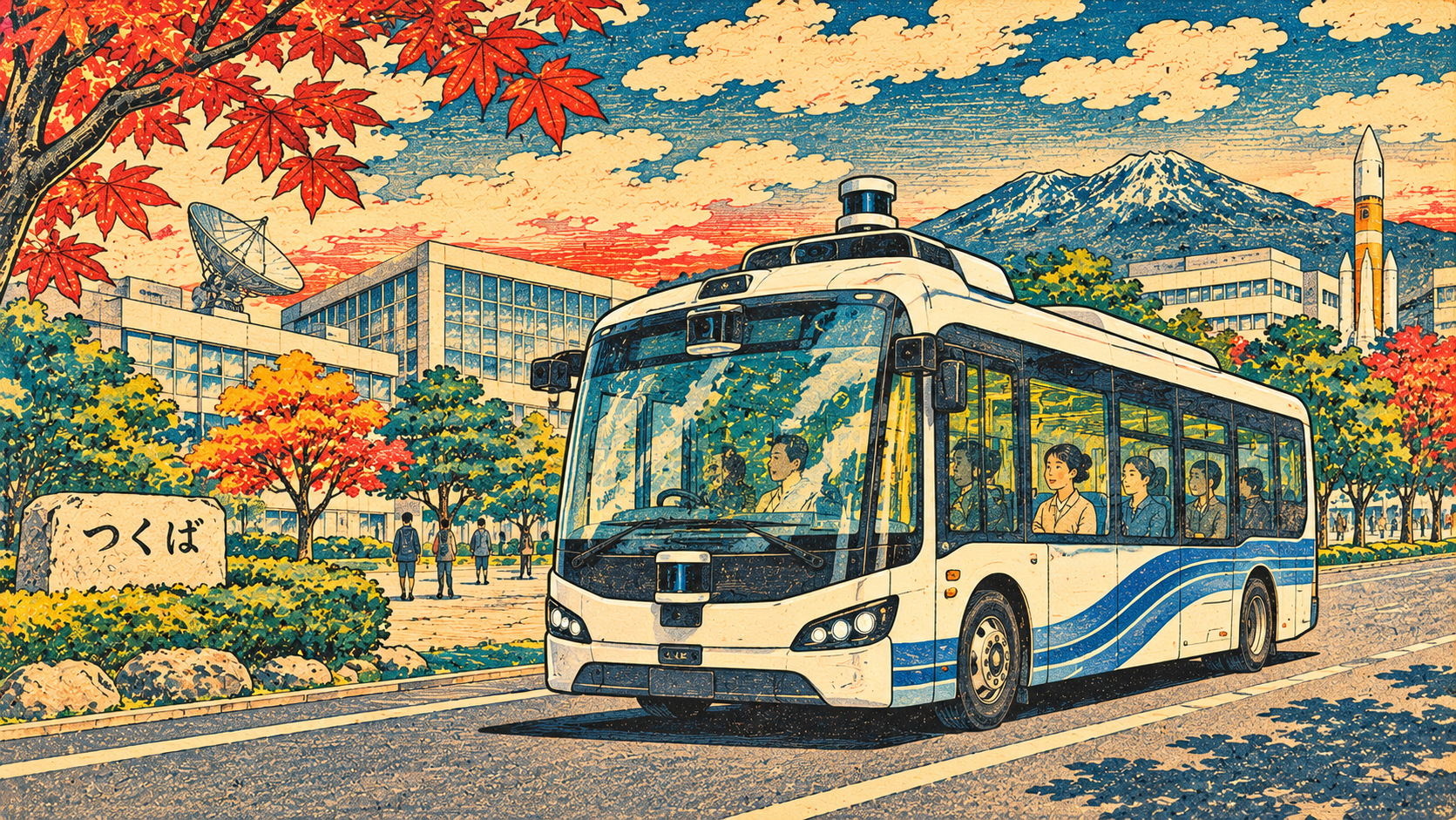
A bus on the University of Tsukuba Loop carries an unusually large technological ambition. It navigates familiar university and city streets as a scheduled service, but its automation software is preparing for a future in which the driver may no longer be required to supervise every moment. For a passenger, however, the most meaningful measure is not how impressive its sensors look. It is whether the bus comes when promised, is safe and remains available tomorrow.
On October 2, 2026, a five-party consortium—Tsukuba City, the University of Tsukuba, Kanto Railway, KDDI and KDDI Smart Mobility—began operating an autonomous bus on an existing, fare-paying Kanto Railway route. A September announcement and October ceremony established the rollout; Science Japan revisited it on November 19. This is not a November launch.
The phrase 'full-scale operations' has led to understandable confusion. The service is Level 2, meaning a driver retains responsibility for supervision and intervention. The consortium wants to reach Level 4 in fiscal 2027, when operation under specified conditions could dispense with continuous driver supervision. Those are materially different achievements.
The daily passenger's view: fares, seats and limits
Tsukuba City's published operating terms are unusually concrete: fares of ¥190–310, discounted tickets for eligible children and passengers with disabilities, a stated top speed of 40 kilometers an hour, and capacity limited to 15 riders. Only seated passengers are accepted for the time being. The route is the University of Tsukuba Loop, a practical connection between campus and the city center.
This is a weekday service, not a seven-day attraction. It does not operate on weekends, Japanese public holidays or December 28–January 3. The city also cautions that extended suspension may be necessary for system adjustments. A regular timetable is a step beyond demonstration trips, but it does not imply that the automated vehicle is guaranteed on every possible departure.
For travelers the official timetable, stop instructions and service notices remain more useful than promotional descriptions of artificial intelligence. The new technology has not removed the ordinary rules of catching a bus.
What Level 2 does—and what Level 4 would change
At Level 2, the vehicle's systems may assist with steering and speed in defined circumstances, but a human driver must monitor the roadway and remain ready to act. A camera feed to a control center is no substitute for that responsibility. Calling the current service driverless would be wrong.
Level 4 involves a qualitatively different operating and regulatory model: the automated system performs the driving task within a defined operational design domain. That domain might be limited by route, weather, speed or other conditions. An operator still needs procedures for emergencies, passenger incidents, roadside failures, communications and recovery.
Tsukuba's fiscal-2027 milestone is therefore a target rather than a promise that the present route will be fully unattended on a specific date. The necessary authorizations, precise route conditions and operating arrangements have not been verified as complete.
The long road from experiments to a paid timetable
Tsukuba began trials with project partners in fiscal 2023. A more extensive Level 2 demonstration ran on the University of Tsukuba Loop from November 21, 2025 to January 23, 2026. Trials on real roads expose difficulties absent from dedicated test tracks: unsignalized intersections, unpredictable pedestrians, traffic flows and stopping accurately at bus stops.
After a November 2025 demonstration ride, the university reported that human input was limited to braking while stationary at bus stops during that observed ride. That does not establish a zero-intervention safety record across all journeys. Trial results should be understood with their dates, conditions and sample sizes intact.
The October 2026 transition changed the unit of success from 'can the vehicle make a trial trip?' to 'can the operator sustain a scheduled transport service?' That requires dependable maintenance, customer communication, staffing and the ability to respond when the machinery is unavailable.
Remote supervision cannot be reduced to a camera icon
KDDI says a Mobility Control Center in Tokyo now monitors vehicle movement and the passenger compartment over its communications network. The group is building experience in remote operations as part of the intended move to Level 4.
The reported evaluation covers AI-camera alerts for falls, counting passengers and detecting entry into restricted areas. These functions raise practical questions: how promptly does a human review an alarm; what happens during network failure; how many vehicles can a supervisor monitor; and what information about passengers is retained? The announcement does not answer all of them.
Remote supervision is best viewed as an additional operational layer, not evidence that the bus is already legally driverless. Drivers, dispatchers, maintenance engineers and monitoring staff must have clearly defined authority when systems disagree or a person onboard needs assistance.
Why a real campus loop matters
Tsukuba was developed as a research-oriented city, and the university provides a rich setting for technological trials. Yet the stronger reason to use this particular bus loop is its everyday demand: students, campus workers and other passengers already need to travel between the university and the station area.
Tsukuba's mayor reported that the fiscal-2025 demonstration achieved a 98.1% ridership rate, a figure presented by the municipality without enough methodological detail in the materials reviewed here to turn it into a citywide approval rate or a comparison with conventional bus occupancy. It does, nevertheless, reflect the administration's interest in testing automation where people already ride.
The route includes ordinary urban intersections and movements of pedestrians and bicycles. Driving those streets within a scheduled operation yields operating data a restricted test course cannot. It also exposes commuters to the real tradeoff between technological novelty and the reliability they expect of any bus.
The labor shortage is real; the immediate labor savings are not proved
Japan's bus operators face driver recruitment pressure, aging workforces and the need to maintain services on routes that may struggle financially. Tsukuba explicitly places autonomous technology within that public-transport challenge and its vision of mobility without dependence on private cars.
But today's Level 2 bus still carries a driver. It has not eliminated the driver position on that route. Even a Level 4 model would require fleet technicians, remote monitors, emergency responders, schedulers and dispatchers. Automation may rearrange labor rather than eliminate it in any simple one-for-one fashion.
The commercial case needs much more than a demonstration of steering. Relevant costs include vehicle acquisition, mapping and software, servicing, communications, insurance, support personnel and replacement buses during downtime. No verified route-level comparison of full operating costs was available from the sources reviewed.
A depot, special-zone law and the less visible infrastructure
A practical innovation in the project's history is the University of Tsukuba Depot. The university and Kanto Railway concluded a land-lease arrangement following approval of a special provision in Japan's National Strategic Special Zone framework in November 2025. A permanent base for storage and servicing can matter as much as the vehicle's onboard software.
The consortium's responsibilities are distributed. Tsukuba City manages overall planning and reporting; the university provides the research setting and cross-sector coordination; Kanto Railway runs the buses; KDDI supplies communications and remote monitoring; KDDI Smart Mobility coordinates planning and evaluation. Other partners contribute mapping, vehicle technology and risk assessment.
This is why the story is bigger than any single AI product. Public infrastructure, an experienced operator, a university, telecommunications, legal arrangements and passenger service all have to work together for a vehicle to become transport rather than a demonstration.
Measuring success after the ribbon-cutting
Useful accountability metrics would include kilometers operated in autonomous mode, interventions under consistent definitions, schedule adherence, cancellations, passenger injuries or near misses, recovery times and the accessibility of boarding and information. Without these data, glowing reports of technological progress do not answer the transit rider's questions.
Science Japan's November 19 account renewed attention to a service that began in October, and JAPAN.co.jp has already run an article about the same opening on November 21. This report is therefore framed as a separate operational and policy analysis, not another first-announcement scoop.
Whether Tsukuba reaches Level 4 in fiscal 2027 will depend on both technology and a convincing operational safety case. The more durable test is whether a community can depend on the route: the right bus arriving at the right stop, safely and consistently. That is a harder achievement than an impressive demonstration—and a more valuable one.
Sources, reporting method and unresolved questions
Based on Tsukuba City, University of Tsukuba, KDDI, local student reporting and Science Japan materials, cross-checked against existing JAPAN.co.jp coverage. No on-site test ride, independent interview or audit was conducted. Costs, authorization status for Level 4 and verified route-wide safety statistics remain unresolved. The topic overlaps an existing November 21 report.