- A research city tests something more difficult than self-driving
- What a passenger can actually buy today
- Level 2 is an important constraint, not a technical footnote
- Why Tsukuba has become a living laboratory
- The long path from prototypes to a timetable
- Japan’s missing bus drivers change the equation
- The difficult parts are ordinary streets
- The remote control center and the labor that remains
- A colorful bus as a form of public consent
- The milestones that will decide whether this is a model
A research city tests something more difficult than self-driving
The meaningful test of an autonomous bus is not whether it can navigate a demonstration track. It is whether a resident can count on it on an ordinary weekday: paying a normal fare, reaching a lecture or appointment, and arriving without having to care how the steering wheel moved. That is the proposition now being examined in Tsukuba, Japan’s long-established science city.
On October 2, 2026, an automated bus began scheduled paid service on Kanto Railway’s Tsukuba University Loop. City officials, the University of Tsukuba, Kanto Railway, KDDI and KDDI Smart Mobility are working toward Level 4 operations in fiscal 2027. But the vehicle currently operates at Level 2, with a driver responsible for monitoring and intervention. It is not a driverless bus.
The October launch was revisited in a November 19 article from the Japan Science and Technology Agency. This report examines what it takes to move beyond a demonstration and make automated mobility part of an actual transport system.
What a passenger can actually buy today
The service runs on an existing loop connecting Tsukuba Center, near the railway station, with the University of Tsukuba. Officially published fares range from ¥190 to ¥310; eligible children and riders with disabilities receive discounts. The capacity is 15 seated passengers, the stated maximum vehicle speed is 40 kilometers per hour, and service is generally limited to weekdays. There is no service on weekends, public holidays or the December 28–January 3 year-end closure, and the city warns of possible longer suspensions for system adjustment.
The mayor reported six trips per weekday and near-capacity use in an October 26 blog entry. Those details show demand for a practical campus-area route, but they do not establish a profitable business model. A small vehicle, specialized monitoring and technical support can change the economics substantially. Without standardized cost and service-performance records, claims of financial success would be premature.
In a commuter’s life, reliability is more consequential than novelty. A technology that operates only intermittently cannot replace a bus that must show up at the right time.
Level 2 is an important constraint, not a technical footnote
At Level 2, automation may assist with steering and speed, but the human driver continues to supervise the driving environment and bears the operational driving responsibility. The system’s competence is meaningful, yet it is still a driver-assisted transport service. Level 4 describes automation within a defined set of operating conditions in which the system performs the driving task and handles fallback safely without a human driver taking over.
Tsukuba’s partners have introduced a remote monitoring operation through KDDI’s Mobility Control Center. Remote oversight should not be confused with legal authorization to operate without a driver. The communications layer, fleet management, regulatory approvals and passengers’ safety procedures all need to fit together before a different level of automation is possible.
A more accurate headline is therefore that Tsukuba is integrating autonomous-driving assistance into everyday bus service while preparing for conditional driverless operation.
Why Tsukuba has become a living laboratory
Tsukuba was selected as the site of a national research and education city in 1963. Japan enacted the Tsukuba Science City Construction Act in 1970, the University of Tsukuba opened in 1973, and Expo ’85 brought the planned research city international recognition. In 2005 the Tsukuba Express opened, changing rail access between the region and central Tokyo.
But a fast railway does not solve the last-mile problem. An extensive campus, dispersed research institutions and residential neighborhoods depend on surface transport. A bus link between a rail terminal and a university serves a real purpose that a laboratory experiment on a closed road cannot replicate.
Tsukuba’s history also includes a special regulatory zone for mobility robots dating to 2011. Officials have spent years navigating the gap between promising machines and the practical rules governing their use in public spaces.
The long path from prototypes to a timetable
Project trials began in fiscal 2023. The partners established their social-implementation consortium in August 2025, and the University of Tsukuba Loop hosted Level 2 test runs from November 21, 2025, to January 23, 2026. The October 2026 launch was explicitly designated a move into an implementation phase using those operational lessons.
It is a many-partner undertaking. Kanto Railway is the transport operator; the university provides a real-world setting; the city coordinates public objectives; KDDI supplies communications and monitoring expertise. Vehicle-development, digital mapping, safety assessment and operational-design organizations contribute further capabilities, including TIER IV and Aisan Technology.
The mayor cited a 98.1% occupancy figure for the preceding fiscal year’s trials. That is a figure for a particular pilot period under its own measurement method, not a nationwide benchmark or a verified average for all regular service after October.
Japan’s missing bus drivers change the equation
Japanese national planning documents depict a severe looming shortage. A Ministry of Land, Infrastructure, Transport and Tourism white paper cites a projection of approximately 116,000 bus drivers in 2021 declining to 93,000 in 2030. If operators tried to preserve the transport service volume of 2022, the associated projection points to a shortfall of 36,000 drivers—about 28% of the required workforce.
It is a forecast under stated assumptions, not a count of currently unfilled jobs. But its significance is plain: when a town loses a route, people without cars can lose access to healthcare, work and education. This has made automated transportation a public-service question, not just a technology-sector ambition.
Level 2 provides no immediate escape from staffing requirements because a driver is still aboard. Even full Level 4 deployment would require new human roles in dispatch, incident response, vehicle maintenance and customer assistance. The practical question is whether one operating model can sustain more dependable service with scarce personnel.
The difficult parts are ordinary streets
The University of Tsukuba reported that a 2025 trial had to navigate challenging unsignalized T-junctions. One observed ride involved minimal intervention, but a successful demonstration does not establish performance in every weather condition, traffic pattern or emergency. Roadworks, bicycles, pedestrians, variable visibility and irregular parking can all change the operating environment.
Japan introduced a permit framework for specified automated operations, associated with Level 4, in April 2023. Its first approved Level 4 vehicle for transport service was in Eiheiji, Fukui Prefecture. Tsukuba’s task is not to invent the national category; it is to show how the category might function dependably on a real urban university route.
An accountable evaluation needs not only mileage but also driver interventions, disengagements, safety incidents, service suspensions and how the system responds when it encounters a condition it cannot manage.
The remote control center and the labor that remains
KDDI and its mobility subsidiary describe a full operational monitoring program that began with the October service. They are responsible for more than supplying a data connection: systems integration, service management and measurements of results are part of the work. For a future larger fleet, the ratio of supervisors to vehicles and the reliability of communications will affect both safety and operating cost.
Yet a bus is not merely an engine moving along coordinates. Passengers may need help boarding, a response to sudden illness, an explanation when a trip is cancelled, or assistance after an emergency stop. The labor associated with those needs will not disappear just because the vehicle can steer itself.
Public reporting does not currently establish a comprehensive audited cost per passenger, the frequency of safety-related interventions or the complete breakdown of service interruptions. Those are the figures to watch as the project grows.
A colorful bus as a form of public consent
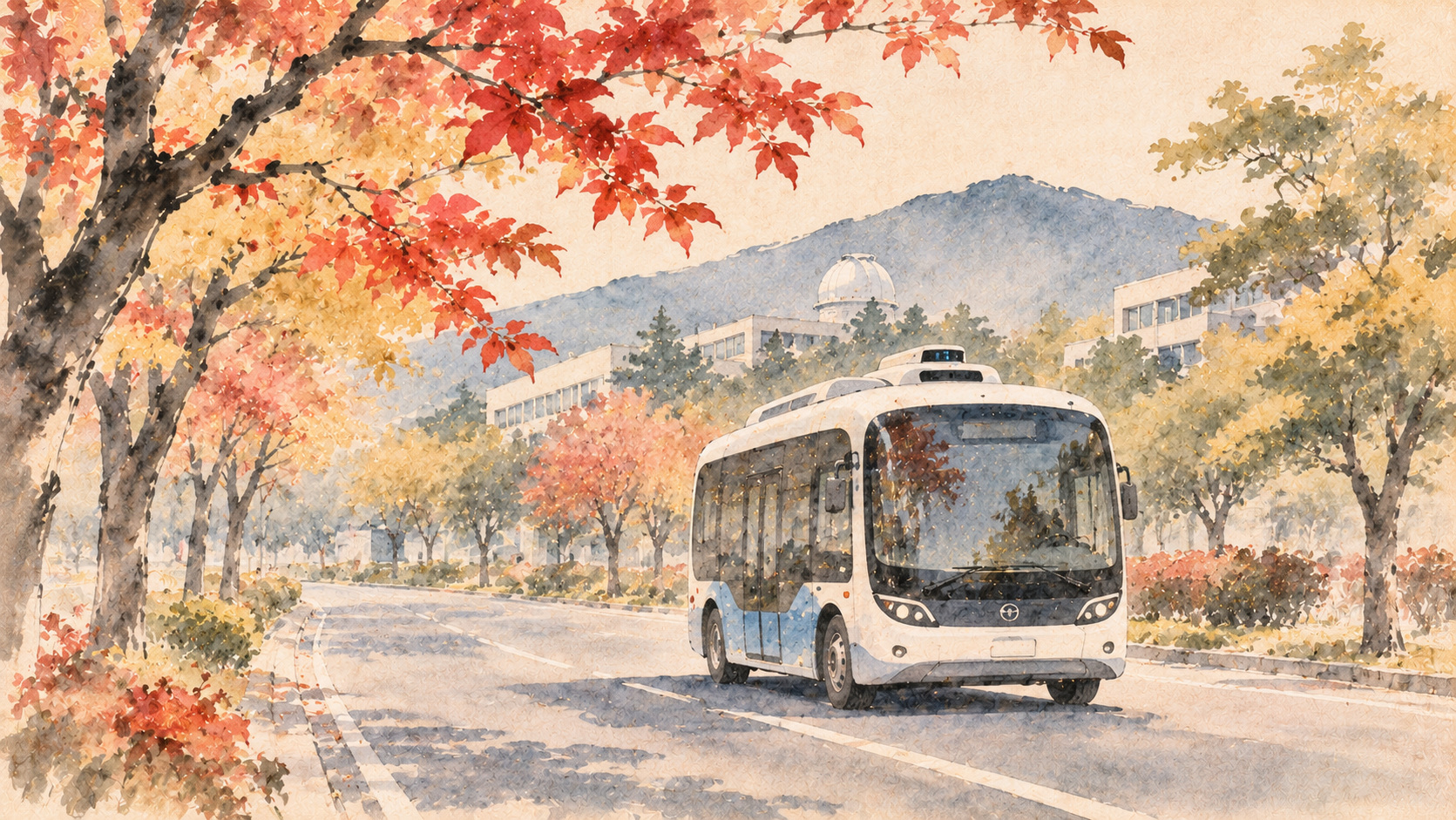
The city asked residents to choose an exterior design, and a proposal called “Streetscapes to Discover” won 177 of 365 votes across three candidates. University of Tsukuba art and design contributors Toshiaki Uchiyama and Rina Katsube worked on the design, which evokes the interwoven buildings and landscapes of the research city.
Artwork cannot prove operational safety. But public participation can influence whether a new service seems like an experiment imposed on the street or a bus that belongs to the neighborhood. Trust is not a substitute for technical evidence; it can be a condition for the technology to earn everyday use.
This small cultural detail illustrates why the project sits at the intersection of engineering, municipal administration and design.
The milestones that will decide whether this is a model
The national government has backed Level 4 transit projects through grants and regulatory support. Tsukuba’s fiscal 2027 objective belongs to that broader effort. It is a target, however, not proof that permits have been issued, routes expanded or operating costs brought under control.
The next milestones are unglamorous and measurable: whether an approved Level 4 service begins; whether it can handle interruptions safely; whether a passenger can travel reliably without a driver aboard; and whether the cost per service hour improves as operations scale.
Tsukuba was built to bring scientific research into public life. Its automated bus may matter most not when it makes headlines, but when nobody thinks to call it an experiment anymore.
Primary sources and reporting limitations
This independent analysis uses city and university documentation, operator announcements, national policy material and local reporting. We did not ride the service, conduct fresh interviews or audit fleet telemetry, safety interventions, operating cost or service reliability. Pilot occupancy claims do not establish profitability or the safety record of current operations.
- Tsukuba City: Autonomous Bus Project
- University of Tsukuba, September 16 launch announcement
- University of Tsukuba: Start-of-service ceremony
- KDDI: Remote monitoring operations
- Mayor of Tsukuba official blog, October 2026
- MLIT White Paper: Bus-driver supply gap forecast
- National Police Agency: Autonomous-driving legal framework
- MLIT: First Level 4 vehicle approval, 2023
- MLIT: History of Tsukuba Science City
- JST Science Japan report, November 19, 2026
- Local reporting by NEWS Tsukuba, October 2
- MLIT: 2026 funding support for autonomous-transport deployment