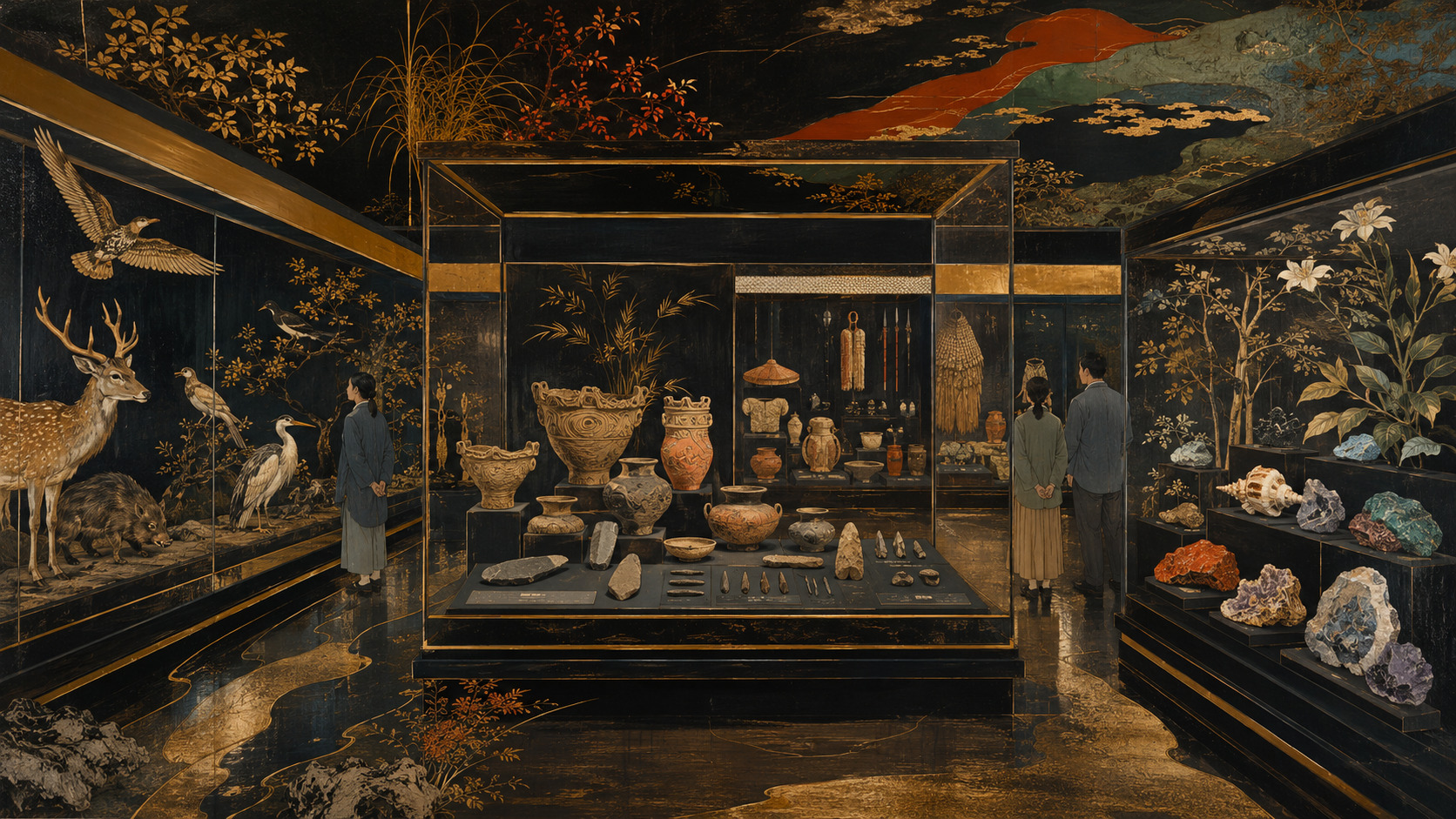
Nothing about the announced venue is itinerant. The exhibition will occupy the second-floor special-exhibition room of the Miyazaki Prefectural Museum of Nature and History from October 17 through November 30. No second stop has been published. The “travel” in its Japanese title is not a promise that display cases will move from city to city; it is a way of asking visitors to move between bodies of knowledge.
The official title is Tabi suru Miyazaki-ten—Dekakeyō, Miyazaki no kioku o tadoru muttsu no tabi e. Japan.co.jp renders that descriptively as “Traveling Through Miyazaki: Set Out on Six Journeys Through Miyazaki’s Memory.” The museum has not published an official English title.
The journeys are folklore, history, archaeology, animals, plants and geology. Miyazaki Prefecture describes their common material as human footsteps, the movement of living things and the memory of the land. Admission is free. Hours are 9:00 AM to 5:00 PM, with last entry at 4:30 PM. The museum closes Tuesdays; when Tuesday is a national holiday, the following weekday is closed instead.
The exhibition’s central idea is a change of speed
A conventional regional exhibition can become a cabinet of symbols: celebrated objects, famous people, scenic landscapes. Tabi suru Miyazaki proposes something more useful. Its six fields operate at different speeds. A household implement may record a working life; a government document, an administrative generation; an excavated vessel, a society without surviving texts; a specimen, changes in distribution; a rock, the movement of plates and magma over millions of years.
Putting them together changes the question. Instead of asking what represents Miyazaki, visitors can ask how Miyazaki came to be legible as a place. Mountains condition roads and settlements. Soil and climate structure plant communities. Forests and water support animal life. Human communities adapt tools, trade, ritual and government to that environment. The fields are not six parallel lanes. They intersect.
The official announcement is still deliberately broad. It identifies the six perspectives but does not list sections, object counts, loans or individual highlights. The concrete examples below come from the museum’s permanent galleries and official collection pages. They establish what each discipline can contribute; they are not an advance checklist for the special exhibition.
| Field | A journey question | Context verified in the museum’s existing displays |
|---|---|---|
| Folklore | How did tools, beliefs and skills connect mountain, village and coast? | Livelihoods, ritual and life passages across mountain, agricultural and maritime communities |
| History | How did institutions and networks redraw the region? | From ancient society to the modern prefecture, including Miyazaki’s reestablishment in 1883 |
| Archaeology | How can objects reveal movement before extensive written records? | More than 20,000 years of southern Kyushu history, petal-shaped dwellings and underground corridor tombs |
| Animals | How do species, groups and learned behavior move? | Forest, wetland and marine environments; cultural behavior among Koshima macaques |
| Plants | How do distribution, discovery and names map a region? | Thirty-nine plants with Japanese names connected to Miyazaki place-names; evergreen forest and wetland ecology |
| Geology | How did seafloor sediment and magma become the present landscape? | The Shimanto Group, fossils from the Miyazaki Group and the roughly 14-million-year-old Okueyama granite |
The final column summarizes permanent-gallery and official museum material. It does not assert that the named examples will appear in the 2026 special exhibition.
A museum built to hold disciplines together
The six-part structure reaches back to the institution’s formation. Miyazaki Prefecture established its first prefectural museum in April 1951 and opened it that June in the Chokokan on the grounds of Miyazaki Jingu. The borrowed building covered 223 tsubo, about 737 square meters. Four exhibition rooms divided special shows, Jomon and Yayoi material, Kofun-period material, and history and folklore from the Nara period onward.
In 1952, it became a registered museum under Japan’s new Museum Act and the first entry in the prefectural board of education’s register. The designation matters historically. The national Museum Act had been promulgated in December 1951, and local institutions were beginning to define museum work as a public, educational and professional activity rather than simply the custody of valuables.
A 1967 planning committee called for an integrated cultural facility in the shrine grove, combining history, natural science and art displays with a hall. The present Miyazaki Prefectural Museum opened in March 1971. Construction cost ¥650 million, and the building initially had 7,629.77 square meters of floor space. The permanent galleries were organized around plants, animals and geology on the natural-history side, and archaeology, history and folklore on the human-history side—the same six fields now placed at the center of the 2026 exhibition.
The institutional boundaries later shifted. The art division moved to the Miyazaki Prefectural Art Museum in 1995; the buried-cultural-properties center became independent in 1996. A major 1998 renewal nearly tripled permanent exhibition space to 2,645 square meters and increased the displayed material roughly tenfold to about 8,000 items. The museum’s organizing phrase was to experience Miyazaki, investigate Miyazaki and consider Miyazaki’s future. Permanent admission became free in 2005.
1951 — Prefectural museum opens in Miyazaki Jingu’s Chokokan.
1952 — Registered under the Museum Act as No. 1 in the prefectural register.
1971 — The present integrated museum opens.
1995 — The art division transfers to the prefectural art museum.
1998 — Renewed permanent galleries open with about 8,000 displayed items.
2005 — Permanent exhibition admission becomes free.
2026 — Six specialist fields are reunited through the idea of travel.
Human movement leaves more than roads
Folklore, history and archaeology can all study movement, but they preserve different evidence. The museum’s folklore galleries organize Miyazaki livelihoods through mountain, village and sea. Charcoal production, farming, milling, fishing, markets, seasonal rites, prayers for safety and life ceremonies show people moving materials and knowledge through landscapes that are often simplified as isolated rural communities.
One collection gives that work national significance. In 1993, the Japanese government designated the museum’s 2,600 “Production Tools of the Mountain Villages of Hyuga” as an Important Tangible Folk Cultural Property. A tool in a case may seem motionless. Its form nevertheless records repeated journeys to forest, field, workshop and market, and the hand-to-hand transmission of technique.
History adds movement in political boundaries. Miyazaki Prefecture was created in 1873, absorbed into Kagoshima Prefecture in 1876 and reestablished on May 9, 1883 after a separation campaign. The permanent history gallery identifies Kawagoe Susumu and Fujita Tetsuzo among the movement’s leaders. “Miyazaki” is therefore not only a natural region waiting to be described. It is also an administrative unit that people argued to restore.
Archaeology reaches beyond that modern frame. The museum traces southern Kyushu history to more than 20,000 years ago. Its permanent displays describe the distinctive petal-shaped pit dwellings found mainly on the Miyazaki Plain from the late Yayoi to early Kofun periods, the representative local Yayoi pottery type labeled 中溝式土器 from Miyazaki City’s Dojihi-gashi site, and the subterranean side-chamber tombs known as 地下式横穴墓 and characteristic of southern Kyushu in the fifth and sixth centuries. The distribution of building forms, ceramics and burial practices can reveal networks where written itineraries do not survive.
Animals and plants make their own maps
Natural-history movement does not obey a passenger timetable. Animals disperse, migrate, forage and learn; plants spread through seed, climate and disturbance. Miyazaki’s museum frames those processes through evergreen broadleaf forest, river and wetland systems, and the sea. Its natural-history entrance places an old tabunoki tree beside new growth and Japanese deer, turning the forest into a sequence rather than a backdrop.
Names can hold a second map. The museum says 39 plants have Japanese names tied to Miyazaki place-names, many using “Hyuga,” the historic name of the province. Many were discovered within the prefecture and formally published as new species. Each name joins biological range to a human route: someone found a plant, preserved or described it, compared it with related species, and attached place to classification.
Koshima offers an equally important animal example. In 1953, researchers observed a young female Japanese macaque, known as Imo, washing sweet potatoes in water. The behavior spread to playmates, mothers and later generations. The museum presents the episode as cultural behavior: what traveled was not only a monkey but a learned practice moving through a social group.
No official page yet says that the macaques or the 39 named plants will be displayed in Tabi suru Miyazaki. They matter as verified local research contexts for the exhibition’s broad phrase “the movement of living things.” That distinction keeps interpretation useful without turning it into an invented object list.
The longest journey begins on a seabed
Geology makes “travel” strange in the most productive way. Much of Miyazaki is underlain by the Shimanto Group, strata the museum describes as having formed on the seabed from the Cretaceous through what older Japanese geological terminology calls the Tertiary. Mud and sand accumulated with pillow lava and red shale. Plate movement deformed and raised those deposits. Material once below the ocean can now be read along mountain roads.
The Miyazaki Group beneath the plain contains fossils of organisms that lived in a warm, shallow sea. Farther north, the museum explains, magma cooled beneath the surface roughly 14 million years ago to form the granite of Okueyama. Erosion later exposed it and helped create the area’s striking mountain forms. A visitor does not have to cross a prefectural border to travel from seafloor to mountain; the rock completes that journey in deep time.
This geological layer prevents the exhibition from treating culture and nature as separate scenery. Bedrock and soil influence plant communities. Plants and water structure animal habitat. Those conditions shape where people settle, what they build with, how they farm and fish, and which places acquire ritual meaning. Japan.co.jp’s analysis is that the exhibition will succeed if visitors can trace those causal links, not simply complete six labeled sections.
Transport partners add a contemporary layer—but details remain open
The museum is the organizer. Its published “special cooperation” partners are Solaseed Air, JR Kyushu’s Miyazaki Branch and the Railway Museum in Saitama. Their names connect air travel, regional rail and transport history to a show built around movement.
That partnership list invites possibilities, but the official page does not yet define the partners’ roles. It does not announce aircraft components, railway artifacts, excursion trains, fare discounts, stamp rallies or lectures. Those may be natural guesses; they are not verified program elements. The responsible reading is narrower: three transport institutions are cooperating, and the form of that cooperation remains unpublished.
A related entrance display is scheduled at the museum from September 26 through November 30, beginning three weeks before the main exhibition. Miyazaki Prefecture’s event listing gives dates and place but no contents. An opening ceremony and preview are scheduled for 2:00 PM on October 16, but no general-public admission process is stated. Regular visitors should treat October 17 as the opening date.
Free admission changes how the six journeys can be used
The special exhibition costs nothing, and the permanent displays have been free since 2005. That is not incidental to the curatorial premise. A visitor can move from the special room back into the museum’s permanent natural-history, history and folklore galleries without making a second purchase. The six journeys can be tested against the institution that produced them.
The museum’s public information room extends that work. It holds about 35,000 books, 300 videos, 1,400 plant specimens, 300 insect specimens, 900 shells and 380 rocks and minerals. Visitors may consult material across animals, plants, geology, archaeology, history and folklore, and handle selected learning objects. The special exhibition therefore sits within a research pathway rather than at its end.
Online, the Miyahaku Digital Collection and the museum’s virtual content provide another route into the holdings. A digital image cannot reproduce weight, surface or scale, but it can help visitors search across departments before or after a trip. The museum’s most important journey may be the one between display, study and a return visit.
What visitors can plan now
Tabi suru Miyazaki special exhibition
- Dates: October 17–November 30, 2026
- Hours: 9:00 AM–5:00 PM; last entry 4:30 PM
- Closed: Tuesdays; when Tuesday is a national holiday, the next weekday
- Venue: Second-floor special-exhibition room, Miyazaki Prefectural Museum of Nature and History
- Address: 2-4-4 Jingu, Miyazaki City, Miyazaki 880-0053
- Admission: Free
- Telephone: 0985-24-2071
The long calendar window should not obscure what remains unannounced. A full checklist, section plan and related public programs may be published closer to opening. Visitors should check the exhibition page and annual calendar immediately before travel, particularly around a Tuesday holiday when the following weekday closes.
The exhibition offers a deceptively simple proposition: stay inside one building and change how you move through a place. Follow an implement into labor, a potsherd into settlement, a plant name into scientific discovery, a behavior into a troop, and a rock into a vanished sea. Miyazaki does not become six different prefectures. The viewer acquires six different clocks.
Sources and documents
- Miyazaki Prefecture: announcement of Tabi suru Miyazaki and Miyazaki Prefectural Museum of Nature and History: exhibition page (official title, six fields, dates, hours, venue, admission, closure rule, organizer and special cooperation)
- Miyazaki Prefecture: related entrance display (September 26–November 30 dates)
- Miyazaki Prefectural Museum: institutional history (1951 predecessor, 1952 registration, 1971 building, 1998 renewal and 2005 free permanent admission)
- Museum: Living at the Dawn of Hyuga and Miyazaki’s Continuing Development (archaeological chronology, petal-shaped dwellings, the pottery type labeled 中溝式土器, subterranean side-chamber tombs and the 1883 prefectural reestablishment)
- Museum: Introduction to Folklore, Life in the Village and Life by the Sea (mountain, village and maritime livelihoods, belief, ritual and life passages)
- Museum: Introduction to the Forest, Living Things of Miyazaki and The Land of Miyazaki (evergreen forest, place-named plants, Koshima macaques, Shimanto Group, Miyazaki Group and Okueyama)
- Museum public information room and Miyahaku Digital Collection (book, video and specimen counts; cross-disciplinary digital holdings)
Reporting was checked primarily against Japanese primary sources available by 11:27 AM JST on September 1, 2026. The exhibition title, institution and company names, terminology for the six fields, dates, hours, admission, closure rule, institutional history and specialist terms were verified in official Japanese material from Miyazaki Prefecture and the museum. The English exhibition title used here is a descriptive Japan.co.jp rendering, not an announced official title. No Japanese quotations were reconstructed from English. Permanent-gallery examples are explicitly separated from the unannounced special-exhibition checklist. Interpretive passages connecting the six fields are Japan.co.jp analysis.
Image rights: © 2026 Japan.co.jp. This AI-assisted editorial illustration may not be republished or reused without prior written permission. For licensing, use the contact page.