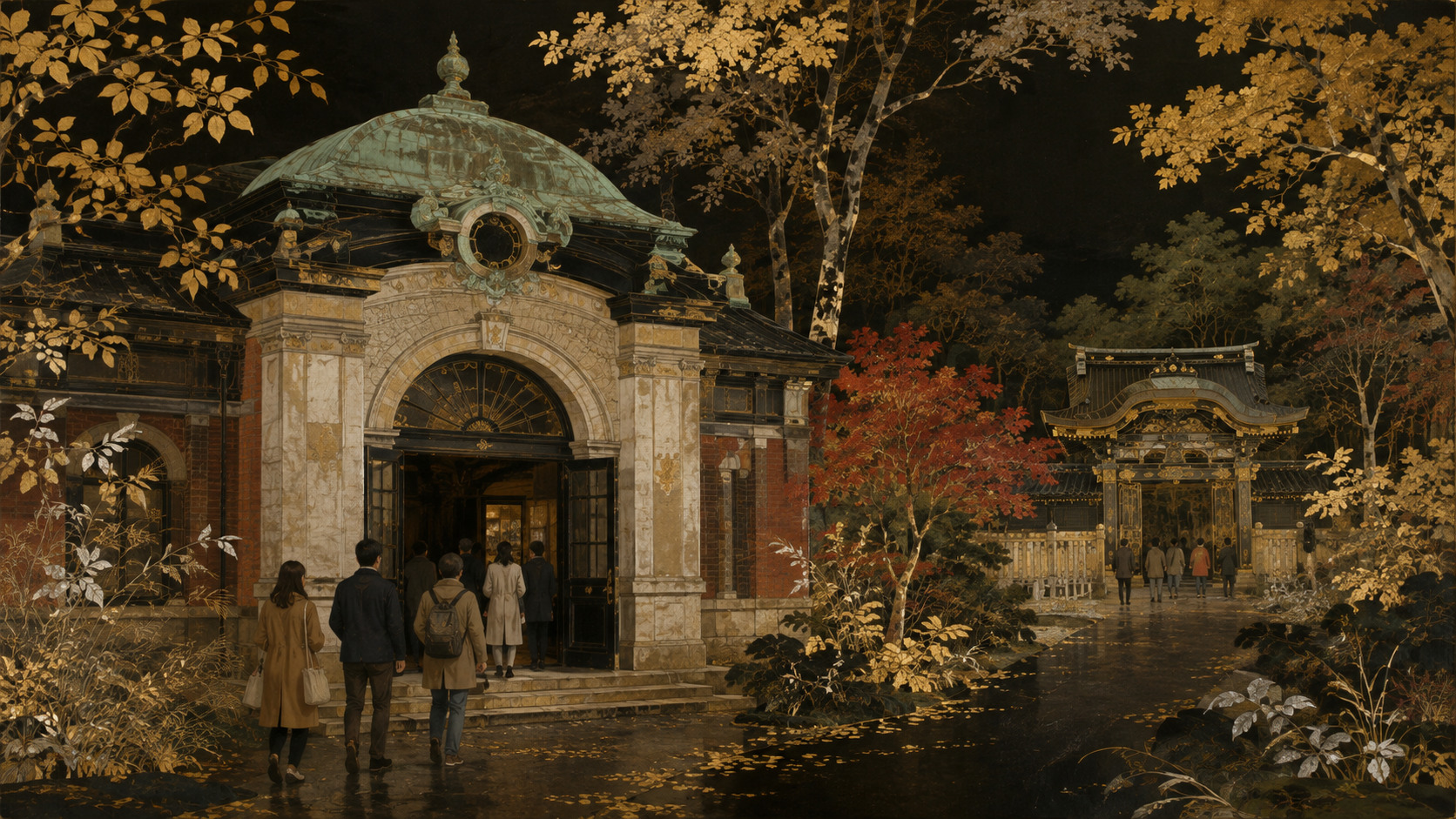
The most revealing room in Ueno this autumn may not contain a painting, specimen or animal. It may be a disused railway entrance, built in 1933 for a station beneath Tokyo’s museum quarter. Or it may be the interior of a Tokugawa funerary precinct whose surviving gates and stone monuments outlasted civil war, earthquake and air raids.
The 2026 Ueno no Yama Cultural Zone Festival places both within guided walks. On October 11 and 26, selected visitors will pass through sites associated with the Tokugawa shoguns, including the normally restricted mausoleum area and the Aoi no Ma room where the last shogun, Tokugawa Yoshinobu, was confined. On November 17, another group will enter the former Hakubutsukan-Dobutsuen Station building and the Old Tokyo Music School’s Sogakudo concert hall.
The scale is deliberately small. The shogunal walk accepts 25 people on each date. The architecture tour accepts 25 in total. Applications are required in advance and places are allocated by lottery. The word “open,” therefore, needs a boundary: neither site is being converted into a general-admission attraction.
An autumn program built around institutional borders
The festival runs from September through November under a council of 28 public and private organizations around Ueno Park. Its 16-lecture series ranges from Chinese painting and museum anniversaries to industrial technology, tsunami science and Japanese serow. Major exhibitions and concerts run alongside the talks. The guided walks matter because they cross boundaries that an ordinary visitor cannot.
The October Tokugawa route joins Ueno Toshogu, Kan’ei-ji’s Konpon Chudo, Aoi no Ma, the Tokugawa mausoleums and Yoshinobu’s grave. The fee is ¥500, covering admission to the inner worship area of Kan’ei-ji’s main hall. Applications for both October dates close on September 11.
The November architecture route links the National Museum of Western Art, National Museum of Nature and Science, International Library of Children’s Literature, Sogakudo and the former station. It is free, with applications due October 16. Placing those buildings in one walk turns Ueno’s familiar institutions into a timeline: Meiji-era public culture, early Western music education, postwar modernism and a railway entrance built for mass urban travel.
| Event | Date and start | Capacity | Fee | Deadline |
|---|---|---|---|---|
| Sites associated with the Tokugawa shoguns | Oct. 11, 10:00 AM; Oct. 26, 1:00 PM | 25 each; lottery | ¥500 | Sept. 11 |
| Ueno Park with a Kan’ei-ji monk | Oct. 12, 11:00 AM | 30; lottery | Free | Sept. 11 |
| Kan’ei-ji at 400 fieldwork | Oct. 31, 10:00 AM | 20; lottery | Free | Oct. 14 |
| Monk’s explanation of Eigaku Soryu | Nov. 11 and 14, 10:00 and 11:30 AM | 50 each; lottery | ¥500 | Oct. 13 |
| Modern and contemporary architecture | Nov. 17, 10:00 AM | 25; lottery | Free | Oct. 16 |
Dates, start times, capacities, fees and deadlines are from Taito City’s 2026 event pages. Those pages do not state finishing times. Stops may change without notice.
Before the museums, the hill belonged to Kan’ei-ji
Kan’ei-ji was founded in 1625 by the Tendai prelate Tenkai on the plateau northeast of Edo Castle. Its formal mountain name, Toei-zan, means “eastern Mount Hiei”: the temple was conceived in relation to Enryaku-ji, the Tendai establishment that guarded the northeastern approach to the imperial capital. Kan’ei-ji prayed for the Tokugawa government’s stability and public peace; it later became a Tokugawa family temple.
At its height, the complex occupied roughly 305,000 tsubo, an expanse far larger than the surviving temple grounds. Six shoguns were buried at Kan’ei-ji: Ietsuna, Tsunayoshi, Yoshimune, Ieharu, Ienari and Iesada. The temple’s mausoleum description says the precincts were arranged according to ideas drawn from the Lotus Sutra.
Very little of that full ceremonial landscape survives intact. Much of Kan’ei-ji burned in the 1868 Battle of Ueno, when shogunate loyalists fought forces of the new imperial government. The shogunal mausoleum buildings then suffered catastrophic losses in the Second World War. Imperially inscribed gates, water basins and funerary pagodas survived; the present memorial hall was rebuilt in 1963.
That history changes the meaning of “hidden heritage.” The mausoleums are not a complete Edo complex waiting behind a fence. They are surviving parts of a landscape repeatedly broken and reassembled. A guided visit is an encounter with what was preserved, what was reconstructed and what is gone.
From battlefield to Japan’s public showcase
In 1873, after the new national government established a public-park system, the former Kan’ei-ji precinct was selected as one of Tokyo’s first parks. Ueno Park opened that October. Four years later it hosted Japan’s First National Industrial Exhibition, an undertaking modeled partly on international expositions. More than 454,000 people entered grounds filled with halls for fine art, agriculture, machinery, horticulture and animals.
The hill became an apparatus for public learning. A museum opened at Ueno in 1882, as did its attached zoological garden—the first zoo in Japan. The Tokyo Music School building followed in 1890. Its hall heard figures who would shape modern Japanese music, including Rentaro Taki, Kosaku Yamada and Tamaki Miura.
The school building nearly left Ueno after deterioration became serious. Taito City acquired it from Tokyo University of the Arts in 1983, relocated and restored it, then opened it to the public in 1987. It was designated an Important Cultural Property the following year as a school building containing Japan’s oldest Western-style concert hall. That history makes Sogakudo more than an architectural companion to the station: both are cases in which obsolete infrastructure was given a cultural afterlife.
1625 — Tenkai founds Toei-zan Kan’ei-ji.
1868 — Most of the complex is lost in the Battle of Ueno.
1873 — Ueno Park opens.
1882 — The Ueno museum and Japan’s first zoo open.
1933 — Hakubutsukan-Dobutsuen Station begins service.
1992 — The Ueno no Yama Cultural Zone Festival begins.
2026 — Restricted mausoleum and station interiors enter the festival tours.
A station for the museum age
Hakubutsukan-Dobutsuen Station opened on December 10, 1933, with Keisei’s underground extension between Nippori and Ueno Koen, now Keisei Ueno. Its name—literally Museum-Zoo Station—described the institutions it served. The surface entrance has a domed, monumental Western-influenced design, markedly different from the compact utility of an ordinary neighborhood stop.
The railway suspended the section during the war in June 1945. Service resumed that October, but the station itself remained closed until May 1953. It stopped taking passengers again in 1997 and was formally abolished in 2004. The structure, platforms and traces of its use remained after trains no longer stopped.
In April 2018, the station building became the first railway facility selected as a Tokyo Historic Building. Keisei and Tokyo University of the Arts renovated the entrance, and the first public opening since abolition followed that November. The official Japanese category is “selected,” not a national Important Cultural Property designation. The distinction matters because heritage labels describe different legal and administrative systems.
The station’s physical inaccessibility has also generated a digital counterpart. Tokyo University of the Arts used three-dimensional capture to create Digital Hakudo Station, an online environment that includes areas unavailable to ordinary visitors. The November tour does something different: it restores physical scale, texture and location—but for only 25 people.
Anniversaries make 2026 more than a routine festival year
The festival began in 1992 and marked its 30th anniversary in 2022. This year, two institutions on the architecture route carry anniversaries of their own. The Tokyo Metropolitan Art Museum is 100 years old. Founded in 1926 with a major donation from coal entrepreneur Keitaro Sato, it was Japan’s first public art museum.
The National Museum of Western Art is observing ten years since its main building joined UNESCO’s serial World Heritage listing for the architectural work of Le Corbusier. The 1959 building is one of 17 component properties across seven countries. These milestones make the architecture walk a survey not simply of age, but of changing ideas about who public culture is for.
Kan’ei-ji brings a new work into the older setting. Japanese painter Yuji Tezuka donated the paired-dragon ceiling painting Eigaku Soryu for the temple’s 400th anniversary in 2025. On November 11 and 14, monks will explain the work during four lottery-selected sessions of 50 people each. The temple separately opens the inner hall on designated ordinary viewing days, so the special guided sessions should not be mistaken for the only way to see the ceiling.
Across the festival, institutional anniversaries are not treated as isolated celebrations. A museum’s centenary, a World Heritage tenth anniversary and a temple’s 400th year become parts of a district-wide argument: Ueno’s importance lies in adjacency and accumulated use.
The necessary tension between preservation and access
The tours’ small capacities are understandable. Mausoleum paths and a disused station were not designed for present-day visitor volumes. Controlled groups reduce pressure on fragile places and allow guides to keep people within safe routes. The published conditions, however, also establish a significant access barrier.
Taito City says wheelchairs and baby strollers cannot be used because portions of the routes have poor footing. It asks participants not to use walking sticks in order to protect cultural property. Stops may be changed, and some facilities may be viewed only from outside. Those are material conditions, not marginal disclaimers. Anyone with mobility requirements should consult the Cultural Promotion Division before applying about the precise route and available assistance.
Japan.co.jp’s analysis is that a heritage program should be judged on two kinds of access: how carefully it admits people to the physical site, and how effectively it shares knowledge with everyone who cannot enter. Keisei’s virtual tour and the university’s 3D project expand the second kind. Detailed post-event documentation, accessible video and precise route information could extend it further.
The value of a locked site is not that exclusion makes it mysterious. Its value lies in the evidence protected inside. Preservation succeeds when that evidence can be understood without being consumed by visitation.
How to apply—and what not to assume
Applications for the Tokugawa walk and the monk-led Ueno Park walk must arrive by September 11. The ceiling-painting sessions close October 13; the Kan’ei-ji fieldwork, October 14; and the architecture tour, October 16. Taito City accepts web applications and return postcards for the principal city-run tours. One companion may be included. The forms request the chosen date, address, name and reading, telephone number, age and corresponding details for a companion.
The festival pages provide start times, not final finishing times. The former-station page promises entry to the station building, not the platform. The Tokugawa itinerary names a group of principal stops but warns that the route can change. Successful applicants should treat the final instructions, not assumptions derived from the event title, as the operational guide.
Twenty-five visitors entering a former station is a modest event. Twenty-five entering a shogunal funerary landscape is equally small. Yet the route between those doors covers four centuries: Tokugawa ritual, civil war, public parks, industrial exhibitions, museums, music education, metropolitan rail and modern conservation.
Ueno is often sold as a convenient concentration of attractions. The festival’s better insight is that the ground between them is itself an exhibit.
Sources and documents
- Taito City: 2026 Ueno no Yama Cultural Zone Festival announcement and official festival portal (organizers, September–November program, 16 lectures, events and exhibitions)
- Taito Cultural Marche: Tokugawa-associated sites tour and modern and contemporary architecture tour (dates, capacity, fees, deadlines, access scope and mobility conditions)
- Kan’ei-ji: temple history, Tokugawa shogunal mausoleums and Konpon Chudo and Eigaku Soryu viewing guidance (foundation, Tokugawa burials, wartime losses, official names and ceiling-viewing conditions)
- Keisei Electric Railway: former Hakubutsukan-Dobutsuen Station history, Tokyo University of the Arts: Digital Hakudo Station and Geidai Art Plaza: Ueno railway history (opening, suspensions, abolition, entrance design, 2018 selection and 3D documentation)
- Tokyo Parks: metropolitan park timeline, National Diet Library: Ueno Park and First National Industrial Exhibition (1873 park opening, Battle of Ueno and 1877 exhibition)
- Tokyo National Museum: opening of the former Ueno main building, Ueno Zoo: official history and Old Tokyo Music School Sogakudo: building history (1882 museum and Japan’s first zoo, 1890 school hall, relocation and preservation)
- Taito Cultural Marche: festival 30th anniversary, Tokyo Metropolitan Art Museum centenary and National Museum of Western Art World Heritage tenth anniversary (1992 festival launch and 2026 institutional milestones)
Reporting was checked primarily against Japanese primary sources available by 11:15 AM JST on September 1, 2026. Official Japanese names, readings, dates, capacities, charges, deadlines and access conditions were verified against Taito City, Kan’ei-ji, Keisei and Tokyo University of the Arts pages. The station-tour scope is reported exactly as the official page states it—inside the station building—and does not imply platform, track or tunnel access. No interview quotations were reconstructed. Interpretive passages about the district’s historical layering and the responsibilities of public access are Japan.co.jp analysis.
Image rights: © 2026 Japan.co.jp. This AI-assisted editorial illustration may not be republished or reused without prior written permission. For licensing, use the contact page.