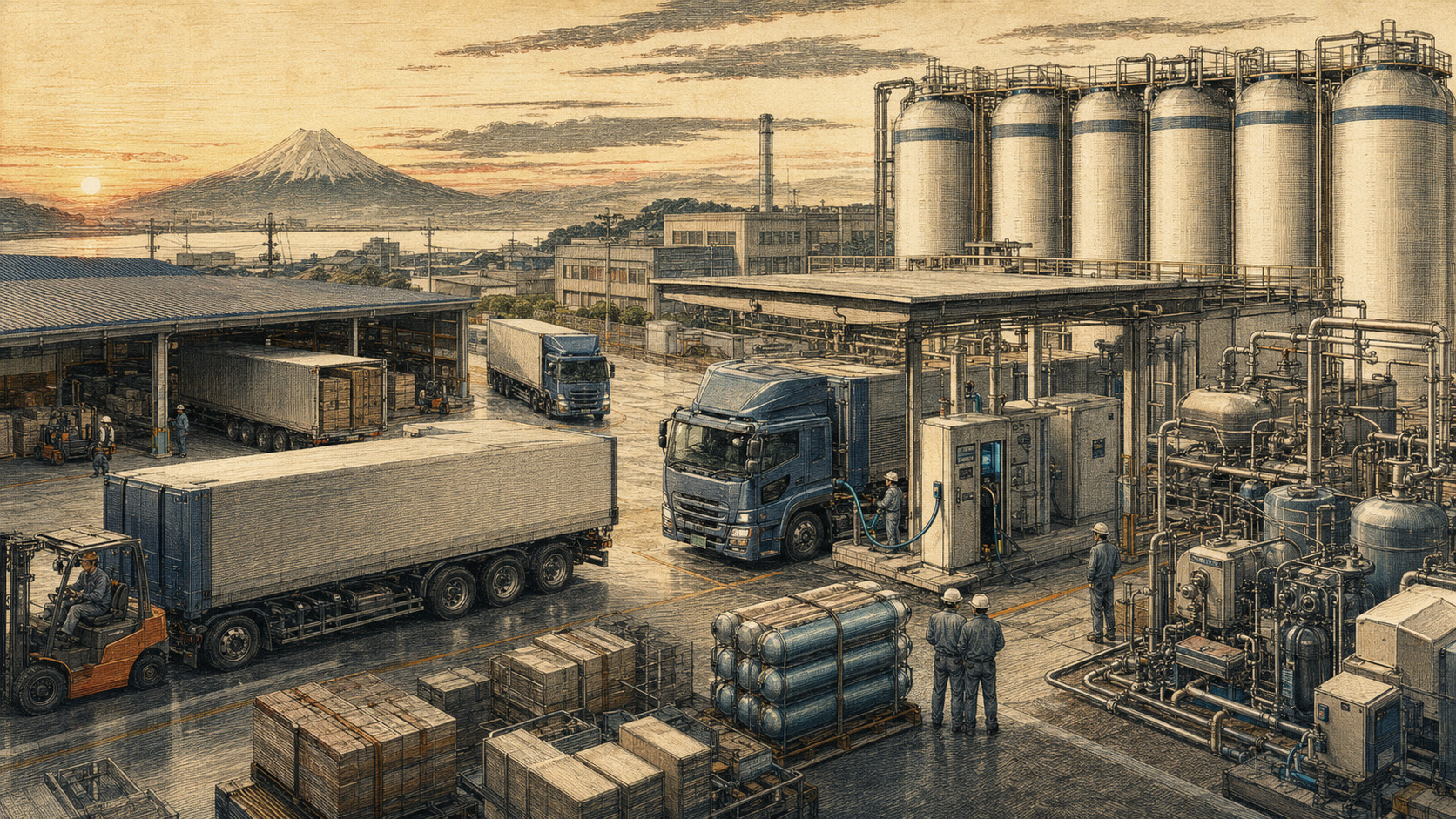
At a passenger filling station, hydrogen’s weakness is geographic. The driver needs fuel near home, near work and along every plausible detour. At a freight depot, geography can collapse into a timetable. A tractor leaves a known yard, follows a planned lane, returns on a dispatch schedule and consumes enough fuel to keep expensive equipment busy. One reliable station can serve an entire first fleet.
That is the logic behind Toyota’s May 4 agreement with Hyroad Energy. Forty Class 8 fuel-cell trucks are to support Toyota logistics in Southern California. Hyroad packages the vehicles with maintenance, operational data and fleet software. Toyota supplies the freight demand and hydrogen from a station it is building at the North American Parts Center California in Ontario, east of Los Angeles. Air Liquide will supply fuel; a mobile heavy-duty station is scheduled first, followed by a permanent site designed to serve fuel-cell vehicles of different makes and sizes.
The arrangement is more significant than another prototype. It organizes the four things that demonstrations often keep separate: truck, service, fuel and paying work. It also reveals the direction of Toyota’s hydrogen strategy. The company has not renounced passenger cars—the 2026 Mirai remains on sale, and Toyota is jointly developing a third-generation passenger-car system with BMW. But Toyota’s largest new commitments increasingly sit where utilization is high, routes are knowable and hydrogen demand can be clustered: trucks, buses, industrial equipment and stationary power.
The Hyroad deal is an operating system, not merely a truck order
Hyroad describes itself as an OEM-agnostic operator. That matters. It is not promising to manufacture every component; it is promising that a fleet customer will not have to coordinate vehicle procurement, parts, maintenance, telematics and service alone. Its bundled model converts unfamiliar hardware into something closer to truck-as-a-service.
The company arrived with an unusual inheritance. In August 2025 it acquired 117 hydrogen fuel-cell trucks, spare parts, software platforms and intellectual property at Nikola Corporation’s bankruptcy auction. Toyota’s release discloses that history but does not say that all 40 Toyota-assigned trucks come from that fleet, nor does it say they carry Toyota fuel cells. The correct reading is narrower: Hyroad supplies the operational package, and Toyota supplies work and fuel.
That distinction prevents two common mistakes. The agreement is not evidence that Toyota sold 40 of its own powertrains. It is also not merely a purchase of vehicles that Toyota will operate by itself. Toyota is becoming an anchor customer and infrastructure sponsor, roles that can be just as important in an immature market as being the component maker.
Full-service contracting transfers some technology risk from the shipper to a specialist. If a fuel-cell compressor fails, software reports a fault or a replacement part is scarce, the fleet wants one accountable counterparty. Bundling cannot erase the cost; it can price, manage and measure it. The commercial test is whether Hyroad can turn that risk into a service charge that competes with the familiar diesel lease, maintenance network and fuel card.
| Party | Disclosed role | Not disclosed |
|---|---|---|
| Hyroad | Trucks, maintenance, data and fleet software. | Vehicle make for each unit, service price, uptime guarantee and penalty terms. |
| Toyota | Logistics demand and hydrogen through Ontario infrastructure. | Fuel price, carbon intensity, route volume and direct capital contribution. |
| Air Liquide | Fuel supply for the Toyota fleet at NAPCC. | Production pathway, delivery distance and contracted kilograms. |
| Truck technology | Class 8 FCEV; up to 70 kg, 15–20-minute fill, up to 500-mile range cited generically. | Exact configuration, curb weight, payload, efficiency and field performance for the 40. |
Thirty-four years from a RAV4 experiment to an Ontario depot
Toyota began full-scale fuel-cell vehicle development in 1992. In October 1996 it unveiled a RAV4-based prototype using a hydrogen-absorbing alloy tank. The next year it showed an onboard methanol reformer. Engineers were still asking which fuel—compressed hydrogen, methanol, natural gas or reformed gasoline—should feed the stack.
By 2001 Toyota had concluded that directly stored pure hydrogen offered the best cleanliness and efficiency. The FCHV-4 put high-pressure tanks and a 90 kW Toyota stack into a Kluger/Highlander platform. In December 2002, four certified Toyota FCHVs went on lease to Japanese government agencies at ¥1.2 million per month. The vehicle’s stated range was 300 kilometers. It was commercialization in the narrowest sense: expensive, supervised and dependent on a few prepared customers.
The first Mirai, launched in Japan in December 2014, transformed that engineering program into a purpose-built sedan. Toyota quoted a roughly three-minute fill, 650-kilometer range on the Japanese JC08 test and a 114 kW stack. The second-generation Mirai, introduced for 2021, made the stack smaller, lighter and more powerful. Yet scale remained modest. Toyota said in February 2025 that about 28,000 Mirais had been sold in more than 30 countries and territories since launch.
That number is neither zero nor a mass market. More revealingly, Toyota said it had supplied more than 2,700 fuel-cell systems to over 100 external customers since 2019 for buses, rail, stationary generators and other applications. The stack was becoming a product independent of the sedan that had industrialized it.
1992 Toyota begins full-scale fuel-cell vehicle development.
1996 A RAV4-based hydrogen prototype becomes Toyota’s first public FCEV.
2002 The Toyota FCHV begins limited government and corporate leasing in Japan and the U.S.
2014 The first Mirai launches in Japan.
2017 Project Portal puts two Mirai stacks into a Class 8 port truck.
2019–2022 Ten Toyota–Kenworth “Ocean” trucks work in the Shore-to-Store project.
2023 Toyota creates Hydrogen Factory; PACCAR and Toyota announce commercial truck plans.
2025 Toyota unveils its third-generation system, designed especially for commercial duty.
2026 Hyroad agreement, Isuzu light-truck program and binding cellcentric investment agreement broaden the commercial strategy.
Project Portal: two Mirai stacks learn to pull 80,000 pounds
The decisive pivot began at the ports of Los Angeles and Long Beach. Toyota revealed Project Portal in April 2017: a Class 8 proof of concept made with two Mirai fuel-cell stacks and a 12 kWh battery. It produced more than 670 horsepower and 1,325 pound-feet of torque, carried a gross combined weight rating of 80,000 pounds and had an estimated range above 200 miles in normal drayage operation.
The small battery is the clue. A fuel-cell truck is an electric truck, but most of its onboard energy is stored as hydrogen rather than in a giant traction battery. The fuel cells convert that hydrogen into electricity steadily; the battery supplies bursts of power, accepts regenerative braking energy and smooths transients. Toyota was testing whether passenger-car stack production and hybrid-control knowledge could be scaled into freight without surrendering payload or shifts to charging.
The first “Alpha” truck was a skunkworks machine built in a little over a year. By mid-2018 it had logged nearly 10,000 miles, and a “Beta” version added a sleeper cab and increased range beyond 300 miles. A feasibility experiment was becoming a repeatable architecture.
Ports were the right theater. Drayage tractors carry heavy containers through neighborhoods already burdened by freight pollution. Their work is intensive, but many lanes connect a small number of terminals, warehouses and inland depots. The same concentration that magnifies local diesel exhaust can make zero-emission infrastructure easier to target.
Shore to Store proved workability—and documented the limits of proof
Toyota and Kenworth then built ten T680 fuel-cell trucks for the $82.6 million Zero- and Near-Zero-Emission Freight Facilities “Shore to Store” project. CARB supplied about $41.1 million and project partners supplied the balance. UPS, Toyota Logistics Services, Total Transportation Services and Southern Counties Express moved real freight; Shell built heavy-duty hydrogen stations in Ontario and Wilmington, with another Long Beach station available.
Toyota’s 2022 completion release emphasized diesel-like capability. Fully loaded to an 82,000-pound gross combined rating, the “Ocean” trucks had an estimated range above 300 miles. A 15-to-20-minute fill let them run multiple shifts and as much as 400–500 miles in a day. Toyota projected an annual reduction of 74.66 metric tonnes of CO₂ per truck against its baseline diesel.
The final public report supplies a more disciplined denominator. Across testing and operations, the trucks accumulated 59,212 zero-emission miles; 21,650 of those were in fleet service. For the total miles, the report estimated reductions of 15.5 kilograms of NOx, 1.01 kilograms of SOx and 304.8 metric tonnes of CO₂-equivalent versus diesel baselines, including production of the fuels. These are meaningful results. They are not millions of commercial miles.
The annual 74.66-tonne press figure and the final report’s 304.8-tonne project total describe different boundaries and should not be added or treated as interchangeable. More broadly, the demonstration established that trucks could perform rigorous duty cycles and refuel quickly. It did not publish a diesel-parity purchase price, unsubsidized cost per mile, long-term station availability or a statistically mature million-mile durability record.
From pilot to product: Kenworth and Toyota industrialize the kit
In May 2023, PACCAR and Toyota expanded their agreement from demonstration to commercial versions of the Kenworth T680 and Peterbilt 579. Toyota would assemble fuel-cell powertrain modules in Kentucky as a Tier 1 supplier. Kenworth began taking deposits, with serial production then planned for 2025.
The commercial T680 FCEV shows how the architecture evolved. Kenworth lists up to 450 miles of range, 58.8 kilograms of compressed hydrogen, a 200 kWh high-voltage battery, two Toyota Gen 2 fuel-cell modules and a 310 kW dual-motor assembly producing 415 continuous horsepower at an 82,000-pound maximum gross combination rating. The battery is far larger than Project Portal’s 12 kWh pack, but still much smaller than the pack of a comparable long-range battery truck.
PACCAR said in early 2024 that it had more than 150 paid deposits for Kenworth and Peterbilt fuel-cell trucks and that customer deliveries would begin in 2025. A deposit is not a delivered vehicle, and neither PACCAR nor Toyota’s 2026 Hyroad release gives a cumulative delivery total. That omission matters in a sector where announced production dates have repeatedly moved.
Toyota’s May 2026 roadmap says Toyota-powered Class 8 trucks will enter its commercial logistics fleet by early 2027. The Hyroad deployment starts sooner and can give Toyota operational experience with a larger serviced fleet while its own powertrain pathway advances. The strategy is layered: act as stack supplier, infrastructure builder, hydrogen buyer and fleet customer, sometimes in the same corridor.
The commercial pivot is now written into Toyota’s organization
In July 2023 Toyota consolidated development, production and sales into a dedicated Hydrogen Factory. At the time, it said requests for external supply could reach 100,000 fuel-cell units by 2030 and that most interest came from commercial vehicles. It targeted a 37% reduction in next-generation system cost through technology, volume and localization, while acknowledging that hydrogen itself remained very expensive. These were targets and expressions of interest, not orders.
The third-generation fuel-cell system announced in February 2025 makes the priority explicit. Toyota says it can offer up to twice the durability of the prior generation, diesel-comparable life, 1.2 times the fuel efficiency and about 20% more driving range, with significant cost reduction. Introduction is planned after 2026 at the earliest in Japan, Europe, North America and China. Public materials do not state a validated service life in hours, production volume or selling price.
Japan remains part of the plan. Toyota and Hino developed a 25-tonne Profia-based prototype with two Toyota stacks and an approximately 600-kilometer target range. In April 2026, Isuzu and Toyota agreed to develop what they call Japan’s first mass-produced light-duty fuel-cell truck, based on the ELF EV and Toyota’s third-generation system, aiming for fiscal 2027 production. A next-generation Isuzu–Toyota route bus is scheduled to enter production in fiscal 2026.
The largest strategic signal arrived on July 27, 2026. Toyota, Volvo Group and Daimler Truck signed a binding agreement for Toyota to become a one-third shareholder in cellcentric, subject to regulatory approval, around year-end 2026 or early 2027. The independent venture is intended to develop and manufacture fuel-cell systems for heavy-duty applications. Toyota is no longer trying to scale every commercial system alone; it is pooling technology and volume with two of the world’s largest truck groups.
Why heavy trucks improve hydrogen’s market design
A private car may travel 30–50 kilometers a day and sit parked most of the time. A commercial truck earns only while moving or performing contracted work. It can consume many times more energy each day, which makes fast replenishment and high utilization valuable. It also turns each vehicle into a much larger hydrogen customer.
Toyota illustrates the contrast directly: a Class 8 truck can carry up to 70 kilograms, roughly the hydrogen in 12 Mirai sedans. Forty full fills would therefore move as much hydrogen as about 480 full Mirai fills. Concentrating that demand at one depot can raise station utilization, justify dedicated maintenance and support contracted deliveries.
Routes are knowable. Dispatch software can schedule a vehicle through Ontario, Long Beach or another fixed hub before pressure falls. Fleet managers can measure kilograms per route, dwell time, payload, weather and driver effects. A retail network must be convenient everywhere; a first freight network only has to be reliable in the places the contract requires.
This does not mean hydrogen wins every truck route. Battery-electric trucks convert grid electricity to wheel motion more directly and can charge during long depot dwell. They are particularly compelling for predictable short routes where charging power is available and battery mass is acceptable. Fuel cells become more attractive as daily miles, payload sensitivity, cold-weather heating, multi-shift use or charging constraints increase. The dividing line is a duty-cycle calculation, not a slogan.
| Operating condition | Battery-electric tendency | Fuel-cell tendency |
|---|---|---|
| Short, repeatable route with overnight dwell | Direct charging and high drivetrain efficiency are strong advantages. | Hydrogen infrastructure may add cost without enough utilization benefit. |
| High daily mileage or multiple shifts | Fast charging and grid capacity become critical; opportunity charging may work. | Fast refueling can preserve vehicle utilization if fuel and station are reliable. |
| Payload-sensitive operation | Large batteries can reduce available payload, though designs keep improving. | More energy is stored in hydrogen; tanks and fuel-cell hardware still carry weight. |
| Remote or corridor operation | Needs appropriately placed high-power chargers. | Needs appropriately placed high-throughput hydrogen stations. |
| Lifecycle emissions | Depends on electricity generation and battery supply chain. | Depends decisively on how hydrogen is produced, conditioned and delivered. |
Forty trucks make a station plausible—and expose its throughput problem
The headline specifications allow a scale check. If every truck took a full 70-kilogram fill every day, the fleet would demand 2,800 kilograms a day. That is an upper-bound illustration, not Toyota’s forecast: real trucks return with fuel remaining, drive different distances and may not operate daily.
Time also concentrates. At 15 minutes per fill, serving 40 trucks sequentially through one fueling position would require at least ten hours; at 20 minutes it would require 13 hours and 20 minutes. Changeovers, pressure recovery, precooling and failures would add time. Multiple fueling positions, staggered arrivals and buffer storage can solve the queue, but the station must be designed around the dispatch plan.
Fuel price dominates the operating ledger. Using Toyota’s best-case “up to 500 miles” from 70 kilograms, a full tank at the U.S. Department of Energy’s 2028 research target of $7 per kilogram would cost $490, or about $0.98 per mile. At $10/kg, the same simplified calculation is $1.40 per mile; at $15/kg, $2.10. These are illustrative fuel-only figures using maximum stated range—not Hyroad’s contracted price or measured cost. They exclude truck lease, driver, maintenance, station, insurance, tolls and payload effects.
The calculations show why a depot is necessary but insufficient. High throughput can spread compressor, storage and staffing costs over more kilograms. It cannot make expensive incoming hydrogen cheap. A long-term take-or-pay contract can finance supply, but it can also lock a fleet into fuel-price risk. Commercial credibility requires publication of kilograms per mile, delivered fuel price, station availability and total cost per loaded mile.
One depot replaces a network with a single point of dependence
California’s passenger-car experience is the warning. A joint 2026 California Energy Commission and Air Resources Board assessment reported 50 public light-duty stations open as of September 2, 2025 and 11 temporarily non-operational. Average network availability over the preceding year was about 60%, constrained by maintenance, equipment failures and hydrogen-supply disruptions. California had 14,128 registered light-duty FCEVs in April 2025—fewer than in the prior annual assessment—even though theoretical station capacity was much higher.
A depot model avoids asking every driver to navigate that network. Toyota can contract fuel, coordinate maintenance and match capacity to a known fleet. But concentration changes the shape of the risk. If the Ontario compressor, supply trailer or storage system fails, a large share of the fleet can stop together. Diesel redundancy is taken for granted; hydrogen redundancy must be designed and paid for.
Toyota’s phased approach recognizes this. The Ontario campus will begin with a mobile heavy-duty station before a permanent station, and that permanent facility is intended to serve vehicles of multiple makes and sizes. California reported nearly $120 million allocated to medium- and heavy-duty hydrogen stations by July 2025, with 13 stations and 42 more planned through combined public and private support. “Planned” does not mean operational, and a nozzle count does not measure daily kilograms or uptime.
Toyota already has a different supply model at Long Beach. The Tri-gen facility converts directed renewable biogas into up to 2.3 MW of electricity, 1,200 kilograms of hydrogen per day and usable water. It has fueled Mirais and Class 8 trucks at adjacent stations. The 2026 Ontario announcements do not say that Air Liquide’s hydrogen will be renewable, low-carbon or supplied from Tri-gen. Tailpipe water is certain; lifecycle carbon is not.
Policy can buy the first truck, not the second decade
California’s current HVIP funding page lists a $240,000 base voucher for a Class 8 fuel-cell truck and $300,000 for a Class 8 fuel-cell drayage truck; qualifying small fleets can receive more. The Hyroad announcement does not say whether these trucks will use HVIP, federal credits or other subsidies. Incentives lower the first-cost gap, but a fleet still pays fuel and downtime year after year.
The regulatory background is also less certain than it was when Shore to Store began. California withdrew its federal waiver request for Advanced Clean Fleets in January 2025. CARB’s 2026 amendment materials propose repealing the private High Priority Fleet and Drayage portions, and CARB says those portions are not currently being enforced. The Ports of Los Angeles and Long Beach nevertheless retain a local goal of a zero-emission drayage fleet by 2035, and the Port of Los Angeles continues to collect a Clean Truck Fund rate from nonexempt containers and fund zero-emission equipment.
That distinction matters to investors. A truck bought only to satisfy a mandate may disappear when the rule changes. A truck that saves time, carries the load, wins shipper contracts and reduces community pollution has a business case that can survive policy cycles. Toyota’s decision to use the vehicles in its own logistics operation is therefore stronger evidence than a lobbying forecast—but only measured cost and utilization will show whether the case holds.
Government targets reveal the remaining gap. The U.S. Department of Energy’s 2024 program plan targeted dispensed hydrogen for heavy-duty vehicles at $7/kg by 2028 and a heavy-duty fuel-cell system cost of $80/kW by 2030. These are research and commercialization goals, not current market prices. Toyota’s claim of large Gen 3 cost and efficiency gains must eventually be expressed in the same bankable units.
This is a shift in emphasis, not a funeral for the Mirai
Toyota still sells the 2026 Mirai in California. It is working with BMW on a shared third-generation passenger fuel-cell system and infrastructure, and it supports fuel-cell taxis in Tokyo. Hydrogen passenger cars remain in the portfolio.
But portfolio weight has moved. Toyota’s own third-generation announcement leads with the commercial sector. Hydrogen Factory was built around external system sales. PACCAR turns Toyota into a Tier 1 truck supplier. Isuzu brings light trucks and buses. Cellcentric brings Daimler Truck and Volvo scale. Hyroad makes Toyota the customer for a serviced heavy fleet. The center of the story is no longer one elegant sedan waiting at a public pump.
The new theory is that commercial demand can build the hydrogen system from dense islands outward. A port, parts center, bus depot or industrial cluster creates repeat consumption. That consumption finances a station. The station supports more vehicles and perhaps nearby industrial users. Standardized stacks, tanks and service reduce cost. Only later do the islands connect into corridors.
It is a more credible sequence than building a nationwide retail network in anticipation of cars that may arrive. It is also narrower. A successful Ontario–Long Beach logistics loop would prove one route, one anchor customer and one supply arrangement. Replication requires different land, permits, power, hydrogen sources, technicians, freight contracts and economics in every region.
The scoreboard for 2027 should be operational, not ceremonial
The Hyroad agreement has value because it can generate the dataset that Toyota’s earlier demonstrations could not. Forty trucks are enough to expose morning queues, component failures, parts delays, fuel variability, driver behavior and the economics of an actual maintenance organization. That evidence should be published in units fleet managers recognize.
- Trucks delivered, trucks available and date each entered paid service.
- Loaded miles, payload, routes, shifts and average daily utilization.
- Hydrogen consumed per mile, delivered fuel price and carbon intensity.
- Station kilograms per day, fueling-position availability, queue time and aborted fills.
- Vehicle uptime, road calls, stack degradation, scheduled and unscheduled maintenance.
- Total cost per loaded mile before and after each public incentive.
The most important number may be the renewal rate. If Toyota expands the contract after seeing the first fleet’s real cost, or if independent carriers sign on without extraordinary demonstration support, hydrogen will have crossed from technology validation into commercial trust.
Until then, the honest conclusion is balanced. Toyota has spent three decades making fuel cells smaller, stronger and easier to manufacture. Project Portal and Shore to Store showed that the stack can pull freight. The third-generation system and cellcentric agreement show serious intent to lower cost and industrialize heavy-duty hardware. Hyroad addresses the operational fragmentation that has stranded many alternative-fuel pilots.
Yet the molecule, station and balance sheet remain co-equal parts of the machine. Centralized refueling makes hydrogen more rational for trucks than for dispersed private cars. It does not guarantee cheap low-carbon fuel, reliable infrastructure or diesel-beating ownership cost. The Renaissance theater in today’s illustration contains many ingenious devices; the invention that matters most is the contract that makes all of them work every morning.
Reporting notes and principal sources
All range, fill-time, durability, cost-reduction and deployment figures attributed to companies are their stated specifications, targets or plans, not independent guarantees. The 2,800 kg/day, ten-to-13⅓-hour single-position fueling window and $0.98/$1.40/$2.10-per-mile fuel examples are independent upper-bound or scenario calculations from Toyota’s generic 70 kg and up-to-500-mile figures; they are not forecasts for the Hyroad fleet. Shore-to-Store’s annual per-truck press estimate and final project totals use different boundaries. No public source found by the reporting cutoff discloses the 40 trucks’ exact manufacturer, fuel-cell supplier, contracted hydrogen price or lifecycle carbon intensity.
- Toyota Motor North America: 40-truck Hyroad agreement, May 4, 2026
- Toyota Motor North America: Ontario fueling, Air Liquide and early-2027 Toyota-powered fleet plan, May 5, 2026
- Toyota Motor North America: NAPCC routes and logistics-fleet plan, April 2025
- Toyota: third-generation fuel-cell system, February 2025
- Toyota: Hydrogen Factory strategy, commercial demand and cost targets, June 2023
- Toyota: 1996 RAV4-based fuel-cell prototype
- Toyota: 2002 certified FCHV leasing program
- Toyota: first-generation Mirai launch and specifications, 2014
- Toyota: Project Portal specifications, April 2017
- Toyota and Kenworth: Shore-to-Store completion statement, September 2022
- Port of Los Angeles, CARB and NREL: Shore-to-Store final technical report
- PACCAR: Toyota truck-powertrain commercialization agreement, May 2023
- Kenworth: T680 FCEV production plan and specifications
- Kenworth: current T680 FCEV product specifications
- PACCAR: more than 150 paid FCEV deposits and planned deliveries, January 2024
- Toyota and FuelCell Energy: Long Beach Tri-gen opening and output, May 2024
- California Energy Commission and CARB: 2026 hydrogen-network assessment
- California HVIP: current truck voucher schedule
- CARB: 2026 Advanced Clean Fleets amendment guidance
- U.S. EPA: California waiver record, including the January 2025 ACF withdrawal
- Port of Los Angeles: Clean Truck Program and 2035 goal
- U.S. Department of Energy: hydrogen and heavy-duty fuel-cell cost targets
- Isuzu and Toyota: fiscal-2027 light-duty fuel-cell truck plan, April 2026
- Toyota, Volvo Group and Daimler Truck: binding cellcentric agreement, July 27, 2026
- Toyota and Hino: Japan heavy-duty fuel-cell truck development
- Toyota and BMW: passenger fuel-cell collaboration, September 2024