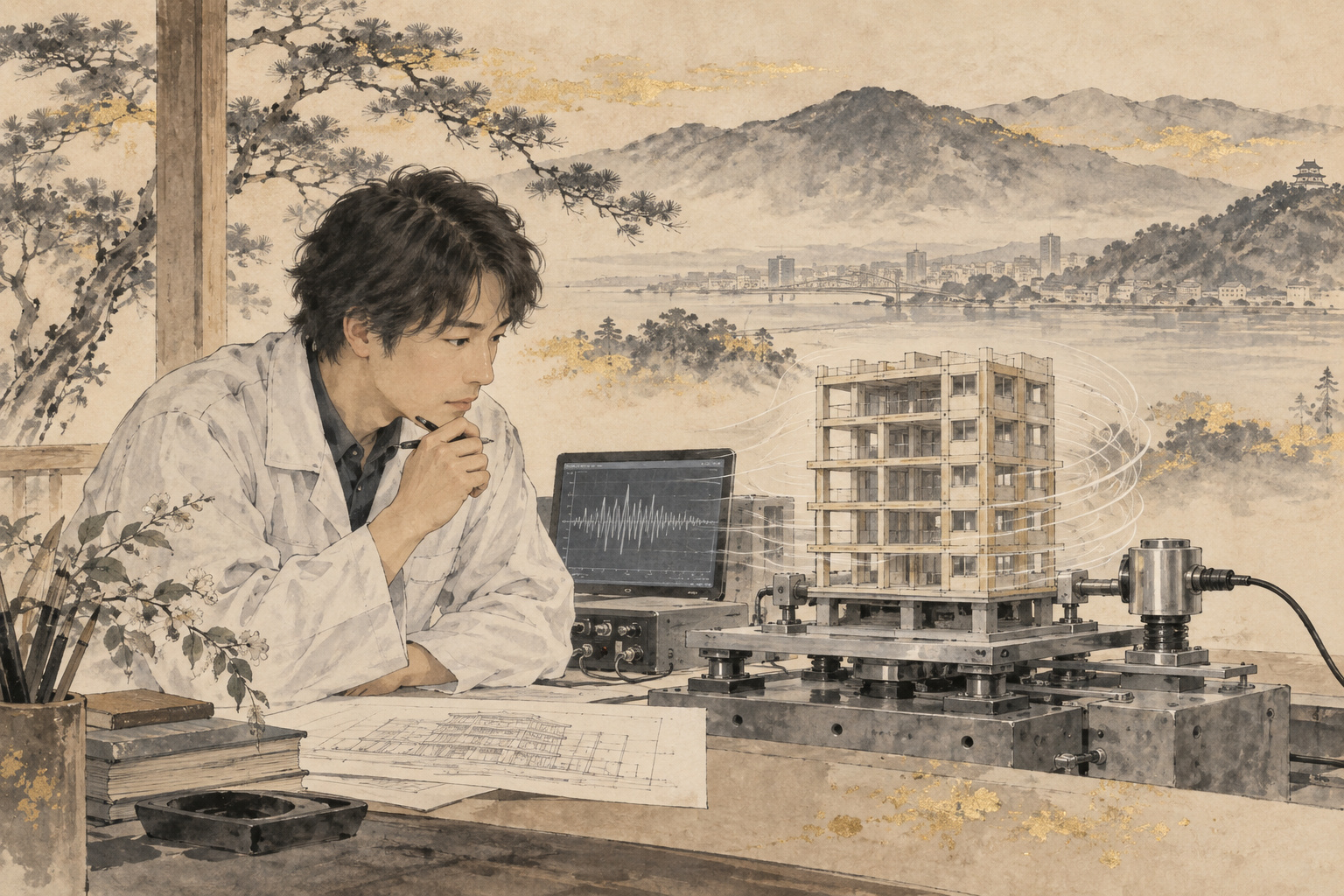
The phrase “one sensor” suggests an unusually simple answer to a difficult problem: finding a building’s hidden structural weaknesses. Research from Toyohashi University of Technology offers a more specific, and scientifically interesting, possibility. A force measurement at a device that deliberately shakes a structure might help identify where its stiffness has deteriorated.
Assistant Professor Daiki Tajiri and Professor Shozo Kawamura developed the method in the university’s Department of Mechanical Engineering. Their work, announced on the Japanese university website on May 26, 2025, appeared in Mechanical Systems and Signal Processing. This Aichi Sunday feature revisits that research; it is not a report of a new September 2026 deployment.[1]
The distinction is important because the published university account describes numerical simulations and experiments on simplified models. It identifies more realistic structures and actual buildings as subjects for further investigation.[2] The opportunity is to simplify an initial investigation, not to turn a single reading into an unconditional verdict on safety.
The signal is in the force
Many vibration-based investigations examine how a structure moves when it is excited by its surroundings or by a mechanical device. Toyohashi’s account describes acceleration measurements from several floors as one established approach, while noting research into methods using acceleration at just one floor. The number and position of sensors affect what information can be collected.[3]
The researchers instead examine force measured at an inertial vibrator, or shaker, placed at the top of the structure. A load cell records force. The method therefore still requires equipment to excite the structure and analysis to interpret the measurement; the sensor is not a self-contained scanner that sees through walls.
Under the researchers’ mathematical formulation, resonances in the force response correspond to the natural frequencies of the combined structure and shaker. Antiresonances correspond to those of the structure considered on its own. That relationship allows a force measurement to carry information useful for investigating structural change.[2]
| Feature | Interpretation in the research model |
|---|---|
| Resonance | Natural-frequency information about the structure and shaker together |
| Antiresonance | Natural-frequency information about the structure alone |
| Diagnosis | Uses these relationships to investigate reduced structural stiffness |
This is a model-based relationship, not a universal inspection chart. A dip in a response is not, by itself, a damaged column. The interpretive step—connecting measured features to physical properties—is what makes the measurement useful.
Stiffness also needs careful definition. It describes resistance to deformation under force. Strength describes the load a component can withstand before failure. They are related engineering concerns, but they are not interchangeable. Identifying a possible stiffness reduction does not automatically determine a building’s remaining load capacity.
An unexpected clue from the laboratory
In the university’s account of the project, Tajiri traces the idea to an experiment intended to characterize a vibrator itself. Metal plates and blocks used as its base introduced additional resonance and antiresonance features. Those features changed with the base’s size and rigidity. A complication in one measurement suggested a way to learn about the supporting structure.[3]
The episode illustrates the central intellectual move. The instrument and what supports it form an interacting system. Rather than treating that interaction only as something to eliminate, a researcher can ask whether it contains usable information about the object being tested.
Tajiri’s university profile places this work within mechanical dynamics and vibration engineering. His research includes identifying vibration characteristics and developing models suited to machines and structures.[8] Reducing the number of sensors, in this context, is as much an analytical problem as a hardware one: what must be measured to answer the question, and what can be inferred reliably?
Aichi’s long relationship with structural investigation
The regional history gives that question weight. The Nōbi earthquake of October 28, 1891, became a turning point in Japan’s investigation of earthquakes and damaged buildings. The Cabinet Office’s historical assessment links the disaster to scientific inquiry, research into earthquake-resistant construction and the establishment of the Earthquake Investigation Committee.[5]
The connection to today’s research is a broad historical one, rather than a claim of direct institutional descent. Observing damage, finding a physical explanation and using that explanation to reduce future harm are recurring tasks. Measurement technologies change; the need to relate evidence to the behaviour of real buildings remains.
There is also a nearer research history. In 2023, Kawamura, Tajiri and colleagues published a method for locating abnormalities in layered structures using force identification. They examined five-layer numerical and experimental models and addressed differences between a mathematical model and measured behaviour. That was a different method, not an earlier demonstration of the 2025 one-sensor arrangement.[4]
It nevertheless shows the continuing challenge behind the headline: an abnormal response has to be translated into a useful indication of location. Detecting change, identifying its source and deciding how to repair a structure are separate tasks. A method that helps with one stage can be valuable without performing all three.
Fewer sensors, but still an operating system
The attraction of reducing sensor numbers is practical. The university describes possible savings in installation and maintenance effort. It also raises the possibility of using active vibration absorbers already installed in some buildings as deliberate sources of excitation for diagnosis. That is a proposed use to explore, not proof that an existing vibration-control device can simply be switched into a certified inspection mode.[7]
A deployment decision would need to count the whole arrangement: the shaker, its installation, power, measurement procedures and the work needed to model the particular building. Reducing the number of measurement points might simplify part of that task while leaving other substantial costs. Sensor count alone cannot establish which approach is cheaper overall.
Several questions would help judge a future field trial. Can measurements be repeated consistently? How much excitation is appropriate while a building is occupied? How well can the analysis distinguish a small change from ordinary variability? Can it separate changes in more than one location? And what happens when the building departs from the assumptions of the model?
These are questions for evaluating practical usefulness, not a list of failures demonstrated by the study. They define the evidence that would make a model result more persuasive to a building owner or engineer. The university’s account does not establish a field accuracy rate or a percentage reduction in total inspection cost.
A measurement is not an emergency clearance
Aichi’s earthquake-building council explains that emergency risk assessments after a damaging earthquake address dangers including collapse in aftershocks and falling exterior walls or glass. Trained assessors undertake that work. The process is distinct both from assessments for disaster-damage certificates and from investigations into the need for restoration before continued use.[6]
The Toyohashi method asks a narrower structural question. Even a reliable indication of stiffness change would not cover every hazard that a site investigation must consider. Its plausible future role is as evidence within a wider assessment, rather than a substitute for all of the observations and judgments involved.
That narrower role still matters. If a limited set of measurements can help direct closer investigation toward a suspect part of a building, it could improve how inspection effort is allocated. Demonstrating that benefit in actual structures would be a meaningful next achievement.
The promise from Toyohashi is therefore a better way of asking a building where it may have changed. The research shows why a carefully interpreted force signal deserves attention. Whether one sensor can become a dependable part of everyday building care will be decided by what happens beyond the laboratory model.
- Toyohashi University of Technology: Japanese research announcement, May 26, 2025
- Toyohashi University of Technology: detailed Japanese release and original-paper identification (PDF), May 26, 2025
- TUT Research No. 38: bilingual account of the method and its origins, December 2025
- Kawamura et al.: Structural health monitoring for layered structure using a force identification approach, Mechanical Engineering Journal 10(3), 2023; abstract
- Cabinet Office: historical lessons report on the 1891 Nōbi earthquake, March 2006; summary (Japanese)
- Aichi council for earthquake countermeasures for buildings: emergency risk assessment and its distinct purpose (Japanese)
- Toyohashi University of Technology release on EurekAlert!: future work and possible use of active vibration absorbers, May 15, 2025
- Toyohashi University of Technology: Daiki Tajiri faculty profile, Japanese name reading and research fields