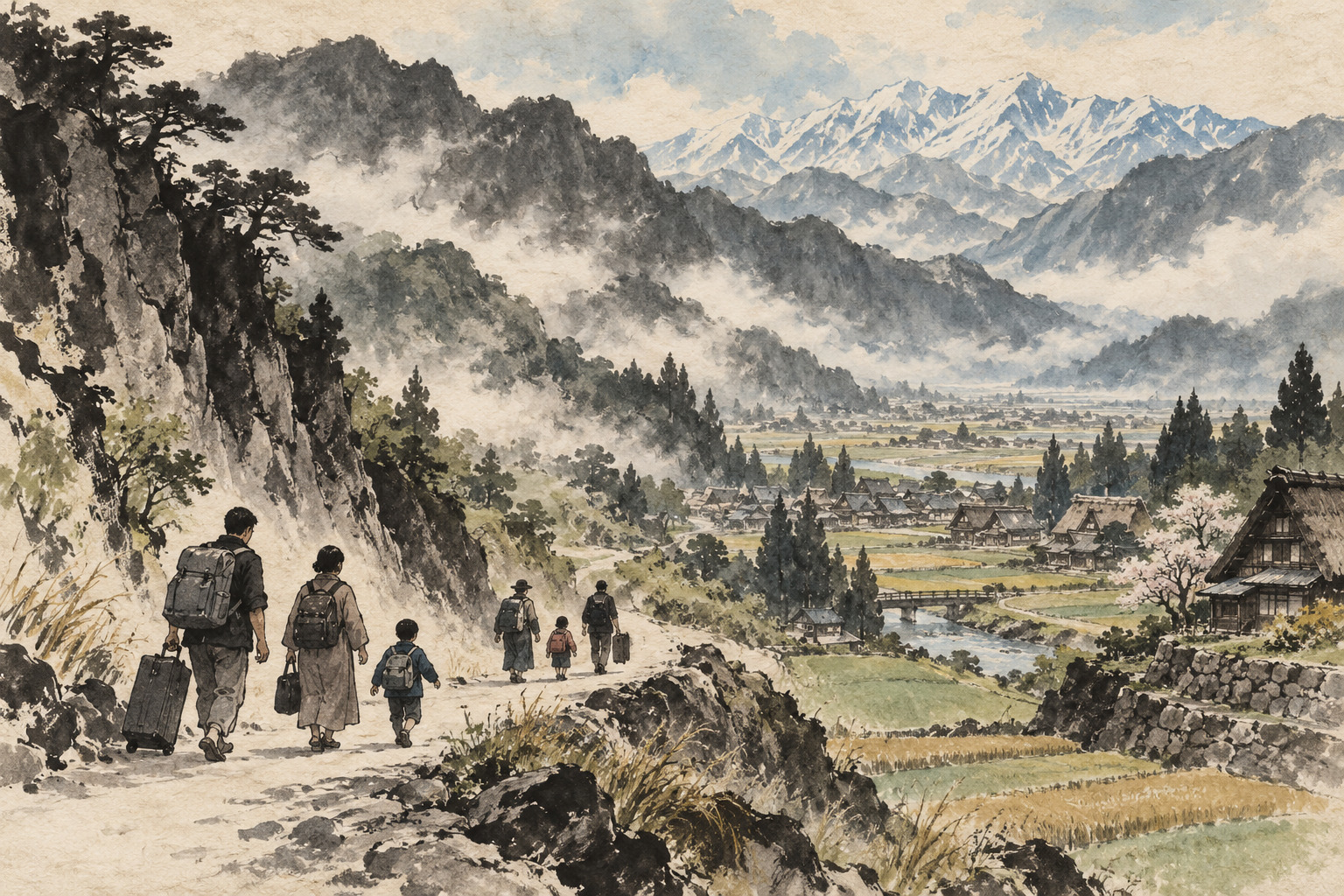
A compact prefecture will open 12 distinct doors in Tokyo. Toyama City, Takaoka, Himi, Namerikawa, Kurobe, Tonami, Oyabe, Nanto, Imizu, Kamiichi, Nyuzen and Asahi are joining the prefectural booth at one of Japan’s largest face-to-face migration events.
Toyama City and Kurobe will attend both days. Takaoka, Himi, Namerikawa, Tonami and Imizu appear Saturday; Oyabe, Nanto, Kamiichi, Nyuzen and Asahi appear Sunday. The prefecture’s own “Toyama, the Country Where I Want to Live” headquarters will operate on both days and serve as the broad entry point.
Six western cities—Takaoka, Imizu, Himi, Oyabe, Tonami and Nanto—also use the shared Toyama WEST identity. That label treats the Gosei area west of Mount Kureha as a connected living and employment region, allowing a prospective resident to compare communities without pretending that municipal boundaries define every commute, school choice or social network.
| Attendance | Municipalities | Role |
|---|---|---|
| Both days | Toyama Prefecture, Toyama City, Kurobe | Prefectural gateway plus individual urban and eastern-area consultations |
| Saturday only | Takaoka, Himi, Namerikawa, Tonami, Imizu | Western-region collaboration and municipality-specific guidance |
| Sunday only | Oyabe, Nanto, Kamiichi, Nyuzen, Asahi | Plain, mountain and eastern-region options |
Toyama has 15 municipalities. Uozu, Tateyama and Funahashi do not appear in the prefecture’s exhibitor list for this fair. Officials did not publish reasons, so absence should not be read as disinterest in migration policy. Toyama’s separate June 2026 living-and-work fair included 14 municipalities; each event has its own configuration.
Competing among more than 700 choices
The organizer is the Furusato Return and Interregional Exchange Promotion Organization. Its national consultation area will bring together more than 700 municipalities and organizations across the two days, accompanied by employment and lifestyle advice, a market and workshops.
For visitors, that concentration lowers the cost of comparison. For exhibitors, it creates an unusually direct form of competition: regions promising space, community and nature sit a few steps from rivals making similar claims. Scenic images may begin a conversation, but they cannot resolve the decisions that determine whether a move works.
Toyama’s pitch rests on compact geography, the short distance between Toyama Bay and the Tateyama range, a strong manufacturing base, housing space and a direct Hokuriku Shinkansen link to Tokyo. The harder questions concern wages, job continuity, winter snow and heating, car dependence, renovation costs, schools, health care, disaster exposure and the expectations attached to neighborhood membership.
The answers vary sharply within the prefecture. Toyama City offers a transit-oriented urban core. Takaoka and Imizu combine manufacturing, port access and cultural assets. Himi and Asahi face the sea; Kurobe and Nyuzen pair abundant water with industry; the Tonami Plain has its dispersed farmsteads; Nanto and Kamiichi place daily life nearer mountain communities. Prefecture-wide promotion works only if it makes these differences easier—not harder—to see.
The achievement—and limits—of 927 migrants
Toyama recorded 927 migrants from outside the prefecture in fiscal 2025, representing 537 households. That was 25 more people than fiscal 2024’s 902, but below the fiscal 2023 peak of 966. Household heads in their 20s through 40s accounted for 378 households, or 70.4 percent.
The Tokyo region supplied 43.5 percent of these migrants, followed by the Osaka region at 10.1 percent and Nagoya at 9.0 percent. Toyama City received 200, Takaoka 137, Nanto 123 and Imizu 110. In smaller communities, however, a few dozen newcomers can matter disproportionately to school enrollment, local commerce, volunteer capacity and business succession.
The definition is crucial. The 927 are people the prefecture and municipalities could confirm through migration counseling offices and related channels. They are not every person who moved into Toyama, and they cannot be compared directly with the resident-register total for incoming population. Nor does a consultation at a fair count as migration. The useful funnel runs from conversation to local visit, employment and housing decisions, relocation and continued residence.
No fair can erase the demographic arithmetic
Toyama’s estimated population stood at 977,238 on August 1, 2026, down 502 in one month. Over the year ending October 1, 2025, the prefecture lost 9,731 residents. Natural change—births minus deaths—accounted for a decline of 9,615, while net migration accounted for a much smaller loss of 116.
The comparison both limits and clarifies migration policy. Roughly 900 counseling-tracked newcomers cannot cancel an annual natural decline approaching 10,000. Yet when the gap between all arrivals and departures has narrowed to 116, several hundred working-age residents and young families can materially alter labor supply, school viability and the age structure of individual places.
As of October 2025, 33.6 percent of Toyama’s population was 65 or older. Out-migration by young people around higher education and first employment is also a regional-policy concern. Attracting newcomers therefore cannot substitute for creating routes home for Toyama natives, retaining graduates, supporting families, integrating foreign residents and designing transport and health systems that remain viable with fewer people.
From retirement migration to one-stop support
Toyama created the “Toyama, the Country Where I Want to Live” Promotion Headquarters in 2007, with the governor at its head. The original rationale reflected its era: population decline and aging were becoming visible just as mass retirement among the postwar baby boom and interest in slower regional living created an opening for permanent and semi-permanent residence.
The policy soon widened beyond lifestyle promotion. In fiscal 2015, Toyama established Living and Work Support Centers in Toyama and Tokyo, combining residential guidance with employment counseling. The Hokuriku Shinkansen’s extension to Kanazawa opened that March, bringing the fastest Tokyo–Toyama journey to a little over two hours and making repeated visits, hybrid work and family ties more practical.
Prefectural data say the number of migrants captured through official channels grew 2.7-fold in the decade after the center opened. The measurement is imperfect, but the institutional change matters: relocation became a process managed across municipal information, housing, jobs and post-move support rather than a tourism campaign with an address form attached.
The target has also expanded beyond immediate full relocation. Trial stays, remote work, two-region living, community revitalization teams and “relationship population” programs allow people to build a connection before moving. Toyama’s June 2026 fair illustrated that broader approach by combining municipal and company counseling with tin-accessory workshops and the prefecture’s sushi campaign.
2007 — Toyama establishes its prefecture-wide residence-promotion headquarters.
2015 — One-stop living-and-work centers open; the Hokuriku Shinkansen reaches Kanazawa.
Fiscal 2023 — Officially tracked migration reaches a record 966 people.
Fiscal 2025 — Toyama records 927 migrants; 70.4 percent of household heads are in their 20s–40s.
June 2026 — The prefecture stages its own Toyama Living and Work Fair in Tokyo.
September 12–13 — Toyama and 12 municipalities join the national Furusato Return Fair.
What a serious visitor should take home
The most useful question is not which subsidy is largest. A prospective resident should ask whether target jobs are permanent, what commuting requires, who clears snow, how a home is insulated and reinforced, what renovation excludes, how flood and landslide maps affect the property, where children would study and patients receive care, and what neighborhood dues and shared work entail.
Municipalities have a corresponding duty to disclose friction early. A move that fails through unrealistic expectations harms both the household and the receiving community. Where possible, candidates should visit more than once—including in winter—rent before buying, meet employers, compare hazard information and speak with established residents as well as selected migration ambassadors.
Joint attendance does not require painting 12 municipalities the same color. Its value is the opposite: one prefectural gateway can let a visitor compare 12 genuinely different daily lives in a single trip. A two-day fair cannot reverse Toyama’s demographic trajectory. It can, however, turn one vague attraction to the prefecture into a tested relationship with one place—and that is the scale at which relocation actually begins.
- Toyama Prefecture, “Toyama and 12 municipalities to exhibit at the 2026 Furusato Return Fair,” September 8, 2026 — schedule, venue, organizer, registration and exhibitors.
- Toyama Prefecture, fiscal 2025 migration results — people, households, age, origin, municipal figures and methodological warning.
- Toyama Prefecture, estimated population as of August 1, 2026 — latest total and monthly change.
- Toyama Prefecture, 2025 Population Movement Survey summary — age structure, natural change and net migration.
- Toyama Prefecture, First Toyama Living and Work Fair 2026 — June participants, companies, migrants and programming.
- Toyama Prefecture, residence-promotion headquarters overview — original rationale and partnership structure.
- Toyama Prefecture, “Promoting Migration and UIJ Turns” — policy history and one-stop support centers.
- Tonami City, Toyama WEST migration event — official definition of the six-city western partnership.
- Toyama Prefecture, Sustainable Development Plan for Depopulated Areas, fiscal 2026–2030 — designated areas and policy framework.
Editor’s note: Event, organization and municipality names, readings, statistical terms and the definition of “migrant” were checked against Japanese primary sources. Exhibiting, counseling, moving and remaining are treated as separate stages; unpublished participation reasons and future results are not inferred.