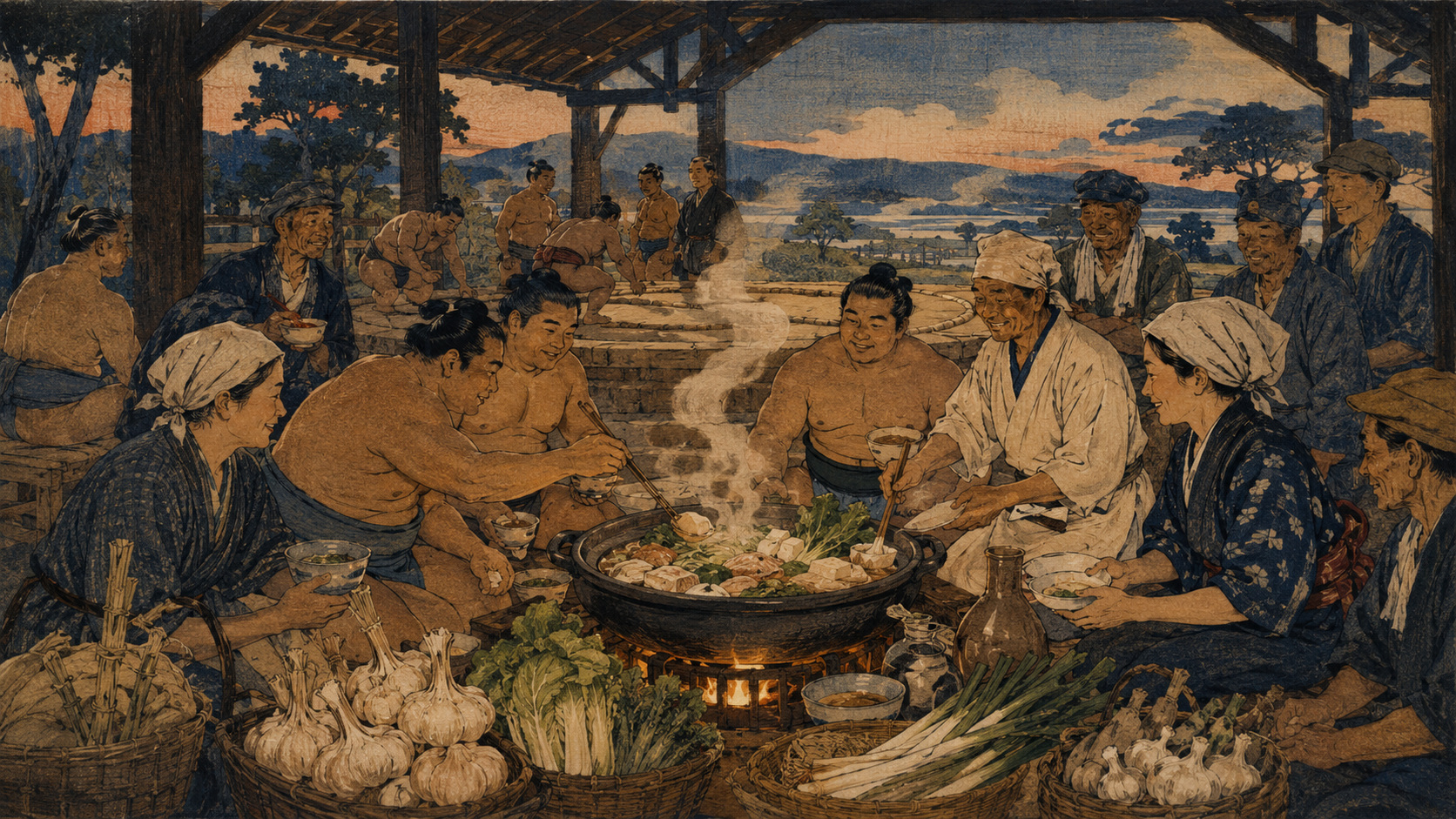
The pot arrived in the place it was designed to explain.
On July 24, at Towada City Sumo Arena, a local restaurant cooked roughly 200 bowls for the public and project participants. Garlic, nagaimo yam, burdock, green onion and pork shared the broth with tofu and fried tofu. The mayor and the head of the tourism organization attended. People asked for seconds, the organizers said.
Nothing in that list is unusual by itself. The unusual part is the map hidden inside it. The ring represents a student-sumo tradition formalized in 1952. The root vegetables point to Aomori’s cool summers, volcanic soils and enormous field-crop economy. The seasoning leads to a Towada manufacturer whose best-known sauce began in the age of local sheep farming. Even the water behind the city’s agricultural plain carries a story of tunnels cut by hand in the 1850s.
Towada Chanko is therefore less a claim that the city has rediscovered an ancient recipe than an attempt to assemble several authentic local histories into a new, repeatable meal. That distinction matters. Traditions can be inherited; they can also be designed. The honest question is whether a designed tradition creates living relationships—or merely a slogan.
What is actually in Towada Chanko
The project’s slogan is Shin-gi-tai o hagukumu, Towada no chikara-meshi—roughly, “Towada power food that nurtures heart, technique and body.” In sumo, shin-gi-tai names the union of mental character, skill and physical condition. The food campaign gives each term a civic reading: “heart” is connection and gratitude around the table; “technique” is the knowledge that turns local ingredients into flavor; “body” is the health sustained by agricultural products.
The base announced by the organizers contains Towada garlic, nagaimo, burdock, green onion and Oirase Garlic Pork, along with tofu and fried tofu from regional producer Taishi Foods. Former wrestler Haruhiro Sugawara, who operates a chanko restaurant in Morioka, supervised development. Towada-based Kamikita Agricultural Products Processing joined the trial process and created a dedicated stock.
The recipe is meant to be adaptable. Organizers say restaurants should keep local ingredients at the center while adding their own ideas. That flexibility is faithful to chanko culture and commercially useful: no kitchen has to reproduce one rigid ingredient list through every season. It also creates a branding problem. If almost anything can enter the pot, consumers need another way to know what makes it “Towada.”
The answer, at least at launch, is a set of three condiments called the dish’s “three sacred tools.”
| Component | What it does | The local or sumo language inside the name |
|---|---|---|
| Oshidashi stock 推しだし | A dedicated broth developed by Kamikita Agricultural Products Processing. | It sounds like oshidashi, the fundamental winning technique of pushing an opponent out; its spelling also contains oshi, a favored or recommended thing. |
| Kinboshi Garlic Miso 金星ニンニクMISO/金ニクMISO | A Towada-garlic condiment that adds stronger aroma, umami and heat. | A kinboshi, “gold star,” is a top-division rank-and-file wrestler’s victory over a yokozuna. “Kin-niku” also echoes the Japanese word for muscle. |
| Nebari-gachi Tororo ねばりガチとろろ | Grated Towada nagaimo and burdock, added for viscosity and an earthy change in flavor. | The name plays with stickiness and persistence; its sound also invites gachi/kachi, seriousness or victory. |
The wordplay may look playful, but it solves a practical branding task. A flexible pot can vary from restaurant to restaurant while the stock and two finishing condiments preserve a recognizable ritual: taste, add miso, add tororo, change the bowl.
Chanko is not one recipe—and its origin is not settled
Outside sumo, “chanko” is commonly treated as shorthand for a large hot pot. Inside the sport, it is broader. The Japan Sumo Association says every dish made by wrestlers can be called chanko: curry, fried chicken and even a French course would qualify. The association also warns that the word’s origin has no settled explanation. Theories connect it to a Chinese-style metal pot, to a familiar word for an older cook, or to the combination of a master as “father” and disciples as “children.”
The hot-pot form spread for practical reasons. Accounts of late-Meiji sumo culture associate its rise with the crowded Dewanoumi stable of the 19th yokozuna Hitachiyama. One vessel could feed many recruits, absorb inexpensive seasonal ingredients and reduce the work of individual service. The method later became a stable standard.
That history changes how Towada’s project should be judged. Authentic chanko does not require a single canonical broth. Its deeper logic is collective cooking: available ingredients, accumulated kitchen knowledge, many people sharing food. A Towada version built by farmers, a processor and restaurants is not violating that logic. It is translating it from a stable to a city.
Nor is chanko itself what makes a wrestler large. A pot rich in meat, tofu and vegetables can be nutritionally balanced. Body mass reflects total intake, rice and accompanying dishes, training and the rhythm of stable life. The cartoon idea that one magical stew produces a sumo body obscures what the meal historically does best: feed a group efficiently.
A ring built, blown down, rebuilt and uncovered
Towada’s claim to be a student-sumo center rests on physical continuity. The first Select High School Sumo Towada Tournament was held in August 1952. The next year, a municipal arena was built in a corner of Central Park.
The first structure was wooden. A storm blew it down in 1957. Towada rebuilt in steel in 1958 and completed a heavy-steel roof in 1975. For decades the site hosted national university and high-school competitions, producing a calendar that repeatedly brought the country’s strongest young wrestlers to a regional city.
Seismic diagnosis eventually forced the roof to be removed in 2017. The tournaments did not vanish: in 2023, after the pandemic interruption, the high-school event returned in the nearby Koma Kaido Dome. But the missing roof was a visible break in the arena’s identity.
Preparation for Aomori’s 2026 National Sports Festival supplied the next rebuild. City documents list a ¥990 million contract covering a 3,087-square-meter steel canopy, a new reinforced-concrete administration building and related work, with construction scheduled from June 2023 through December 2024. The tourism organization now describes the venue as one of Japan’s largest roofed outdoor sumo arenas.
1952 — First Select High School Sumo Towada Tournament.
1953 — Municipal arena opens in Central Park.
1957 — Wind destroys the original wooden structure.
1958 — Arena is rebuilt in steel.
1975 — Heavy-steel roof is completed.
2017 — Roof is removed after seismic assessment.
2024 — Rebuilt canopy and administration facilities are completed for the 2026 sports festival cycle.
2026 — The 61st university and 75th high-school Towada tournaments are held on August 14 and 15.
Those ordinal numbers reveal the scale of the commitment. A “traditional” festival can survive as memory; an annual tournament requires committees, ticket sellers, officials, schools, accommodation, transportation, maintenance and spectators. Towada’s sumo culture has an institutional backbone.
The sacred ground of student sumo is still producing results
The 2026 events were not ceremonial exhibitions. Twelve selected universities competed on August 14; Nihon University defeated Nippon Sport Science University 4–1 in the team final to win its first Towada title since 2019. On August 15, 40 selected high schools arrived. Tottori Johoku won the team competition, while local Sanbongi Agricultural Keitaku High School finished third for the first time in ten years. A Sanbongi student also took third in the individual event.
The local school result matters to the food story. “Student-sumo sacred ground” can sound like tourism copy until a nearby agricultural high school walks into the same ring and reaches the national podium. The relationship between farming and sumo is not merely decorative: students live inside both educational worlds.
Professional sumo provides another line outward. The Japan Sumo Association lists makuuchi wrestler Nishikifuji as a Towada native, and newly promoted wrestler Okaryu also comes from the city. Their careers are not products of the chanko project, but they give young spectators a contemporary route from local practice to the professional dohyo.
Yet the organizers identify a paradox. National competitions continue, while everyday contact with sumo has thinned. Dedication sumo at festivals and children’s wanpaku events once made the sport locally familiar. A large arena can preserve elite competition without ensuring that the broader population encounters the culture between tournament days.
Food is being asked to cross that gap. A match is scheduled and seasonal. A bowl can enter a restaurant, a family meal or a visitor’s afternoon. It turns sumo from something watched at a venue into something talked about at a table.
Before the farms, a canal cut through stone
The vegetables in Towada Chanko grow on a plain whose agricultural history is unusually visible. In the mid-19th century, the Sanbongihara plateau was described as an open, water-poor expanse. The Oirase River ran below it; the city says the plateau stood about 30 meters higher, so water had to be taken from far upstream.
Nanbu domain official Nitobe Tsuto—grandfather of Nitobe Inazo, later the author of Bushido—began the project in 1855, when he was already in his early sixties. Workers cut two tunnel sections through rock and dug an open channel toward Sanbongi. After roughly four years, water reached the plateau in 1859. The domain lord named the artificial river Inaoigawa.
The Ministry of Agriculture describes a plan motivated by repeated crop failures and famine, financed by domain money, private investors and Nitobe’s own property. Rice was harvested on the reclaimed land in 1860. Later generations extended the water network; the ministry says its branches now total about 70 kilometers and irrigate roughly 5,900 hectares.
The project did more than water fields. The gridded town plan built beside the new agricultural settlement became the skeleton of modern Towada. In other words, local food is not simply one industry among many. Water engineering, settlement and city formation grew together.
Why these particular roots thrive here
Aomori Prefecture says its cool summers, fertile volcanic-ash soils and abundant water support a diverse vegetable economy. Nagaimo, garlic and burdock—the three crops most visible in Towada Chanko and its condiments—all have Japan’s largest planted area at the prefectural level. Aomori’s vegetable output value has ranked first in Tohoku for 31 consecutive years.
Towada promotes itself as Japan’s leading garlic-producing municipality, a status embedded in city plans and public campaigns such as “Towada Garlic Day” on October 29. JA Towada Oirase calls its territory one of the prefecture’s largest garlic production zones. Garlic planted in autumn develops through severe cold, producing the large, white cloves for which the region is known.
Nagaimo and burdock are useful to the pot for more than symbolism. Nagaimo can be cut and simmered, but here it also becomes grated tororo, changing the broth’s texture at the table. Burdock supplies aroma and earthiness, and its long root gives the finishing paste body. Green onion, tofu and fried tofu absorb broth; pork contributes fat and protein.
Oirase Garlic Pork closes a local loop in name and production. Aomori’s official product guide says the pigs receive feed containing powdered Towada garlic. The meat is not intended to taste of raw garlic; the brand turns a crop associated with the city into part of livestock production.
Not every bowl can be treated as a perfect farm-to-table ledger. The announcement names companies and local ingredients, but it does not publish the origin of every input, the percentage by value sourced in Towada, seasonal substitution rules or the premium paid to producers. “Local” is a direction of travel, not yet an audited claim.
A seasoning maker that already learned this lesson once
Kamikita Agricultural Products Processing is a particularly apt partner. The Towada company began in the postwar period as an organization connected to sheep and wool. As that industry declined, it moved into soy sauce. In 1965 it developed Stamina Gen Tare to make locally eaten mutton more appealing.
The sauce—known throughout Aomori simply as Gen Tare—uses ingredients including local garlic, apples, onions and ginger. Aomori’s official tourism account describes a business model that bought sound but cosmetically imperfect vegetables from local members, processed them and created added value. A problem of agricultural utilization became a durable regional taste.
That history mirrors the chanko project. A processor takes ingredients whose individual value may fluctuate and turns them into a standardized, memorable base that restaurants can use. “Oshidashi” stock gives Towada Chanko an industrial anchor: a product that can be reproduced, distributed and eventually measured.
It also concentrates risk. If a branded local dish depends too heavily on one proprietary stock, restaurants may have less room to develop their own kitchen identity, and the economic benefit may cluster in processing rather than spreading evenly to farms. The announced model tries to hold both sides: a common flavor tool, but freedom around the pot.
Towada has used food to tell a civic story before
The city’s best-known precedent is Towada barayaki: beef belly and abundant onions cooked on a hotplate with a sweet-savory sauce. In October 2014, the Towada Barayaki Seminar won the Gold Grand Prix at the ninth B-1 Grand Prix in Koriyama. The victory brought national recognition, but the movement’s language was always larger than a recipe. B-1 organizers describe the events as community revitalization through local food, not simply a contest to identify Japan’s tastiest dish.
In 2022, the national government recognized the Towada area under its SAVOR JAPAN program, citing food culture including barayaki and efforts to communicate it internationally. That experience gives the city a base of restaurant promotion, storytelling and food-event logistics.
Towada Chanko should not be treated as a sequel with a guaranteed ending. Barayaki already existed in local eating culture before civic organizers amplified it. Towada Chanko is being launched deliberately by the city and tourism organization. One is a local dish turned into a movement; the other begins as a cultural-development project and must become a dish people voluntarily order.
That is a harder test than attracting a queue for a free festival serving. Success begins when residents pay for the second bowl.
The tourism strategy behind the steam
The city explicitly places Towada Chanko inside its Tourism Strategy 2025–29. That plan says Towada’s visitor numbers have recovered toward pre-pandemic levels but identifies a shortage of high-value products, weak profitability in distinctive local food culture, insufficient food service and low civic pride. Its headline vision is sustainable tourism that “earns and enriches,” centered on nature and art.
Nature and art are obvious Towada assets: Lake Towada, the Oirase Gorge and the Towada Art Center already shape the visitor image. Sumo offers something different. It is based in the city center, attached to dates when visitors are already gathering, and connected to agricultural and restaurant spending. A bowl can lengthen an arena visit, create an evening meal and give a traveler something legible to order without erasing the place behind it.
The timing is deliberate. Organizers listed distributions at the August student tournaments, the National Sports Festival sumo competition beginning September 11, soccer on October 10, basketball on October 16 and the National Sports Festival for People with Disabilities volleyball program on October 25. The pot moves from its natural home at the sumo ring to other sports, carrying the city’s sumo identity with it.
Restaurant service is targeted for autumn 2026. That step is more important than the launch. Event distribution produces awareness; menus produce a market. Restaurants will determine portion, price, seasonality, staffing, waste and whether the dish works when no official is standing nearby to explain it.
The economics of an adaptable pot
Chanko has advantages as a regional food platform. It can accept cosmetically imperfect vegetables. A kitchen can adjust the mix to harvest and price. One batch serves a group. The visible ingredients communicate abundance, while broth and condiments preserve value that might otherwise be lost. It works in cold weather, when Towada’s tourism strategy says demand falls sharply.
But the same flexibility can hide weak sourcing. A menu may feature one local clove and otherwise rely on the cheapest wholesale inputs. A restaurant may carry the name without buying from the farmers the campaign was designed to support. Or an official specification may become so strict that small kitchens cannot participate.
A durable model needs a transparent middle path. The city could define a small set of required Towada ingredients, disclose optional seasonal components, publish the participating restaurants and identify the farms or producer groups where practical. The processor can preserve consistency, while kitchens compete on technique, side dishes and presentation.
- Adoption: number and geographic spread of restaurants serving it after the free-event period.
- Demand: paid bowls sold, repeat orders and seasonal retention—not only samples distributed.
- Farm value: volume and value of Towada produce purchased, including otherwise underused grades.
- Cultural reach: residents and visitors who attend sumo activities after first encountering the dish.
- Shared benefit: how revenue is distributed among farms, processor, restaurants and cultural programs.
A launch, not yet a tradition
By the information cutoff, Towada had completed the most photogenic stage: a crowded unveiling, a steaming bowl at the arena and a calendar of major sports events. It had also done something more substantial by bringing farmers, a processor, restaurant workers and a former wrestler into product development.
The unanswered questions are operational. Which restaurants will serve it? Will they use the three condiments under a licensing or purchase agreement? How much will a bowl cost? What minimum share must come from Towada? How will the recipe handle crop failure or high input prices? Who owns the name and quality rules? Will a portion of sales support youth sumo or arena programming?
Those details determine whether “culture, food, industry and tourism” are truly connected or simply printed beside one another. A one-season promotional dish can still be enjoyable. A cultural institution needs feedback, apprentices, recurrent income and a reason for residents to claim it as their own.
Towada’s history offers a useful warning and a source of confidence. The arena survived wind, steel replacement, the loss of its roof and a rebuild. The agricultural plain exists because people spent four years moving water through stone, then extended the system across generations. The city’s famous sauce emerged when a sheep organization adapted to a changing economy.
None of those systems endured by remaining pure. They endured by changing form while keeping a local purpose.
When the ring becomes a table
Sumo is often described through oppositions: winner and loser, east and west, inside the ring and outside it. Chanko expresses the other side of the sport. Everyone eats from the same kitchen. Technique matters, hierarchy remains, but the meal converts individual bodies into a household.
Towada is attempting the same conversion at city scale. The wrestler contributes memory and language. The farmer contributes the root and clove. The processor contributes repeatability. The cook contributes judgment. The visitor contributes money and attention. The resident decides whether the result tastes like home.
The ingredients cannot guarantee that relationship. Garlic can become a logo; “sacred ground” can become a slogan; free bowls can disappear with the event tents. Yet the design contains a serious idea: culture is more likely to survive when people can practice it in ordinary life.
A tournament lasts a day. A roof waits all year. A canal keeps moving water after its builders are gone. If Towada Chanko succeeds, it will do something similarly modest and persistent: place the ring on the table, one paid, shared pot at a time.
Reporting notes and principal sources
This article reviews public information available through August 16, 2026 at 6:00 AM JST. Claims about the dish’s ingredients, partners, July unveiling and planned rollout originate with Towada City and the Towada Oirase Tourism Organization unless otherwise noted. No standard recipe, price, restaurant roster, procurement percentage or commercial forecast was public at the cutoff; the discussion of risks and success measures is Japan.co.jp analysis.
- Towada Oirase Tourism Organization: launch, ingredients, partners and rollout of Towada Chanko
- Towada City: history and redevelopment of Towada City Sumo Arena
- Towada City: 61st university and 75th high-school sumo tournaments
- Daily Tohoku: result of the August 14 university tournament
- Daily Tohoku: result of the August 15 high-school tournament
- Towada City Tourism Strategy 2025–29
- Towada City: Inaoigawa canal, reclamation and city history
- Ministry of Agriculture, Forestry and Fisheries: Nitobe Tsuto and the Sanbongihara reclamation
- Aomori Prefecture: vegetable production, climate and major root crops
- JA Towada Oirase: local garlic and other farm products
- Aomori product guide: Oirase Garlic Pork
- Official Aomori tourism site: the history and agricultural model of Stamina Gen Tare
- Japan Sumo Association: the meaning and disputed etymology of chanko
- Japan Sumo Association: the oshidashi winning technique
- Japan Sumo Association: the meaning of kinboshi
- Japan Sumo Association: Nishikifuji profile
- Japan Sumo Association: Okaryu profile
- Towada City: 2026 National Sports Festival schedule and venues
- Towada City: 2014 B-1 Gold Grand Prix for Towada Barayaki
- Ministry of Agriculture, Forestry and Fisheries: Towada food culture and SAVOR JAPAN