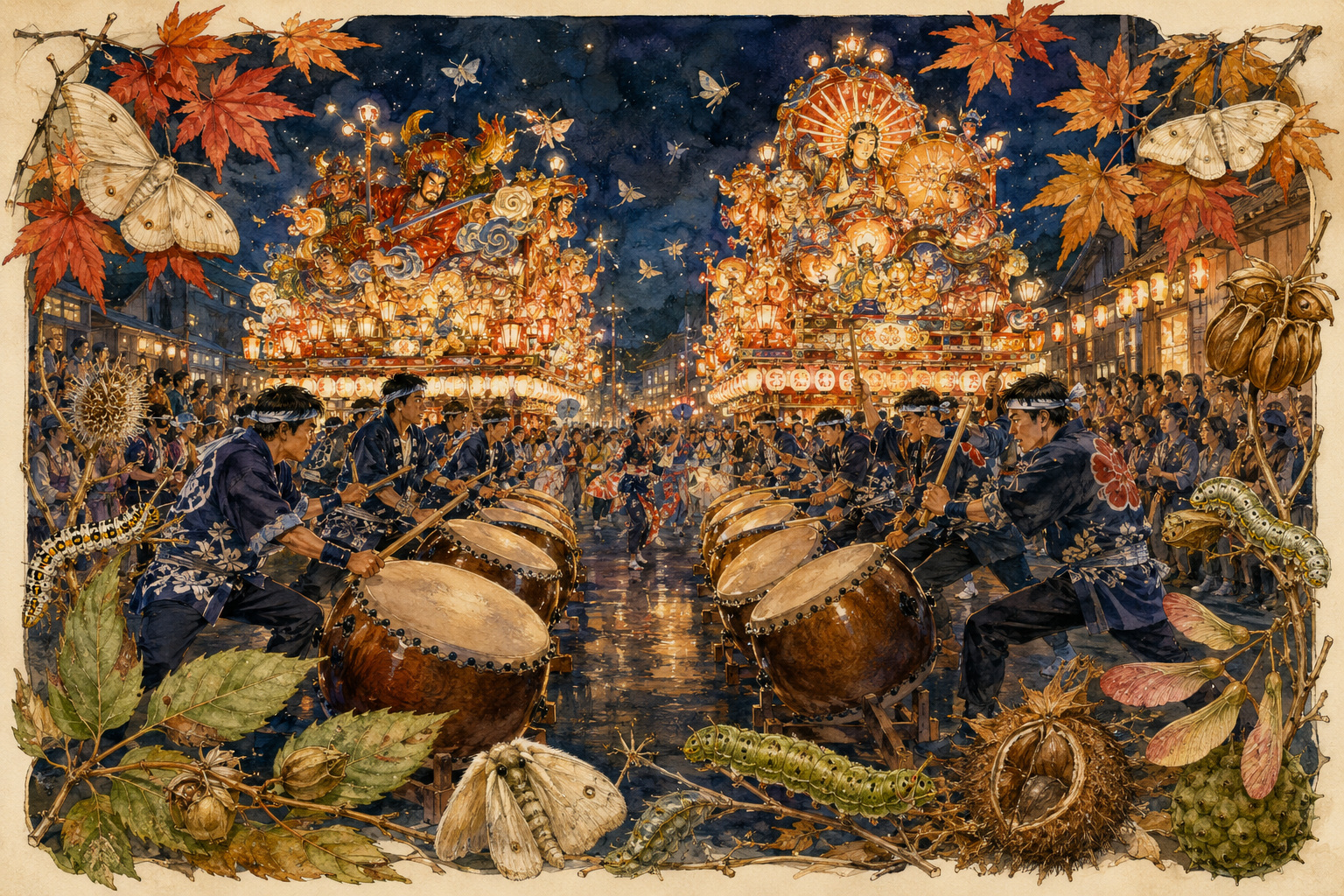
THE MOST consequential change in Towada’s autumn festival happens gradually. A float that can be examined at noon begins moving at five. The sky darkens, electric light separates figures from ornament, and the administrative avenue known as Koma Kaido becomes a corridor of drums, flutes and spectators.
The 2026 Towada City Autumn Festival—Towada-shi Aki Matsuri in the official Japanese reading—runs Friday, September 4, through Sunday, September 6. Events move among Sanbongi Avenue, Kanchogai Avenue and the central parking area. Towada City, the Towada Chamber of Commerce and Industry, and the Towada Oirase Tourism Organization are the organizers.
Promotional language can make the programme sound more combative or equestrian than it is. “Fighting drums” describes drummers answering one another with force; it is not a brawl. Nambu Koma Odori is a horse-themed folk performance, not a display of ridden horses. The detailed 2026 timetable uses a third and more precise name for Saturday’s set piece: Towada-bayashi Kyōenkai, a competitive showcase of local festival music.
Three Days, Two Avenues, Different Speeds
Friday and Sunday are the two broad procession days. From 2 to 4:30 p.m., Sanbongi Avenue hosts nagashi dancing, mikoshi, a parade and the joint movement of festival floats. Friday adds a 5:30 to 8:30 p.m. programme of nagashi dance and mikoshi on Kanchogai Avenue.
Saturday slows the floats before setting them in motion again. They remain on display along Kanchogai Avenue from noon to 5 p.m. A ceremony and stage programme begin at 1 p.m. west of the central parking area. The festival then shifts into a twilight and night procession from 5 to 8:30 p.m.
| Date | Time | Place | Principal programme |
|---|---|---|---|
| Friday, Sept. 4 | 2–4:30 p.m. | Sanbongi Avenue | Nagashi dance, mikoshi, parade and joint float procession |
| Friday, Sept. 4 | 5:30–8:30 p.m. | Kanchogai Avenue | Nagashi dance and mikoshi |
| Saturday, Sept. 5 | Noon–5 p.m. | Kanchogai Avenue | Floats and related displays |
| Saturday, Sept. 5 | 1–4 p.m. | West side, central parking area | Awards, children’s drumming and Towada-bayashi competition |
| Saturday, Sept. 5 | 5–8:30 p.m. | Kanchogai Avenue | Twilight and night procession |
| Sunday, Sept. 6 | 2–4:30 p.m. | Sanbongi Avenue | Nagashi dance, mikoshi, parade and joint float procession |
Saturday Gives the Music Its Own Stage
The Towada-bayashi competition runs from 1:40 to 4 p.m. beside the central parking area. It follows an awards ceremony and a performance by children from Makiba no Kodomoen. The float display continues nearby, allowing visitors to move from stationary craftsmanship to music presented as the main event.
Kyōen, rendered here as competition, also carries the sense of ensembles performing together and testing their presence against one another. The programme is not simply a loudness contest. Festival music supplies movement cues, regulates the pace of dancing and creates a shared pulse among groups gathered in the same civic space.
This formal title matters editorially. The published schedule does not label the session a “fighting-drum tournament.” It calls it the Towada-bayashi Kyōenkai. Descriptive language may introduce the energy, but it should not replace the organizer’s name for the event.
What “Fighting Drums” Actually Means
Aomori Prefecture’s official tourism site lists kenka-daiko, or “fighting drums,” among the festival’s attractions. Its Japanese explanation says participants exchange drum patterns and compete in spiritedness. The fight is sonic: one side projects a phrase, another returns it.
The distinction prevents spectacle from swallowing meaning. Drums can sound confrontational while performing a social task—coordinating movement and allowing separate neighborhood groups to assert identity inside a common festival framework.
There is also a limit to what the current record establishes. As of August 29, the detailed 2026 programme does not provide a separate time slot titled Kenka Daiko. It does schedule the Towada-bayashi competition. The two terms illuminate one another, but should not be treated as interchangeable entries on the timetable.
Nambu Koma Odori Is Folk Dance, Not Horsemanship
Nambu Koma Odori is the second phrase that requires care. The Aomori Prefectural Board of Education records the version preserved in Towada’s Horanai district as a prefecturally designated intangible folk cultural property. The custodian is the Horanai Nambu Koma Odori Preservation Society, and the form has also been selected nationally for documentary safeguarding.
Koma refers to the horse motif represented through performance. It does not advertise racing, mounted acrobatics or a procession of live animals. Calling it a “horse performance” without that qualification changes the type of event.
The prefectural tourism page and organizer material identify Nambu Koma Odori as a festival attraction. Yet the detailed schedule available on August 29 gives neither a dedicated appearance time nor a troupe name. Visitors travelling principally to see it should confirm those details with the organizer before departure.
The Floats Change When the Street Goes Dark
Saturday is designed as a before-and-after encounter. The five-hour daytime display makes joinery, figures and surface detail available at a walking pace. At 5 p.m., the objects become vehicles again. Their lighting is no longer decoration viewed in isolation; it moves through sound, shadow and a changing crowd.
The setting contributes as much as the hour. Towada City describes Kanchogai Avenue—also called Koma Kaido—as 1.1 kilometres long and 36 metres wide, with roughly 160 pine trees and 150 cherry trees. The government district was developed after the war on land associated with an Imperial Army remount depot. Water channels and horse sculptures now mark the avenue.
On ordinary days it connects public offices. During the festival it controls distance and sightline, giving large floats room to turn into a sequence rather than a cluster. The avenue, not only the illuminated decoration, stages the night procession.
From Harvest Prayer to Managed City Event
Aomori’s official tourism account traces the festival to harvest prayers during the late-Edo development of the Sanbongi plain. That origin places agricultural season, collective labour and gratitude underneath a contemporary schedule that now includes parades, children’s drumming and timed road closures.
Continuity does not mean a frozen form. Lighting systems change, roads acquire new functions and participating organizations turn inherited practice into an annual civic operation. Tradition survives through revision, rehearsal and coordination.
Food stalls are planned along Kanchogai Avenue throughout the three days, while Towada Jiman-ichi (Autumn), a local-products market, is scheduled at the central parking area. The waiting time between performances thus becomes part of the event’s local economy rather than dead space.
Road Closures Matter as Much as the Programme
Restrictions move with the festival. Sanbongi Avenue is affected from 1 to 5 p.m. on Friday and Sunday. Friday’s Kanchogai Avenue restriction runs from 5 to 9 p.m. Saturday is divided into noon–4 p.m. and 4–9 p.m. periods. Drivers should consult the official map and choose a parking area before approaching the center.
General parking is listed at ¥200 per use. The official access guide estimates about 40 minutes by Towada Kankō Dentetsu bus from Shichinohe-Towada Station and about 45 minutes by JR Bus Tohoku’s Oirase service from Hachinohe Station.
Local circulation needs closer attention. Towada City says the south and north city-loop buses and the west- and east-district shuttle buses will be completely suspended from September 4 through 6. That notice applies to the specified municipal routes; it does not say every regional bus will stop.
- Review the latest weather response, road-closure map and programme changes on the official site.
- If Nambu Koma Odori is essential to the visit, confirm its troupe, time and location.
- Identify whether a planned connection uses one of the suspended city-loop or district shuttle-bus routes.
- Festival information: Towada Chamber of Commerce and Industry, 0176-24-1111.
The most coherent visit follows the festival’s deliberate change of pace: inspect the floats in daylight, hear the ensembles in their competition, then return to the avenue as the same structures move under illumination. Towada’s autumn is constructed from object, sound and street in equal measure.
FRIDAY, 2 P.M. The three-day programme opens on Sanbongi Avenue.
FRIDAY, 5:30 P.M. Nagashi dance and mikoshi move to Kanchogai Avenue.
SATURDAY, 1:40 P.M. The Towada-bayashi competition begins.
SATURDAY, 5 P.M. The twilight and night procession starts.
SUNDAY, 2 P.M. The final joint procession begins on Sanbongi Avenue.
- Towada City Autumn Festival — official 2026 schedule, venues, road restrictions and parking
- Towada City — official festival notice and detailed programme
- Towada City — municipal transport operations and festival suspensions
- Aomori Prefecture tourism site — official reading, history and cultural features
- Aomori Prefectural Board of Education — Nambu Koma Odori cultural-property record
- Towada City — Kanchogai Avenue (Koma Kaido) profile
This English edition was written independently from Japanese municipal, organizer and prefectural records available through August 29, 2026. Official names, readings, times, transport restrictions and cultural-property terminology were checked in Japanese. Because the detailed schedule does not identify a Nambu Koma Odori troupe or appearance time, that limitation is stated in the article. This is a pre-event guide and cultural analysis, not an on-site report.