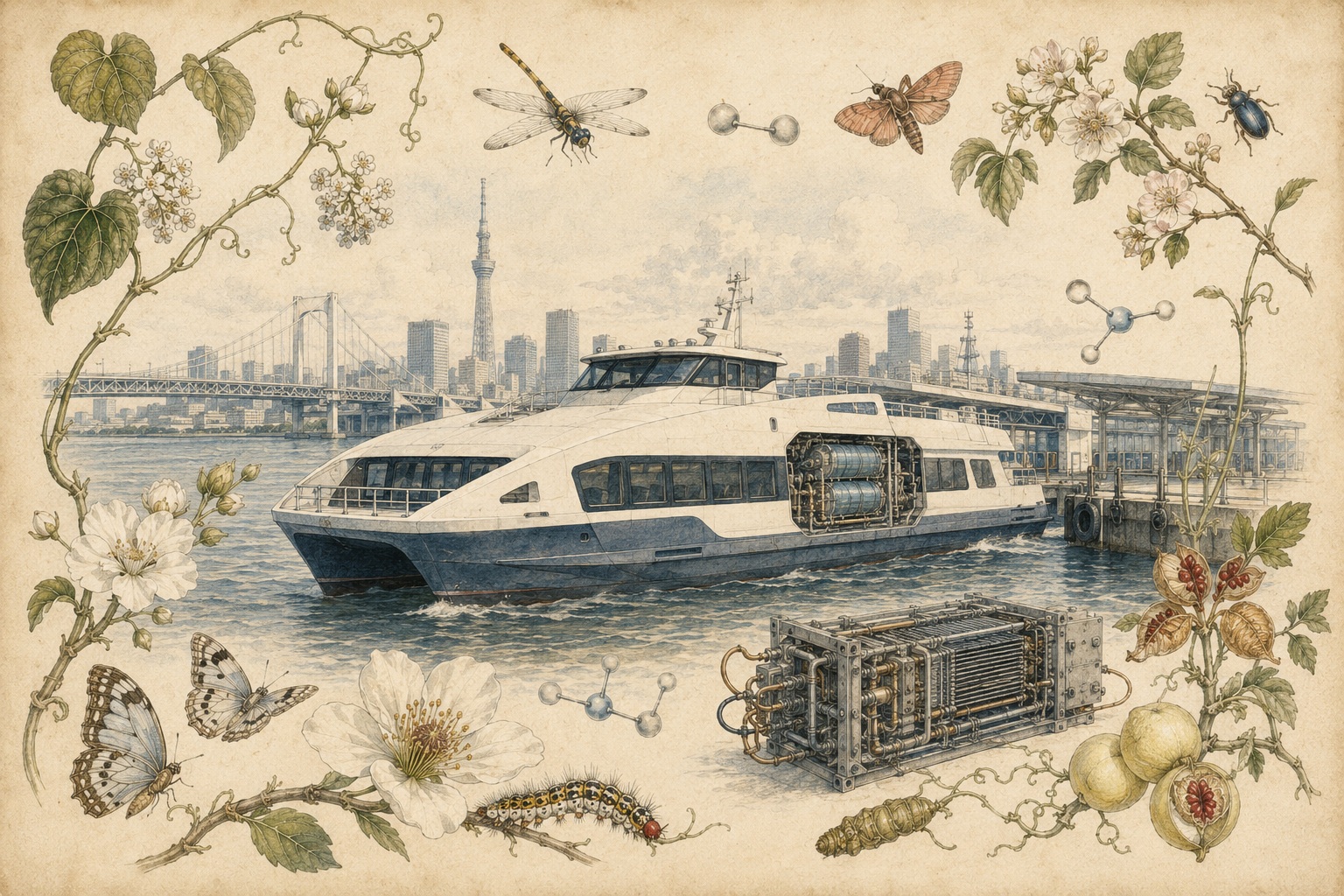
World expos are filled with temporary futures. Robots operate for six months. Pavilions are dismantled after closing day. Experimental transport systems disappear when the crowds go home. Whether the technology was truly a preview of society can only be judged after the event ends.
Mahoroba is about to take that test.
During Expo 2025 Osaka, Kansai, it carried passengers between Universal City Port and Yumeshima and allowed ordinary visitors to experience a passenger vessel powered by hydrogen fuel cells and plug-in electricity. A year after the Expo, the ship is not being placed in a museum. It is moving east.
Tokyo intends to operate the vessel in Tokyo Port beginning this winter, using it both as passenger transport and as a public platform for explaining hydrogen and the role of the port.
That is more than reuse. In Osaka the ship’s job was to show a future. In Tokyo it has to become routine: depart on schedule, carry passengers, charge batteries, receive hydrogen, undergo maintenance and repeat the cycle in winter conditions.
The second task is harder. Social implementation is not proving a world first once. It is proving that the same system still works the following week.
What exactly is Mahoroba?
According to Namura Shipbuilding’s technical review, Mahoroba is a catamaran passenger vessel of 177 gross tons with capacity for 150 passengers, a cruising speed of 10 knots and maximum range of about 130 kilometers. Its registered length is 29.5 meters, breadth 8.0 meters and molded depth 2.5 meters; Expo materials described the overall vessel at about 33 meters long.
The propulsion plant combines pure-hydrogen fuel cells with lithium-ion secondary batteries. It has no conventional diesel propulsion engine; electricity from fuel cells and batteries drives port and starboard propulsion motors.
Namura’s system diagram shows four 60 kW fuel-cell units, for 240 kW total fuel-cell output. The propulsion architecture is divided into independent port and starboard systems so that one side can continue operating if the other stops. Under appropriate conditions, the vessel can also continue using lithium-ion batteries if the fuel-cell system is unavailable.
Stored energy is split between high-pressure hydrogen at the stern and the onboard battery system. Namura describes roughly 1,000 kWh in the lithium-ion batteries and approximately 2,000 kWh equivalent in the hydrogen fuel-cell energy system, for around 3,000 kWh total stored energy.
Hydrogen is stored at around 70 MPa and reduced onboard to below 1.0 MPa before delivery to the fuel cells. From the quay the vessel looks like a quiet passenger craft; inside, high-pressure gas, batteries, inverters, motors and control systems operate as one integrated electric plant.
It is not just a hydrogen ship—it is a plug-in hydrogen ship
Tokyo and the Expo describe Mahoroba as a hybrid using electricity generated by fuel cells together with plug-in electrical power.
That means the objective is not to make every onboard kilowatt-hour from hydrogen. When shore electricity is available, batteries can be charged. During operation the management system can combine stored electricity and fuel-cell generation.
This has direct economic logic. Hydrogen remains expensive. If inexpensive electricity is available at berth, using more shore charging can reduce hydrogen consumption. If battery-only range or charging time is insufficient, hydrogen provides onboard generation.
Namura’s technical documentation describes both a fast-charging system compliant with the CHAdeMO protocol and conventional charging, allowing large amounts of energy to be charged during limited berth time while retaining charging capability where high-power infrastructure is unavailable.
That “do not bet on only one energy carrier” architecture is practical in an immature market. Batteries provide resilience when hydrogen logistics are constrained; hydrogen extends capability beyond what batteries alone may comfortably supply.
The 2021 project developed a ship and a filling station at the same time
One of the most important design decisions was that the project never treated the vessel as a standalone object.
In July 2021 Iwatani, Kansai Electric Power, Tokyo University of Marine Science and Technology and Namura Shipbuilding began a NEDO-supported project to develop and demonstrate a hydrogen fuel-cell vessel and energy-supply system capable of commercial operation.
A ship can have excellent fuel cells and still be commercially useless if a port cannot fill it safely. The project therefore developed marine hydrogen bunkering equipment alongside the vessel: hydrogen-station equipment, dispensers, hoses, nozzles and a dedicated filling arm.
Filling a ship is not identical to filling a car. The vessel moves in wind and waves. Distance to the quay changes. A long hose may be required. Designers have to account for salt exposure, corrosion, hose mass, contact with the vessel, emergency disconnection and leak detection.
A dedicated marine hydrogen-bunkering facility was completed during FY2023 at Kansai Electric’s Nanko Power Station site. The development included a special arm for paying out and securing the filling hose while reducing the effect of vessel motion.
In hydrogen shipping, the “product” is therefore not fully invented until the port can safely put fuel into it.
First break things on Raicho N
Before finalizing Mahoroba, the development team used Tokyo University of Marine Science and Technology’s experimental vessel Raicho N for preliminary work.
This is the unglamorous engineering step that prevents expensive mistakes. If designers discover poor tank placement or an impractical filling connection after a passenger vessel is complete, modification becomes costly. A research vessel allows engineers to test component behavior, cooling, bunkering, communications and control first.
Namura reports one test configuration using three roughly 70 MPa hydrogen cylinders holding a combined 21 standard cubic meters, or 1.67 kilograms, of hydrogen. At 60 kW fuel-cell output, that represented roughly 23 minutes of operating time in the test condition.
Bunkering development also began with automotive-type hydrogen tanks installed on the experimental vessel so the team could identify problems unique to ship filling: motion, long hose runs and marine corrosion.
Safety means controlling where hydrogen goes after a leak
Hydrogen is light and rises rapidly after release. It is also flammable over a wide concentration range and easy to ignite. Marine design therefore has to do more than prevent leaks; it has to control the consequence of a leak.
Mahoroba establishes the hydrogen-tank area as an Emergency Shutdown protected machinery zone. Hydrogen detectors monitor for leakage, and explosion-protected mechanical ventilation prevents gas from accumulating if a release occurs.
The tank arrangement was also used to minimize the defined hazardous zone. Namura’s design work placed hydrogen equipment in a concentrated area toward the central aft portion of the catamaran, allowing passenger spaces—including open views aft on the upper deck—to coexist with the safety envelope.
HAZID, or Hazard Identification Study, was used to evaluate not only conventional passenger-ship hazards but additional risks involving fuel cells, hydrogen tanks and hydrogen piping.
Safety was not a final layer of equipment added after the ship was designed. It helped decide the ship’s layout.
In 2024 it crossed from experiment to certified passenger vessel
Mahoroba was designed around MLIT’s safety guidelines for hydrogen fuel-cell vessels, incorporating evidence collected on the experimental ship.
Namura’s technical paper says the vessel received its ship inspection certificate on July 24, 2024 as Japan’s first pure-hydrogen fuel-cell vessel of its kind, demonstrating that it could move from research testing into inspected passenger operation.
Namura built the light-alloy catamaran, while Iwatani, Tokyo University of Marine Science and Technology and other project partners contributed to the vessel system. Kansai Electric’s role in the wider NEDO project included charging and hydrogen-supply infrastructure and energy management.
A public unveiling was held in Osaka on March 21, 2025. Commercial Expo service followed in April.
At the Expo, it was a “pavilion on the water”
Expo 2025’s official website described Mahoroba as a “pavilion on the water.”
The vessel connected Universal City Port and Yumeshima, turning transportation time into a direct encounter with hydrogen technology. Published Expo fares were ¥3,000 for an adult one-way trip and ¥5,000 round trip; Osaka Suijo Bus operated the passenger service.
Expo materials listed the vessel at 177 gross tons, 33 meters long, 8 meters wide and 150 passengers. This was not merely a lab demonstration. Customers bought tickets, followed a timetable and used the ship as transportation.
The cabin design itself emphasized water and hydrogen, making the vessel part transport and part public exhibit.
In 2025 Mahoroba won the Ship of the Year 2024 Small Passenger Ship category award, with Iwatani, Namura Shipbuilding, Tokyo University of Marine Science and Technology and Setouchi Craft recognized.
| Expo 2025 Osaka | Tokyo Port from winter 2026 | |
|---|---|---|
| Primary role | Expo access + future-technology experience | Hydrogen implementation + port outreach + environmental education |
| Name | Mahoroba | Registered name remains Mahoroba; public nickname being selected |
| Operating area | Osaka Port / Yumeshima area | Tokyo Port; route and boarding point still under adjustment |
| Public use | Ticketed Expo passenger service | Public rides, environmental education and international-event use planned |
| Strategic meaning | Show the technology | Prove the technology has a life after the showcase |
Mahoroba keeps its registered name—Tokyo is choosing a nickname
From June 19 through August 31, Tokyo is inviting the public to propose a nickname for the vessel’s new life in the capital.
There is a useful legal and cultural distinction: the registered ship name Mahoroba is not being changed. Tokyo is selecting a common nickname intended to make the vessel familiar to the public.
Tokyo will select candidate names from the submissions and put them to a public vote. The final nickname is scheduled to be announced around late November.
Among entrants who register an email address, up to 600 people will be selected for advance-reservation rides. Entrants whose names become voting candidates are also planned to receive a wheelhouse visit when riding the vessel.
As hydrogen policy, this may look like a small public-relations device. As social implementation, it matters. Infrastructure becomes normal partly when citizens stop thinking of it as “the government’s demonstration ship” and start referring to it simply as a familiar vessel.
Tokyo Port already has a tradition of teaching from the water
Tokyo’s plan to use the ship for environmental education fits the culture of the port.
Tokyo Port officially opened as a foreign-trade port on May 20, 1941. It evolved from Edo-era maritime trade through postwar reconstruction and then embraced containerization early; in 1967 Japan’s first full-container ship called at Shinagawa Pier.
Today the port is a major international logistics gateway supporting life and industry across the metropolitan region and eastern Japan. The Tokyo Port Bureau already operates educational and inspection vessels, including Tokyo Minato Maru, to show residents and schoolchildren container terminals, logistics facilities and the role of the port.
Using Mahoroba as a hydrogen-and-port learning platform therefore extends an existing model: understand the port by seeing it from the water.
In the 1960s containerization transformed what port infrastructure looked like. In the 2020s decarbonization is beginning another transformation—cargo-handling equipment, trucks, vessels, warehouses, electricity and fuel supply are all entering carbon-neutral-port planning.
A hydrogen vessel passing a container terminal can become a surprisingly effective classroom for showing both eras at once.
The real Tokyo test starts in winter
The Osaka Expo ran from spring into autumn. Tokyo says its new operation begins “this winter.”
Fuel cells and batteries respond to temperature. Passenger heating loads differ from summer air-conditioning. Bunkering, weather and operating decisions also change across seasons.
Tokyo has not yet published the route or detailed timetable, and Mahoroba’s 130-kilometer design range should not be treated as a prediction of its daily Tokyo operating distance.
The useful output from winter operation will be data: kilometers sailed, kilograms of hydrogen used, kilowatt-hours charged, passenger load and which energy-management strategy minimizes cost and emissions.
During Expo development, Kansai Electric, Tokyo University of Marine Science and Technology and other partners accumulated hydrogen and electricity filling/consumption data to optimize energy management. Tokyo can add a different operating environment to that record.
Because it is plug-in hybrid, using less hydrogen can be a success
Hydrogen demonstrations sometimes create the impression that greater hydrogen consumption means greater adoption. An efficient energy system can point the other way.
If low-carbon shore electricity is cheap and the voyage is short, running more of the trip from batteries may be more efficient and less costly. Hydrogen can be reserved for range extension, schedule resilience or periods when charging is constrained.
Mahoroba’s real objective should therefore be minimizing total energy cost and emissions rather than maximizing kilograms of hydrogen burned through fuel cells.
The development team created a Total Energy Management System intended to manage not only onboard energy but charging and hydrogen-bunkering information ashore.
On a day when power is cheap, batteries can do more work. On a day when charging capacity is constrained, hydrogen can contribute more. The intelligence of a hybrid vessel lies partly in knowing when not to use its most expensive fuel.
Where will Tokyo’s hydrogen come from?
Tokyo’s June announcement does not identify the specific hydrogen production source, carbon intensity or bunkering site for the winter operation.
It would therefore be inaccurate to assume that the Tokyo vessel will automatically use renewable hydrogen.
Fuel cells emit no CO₂ when converting hydrogen to electricity onboard. If the hydrogen is produced from unabated natural gas, upstream emissions still exist. Renewable electrolysis can lower those emissions, but the electricity source must be verified.
Tokyo is promoting wider hydrogen use through the TOKYO H2 project. If the vessel becomes a long-running public service, one of the most useful future disclosures would be annual verified carbon intensity of the hydrogen actually consumed.
The best Expo legacy may be using expensive equipment until it wears out
Large events create temporary infrastructure. A credible sustainability story depends partly on what happens to those assets after closing day.
A vessel has a major advantage over a pavilion: it can move. When its Osaka mission ends, it can relocate to a city with another use case.
Fuel cells, high-pressure tanks, batteries and electric propulsion are expensive assets. Using them for one event wastes much of their potential learning and economic life. Continuing operation spreads embodied cost over more passenger trips and more years of data.
Tokyo operation can also transfer human knowledge: bunkering procedures, inspection routines, crew training, emergency response and public communication.
That is how “Expo legacy” becomes infrastructure instead of nostalgia.
There is still a risk that it becomes only a PR vessel
Tokyo explicitly says the project will promote understanding of hydrogen and the role of Tokyo Port. That public-education value is real.
But a technology policy also deserves harder metrics.
How many days will it operate each year? How many passengers will it carry? What is operating cost per voyage? How much hydrogen versus shore electricity will it consume? How does it compare with a battery-electric vessel on the same route? Can the model lead to additional ships?
If Mahoroba runs only a few ceremonial events each year, it will function mainly as an outreach asset rather than a model for decarbonizing urban water transport.
If it operates regularly, treats refueling and maintenance as normal work and publishes useful operating data, it can become a valuable commercial dataset.
- Operating days per year: Is the vessel moving from events toward routine service?
- Passengers per year: How effectively is the 150-passenger capacity used?
- Hydrogen consumption: Kilograms per kilometer and per voyage.
- Shore charging: What is the optimal split between plug-in electricity and hydrogen?
- Equipment utilization: How many hours do the expensive fuel-cell and bunkering assets actually operate?
- Operating cost: How does it compare with conventional and battery-electric alternatives?
- Hydrogen carbon intensity: Lifecycle emissions of the actual fuel supply.
- The next vessel: Does Tokyo’s data lead to fleet replication?
Mahoroba is no longer Japan’s only passenger-fuel-cell story
Japan’s hydrogen passenger-vessel market is beginning to diversify.
MOL Group’s HANARIA has operated commercially from Kitakyushu since 2024 with hydrogen fuel cells, lithium-ion batteries and a biodiesel generator. It won Ship of the Year 2024.
In 2027, NYK’s Tokyo Bay dining ship AMANE is scheduled to enter service with a hydrogen fuel-cell system.
The architectures differ. HANARIA is a hydrogen/battery/biodiesel hybrid. AMANE is being designed around a premium Tokyo Bay restaurant service. Mahoroba combines pure-hydrogen fuel cells with plug-in batteries and now moves from Expo transport to public-port operation.
One vessel can remain an experiment. Multiple vessels built by different yards for different owners and cities begin to create markets for components, inspection, insurance, hydrogen supply and crew skills.
Tokyo Bay is becoming a laboratory for next-generation marine fuels
Tokyo Bay has hosted more than hydrogen fuel-cell demonstrations. Ammonia-fueled tugboat projects and other next-generation vessel trials are also moving through the bay.
Harbor craft and regional passenger vessels are useful early platforms because they return to the same region every day. Fuel infrastructure can be concentrated and technical support remains nearby.
MLIT’s broader roadmap has targeted hydrogen-fueled ship demonstrations beginning around 2027 and commercial operation after 2030. Mahoroba is a fuel-cell vessel rather than the large hydrogen-combustion ships being developed under other programs, but ports will need overlapping capabilities: fuel safety, training, emergency response and public acceptance.
A 177-ton passenger ship will not solve the engineering of a 17,500-deadweight-ton hydrogen-powered multipurpose vessel. But it can teach the port how to live with hydrogen vessels before larger ones arrive.
The second life matters more than the second name
Tokyo is spending the summer of 2026 asking the public what to call the vessel. That is fun and useful.
The more consequential question is what the vessel does after the naming ceremony.
Can knowledge created in Osaka move to Tokyo? Can the same fuel-cell, battery and safety architecture survive a different city, season and operating pattern? Can crews and bunkering teams make hydrogen routine? Can operating data lead to a second and third vessel?
Mahoroba takes its name from an ancient expression describing a wonderful, livable place. In Osaka it was used as an image of a desirable future.
Tokyo gives the ship a harder job.
Do not show the future. Use it.
If Mahoroba succeeds, its real Expo legacy will not be a photograph beside Yumeshima.
It will be hundreds of ordinary departures in Tokyo Port until passengers stop thinking of it as “the Expo hydrogen ship” and start thinking of it as simply one of Tokyo’s boats.
May 20, 1941 Tokyo Port formally opens as a foreign-trade port.
1967 Japan’s first full-container ship calls at Shinagawa Pier, helping move Tokyo Port into the container era.
2019 Iwatani and Tokyo University of Marine Science and Technology advance plans for a pure-hydrogen fuel-cell passenger vessel.
July 2021 NEDO selects the Iwatani / Kansai Electric / TUMSAT / Namura project to develop the vessel and energy-supply system.
August 2021 Revised MLIT hydrogen fuel-cell ship safety guidelines become a core design reference.
2022 Preliminary testing begins using TUMSAT experimental vessel Raicho N.
FY2023 Dedicated marine hydrogen-bunkering equipment is completed at Kansai Electric’s Nanko Power Station site.
July 24, 2024 Mahoroba receives its ship inspection certificate as a pure-hydrogen fuel-cell passenger vessel.
March 21, 2025 Mahoroba is publicly unveiled in Osaka.
April–October 2025 Passenger service operates during Expo 2025 between the Universal City / Yumeshima area, functioning as a “pavilion on the water.”
July 2025 Mahoroba receives the Ship of the Year 2024 award for the Small Passenger Ship category.
June 19, 2026 Tokyo announces winter operation in Tokyo Port and opens the public nickname competition.
August 31, 2026 Nickname submission deadline.
Late November 2026 Tokyo plans to announce the nickname after a public vote.
Winter 2026–27 Tokyo Port operation is scheduled to begin, with route and boarding point still being arranged and public rides, environmental education and international-event use planned.
Reporting notes and principal sources
This article uses public information checked through August 9, 2026, 12:50 a.m. JST. Tokyo has not yet disclosed the specific Tokyo Port route, boarding point, timetable, hydrogen bunkering location, hydrogen production method/carbon intensity or annual operating days. The roughly 130-kilometer figure is Namura’s design maximum cruising range and is not a forecast of daily Tokyo operation. Expo materials list the vessel at about 33 meters overall while Namura’s technical paper gives a registered length of 29.5 meters; both are retained because the measurement definitions differ.
- Tokyo Metropolitan Government: nickname competition and winter operation of the hydrogen fuel-cell vessel, June 19, 2026
- Tokyo Port Bureau: hydrogen fuel-cell vessel nickname and Tokyo Port operation page
- Expo 2025: official Mahoroba hydrogen fuel-cell ship page
- Expo 2025: Universal City Port–Yumeshima service guide and vessel specifications
- Namura Shipbuilding Technical Review No.28: development of hydrogen fuel-cell vessel Mahoroba
- Iwatani / Kansai Electric / TUMSAT / Namura: launch of NEDO vessel-and-bunkering development project, July 29, 2021
- NEDO: Mahoroba unveiling ceremony in Osaka, March 2025
- Tokyo University of Marine Science and Technology: Ship of the Year 2024 Small Passenger Ship award
- Tokyo Port Bureau: History of the Port of Tokyo
- Tokyo Port Bureau: educational inspection vessel program
- NEDO: hydrogen fuel-cell vessel structural and commercial-operation R&D results
- NEDO: next-generation vessel development and larger hydrogen-fueled ships