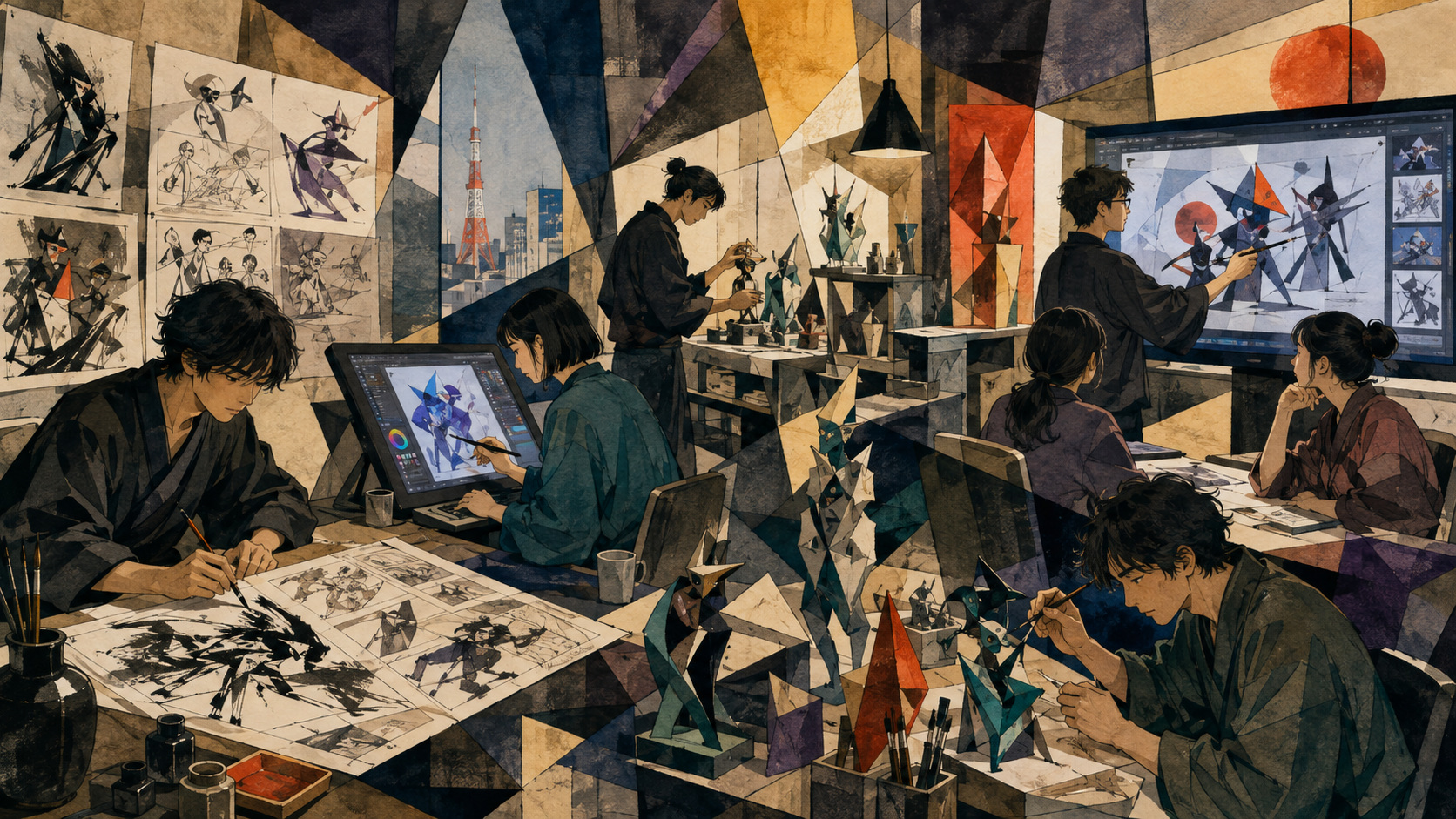
A character enters a room in Marunouchi. On a screen, it may have a silhouette, a voice and enough movement to suggest a life beyond the frame. On a slide beside it, the creator must make a second kind of world: audience, budget, release path, partners, revenue and rights. One world asks viewers to believe. The other asks a company, a bank or an investor to take risk.
This is the tension inside Tokyo’s “Modern Tokiwa-so” entrepreneur development program. Its name reaches back to a small wooden apartment where several young artists who would reshape postwar manga once lived near one another. Its methods belong to a different age: liquid-crystal drawing tablets, artificial intelligence, markerless motion capture, a recording booth, editing software, pitch decks and meetings with venture capital.
The first participants began in October 2025. Through March 2026, seven sessions addressed digital production—including AI and motion capture—and a common-theme assignment. From April through September, each participant was to develop a prototype based on original intellectual property, while building a plan for commercialization. Their September 9 presentation at Tokyo Innovation Base is the public hinge between those two tasks.
What will happen on September 9
The event is scheduled from 4:00 to 6:45 PM on the second-floor stage at Tokyo Innovation Base, 3-8-3 Marunouchi. Tokyo lists a capacity of about 100 and no admission charge; registration runs through 1:00 PM on September 8, subject to availability and changes. The program includes an address from the organizer, a keynote, the first cohort’s prototype presentations, an introduction to the second cohort and networking.
The keynote speaker, Salamander Pictures chief executive Daiki Sakurai, has worked on both sides of the creative-business divide. He began as a scriptwriter at Production I.G, moved into producing, joined Netflix’s anime creative team in 2017 and founded Salamander Pictures in 2023. His announced subject—becoming a creator who can work globally through both creative and business perspectives—is effectively the thesis of the day.
Tokyo’s official event notice does not publish the prototype titles or promise deals. Earlier metropolitan publicity profiled three members of the first cohort, illustrating its range rather than providing a complete presenter list. USAP described work spanning music, multilingual distribution, local-revitalization virtual characters and the metaverse. Animation designer Eisuke Ishizuka, a freelancer since age 17, said he had felt a shortage of the business knowledge needed to keep original animation reaching audiences. The visual storyteller Arumiran described building the “Princess’s Blue Anemone” world across illustration, manga and short video while valuing peer exchange and the lab.
The cohort was not recruited simply as an art class. Eligibility covered corporations within ten years of founding and sole proprietors conducting anime- or manga-related business in Tokyo, as well as people planning to establish a business in the capital. The call asked for creators pursuing original IP, digital methods, global reach and new business models. Tokyo is the host; ABC Animation operates the program office.
August–September 2025 · First-cohort recruitment and selection.
October 2025–March 2026 · Seven sessions on digital tools and a common-theme assignment.
March 2026 · Assignment presentation to invited industry participants.
April–September 2026 · Original-IP prototype production and commercialization planning.
September 9, 2026 · Public prototype presentation and networking in Marunouchi.
The sequence matters. A polished clip can prove taste and technique. It cannot by itself establish demand, settle ownership or show that a team can deliver a season. A pitch deck can impose discipline. It can also disguise unknowns with a confident arrow rising to the right. The event’s value will lie less in theatrical certainty than in whether creators can state what has been tested, what remains conjecture and what kind of partner they actually need.
Before Tokiwa-so became a myth
The original Tokiwa-so was built in 1952 in Shiinamachi, now part of Minami-Nagasaki in Toshima Ward. It was a two-story wooden apartment building, not a public accelerator. Osamu Tezuka lived there from 1953 to 1954. Hiroo Terada arrived in 1953; Fujiko F. Fujio and Fujiko Fujio A followed in 1954; Shinichi Suzuki, Naoya Moriyasu, Shotaro Ishinomori, Fujio Akatsuka, Hideko Mizuno and others lived there at different times. Not every important relationship overlapped for the same number of months, and not every artist associated with the place was a resident.
What later generations remember is proximity. Young artists compared pages, exchanged techniques, helped one another meet deadlines, argued about what manga could become and remained within reach of editors and publishers. They were drawing into a rapidly expanding postwar market for children’s magazines and books. The building mattered because an ecosystem had gathered around it.
That history is easily polished into a parable: place gifted young geniuses in cheap rooms, let friendship perform its magic, and culture will follow. The real lesson is less romantic. Affordable space reduced pressure. Editorial commissions provided cash and deadlines. Publishers connected work to mass distribution. Assistants and peers absorbed production shocks. A growing readership made experimentation economically imaginable. Creative community and commercial infrastructure were interdependent.
The hardship should not be reproduced. The original building aged, lacked modern comfort and was demolished in 1982. Toshima City’s reconstructed Tokiwaso Manga Museum opened in July 2020. The museum can preserve the narrow rooms and communal memory. A contemporary support program has to preserve something less visible: the ability to learn beside peers while improving one’s bargaining position.
| Question | Original Tokiwa-so | Modern Tokiwa-so |
|---|---|---|
| Place | A privately run wooden apartment built in 1952. | A Tokyo-supported program using Atelier Lab at the Tokyo Contents Incubation Center. |
| Medium | Paper, ink, pen, print magazines and books. | Manga and anime using digital drawing, 2D/3D tools, motion capture, sound and editing. |
| Learning | Informal exchange, mutual help, editors and hard deadlines. | Structured workshops, dedicated support, peer contact, business planning and pitches. |
| Gatekeepers | Principally magazine and book publishers. | Publishers, studios, platforms, brands, investors, financial institutions and audiences. |
| Economic question | Can the artist secure assignments or serialization and keep producing? | Can the creator govern an original rights portfolio, finance production and reach markets? |
| Shared principle | Talent develops through repeated work, candid feedback, professional connections and time that is not consumed by survival. | |
The most important resident for correcting the popular silhouette of Tokiwa-so may be Hideko Mizuno. Manga history is often recited as a procession of men even though women were central to the development of modern girls’ manga and to the building’s story. A modern program should widen access, not simply cast new people into an old heroic script.
“IP” is a bundle of decisions
In startup language, “IP” can sound like a glowing object: invent a memorable character, own it, extend it across formats, and revenue will follow. In law and business, the object is a bundle. There may be copyrights in drawings, scripts, music, animation, software and recordings; moral rights belonging to human authors; performer and voice permissions; trademarks for names and symbols; contracts with collaborators; and licenses divided by territory, language, medium and duration.
Under Japanese law, copyright generally arises automatically when a protectable work is created; ordinary protection does not depend on registration. Economic rights can be assigned or licensed. Authors’ moral rights cannot be transferred. Those propositions are only the beginning. A two-person project can become difficult if one person designed the character, another wrote the world, a third composed the theme and nobody agreed in writing who may authorize a game, translation or merchandise.
Ownership is not the same as operational freedom. A creator may “own the IP” yet lack a usable voice contract, a chain of title for commissioned art, clearance for stock assets or the right to show a prototype to investors under their terms. Conversely, a broad transfer may produce immediate cash while surrendering future control. No universal answer fits every property. The business skill is knowing which rights are being exchanged, for what consideration, for how long, where and with what approval, audit, reversion and sequel provisions.
| Layer | What must be clear | Why a partner will care |
|---|---|---|
| Authorship | Who created each script, image, design, track, performance and software element? | A broken chain of title can block distribution, finance or acquisition. |
| Ownership and licenses | Which rights were assigned; which were licensed; what territories, media, languages and terms apply? | A partner needs to know what can legally be exploited and whether exclusivity already exists. |
| Brand protection | Are names and logos available, and where might trademark protection be useful? | A title can collide with an existing mark even when the artwork is original. |
| Creative control | Who approves adaptations, casting, localization, merchandise and changes to the world? | Approval rights affect speed, quality, risk and the creator’s long-term voice. |
| Economics | Fees, royalties, recoupment, expenses, accounting, audit rights and revenue waterfall. | “A share of profit” means little until profit and deductions are defined. |
| Exit and continuity | What happens after cancellation, inactivity, bankruptcy, missed milestones or a partner’s withdrawal? | An unfinished or frozen property needs a path back to use. |
This is not a demand that every illustrator become an intellectual-property lawyer. It is a demand that a creative enterprise bring legal and production expertise into the room early enough that the work does not outrun its permissions.
A giant market and small negotiating tables
The commercial invitation is real. The Association of Japanese Animations estimated the broad anime market—the amount paid by users across domestic and overseas segments—at a record ¥3.8407 trillion in 2024, up 14.8 percent. The overseas portion was ¥2.1702 trillion, up 26 percent, and larger than the ¥1.6705 trillion domestic portion. The narrower revenue of commercial animation production companies was ¥466.2 billion. These are different measures, not directly interchangeable, but the gap helps explain why creators ask where value accumulates.
Japan’s government has set a goal of ¥20 trillion in overseas sales for Japanese-origin content by 2033. The target gives programs like Modern Tokiwa-so a national economic backdrop. Yet a larger export total does not automatically create durable small studios, clearer contracts or better-paid individual creators. Gross market demand can grow while production risk and bargaining weakness remain concentrated farther down the chain.
That tension became unusually concrete in 2025 and 2026. After studying anime production transactions, the Japan Fair Trade Commission reported that, when copyright held by a prime contractor was transferred, about 30 percent of surveyed prime production companies said they had often been able to negotiate the rights holder and transfer compensation; roughly 40 percent said they often could not negotiate or were not given a forum to do so. Testimony also revealed conflicting assumptions over whether the price for transferred copyright was genuinely included in a thin production fee.
On June 22, 2026, the commission and the Cabinet Office’s intellectual-property secretariat issued transaction guidelines for film and anime. They call for prompt written clarification of terms, forbid conduct that can amount to imposing markedly low consideration or uncompensated copyright transfers, and address cancellations, payment delays and unpaid extra work. The guidance specifically recognizes a production reality: schedules shift, many stakeholders request retakes, and freelancers have reported doing the equivalent of two episodes’ work while receiving one episode’s fee.
Entrepreneur training can help a creator understand a term sheet. It cannot by itself repair an industry’s unequal leverage. Nor should “become a founder” be offered as the answer to every worker who needs a fair commission. A sustainable creator economy needs capable companies and enforceable standards at the same time.
The production committee is neither villain nor rescue
Japanese anime has often been financed through production committees: several businesses—potentially a broadcaster, publisher, distributor, advertising company, music label, toy company or platform—share investment and coordinate the uses of a property. The system spreads the risk of an expensive, uncertain project and brings specialized distribution and merchandising capabilities together. It has enabled works that one company might not finance alone.
Its distribution of upside depends on participation and contract. A studio hired for a production fee is not in the same position as an investor holding exploitation rights. The 2025 Fair Trade Commission study found that copyright often ultimately sat with the investing committee, while production companies held divergent views on whether rights compensation was real, sufficient or negotiable. That does not make every committee arrangement abusive. It makes the terms decisive.
An original-IP creator approaching a committee or platform therefore faces a strategic choice, not a moral slogan. Retaining every right can preserve control but leave the project unfunded and undistributed. Selling too broadly can finance the first work while separating the creator from later success. Taking an equity stake may bring upside and also risk. A minimum guarantee may protect cash flow but be recoupable before royalties arrive. The right deal depends on budget, bargaining power, time, ambition and the creator’s willingness to run a company.
- Audience: Who has responded to the concept, through what evidence, and how expensive are they to reach?
- Format: Is the first viable product a manga chapter, short animation, vertical video, virtual performance, book, game concept or licensing kit?
- Rights: Which elements are controlled, which are commissioned, and what has been cleared?
- Production: Who performs each task, for how long, at what rate, with how many review cycles?
- Distribution: Why will a platform, publisher, broadcaster, event or retailer put the work in front of people?
- Revenue: What pays first—commission, presale, license, subscription, merchandise, sponsorship or equity—and when does cash arrive?
- Survival: What happens if the release is delayed, the partner withdraws or the first audience is smaller than forecast?
What a prototype can prove
Atelier Lab compresses several stages of production into one place. Its creators’ working lab provides high-performance computers and pen displays for illustration, manga, 2D/3D animation and video. Its markerless motion-capture system uses multiple cameras to capture movement and expression without a dedicated suit. Its sound stage supports voice, narration and basic effects, including simultaneous recording for as many as three people. Its editing room handles image finishing and color adjustment.
This is more than equipment access. A creator can test whether a drawn character survives motion, whether dialogue works when spoken, whether a visual language extends from a page to a short clip and whether a sound cue changes the tone. Work that once required bookings at several specialist facilities can be tested in a single environment. For a small operation, that lowers the cost of being wrong early.
But a prototype is a selective promise. Thirty polished seconds can be made by a tiny team through heroic effort; a weekly or seasonal series requires repeatable workflow, supervision, backups, quality control and cash. A five-page manga can establish voice; serialization tests stamina and schedule. A popular character post can establish attention; merchandise requires design files, samples, manufacturing, inventory or licensing, safety compliance, customer service and returns.
| The prototype shows | Evidence still needed | A useful next test |
|---|---|---|
| A memorable character | Whether a defined audience returns for the character, not merely a single image. | Release a short sequence and measure completion, follow-through and repeat engagement. |
| A compelling visual world | Whether it can be produced consistently within cost and schedule. | Build a second unit under an explicit time-and-labor budget. |
| A moving short | Whether the pipeline scales and every asset, voice and track is cleared. | Create a production bible, rights ledger and costed delivery plan. |
| Online attention | Whether followers become viewers, buyers, licensees or members. | Offer one clearly priced product or opt-in and measure conversion. |
| Partner interest | Whether interest becomes a paid, bounded commitment. | Define a pilot with milestones, budget, rights and an exit clause. |
The best prototype presentation will not pretend these columns are identical. It will turn their distance into a plan.
The creator-founder problem
Creative and managerial work draw on different forms of attention. The artist pursues surprise, ambiguity and coherence. The operator monitors cash, contracts, calendars, staffing and delivery. The salesperson repeats the explanation. The licensor protects consistency. The founder hires, decides and sometimes says no to a technically exciting opportunity because it would bankrupt the schedule.
Some people can move among these modes. Few should be expected to perform all of them indefinitely. Turning every creator into a solo chief executive risks converting the promise of independence into unpaid administration. A more sustainable interpretation of Modern Tokiwa-so is not “artists must become businesspeople.” It is “artists should understand enough business to choose partners, build complementary teams and avoid surrendering important decisions by accident.”
The old Tokiwa-so also depended on specialization outside its rooms. Editors supplied judgment, deadlines and access to printing and readers. Today’s equivalent may include a producer, rights manager, accountant, attorney, production manager, localization partner, audience strategist or experienced chief operating officer. The founder’s highest-value decision may be recognizing which of those roles the project needs first.
Venture capital is one possible source of money, not the definition of success. Equity investors generally seek growth and an eventual return that may not fit a creator who wants a small, profitable studio or a carefully paced body of work. Publishing advances, commissions, presales, grants, debt, brand partnerships, crowdfunding and licensing carry different costs and control. A credible program should teach the ability to decline unsuitable money as well as the ability to raise it.
AI enters the atelier
Artificial intelligence was explicitly included in the first cohort’s seven-session curriculum, and the lab describes AI-assisted functions in motion capture and drawing workflows. One profiled participant, USAP, said generative AI had helped awaken an interest in creating. The technology can reduce friction in ideation, translation, cleanup, previsualization, motion extraction and repetitive production tasks. For small teams, that can expand what is testable.
It also turns provenance into a business requirement. A distributor or investor may ask which model was used, whether confidential material was uploaded, what rights govern the inputs and output, whether a voice or likeness was authorized, and how much human creative contribution exists. Japan’s Agency for Cultural Affairs has emphasized that copyright analysis depends on facts: the creative contribution of a person cannot be inferred merely from the number of prompts or generated candidates, while human creative additions can themselves be protected. Its guidance is not a blanket clearance for any model, training source or output.
A young company needs an AI policy before a dispute forces one. It should record tools and versions, protect unreleased material, avoid imitating living artists as a substitute for consent, secure performer permissions, retain working files showing human decisions, and be prepared to replace an uncertain asset. “Made faster” is not an adequate answer if a commercial partner cannot confidently use the result.
Global is not a translation button
The overseas appetite for Japanese animation is evident in the market figures, and digital distribution allows a small creator to be seen without first obtaining a nationwide broadcast slot. Yet visibility is not the same as a market. Language is only one layer. Humor, platform norms, payment methods, ratings, music clearance, consumer law, merchandising partners, tax, publicity and community management vary by territory.
A global plan can begin smaller than “the whole world.” It might identify one language community, one festival, one platform format or one licensing category where the work has an advantage. It can test subtitling and dubbing separately. It can decide whether the creator will sell directly, appoint an agent, license territory by territory or grant a broader distributor mandate. It can budget for localization as creative production, not an afterthought.
The founder must also distinguish reach from resilience. Twenty-language distribution is a meaningful experiment, but an international audience dispersed across free platforms may generate less dependable cash than a modest domestic commission. Conversely, a licensing partner may deliver money and access while requiring long exclusivity. The business plan should state the trade, not hide it beneath the word “global.”
Money after demo day
Tokyo has acknowledged that a presentation cannot be the endpoint. On August 12 it announced ABC Animation as the partner for a new graduate-support arrangement running through March 31, 2027. The scheme calls for support equal to half of production expenses, capped at ¥5 million per recipient, along with an overseas program intended to develop sales channels and commercialization. Tokyo pays the partner according to activities and achievement of performance indicators.
That is potentially more consequential than applause in a pitch room. Prototype programs often create a valley immediately after demo day: attention rises, but the money, contracts and production capacity needed for the next proof are not yet in place. Cost-sharing can help cross it. An overseas program can convert a general ambition into scheduled meetings and market feedback.
The announcement, however, should be read precisely. It describes a support framework for program graduates; it does not say that every September presenter automatically receives the maximum, that Tokyo takes away all financing risk or that overseas deals are assured. Half of a bill still requires the other half. Reimbursement timing matters. So do eligible costs, milestones, ownership and the capacity to manage a funded production.
The public interest extends beyond producing exportable characters. A strong program should help build firms that pay collaborators on time, state terms before work begins, compensate revisions, keep usable records and survive a delayed release. A property that becomes famous while its production company remains fragile is not a complete policy success.
How to judge the experiment
The easiest metrics are event attendance, social impressions, prototypes completed and meetings held. They demonstrate activity. They do not show whether creators gained durable agency. Better evaluation must follow participants after the stage lights dim.
- Creator continuity: Are participants still producing original work one and two years later?
- Income quality: Did paid work, recurring revenue and cash runway improve—not only gross audience reach?
- Rights and leverage: Do creators understand and retain the rights important to their plans, or receive explicit compensation when transferring them?
- Fair production: Are collaborators contracted in writing, paid on time and compensated for additional work?
- Market evidence: Did prototypes lead to paid pilots, publication, licensing, distribution, investment or measurable audience conversion?
- Diversity and access: Can creators outside established networks, across gender, age, disability and economic background, participate and progress?
- Learning from failure: Can a creator stop an unviable format, reclaim assets and redirect the underlying world without being treated as a failed person?
Failure deserves particular care. Most original properties will not become large franchises. A healthy incubator does not erase that uncertainty. It makes experiments cheaper, evidence clearer and rights more portable so that an unsuccessful format does not destroy the creator’s career. The original Tokiwa-so is remembered for the residents who became giants; policy must also work for skilled participants who build modest studios, serve niche audiences or carry what they learned into other projects.
What should be rebuilt
On September 9, an audience may be tempted to look for the next famous character. That is natural and perhaps premature. The deeper object on display is a method: can a creator move between solitary imagination and collective production without losing the thread of either? Can Tokyo supply expensive tools and useful introductions while leaving enough room for strange work that does not resemble the last market success?
The old Tokiwa-so was not important because hardship makes art. It was important because a rare arrangement of affordable place, peers, editors, deadlines and a growing distribution system allowed skill to compound. Its most useful legacy is not the romance of a cold room or the mythology of inevitable genius. It is the recognition that culture emerges from conditions as well as individuals.
A modern reconstruction therefore should not be a museum with faster computers. It should be an institution where an illustrator can learn the cost of an animation pipeline, an animator can read a rights clause, a producer can respect the artist’s core, and all of them can find collaborators before a crisis. The room should make candor possible: this world is beautiful; this contract is too broad; this schedule is impossible; this audience has not yet been proven; this smaller version we can make.
If that happens, the program’s success will not be a single dazzling pitch. It will be a cohort leaving with fewer illusions and more possibility—original worlds whose makers know not only how to begin them, but how to protect, share, finance and continue them.
Reporting note and principal sources
Event details and program status were checked through August 13 at 9:52 AM JST. The September prototypes were not public at that time. Legal and business discussion is general reporting, not advice for a particular transaction.
- Tokyo Contents Incubation Center: September 9 first-cohort prototype presentation
- Tokyo Contents Incubation Center: 2025 kickoff and first-cohort program schedule
- Tokyo Metropolitan Government: first-cohort recruitment, eligibility and goals
- Tokyo Metropolitan Government: first-cohort profiles of USAP, Eisuke Ishizuka and Arumiran
- Tokyo Contents Incubation Center: Atelier Lab facilities
- Tokyo Contents Incubation Center: incubation, office and management support
- Tokyo Contents Incubation Center: August 12 graduate-support partner and terms
- Toshima City: official Tokiwa-so manga map, residents and museum history
- Toshima City: Tokiwa-so built in 1952, demolished in 1982 and museum plan
- Association of Japanese Animations: Anime Industry Report 2025 market figures
- Japan Fair Trade Commission and Cabinet Office: June 2026 film and anime transaction guidelines
- Japan Fair Trade Commission: anime production transaction findings, including copyright negotiation
- Agency for Cultural Affairs: AI and copyright materials
- Agency for Cultural Affairs: copyright contracts, transfers and moral rights
- Cabinet Office: 2024 overseas content sales and 2033 target