After a major earthquake, a toilet bowl may look unbroken and a tap may still release water. Neither proves that flushing is safe. An apartment pump may have lost power, a joint in the building’s drain stack may have shifted, or a buried sewer may have failed. Water released upstairs can then emerge through a lower-floor toilet or inside a wall. The fixture that looks normal can conceal one of the first urban health emergencies.
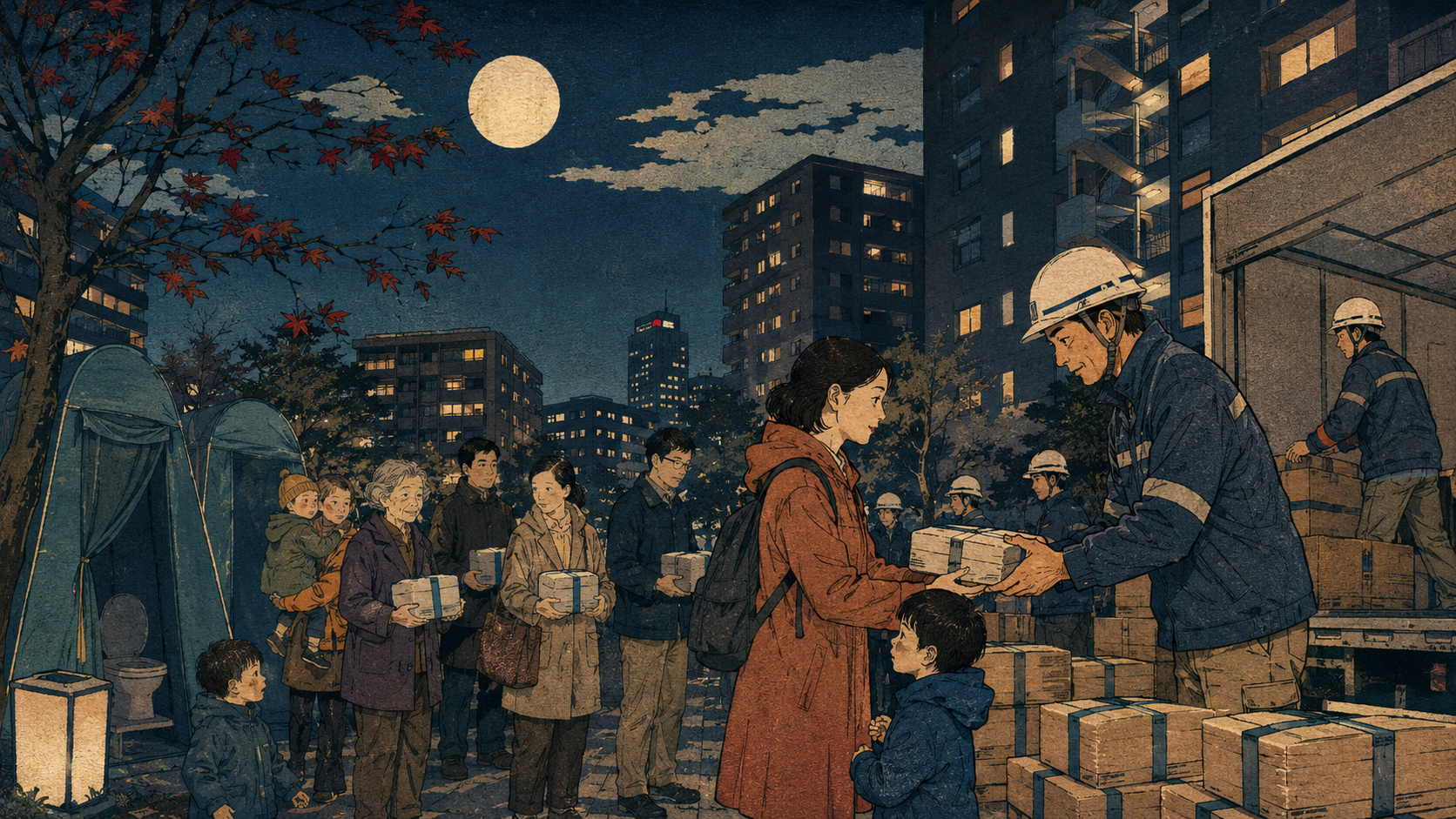
Koto Ward’s fiscal-2026 program is designed to place that “do not flush yet” decision inside roughly 543,000 people’s homes. The ward’s procurement specification covers every household on its resident register as of April 1. A package addressed to the head of household will contain 15 uses for each registered household member and one full-color, A5 guidebook of 20 to 30 pages.
These are not 15 identical devices. Each resident receives five uses of a solidifying-agent type, in which powder or a tablet turns liquid into gel; five uses of an absorbent-sheet type; and five uses of a type supplied with an odor-control bag. Koto wants people to try a unit before disaster strikes, compare the options, and then buy the system that works for their housing, storage, care needs and dexterity.
Exactly what will arrive—and who qualifies
| Program element | Koto’s published procurement terms |
|---|---|
| Eligibility | Every household registered in Koto Ward on April 1, 2026. Delivery uses the head of household’s name, postal code, address, household size and other necessary data. |
| Quantity | Fifteen uses per person: five solidifying-agent units, five absorbent-sheet units and five units supplied with odor-control bags. One guidebook per household. |
| Languages | Product instructions in Japanese, English, Chinese and Korean. English, Chinese and Korean guidebook PDFs are to be offered by QR code or a similar route. |
| Guide | Full-color A5, 20–30 pages, with distinct advice for detached homes and apartment buildings, plus use, hygiene and stockpiling information. |
| Support | A toll-free call center from distribution through the end of the contract, 9 a.m.–5 p.m. on weekdays, with multilingual support. |
| Selected bidder | Daimaru Matsuzakaya Department Stores was chosen as the contract candidate through a proposal competition involving five bidders. |
| Contract | Runs through March 31, 2027, including forwarding, redelivery, undelivered packages and inquiries. |
Multiplying Koto’s January 1 population of 543,193 by 15 gives 8,147,895 uses. That is a scale estimate, not the contracted quantity: eligibility is fixed by the April 1 resident register, after intervening moves, births and deaths. The ¥1,558,269,000 budget equals approximately US$9.59 million at this edition’s displayed rate of ¥162.43 per dollar. It is not a per-product price. It covers a program that also includes customized packing, the guide, delivery and redelivery, data handling, customer support and administration.
Mid-August or September? Two schedules, clearly separated
The latest report on Mayor Tomoka Okubo’s July 8 regular news conference says delivery is intended to begin in mid-August. At the conference, the mayor showed the kit and encouraged residents to use one in advance. The draft specification published for bidder selection set a different baseline: products and guidebooks by late August, household distribution from September through late February 2027.
The two dates need not represent an error. The public draft was a procurement baseline; the selected contractor may have enabled a revised sequence or an earlier first batch. At this report’s cutoff, Koto’s website did not publish a final neighborhood-by-neighborhood delivery calendar. This article therefore identifies mid-August as the newer rollout announcement reported from the mayoral briefing, and September–February as the original published procurement schedule. The ward’s final notice and the call center opening should control what residents expect.
Why 15? The gap between a three-day minimum and a seven-day target
Tokyo asks households to store portable or simplified toilets for at least three days and preferably one week. The planning assumption is five uses a day for each person. Koto’s 15 uses exactly match the minimum three-day buffer. They fall 20 short of the 35-use recommended weekly reserve.
That arithmetic reveals the program’s design. A package divided among three treatment methods is not simply a complete ration to hide in a closet. It is a sampler and a training device. Residents can discover whether a bag stays fixed under body weight, how long a treatment takes, whether an older adult can close it while wearing gloves, what a child finds frightening, how much odor remains and how much storage is necessary. The public provision becomes resilience only if that experience leads to a household-specific purchase and plan.
Tokyo’s March 2025 Toilet Disaster Prevention Master Plan estimates that a central Tokyo earthquake could produce a maximum shortage equivalent to about 57,000 toilets during the first week. Keeping people safely at home when their building is habitable reduces demand at crowded shelters. A household toilet reserve is therefore not only a personal convenience. It is part of a citywide capacity strategy that leaves limited shelter facilities to those who cannot remain at home.
An intact bowl can still be unsafe: the apartment connection
Every apartment toilet is connected to neighboring homes through branch pipes, a vertical stack and the public sewer. A power failure can stop booster pumps and remove water from upper floors. A displaced drain joint can leak inside a shaft even when the municipal main remains sound. Conversely, the building can be intact while the street sewer is damaged. Pouring stored bathwater into a bowl does not solve the problem; it can force sewage into somebody else’s unit.
The safe early rule is to suspend flushing until the building manager, management association or authorities have confirmed the drainage route. A portable-toilet bag can then be fitted to an undamaged bowl. If the fixture is cracked, sewage is backing up or aftershocks make the room unsafe, residents should not approach it.
Storage and collection of used bags must follow the product instructions and the emergency directions issued by Koto and the building. Disposal rules vary by municipality, collection capacity and the type of disaster. Treating every used bag as ordinary burnable garbage before an official collection plan is announced could create leakage, worker exposure and overloaded waste points.
Koto contains extensive areas at or below sea level. Its flood planning says a river overflow or levee failure could produce inundation of up to about 10 meters in some locations. Earthquakes are not the only scenario. Flooding, storm surge and prolonged power loss can constrain pumps, wastewater treatment, elevators and garbage collection at the same time. Vertical evacuation may save a resident from water while leaving water supply and used sanitation waste to be carried by stairs.
Why avoiding a toilet can become fatal
Japan’s Cabinet Office toilet guideline describes a predictable chain. A facility that is dirty, dark, distant, unstable or unsafe makes people reduce food and drink so they will not need to use it. Dehydration, constipation and urinary problems follow. Combined with immobility, dehydration raises the danger of deep-vein thrombosis, widely described in Japanese disaster policy as economy-class syndrome. Reduced eating worsens nutrition; chronic illnesses become harder to manage. These factors can contribute to disaster-related death long after the initial shaking.
If waste is not isolated, bacteria, insects and odor enter the sleeping and eating area. Infection control becomes harder when handwashing water, soap and cleaning materials are scarce. Yet sanitation is more than disease control. Lighting, locks, separation and choice, protection from assault, handrails, wheelchair space, ostomy needs, room for a caregiver, menstrual-waste disposal and a safe place to change diapers are conditions of dignity.
A household bag cannot satisfy every need. Portable toilets must sit within a layered system of shelter toilets, manhole-connected units, toilet trailers, accessible facilities, cleaning teams, handwashing, lighting, sewage inspection, collection and final treatment. Koto’s distribution is an initial layer while networked infrastructure is unavailable—not a replacement for that infrastructure.
Edo did not flush waste away—it sold it as fertilizer
Tokyo’s sanitation history was not a straight march toward the sewer. Human waste from Edo’s row houses and samurai estates was collected and sold to farmers as fertilizer. Nutrients left the city, grew vegetables in surrounding villages and returned as food. The system had odor and health limitations, but it treated waste as a commodity in a circular economy rather than diluting it in water.
Epidemics accelerated modern sanitation. Cholera outbreaks, including the 1877 crisis, strengthened the case for urban drainage. Work on the Kanda Sewer, one of Tokyo’s earliest modern sewer systems, began in 1884; sections remain in use. In 1922, the Mikawashima Sewage Treatment Plant began operating as Japan’s first modern treatment works. The Great Kanto Earthquake struck the following year, making reconstruction and public health inseparable.
War interrupted expansion. In fiscal 1961, sewer coverage in the 23 wards stood at only 22 percent. Water pollution became severe enough that the Sumida River fireworks were suspended. Coverage reached 70 percent in fiscal 1978 and the fireworks returned. In March 1995, the wards achieved near-complete coverage. The present system includes about 16,221 kilometers of sewers and 13 water reclamation centers serving about 9.49 million people.
Success made the flush feel automatic. But about 80 percent of the 23-ward system uses combined sewers carrying stormwater and wastewater together, and the urban chain remains exposed to aging pipes, extreme rain, power failure, building damage and ground movement. A portable toilet is not a rejection of modern sewers. It is a small, distributed redundancy that temporarily turns each household into a waste-isolation point when a vast integrated network cannot safely accept another flush.
1995, Kobe: the blind spot of a highly connected city
At the time of the Great Hanshin-Awaji Earthquake, roughly 97 percent of Kobe was connected to sewers. Normal sanitation was advanced, but vacuum trucks for night soil had declined to about 20, according to the Cabinet Office’s historical summary. Food, water, blankets and medicine took priority. Toilet response lagged. Temporary units arrived on day three at the earliest locations and day 11 at some others.
High connection had thinned the fallback system. Non-flushable bowls multiplied, waste accumulated at shelters, and older residents struggled with Japanese-style squat units or steps. Kobe taught two durable lessons: toilets cannot remain an item ordered only after food and water, and the first days must be bridged by supplies already in the affected place.
Chuetsu, Tohoku and Noto: the lesson returns in new forms
| Disaster | Sanitation lesson |
|---|---|
| 2004 Niigata Chuetsu Earthquake | Evacuees complained that one toilet per 100 people was insufficient. Surveys found 33.3 percent of respondents in Ojiya and 13.8 percent in Kawaguchi reduced drinking because of toilet anxiety, making the health chain measurable. |
| 2007 Niigata Chuetsu-oki Earthquake | An early ban on flushing after water loss, combined with stocked portable or simplified toilets, disinfectant and wet wipes, produced a more effective initial response. |
| 2011 Great East Japan Earthquake | Only 34 percent of responding municipalities said temporary toilets reached them within three days; one case took 65 days. Cold, wind, outdoor access and vacuum-truck shortages compounded the problem. |
| 2024 Noto Peninsula Earthquake | Wide road, water and sewer damage delayed conventional deliveries. Toilet vehicles and multiple formats proved valuable, while government discovered that it lacked a ready inventory of available response vehicles. A national vehicle registry followed in 2025. |
The Cabinet Office issued its first comprehensive shelter-toilet guideline in 2016 and revised it in 2022 and December 2024. The framework moved beyond counting fixtures. It now plans different technologies for immediate, emergency and recovery phases and incorporates cleaning, hygiene, lighting, security, accessibility and final waste treatment.
Tokyo followed with its 2025 master plan. Its initial capacity objective is one toilet for every 50 evacuees, together with the elimination of “toilet blank areas.” The city also stresses people sheltering at home and outside formal shelters. Koto’s household distribution is one ward-level implementation of a national shift from waiting for temporary toilets to pre-positioning multiple forms.
Delivering eight million uses—and handling the waste later
Changing package quantity for each household and reaching nearly 300,000 addresses is not an ordinary mass mailing. Koto’s draft says the ward will give the contractor the head of household’s name, postal code, address, household size and other necessary information. The contractor must manage the data, print labels, pack, forward, redeliver, handle failures and record inquiries.
The result must also work for older people, foreign-language readers, residents with disabilities and households whose members are not home during business hours. Four-language product instructions and translated guide PDFs are important. They do not reach someone who cannot scan a QR code or connect after a disaster. Clear paper diagrams, legible type, neighborhood drills and demonstrations by apartment associations are necessary complements.
At full use, the distributed stock could generate millions of sealed waste bags over a short period. Homes need protected temporary storage. Collection points need space. Trucks need fuel and passable roads. Incinerators need capacity. Without a plan for double containment, pickup, worker safety and final treatment, a successful distribution can become a second sanitation problem. Koto’s finished guide and emergency communications will need to state collection rules that fit the actual disaster and operating waste system.
What to do on delivery day: turn a box into a reserve
| Action | Purpose |
|---|---|
| 1. Check people and contents | Confirm 15 uses per resident, five of each method. Report shortage or damage through the official channel. |
| 2. Test one | Learn how the bag fits, how treatment works, how to seal it, what odor remains and whether every family member can manage. |
| 3. Build to one week | At five uses a day, the target is 35 per person. Koto’s starter leaves 20 to add. |
| 4. Store accessories together | Toilet paper, gloves, hand hygiene, wet wipes, a light, opaque outer bags and cleaning supplies. |
| 5. Set the communication route | Know who checks drainage safety and gives the stop-flush or restart instruction: building association, manager, neighborhood or ward. |
| 6. Separate clean and dirty zones | Keep unused materials, the use area and sealed temporary waste apart and protected from children and pets. |
| 7. Add personal needs | Care supplies, ostomy materials, diapers, menstrual products, medication, deodorization and an aid for stable seating. |
| 8. Review shelf life | Follow storage conditions and expiration guidance and update the quantity after a move, birth or household change. |
The selected product instructions and Koto’s guide must govern actual use. Some systems recommend first isolating water already in the toilet bowl with a separate bag before fitting the waste bag, but designs vary. Never put a used bag down the toilet, and do not assume a treatment chemical can be poured directly into bowl water. A visible inspection of one apartment is not authorization to restart flushing through a shared stack.
Koto is part of a wider ward movement
Minato Ward distributed 20 uses per person to every household in fiscal 2023 and then established provision for births and new arrivals. Shinagawa Ward sent 20 uses to every resident beginning in October 2024 and developed a broader disaster-toilet plan in 2025. Koto’s 15-use quantity differs, but the program belongs to a broader shift among Tokyo wards: move the first sanitation capacity into homes before the disaster.
Universal distribution reaches households that do not know what to buy, cannot easily afford a large box or have never treated toilets as a preparedness item. Its limitations are equally real. It supplies people who already own enough, a standard package cannot meet every disability or care need, and a delivered box does not prove that anyone tested or supplemented it. Evaluation should therefore measure more than packages sent: use trials, household expansion to seven days, apartment stop-flush rules, drills, undelivered rates and safe collection planning.
Ten things to watch as the program rolls out
| Open item | Why it matters |
|---|---|
| Final delivery start and sequence | Reconciles the reported mid-August launch with the draft’s September start. |
| April 1 eligible population and households | Establishes contracted quantity, delivery rate and the difference from estimates. |
| Final products and performance | Tests shelf life, bag strength, odor control, absorption and compliance with the referenced standard. |
| Finished guidebook | Allows review of stop-flush, apartment, hygiene, waste and accessibility guidance. |
| Undelivered items and new residents | Clarifies treatment of address failure, prolonged absence and arrivals after April 1. |
| Personal-data controls | Tests transfer, storage, subcontracting and deletion of household-register data. |
| Resident trial rate | Shows whether the sampler produces knowledge and additional private stock. |
| Apartment coordination | Confirms building-level rules for drainage checks, flushing, temporary storage and collection. |
| Collection and treatment | Explains how millions of used bags move when roads, fuel and waste facilities are constrained. |
| Continuity | Determines whether births, moves, expired stock and household changes receive ongoing provision. |
Conclusion: a city is tested when it cannot flush
Tokyo moved from Edo’s nutrient cycle through cholera control, the Kanda Sewer, Mikawashima treatment and postwar construction to a city where almost every household can flush without thinking. That achievement transformed public health. It also created a sophisticated dependency: electricity, water, building pipes, public sewer, collection and treatment must all remain connected.
Koto’s delivery creates one bypass at every home. ¥1.558 billion and roughly 8.15 million uses are large numbers. Yet 15 uses are only three days at the planning rate. The aim cannot be to tell residents that government has completed their preparation. It is to make them try three methods, add 20 more uses, establish an apartment rule and prepare to store and surrender used waste safely.
Emergency toilets are unglamorous and, ideally, never used in disaster. But like food and water, they make it possible to drink, eat, sleep and continue taking medicine. Urban resilience begins not only in tall flood walls or deep sewer mains, but in the moment every household knows when not to flush—and has one small bag that preserves health and dignity.
Sources and further reading
- Koto Ward: Emergency portable-toilet distribution and stockpiling proposal — Purpose, contract period, five-bidder evaluation and selection of Daimaru Matsuzakaya.
- Koto Ward: Draft contract specification — Fifteen uses, three formats, April 1 eligibility, guide, four languages, delivery, call center and original schedule.
- Koto Ward: Fiscal 2026 initial budget overview — ¥1,558,269,000 program, 543,193 population and disaster-prevention-fund support.
- Koto Ward: Enacted fiscal 2026 budget — March 27, 2026 passage and the general-account total.
- News On Japan/Tokyo MX: Koto Ward to distribute emergency toilet kits — Mayor’s July 8 presentation, 15 uses in three varieties and reported mid-August delivery start.
- Tokyo Metropolitan Government: Tokyo Toilet Disaster Prevention Master Plan — March 2025 plan, quantity, quality and elimination of toilet blank areas.
- Tokyo Metropolitan Government: Thinking about disaster toilets — Maximum shortage of about 57,000, home reserves and at-home evacuation.
- Tokyo Metropolitan Government: Disaster-toilet stockpiling campaign — Three-day minimum, one-week recommendation and health consequences of toilet avoidance.
- Cabinet Office: Guidelines for securing and managing shelter toilets, December 2024 revision — Kobe, Chuetsu and Tohoku evidence; health, hygiene, safety and operation.
- Cabinet Office: Disaster-response vehicle registry — Toilet-vehicle use in Noto and the national registry begun in June 2025.
- Tokyo Bureau of Sewerage: History of Tokyo’s sewer system — Edo fertilizer use, cholera, Kanda, Mikawashima and coverage milestones.
- Tokyo Bureau of Sewerage: Sewerage in the 23 wards — Pipe length, treatment facilities, served population and flow.
- Tokyo Bureau of Sewerage: Improving the combined system — About 80 percent combined sewer coverage and wet-weather measures.
- Shinagawa Ward: Free portable toilets for all residents — Distribution of 20 uses per resident in 2024.
- Minato Ward: Portable toilets for every household — Twenty uses per person and continuing support for births and new arrivals.
- Koto Ward: Flood-evacuation agreements with apartment buildings — Below-sea-level districts and possible inundation of about 10 meters.
Editor’s note: This report reflects Koto, Tokyo Metropolitan Government, Cabinet Office and sewer-bureau material, plus reporting available by 10:37 a.m. JST on July 17, 2026. Mid-August is the latest reported launch from the July mayoral presentation; September–February is the original timeline in the public draft specification. The 8.15-million-use figure is an estimate using Koto’s January 1 population, not the contract quantity determined by the April 1 register. The dollar conversion uses the edition rate of ¥162.43. Residents must follow the final product instructions and current ward and building-management directions for flushing, temporary storage and collection during an actual disaster.