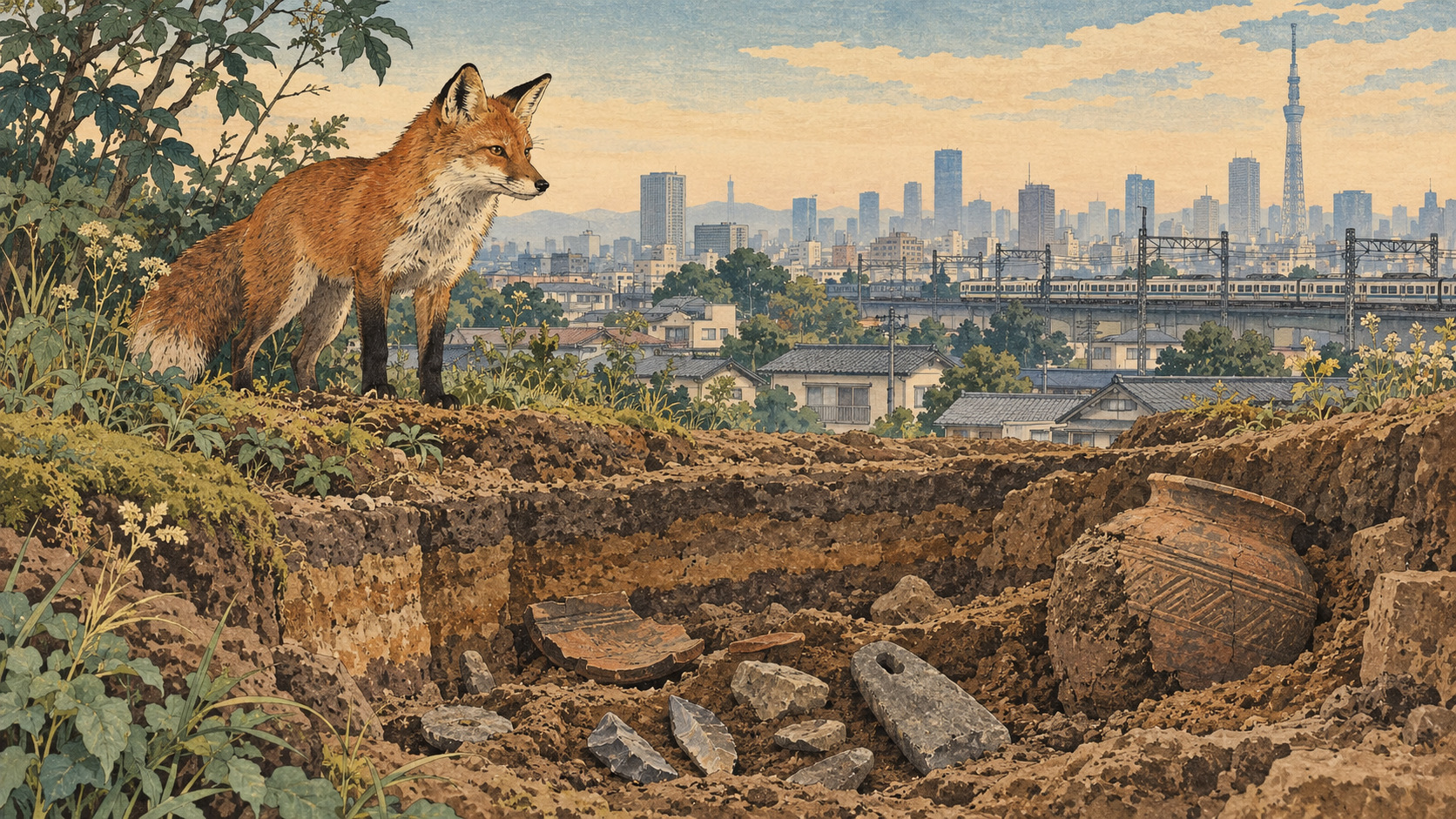
The extraordinary history is real. The story becomes stronger when we distinguish the places and dates.
The oldest story is not where the headline suggests
There is a powerful temptation to say that a Tokyo neighborhood has just revealed 30,000 years of continuous history. The evidence is more interesting—and more specific. The Itabashi Local History Museum documents stone tools from the Nishidai Gotōda site dating to approximately 32,000 years ago. The current heritage program, however, concentrates on Kami-Itabashi and a different prehistoric location, the Moro site. These are related pieces of a ward-wide archaeological record, not proof of continuous occupation at one address.
A schoolboy noticed something in the road
The Moro site's history has the makings of a detective story. In March 1951, a junior-high-school student named Takizawa, whose given name is written 浩 in the ward record, noticed obsidian implements and stones in an exposed road cutting in present-day Komone. According to the ward's historical account, researchers from Meiji University and the Musashino Folk Museum excavated the location that July. Their work helped establish evidence of human activity before the Jōmon period in southern Kantō. A young person's observation became a significant archaeological lead.
A distinctive blade and a larger argument
Moro is associated with the distinctive Moro-type knife-shaped stone tool. For archaeologists, such finds mean far more than the chance to display an ancient object. Their shape, technological features and geological context help researchers compare sites and reconstruct prehistoric toolmaking. Yet an excavated blade cannot identify its individual owner, tell us precisely how a village lived or show an unbroken lineage from Paleolithic people to today's residents. Archaeology proceeds by testing such boundaries.
The 2026 program takes history onto the streets
The 21st Itabashi Cultural Heritage Week runs from October 17 through November 28 under the Japanese theme “そう、層 これぞカミイタ~今に息づく時の重なりに触れる~,” an intentional play on the layers of time embedded in Kami-Itabashi. Its organizers emphasize the Shakujii River, the old Kawagoe road and the Tōjō railway as forces that shaped the area. Temples, shrines, performing traditions and traditional dyeing are included alongside archaeological places. It is a walking lesson in how different kinds of evidence occupy the same urban landscape.
An unusual chance to enter Moro
The Moro site is scheduled for special access on October 31 and November 1 and 3, from 10 a.m. to 3 p.m., at Komone 5-chōme 17. Visitors are instructed to enter from the Shakujii River side. The ward's ordinary walking guide notes that entry is generally restricted for tree protection. These open days are exceptional, and rainy conditions may cause changes. This is not a newly unearthed ruin or a permanent archaeological theme park: it is managed heritage, made temporarily accessible.
What a Buddhist temple adds to the story
Nearby Anyō-in offers another historical layer. Its special opening on the same dates includes the temple's kuri, or residential building, and named Buddhist sculptures. Ward records say the building was moved from the former principal residence of the Matsudaira family of Maebashi in 1929. The temple bell was designated an Important Art Object before it could be melted down during wartime metal requisitioning. A walk between the archaeology and the temple is also a journey through architectural reuse and twentieth-century preservation.
The stone guardians that look like wolves
At Sakuragawa Mitake Shrine, guardians are represented in wolf-like form rather than the more familiar lion-dog appearance. The ward associates them with older mountain worship; the precise founding year of the shrine is unknown. They will be included in the special opening on October 31 and November 1 and 3. No theory of uninterrupted prehistoric belief is needed to appreciate them. These are examples of different forms of religious life living side by side in an urban setting.
Culture that must be practiced to survive
The program also opens up less tangible forms of heritage. The Kanda-style Yayoi festival-music preservation group offers a public rehearsal on November 7, while Tokiwadai Tenso Shrine displays historical materials on November 7 and 8. A ward education publication traces the local transmission of festival music to artisans who learned it in Edo about 150 years ago. Such heritage depends not just on objects but on people who still know how to perform it.
An artisan's brush joins the historical record
At the shrine's Mori no Machiya venue, traditional hand-painted yūzen works will be exhibited on November 7–8, with small-group handkerchief-making sessions. The local government identifies Moriaki Terasawa as a registered bearer of the technique. The sessions are listed at ¥3,000, with six places per sitting. Traditional dyeing introduces a crucial counterpoint to ancient artifacts: expertise can be carried through movements of the hand as well as objects displayed behind glass.'
Rivers, roads and a railway
Today's Kami-Itabashi is an ordinary part of metropolitan Tokyo, intersected by transport lines and dense housing. It developed through the interaction of a river corridor, the Kawagoe road and, later, railway service. Its layered appearance should not be confused with a seamless history. Communities moved, beliefs changed and buildings were relocated. Understanding those breaks may be as important as understanding what survived.
Why the story matters beyond Itabashi
The program illustrates something larger than a seasonal heritage outing: significant history can exist beneath familiar streets without announcing itself. Moro reminds us that scientific discovery may begin with a student looking closely at an exposed surface. Today's access depends on curators, local preservation groups, temple custodians, artisans and volunteers. Visitors should check individual dates rather than assuming all sites are open throughout the six-week period. The past becomes public knowledge when people are allowed to encounter it carefully.
Plan your visit
The heritage program runs for several weeks, but individual sites open on specific dates only. Moro is scheduled for October 31 and November 1 and 3; access may be affected by rain. General site visits require no reservation, while the yūzen hands-on sessions are limited and ticketed. Check the ward’s official schedule before traveling.
Sources and reporting notes
Based on original Itabashi Ward, museum and education-board documents. No on-site reporting or original interview is claimed. The ward’s Paleolithic record and the Kami-Itabashi program are related but not identical locations.
- いたばし文化財ふれあいウィーク2026/Itabashi Cultural Heritage Week
- 時代を紡ぐ「茂呂遺跡発掘調査から60周年」/Moro excavation history
- 板橋区立郷土資料館:西台後藤田遺跡出土石器/Nishidai Gotōda stone tools
- 板橋区公式:常盤台散策コース/Tokiwadai heritage walk
- 板橋区教育広報:上板橋の文化財/Board of Education cultural heritage overview
- 板橋区立郷土資料館:再発見!いたばしの遺跡/Museum archaeology catalogue
- 広報いたばし 2026年10月10日号/Official October 10 bulletin
- 板橋区:2026年10月16日発表/Ward October 16 release