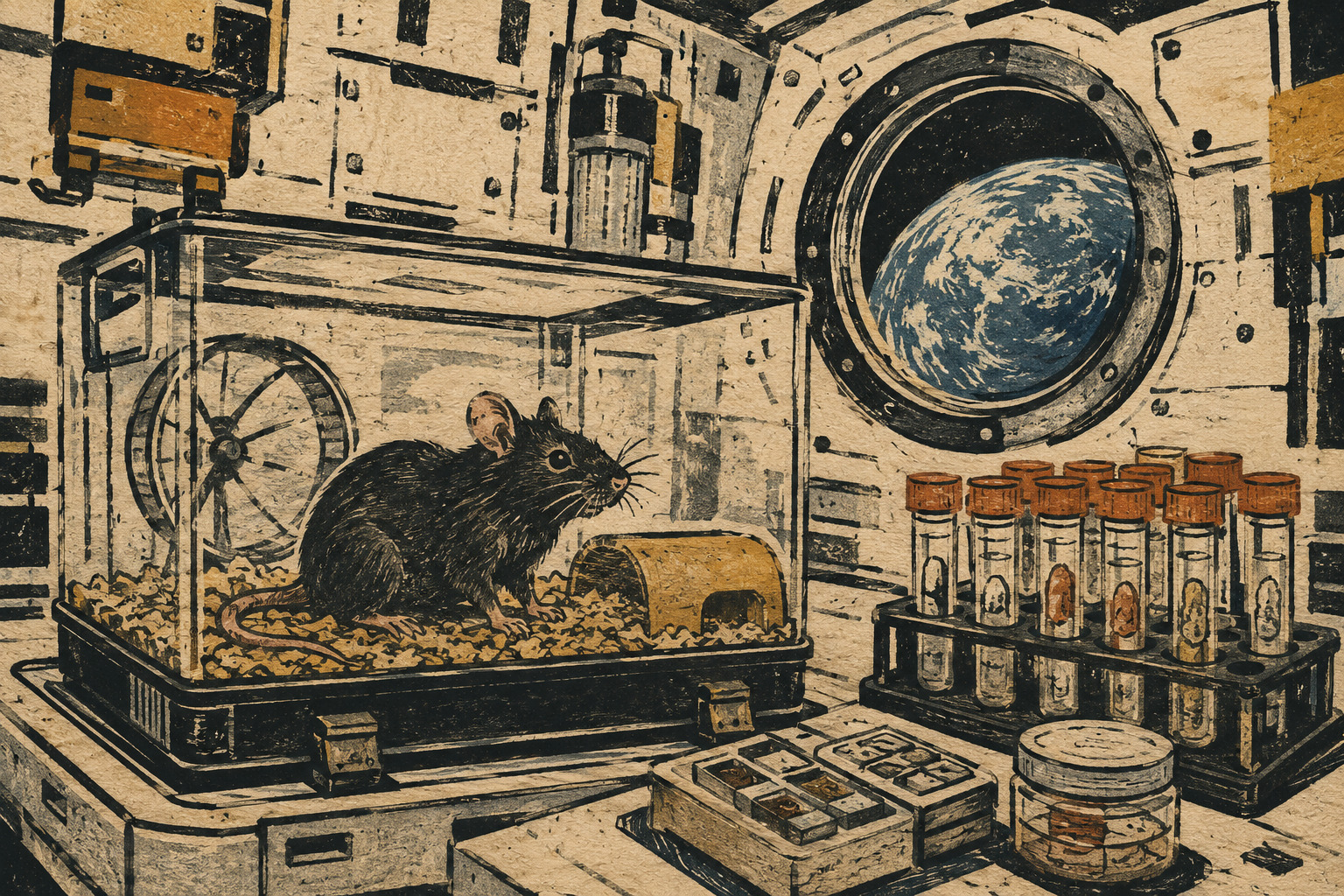
A fragment of tissue in a freezer can become a new space experiment without another rocket. One team may have examined muscle after the flight; years later, another can use a different technique on kidney, marrow, retina or salivary gland from the same mission. A researcher can inspect gene expression online, form a hypothesis, request an unprocessed tissue and test the idea at the molecular level. That is the purpose of the integrated Biobank for Space Life Science, or ibSLS.
On August 20, 2026, Nature Communications published the platform’s architecture, contents and research case. JAXA and Tohoku University announced full operations the next day. The current core covers JAXA Mouse Habitat Unit missions MHU-1 through MHU-5. Users can search genes and metabolites in a web browser, compare organs and experimental groups, look for signals repeated across flights, consult human reference resources and continue to the application process for physical specimens kept at Tsukuba Space Center.
Second and third discoveries from one launch
A mouse study on Earth can often be repeated with a different condition. In orbit, researchers must design flight hardware, pass vibration and safety tests, obtain scarce launch capacity, allocate astronaut time, manage food, water and waste in microgravity, and return the animals and samples without losing the experiment. The number of mice is small. So is every vial of blood and piece of tissue. A mission cannot simply be reflown whenever a new question appears.
That is why “leftover” is the wrong word for spaceflight tissue. A sample not analyzed with today’s method may yield different information to a more sensitive proteomic, spatial-transcriptomic or single-cell technique five years from now. Tissue disappears as it is cut, thawed and measured. Yet careful preservation, metadata and scientific prioritization can lengthen the useful life of the mission.
| ibSLS layer | What a researcher can do | Why it matters |
|---|---|---|
| Mission context | Review purpose, gravity, duration, collection time, controls and major papers | Preserves the experimental story behind every number |
| Transcriptome | Search a gene and inspect expression across tissues and groups | Shows which genes became more or less active |
| Metabolome | Compare plasma molecules by time, gravity, genotype and mission | Shows the biochemical state the animal actually entered |
| Cross-mission tools | Identify gene or metabolite changes shared by separate flights | Separates repeatable signals from mission-specific noise |
| Specimen sharing | Build a hypothesis from the data and apply for archived tissue | Moves digital exploration into a new physical measurement |
The scarcity of space experiments is a weakness. A biobank turns it into a strength by allowing many scientists to read one specimen with different questions.
Animals went first because nobody knew whether people could
The history of space biology combines scientific progress with animal loss. In 1947, the United States launched fruit flies on a V-2 rocket to study high-altitude radiation. Albert II, a rhesus monkey, reached space in 1949 but died on impact. In 1957, the Soviet dog Laika became the first animal to orbit Earth on a mission that offered no path home. Early programs placed animals at the front of the danger to learn whether acceleration, weightlessness, radiation and life-support systems could be survived by humans.
Once people could fly, the question changed from “Can life survive?” to “What happens when a body lives there for a long time?” Human astronauts can provide heart readings, blood and urine, but not simultaneous samples of brain, kidney, bone, skeletal muscle and immune organs. Mice offer controlled genetics, diet, age and exposure, then allow molecular profiling across tissues that cannot be obtained from a person.
Japan’s human-spaceflight research reached an early landmark with STS-47, known as Spacelab-J or Fuwatto ’92. The joint NASA–National Space Development Agency of Japan mission carried Mamoru Mohri and ran 24 materials-science and 20 life-science experiments. Subjects included crew members, Japanese koi, frogs and frog eggs, fruit flies, chicken embryos, cultured cells and seeds. When Kibo was assembled on the ISS in 2008 and 2009, Japan moved from placing short experiments aboard another nation’s spacecraft to operating a permanent orbital laboratory.
1947 — The United States launches fruit flies to investigate radiation at high altitude.
1950s — U.S. and Soviet flights use mice, dogs and primates to test survival before crewed flight.
1992 — Spacelab-J conducts 44 material and life-science experiments in a joint U.S.–Japan mission.
2009 — Kibo is completed as Japan’s first long-term human space facility.
2016 — MHU-1 houses twelve mice for 35 days and returns every one alive.
2019 — JAXA and Tohoku University sign a partnership centered on healthy longevity.
2020 — The first ibSLS release makes MHU-3 gene-expression data searchable.
2022–23 — Metabolomics, human references and broader mission comparisons are added.
August 2026 — ibSLS enters full operation, linking five MHU missions to specimen access.
Japan’s centrifuge separated “space” from “weightlessness”
One of the hardest problems in a space-mouse study is assigning cause. If a ground mouse and a flight mouse differ, the explanation might be microgravity—or radiation, launch and landing stress, confinement, noise, vibration, food, handling or timing.
JAXA’s Multiple Artificial-gravity Research System, MARS, addresses that problem directly. Mice live in individual cages, and a centrifuge can give some animals artificial gravity while others remain in microgravity inside the same Kibo laboratory. Both groups share launch, orbital radiation and the ISS environment, leaving gravity as a more clearly isolated difference. Individual housing and video tracking also allow the behavior, tissues and molecular profile of one mouse to remain linked.
MHU-1 launched twelve eight-week-old male mice in 2016. Six lived in microgravity and six under artificial 1 g for about 35 days. All came home alive, and the returned males later sired healthy offspring. Microgravity animals showed changes including bone loss, reduced muscle mass and altered muscle-fiber characteristics; several were suppressed by artificial 1 g. The finding moved the field beyond saying that “space weakens the body.” It offered a way to identify mechanisms that Earth gravity normally maintains.
MHU-4 in 2019 and MHU-5 in 2020 set the centrifuge to roughly one-sixth of Earth gravity—the lunar level. Lunar gravity prevented loss of mouse muscle mass but did not completely stop the shift in fiber type from slow toward fast. Gravity was no longer a yes-or-no variable. It became a dose: somewhere among Earth’s 1 g, the Moon’s one-sixth and Mars’s roughly three-eighths lie different thresholds for protecting bone, muscle and metabolism.
A biobank born after disaster reached into orbit
The other parent of ibSLS is not a space agency but a medical institution created during reconstruction. Tohoku University established the Tohoku Medical Megabank Organization, ToMMo, in 2012 after the Great East Japan Earthquake. Its goals included rebuilding regional medical capacity, following the health of affected communities and developing personalized prevention and medicine. Beginning in 2013, community and three-generation cohorts in Miyagi and Iwate accumulated blood, urine, health, lifestyle, genomic and other molecular information from approximately 150,000 participants.
JAXA can compare a small number of mice under unusually precise conditions. ToMMo can follow a large and varied human population over time. The first comes closer to controlled mechanism but cannot simply be transferred to people. The second captures real human variation but must disentangle diet, environment, disease history, genetics and age. Linking the two is an attempt to make their weaknesses complementary.
A scientist who finds a lipid metabolite rising in a space mouse can follow a link into ToMMo’s Japanese Multi-Omics Reference Panel, jMorp, and ask how that molecule changes with human age. A mouse gene can be mapped to its human counterpart and to tissue-expression or population data. This does not make mouse and human interchangeable. It gives an animal-derived hypothesis a first test against large human datasets.
A system built after the 2011 disaster to follow 150,000 people became a bridge carrying the biology of a few dozen space mice back into the study of human aging.
What the mice have already shown
MHU-3 focused on Nrf2, a transcription factor that coordinates the response to oxidative stress. Wild-type and Nrf2-knockout mice were compared in space and on the ground. The results implicated Nrf2 in lipid metabolism, immune regulation, bone metabolism and muscle remodeling. In knockout mice, spaceflight-related inflammation, immune suppression and microthrombotic changes were more severe. Nrf2 is not a “space gene”; it protects cells on Earth. Space stress made its ordinary importance unusually visible.
Kidney studies found altered expression of genes involved in blood pressure, bone mineralization and lipid metabolism. Researchers also observed higher circulating lipids and signs that the kidney responded through pathways for handling and excreting the excess. Shared specimens have supported questions involving the retina, sulfur metabolism, salivary glands, iron dynamics and spinal cord—subjects that the original principal investigators could not all pursue.
Cross-mission analysis adds another layer. In a demonstration using liver data from MHU-3 and MHU-2, ibSLS identified 78 genes that increased and 134 that decreased in both missions. Researchers then distinguished genes whose changes weakened under artificial 1 g from genes that changed even when gravity was restored. The first group becomes a candidate for gravity dependence. The second may reflect radiation, launch stress, confinement or another shared part of flight.
The value is not that a Venn diagram produces a final answer. Separate missions can help rank signals by reproducibility, reduce the influence of chance in small groups and identify which remaining specimen deserves a costly new assay.
A month in a mouse is not human aging
Bone loss, muscle atrophy, metabolic disruption and immune change can appear rapidly during spaceflight and resemble changes seen with age. The shorthand is that space “accelerates aging.” Resemblance, however, is not identity. One month of microgravity in a young mouse does not recreate decades of hormonal change, chronic disease, exercise, nutrition and social environment in an older person.
All mice represented in the current MHU-1 through MHU-5 datasets are young male C57BL/6J animals. There are no female mice in this release. Experimental groups often contain three or six animals. Collection time, hardware, gravity, processing and analytical platforms differ across missions. The 2026 paper explicitly warns that the web platform’s differential-expression model is simplified, using experimental group as the sole design factor, and does not model every dataset-specific source of variation.
| Tempting interpretation | Necessary scientific limit |
|---|---|
| Space reproduces aging | Some molecular and physiological changes overlap; it is not a model of aging as a whole. |
| Artificial gravity prevents space illness | It mitigated selected bone and muscle effects; organs, radiation and long-duration outcomes remain separate problems. |
| A mouse target becomes a human drug | Human relevance, toxicity, dose and clinical efficacy still require successive validation. |
| A repeated signal must be caused by gravity | Hardware and processing differ; artificial-gravity controls and new experiments are still needed. |
| An open interface makes interpretation automatic | The browser is an entry point; design, statistics, multiple testing and biological plausibility still matter. |
“Democratization” does not mean opening the freezer without rules
The Nature Communications paper describes ibSLS as democratizing access. The digital part means that a scientist need not lead a space mission to inspect processed data, make a graph, download a table or follow an accession to raw sequencing records. The processing and visualization code has been deposited on GitHub and Zenodo. The entrance is being widened from expert reconstruction of scattered raw files to hypothesis generation by researchers in aging, disease and drug discovery.
Physical specimens impose a different responsibility. They are finite, consumed by sectioning or assay and were obtained through animal lives. JAXA’s current guidance makes them available on request first to Japanese investigators and then to U.S. investigators through the Japan-U.S. Open Platform Partnership Program. The requester files a scientific plan and material transfer agreement; JAXA reviews the request; the principal investigator and an institutional official sign before shipment.
By June 2025, the sharing program had supplied 134 tissue types to 52 studies, resulting in seven peer-reviewed papers. The numbers show a working system, but also how long the path from allocation to published result can be. Not every request will produce a positive finding. Because the material is scarce, negative results, processed data and code should return to the common resource rather than disappear in a laboratory drawer.
Five tests for the next decade
- Coverage: whether MHU-6 onward, proteomics, epigenomics and behavior video enter the platform
- Diversity: whether future missions include females, different ages, strains and disease models
- Standardization: whether differences in collection, storage and measurement become easier to model
- International fit: whether identifiers and metadata interoperate with NASA GeneLab, SOMA and other repositories
- Return: whether recipients contribute papers, code, processed data and negative findings back to the shared system
As the ISS era moves toward its final years, human plans are extending to lunar orbit, the lunar surface and eventually Mars. Time away from Earth gravity will be measured in months and years. Can exercise alone preserve muscle and bone? Would short bouts of centrifugation be sufficient? What does lunar gravity protect, and what does it fail to protect? How do radiation and partial gravity interact in metabolism and immunity? Answers will come not only from the next mission, but from rereading old missions accurately.
The mission continues after the mouse returns
A rocket launch is the visible moment of space research. The scientific value is often decided by quiet work after landing: separating blood, preserving organs, protecting the identity of each animal, standardizing how gene activity is calculated and documenting conditions so that another scientist can understand them years later. Storage and annotation are less dramatic than flight, but they are instruments of reproducibility.
ibSLS is not news about sending new mice into orbit. It is news about making flights accumulated since 2016 readable by a scientist in 2026 and useful to lunar exploration and aging research in the 2030s. A mouse has a finite amount of tissue. Connecting experimental context, molecular profiles, analysis code and remaining specimens can make the number of questions from that tissue much larger.
The first animals went to space so humans could learn whether they might survive the trip. Today, mice that came home continue to ask how humans might live longer and remain healthier, in space and on Earth. What ibSLS has opened is not simply a freezer. It is the time between one past flight and many future experiments.
- JAXA and Tohoku University — ibSLS full-operations announcement (August 21, 2026)
- Nature Communications — ibSLS as a Biobank for Democratizing Access to Multi-Omics Data and Biospecimens from Spaceflight Research
- Tohoku Medical Megabank Organization — ibSLS database
- JAXA — Biorepository and MHU Biospecimen Sharing Program
- JAXA — MHU-1 comprehensive study of mouse responses to space
- Scientific Reports — Male mice housed on the ISS for 35 days and healthy offspring
- Communications Biology — Lunar gravity and mouse skeletal muscle
- JAXA — Addition of metabolomics and human-reference links to ibSLS (2022)
- JAXA — MHU-3 study of Nrf2 and space stress
- ToMMo — Mission and approximately 150,000-person cohort
- JAXA — Kibo structure and assembly in 2008–09
- NASA — STS-47 Spacelab-J
- NASA History — A Brief History of Animals in Space
Editor’s note: This article is based on JAXA, Tohoku University and NASA materials and peer-reviewed papers available through August 21, 2026. Japan.co.jp did not independently interview the research team. The totals of 291 and 228 are sample profiles reported for the current release as of 2025, not numbers of mice. The 134 tissue types, 52 studies and seven papers are sharing-program totals as of June 2025. Similarities between spaceflight changes and aging, and possible drug-discovery applications, are research hypotheses and prospects—not evidence of a treatment. The lead image is a concept illustration, not a photograph of an actual flight mouse, habitat or stored specimen.