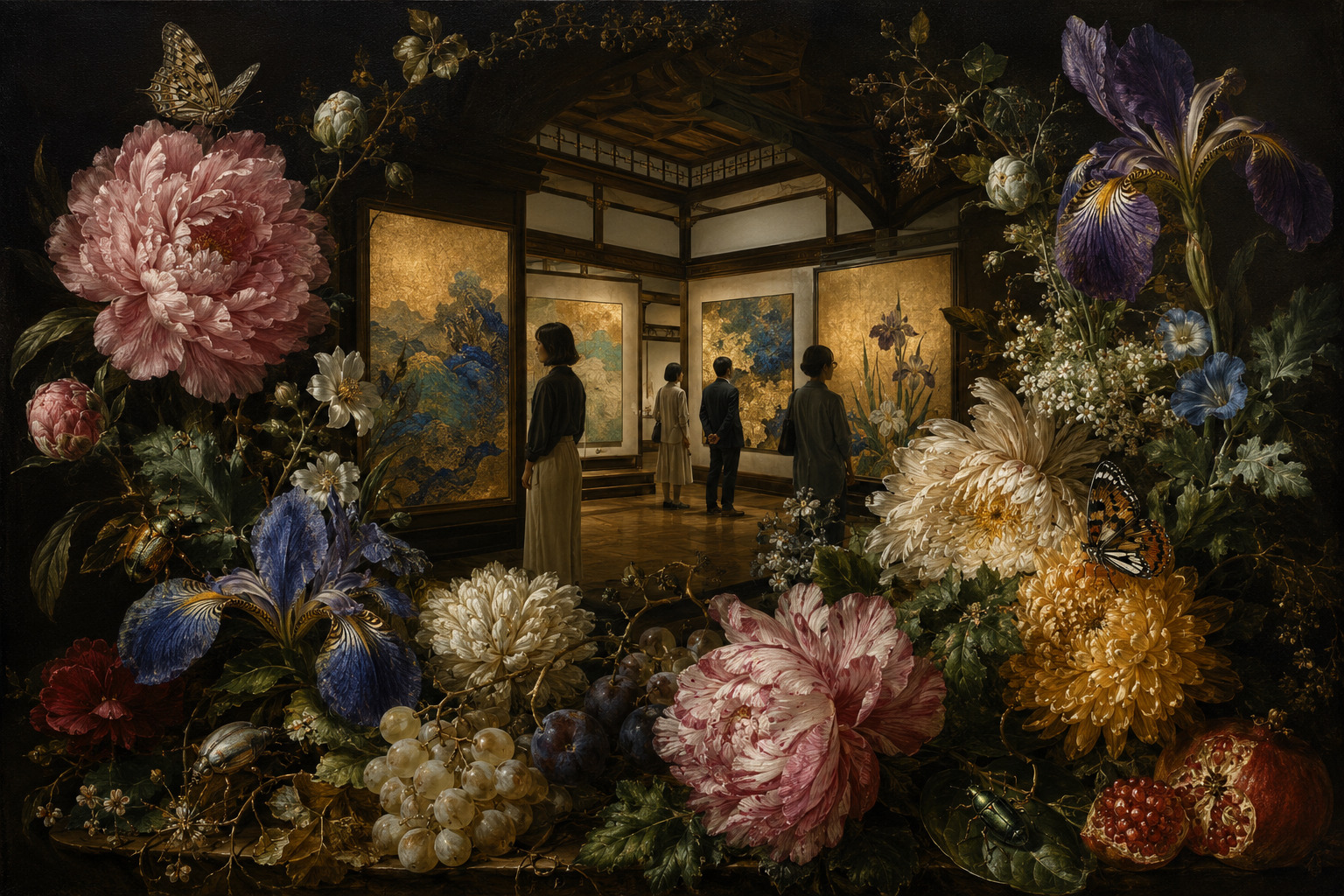
Two buildings on Tokyo University of the Arts’ Ueno campus give one annual exhibition two very different settings. Chinretsukan Gallery, completed in 1929, offers flexible rooms now used for degree shows and faculty and laboratory exhibitions. Masaki Memorial Gallery, completed in 1935, contains a second-floor shoin-style Japanese room made for displaying Nihonga.
Through September 6, those spaces host the Tokyo University of the Arts Japanese Painting, Lab 1 Exhibition, the official English name for the 2026 research presentation organized by the university’s Japanese Painting Lab 1. The Japanese title is 東京藝術大学日本画第一研究室研究発表展. It is commonly shortened to Ichiken-ten, or the Lab 1 Exhibition.
The university lists 20 participants: students, faculty members and invited artist Reiichi Tsuchiya. Admission is free. More important than the head count is the institutional purpose. This is not simply a group show held after the research has finished; planning and operating an exhibition are themselves part of the laboratory’s graduate training.
The Exhibition Is Part of the Curriculum
Tokyo Geidai says students in Lab 1 organize practical exhibitions while developing their own work. Its stated aim is to find new ways for tradition to take expressive form in the present, with instruction spanning classical expression, diversified contemporary practice and methods of display. The laboratory also describes this work as a foundation for artists with an international perspective.
That makes decisions about sequence, spacing and venue part of the educational result. A painting is never seen in isolation: its height, light, neighboring works and architectural setting condition the encounter. Moving between a flexible modern gallery and a room designed for Japanese painting gives students a concrete way to test how inherited forms operate in the present.
The university’s May 1, 2026 staff list names professors Kazuho Ueda and Yo Ebi in Japanese Painting Lab 1. The wider painting department describes its educational mission as pursuing creativity in contemporary painting while inheriting and developing traditional techniques and spirit. It summarizes the goal as the “creation of contemporary painting based on tradition.”
Materials Matter, but They Are Not the Definition
Nihonga is often introduced through materials and tools: paper or silk, mineral and other pigments, ink, animal glue and brushes. Tokyo Geidai’s curriculum does include classical copying, drawing, and the study of materials and technique. Yet its official account does not reduce the field to a checklist of substances.
Students are asked to understand how traditional materials and aesthetics emerged and then to investigate contemporary pictorial expression. In that framework, tradition is neither a museum label nor an answer to be repeated. It is a body of choices that can be examined, retained, recombined or placed in a different context.
What Lab 1’s Exhibition Training Includes
- Research grounded in each student’s regular studio practice
- Exhibitions planned and operated by students
- Classical expression alongside contemporary display forms
- Preparation for artistic work with an international outlook
The exhibition organizer says the annual presentation explores new expressions in Nihonga and invites viewers to consider the field through contemporary sensibilities. That is a documented institutional objective, not an independent critical verdict. The official announcement and flyer do not provide a complete checklist of titles, materials, dimensions, placements or artists’ statements, so this report does not characterize individual works that it cannot verify.
An Invited Artist Adds a Generational Reference Point
The invited artist, Reiichi Tsuchiya, is a member of the Japan Art Academy’s painting division for Nihonga. The academy records that he received its 2006 award, was appointed a member in December 2009 and received the Order of the Rising Sun, Gold Rays with Neck Ribbon in 2025.
His inclusion places an artist with a long institutional career beside a research community of students and faculty. It would be tempting to frame that arrangement as a contest between age and youth, but the published material does not describe Tsuchiya’s work or its position in relation to the others. The fact that can be established is more modest: the laboratory has deliberately brought an outside, senior practitioner into its annual research presentation.
Two Galleries, Two Histories
Chinretsukan was built in 1929 and now functions as an adaptable exhibition space. Masaki Memorial Gallery was completed in 1935 to honor Masaki Naohiko, the fifth president of the university’s predecessor, the Tokyo Fine Arts School. Its shoin-style room on the second floor was made for the display of Japanese painting, and the building is ordinarily closed outside exhibitions and other limited occasions.
That architectural pairing sharpens the show’s central question. New directions in Nihonga do not have to mean novelty detached from history. They can emerge from studying technique, testing presentation, working across generations and deciding anew how inherited visual language should occupy a contemporary room.
| Official English title | Tokyo University of the Arts Japanese Painting, Lab 1 Exhibition |
|---|---|
| Dates | Wednesday, August 26–Sunday, September 6, 2026 |
| Hours | 10:00 AM–5:00 PM; last admission at 4:30 PM |
| Closed | Monday |
| Venues | Chinretsukan Gallery, first and second floors; Masaki Memorial Gallery, second floor |
| Admission | Free |
The exhibition does not propose that Nihonga has reached a new final definition. Its educational structure makes the opposite case: a tradition remains active when artists learn its history closely enough to make consequential choices in the present.
- University Art Museum, Tokyo University of the Arts: official exhibition page (Japanese; dates, hours, venues, admission, organizer, 20 participants and stated purpose)
- University Art Museum: official English exhibition page (official English title and visitor information)
- Official exhibition flyer (participant names, dates and venues; not reproduced as the article image)
- Tokyo University of the Arts: Department of Painting (Japanese; Nihonga educational principles and Lab 1 exhibition training)
- Tokyo University of the Arts: staff list (Japanese; Kazuho Ueda and Yo Ebi as of May 1, 2026)
- Japan Art Academy: Reiichi Tsuchiya (Japanese; reading, division, academy award, appointment and decoration)
- Geidai Art Plaza: University Art Museum buildings (Japanese; history, architecture and present use of Chinretsukan and Masaki Memorial galleries)

This report is based primarily on Japanese-language material published by Tokyo University of the Arts, its University Art Museum and the Japan Art Academy and available by the morning of August 31, 2026 JST. It does not state unverified artwork titles, materials, dimensions, placements, artist quotations or attendance. “New expressions” is attributed to the organizing laboratory as its research aim, not asserted as an independent critical conclusion. The accompanying image is an editorial illustration, not documentary evidence of the artworks or installation.