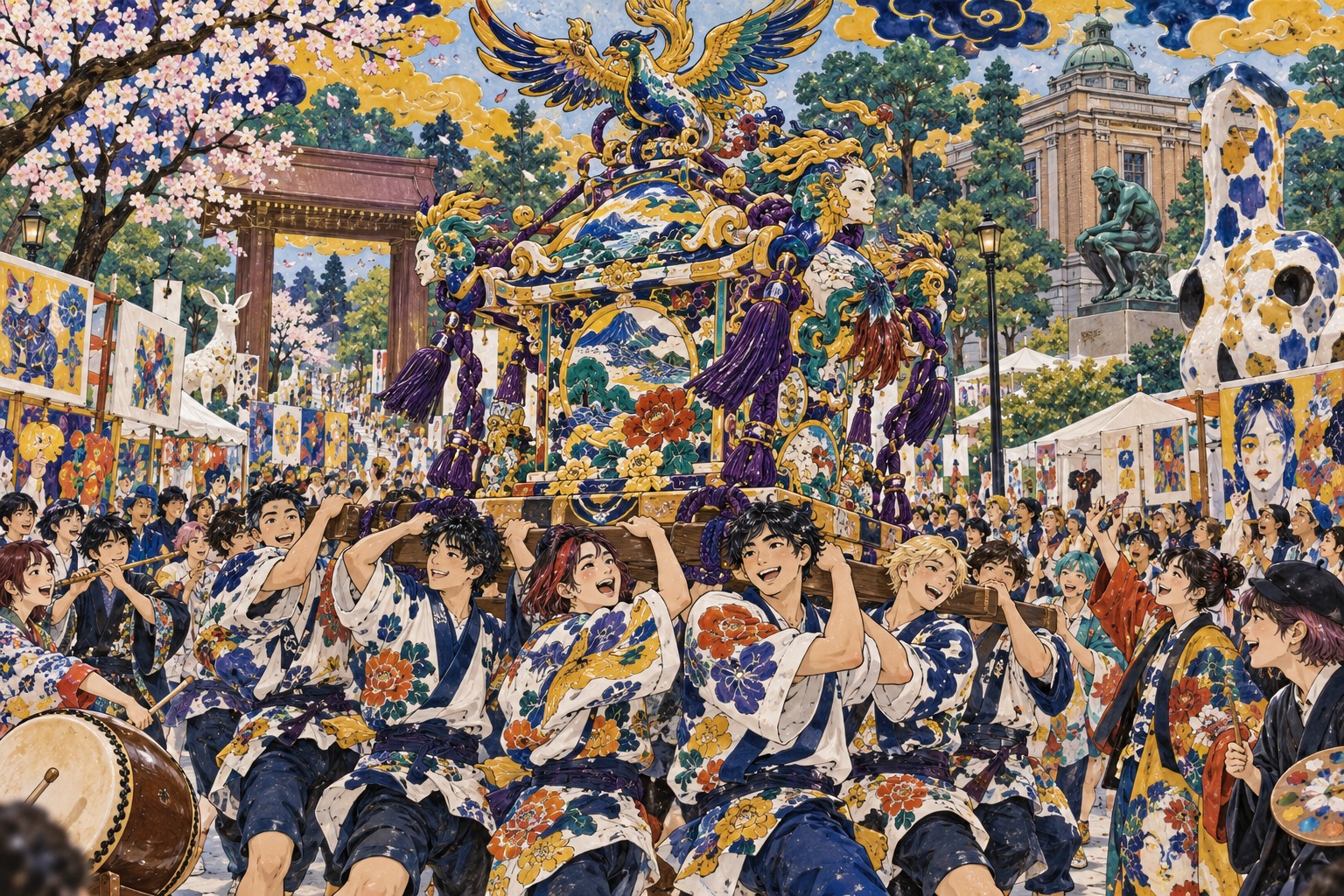
On the final afternoon of Geisai 2026, the official live page showed three things happening at once: a Tokyo Geidai wind orchestra performance in Sogakudo, a band on the outdoor stage and a mikoshi moving toward the main gate. A technical adjustment pushed one stage start from 3:00 to 3:20 p.m. That small operational notice captured the nature of the festival. This was not a sequence of polished objects waiting in silence. It was a public system of sound, movement, crowds, equipment and student decisions.
The 79th Geisai ran September 4–6 from 9 a.m. to 7 p.m. at Tokyo University of the Arts' Ueno campus and around Ueno Park. Its theme was “コイ、コガレ” (“Koi, Kogare,” retained in Japanese because the official material supplies no definitive English rendering). Exhibitions and performances shared the program with handmade mikoshi and happi coats, food stalls, stages and an art market. For three days, the campus became less a protected place of training than a porous civic venue.
A Festival Built From Simultaneity
Most cultural institutions regulate attention: one ticket, one gallery, one seat, one start time. Geisai disperses it. A visitor has to choose between a concert already beginning, an exhibition across the campus, a float approaching the gate and the possibility that an unplanned performance will become the day's defining encounter.
That impossibility of seeing everything is productive. Each visitor edits a different festival through walking, waiting and accident. Students encounter audiences who did not arrive for their discipline. Music becomes audible before it becomes visible; a large object becomes a procession; a market purchase changes a display into a possession. The festival is not merely the sum of its scheduled works. It is the choreography between them.
The Mikoshi Is Collaboration Under Load
Geisai's enormous handmade mikoshi and happi coats are its most recognizable forms. Recent official university records describe first-year undergraduates divided into four cross-department teams, bringing together students from the fine arts and music faculties. They build the floats and garments, then turn them into performance in Ueno Park.
The phrase “interdisciplinary collaboration” can sound painless in institutional language. A mikoshi makes the compromises physical. A sculptural idea must be light and strong enough to carry. Costume must allow movement. Sound must work outdoors. Performers, makers and organizers have to agree on timing and safety. The float succeeds only when another discipline can use what one discipline has made.
Exhibition and Performance Trade Audiences
Tokyo Geidai is organized around demanding specializations: painting, sculpture, crafts, design, architecture, composition, instrumental music, vocal music and many more. During Geisai, departmental and independent exhibitions sit within the same map as formal concerts, student bands and outdoor events. The institutional idea of a comprehensive arts university becomes a route a visitor can walk.
For students, that public exposure tests a competence not identical to artistic technique. Work must be lit, labeled, guarded, timed, amplified, explained and made accessible through a crowded environment. A conservatory audience and a family passing through Ueno Park do not bring the same expectations. Learning to meet both without flattening the work is part of becoming a public artist.
The Art Market Introduces Price and Consequence
At the art market, visitors can handle and buy work directly. That exchange forces questions a critique room can postpone: How much does the object cost? Can it be reproduced? Can it travel? Does the artist know how to describe it to someone outside the field? What changes when the work leaves campus and enters a stranger's home?
Sales do not determine artistic importance. Large installations, experimental performances and difficult works may resist ordinary commerce, while a portable object can be immediately legible. Still, direct exchange gives students information that applause cannot. A price, a conversation and the responsibility of delivery make “the public” specific.
| Festival space | Public relationship | Practical test |
|---|---|---|
| Exhibition | Viewer | Space, labels, circulation |
| Concert or stage | Listener | Timing, acoustics, production |
| Mikoshi and happi | Team and street | Collaboration, movement, durability |
| Art market | Buyer | Price, explanation, distribution |
| Food stall | Festival guest | Operations, safety, service |
Ueno Is a Participant, Not a Backdrop
The festival extends from the Ueno campus into Ueno Park and the university's relationship with neighboring streets and businesses. When floats move toward the gate, outdoor stages become audible beyond their immediate audience and visitors circulate between campus and park, the boundary of the school grows thin.
That matters in a district already dense with national museums, the Tokyo Metropolitan Art Museum, the National Museum of Nature and Science and other cultural institutions. Those institutions usually organize culture within buildings. Geisai links the spaces between them through temporary movement and student work. Yet no official post-event figures for 2026 attendance, participating shops or local economic effects were available by deadline. The civic value should not be converted into unsupported arithmetic.
A 79th Festival Inside an Institution Founded in 1949
Tokyo Geidai's roots reach deeper than the university itself. Tokyo Fine Arts School and Tokyo Music School were established in 1887; the former opened in 1889, while the latter developed as Japan's first national music school. The two were brought together under Tokyo University of the Arts in the 1949 postwar education reforms.
Geisai's 79th edition makes that union recur at student scale. The university can combine art and music administratively while daily training still separates disciplines into studios, workshops and rehearsal rooms. The festival forces them back into contact. Its most durable tradition is not one visual style but the annual reconstruction of a comprehensive arts university in public.
1887 — Tokyo Fine Arts School and Tokyo Music School established
1889 — Tokyo Fine Arts School opens
1949 — Tokyo University of the Arts established around the two schools
2026 — The 79th Geisai adopts the theme コイ、コガレ
The Pandemic Interrupted More Than a Schedule
The university archive records online videos and projects for the 2020 and 2021 editions, when the familiar gathering of floats, stalls and audiences could not operate normally. An official student essay remembers the rupture as a break in the transmission of experience: students had to ask what it meant to study art together when the physical “together” disappeared.
In-person Geisai returned in 2022 after a three-year interval. The succeeding festivals restored mikoshi, exhibitions, concerts and markets, but the digital layer did not vanish. The 2026 live page's status updates and quick schedule correction show online communication serving the physical event. Recovery was not a rewind to 2019; it was a rebuilt festival carrying methods learned during interruption.
The Most Important Results Arrive After Teardown
By the reporting deadline, the university had not published a consolidated 2026 attendance figure, mikoshi prizes, art-market vendor count or sales total. This article therefore reports verified dates, format and official live information, and uses documented recent university practice to explain the mikoshi tradition. It does not manufacture a numerical verdict on success.
The deeper outcome will be harder to count. It may appear when a first-year maker calls a musician met on the float team; when a buyer follows a student's later work; when a child who heard an outdoor ensemble returns for a concert; or when a neighborhood contact becomes a future collaborator. A festival can make a university visible for three days. Its educational value lies in the relationships that remain after the streets have been cleared.