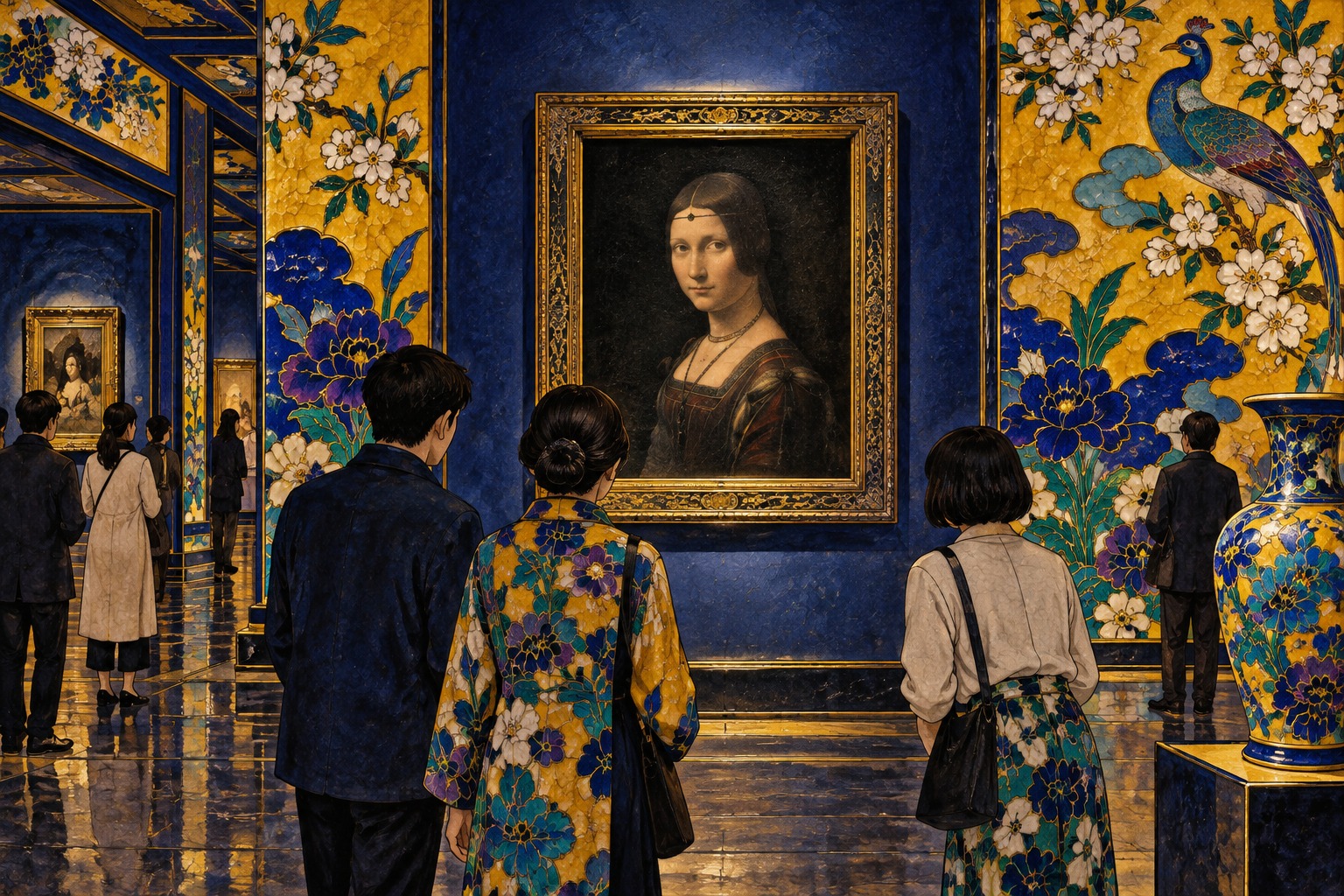
She does not quite return the viewer's gaze. Her body turns to one side, her face rotates toward us and her eyes slip just beyond the encounter. A stone parapet holds her inside the picture. A narrow band and jewel cross her forehead. Leonardo da Vinci painted this Portrait of a Woman in oil on walnut around 1490–1497, during the years in which portraiture was learning to make stillness feel like suspended action.
The work widely known as La Belle Ferronnière will be shown in Japan for the first time when Masterpieces of the Renaissance from the Musée du Louvre opens September 9 at the National Art Center, Tokyo. Running through December 13, the exhibition brings together more than 50 Louvre works across painting, sculpture, prints, drawings and decorative arts.
This report appears two days before opening. It examines the announced works, curatorial structure and documented history; it does not pretend to review a gallery installation not yet open to the public. Judgments about placement, lighting, condition and crowd flow must wait for direct observation.
The Louvre Calls the Famous Name a Mistake
The exhibition label is more revealing than a conventional masterpiece announcement. In Japanese it identifies the painting as Portrait of a Woman, followed by “the incorrectly given alternative title La Belle Ferronnière.” The Louvre's collection record is equally direct: Portrait de femme, dit à tort La Belle Ferronnière—a portrait of a woman wrongly called by that name.
“Ferronnière” became the name of the narrow forehead band and central jewel visible in the painting. But the portrait was entangled with another female likeness and with a legend concerning a mistress of King Francis I. The Louvre's correction matters because no evidence identifies Leonardo's sitter as that woman.
Scholars have proposed women connected to the Milanese court, but the identity remains unsettled. It is safer—and more interesting—to say what the evidence supports: the costume belongs to that courtly environment, while Leonardo constructed a presence that has survived the disappearance of the sitter's name.
A Gaze Made From Distance
The title mystery should not eclipse the painting's formal intelligence. Italian portraiture had often relied on profile views. The three-quarter pose, developed strongly in northern Europe and absorbed in Italy, reveals both sides of a face while allowing shoulders, head and eyes to follow different vectors.
Leonardo uses that possibility with restraint. The parapet brings the woman close and then bars access. Her face establishes contact, but her pupils refuse complete reciprocity. Precise descriptions of skin, red fabric, the rear cap known as a scuffia and the jeweled forehead band establish social specificity. The body's torque creates time: she seems to have just turned, or to be about to turn away.
The National Art Center describes Leonardo's effort to capture not only appearance but complex inner emotion. That is a curatorial interpretation, not a license to diagnose the sitter. The achievement may lie precisely in preventing one emotion from becoming final. Psychological presence is produced as an unanswered question.
Portraiture Was Politics in Milan
After training in Florence, Leonardo moved to Milan in the early 1480s and worked within the court of Ludovico Sforza. The portrait belongs to that first Milanese period. In a court where engineering, ceremony, theater and art served political display, portraiture could preserve a likeness while advertising dynasty, marriage, rank and cultural refinement.
Yet Leonardo's woman is not exhausted by her status signs. Clothing and jewelry place her socially; the slight misalignment of body, face and eyes keeps something unpossessed. That tension belongs to a broader Renaissance expansion of portraiture, as interest in the individual grew and commissions spread beyond rulers and senior clergy toward intellectuals and wealthy urban patrons.
Leonardo's originality should not be made solitary. Oil technique, three-quarter portrait formats, prints, casting knowledge and classical models moved between regions. Artists crossed the Alps; images crossed Europe faster than their makers. The Tokyo exhibition's mixed media and geographic range restore that network around the famous name.
Four Themes, More Than 50 Works
The exhibition organizes the 15th- and 16th-century Renaissance through four themes derived from Leonardo: travel; technical innovation and refinement; a new gaze toward antiquity; and the rise of portraiture. This is not a chronological parade of great men. It treats movement, making, recovery and individual representation as forces that changed art.
| Theme | Historical question | Announced examples |
|---|---|---|
| Travel | How did movement carry knowledge and style? | Dürer's Rhinoceros; an El Greco portrait |
| Technique | How did printing, casting and glazing alter expression? | Marcantonio Raimondi prints; Limoges enamel |
| Antiquity | How was the classical past recovered and remade? | Botticelli's Virgin and Child with Five Angels; Cranach's Three Graces |
| Portraiture | How could surface and inwardness share an image? | Leonardo's Portrait of a Woman |
The Renaissance here is not exclusively Italian. Northern oil practice, Italian perspective and antiquarian study, mobile artists and reproducible prints created a continental exchange. More than 50 objects cannot summarize two centuries, but they can show how a painting, bronze, print, drawing, ceramic vessel and enamel participated in the same circulation of forms.
The Portrait's Route to France Has Missing Pages
The Louvre collection record says the painting is first mentioned with reasonable certainty at the Château de Fontainebleau in 1642. It probably entered the French royal collection earlier, perhaps under Louis XII or Francis I, but no known 16th-century document indisputably records the work.
That qualification overturns attractive stories. One theory connected the portrait to an inventory and the French seizure of Milan in 1499; the Louvre record explains why the inventory's dating undermines the claim. Another identified it with a portrait of a Lombard woman seen at Blois in 1517, but the observer did not name Leonardo and the comparison cannot be established.
From the former royal collection, the painting entered the Louvre in 1793. Its journey to Tokyo is therefore the latest leg of a history running from Milan to a French palace and a public national museum, but responsible history keeps the blank spaces visible.
Japan Has Met Leonardo Before—Rarely
The first-in-Japan announcement applies to this painting, not to Leonardo's work in general. In 1974, the Tokyo National Museum displayed the Mona Lisa in Honkan Special Room 5. The museum later recorded attendance above 1.5 million. In 2007, that room received another first: the Uffizi's Annunciation, shown in Japan for the first time as the centerpiece of The Mind of Leonardo.
Those precedents sharpen the importance of the 2026 loan. The Mona Lisa arrived as a global icon; the early Annunciation presented the young artist's technical formation; Portrait of a Woman brings the courtly experiment of Milan. Together they allow Japan's encounter with “the universal genius” to become more specific—one work, support, commission environment and evidence problem at a time.
c. 1490–1497 — Leonardo paints Portrait of a Woman during his Milan period
1642 — First reasonably certain record at Fontainebleau
1793 — The former royal painting enters the Louvre
1974 — Tokyo National Museum displays the Mona Lisa
2007 — The museum presents the Annunciation in its Japan debut
2026 — Portrait of a Woman makes its first trip to Japan
How to Look Beyond the Star Loan
A rare Leonardo can pull an entire exhibition into its gravitational field. The four-part structure offers ways back out. After studying this portrait's three-quarter pose, compare how another region aligns shoulders and eyes. Move from oil on walnut to ink on paper, engraved copper, cast bronze, glazed ceramic and enamel. Ask how replication and migration enabled originality rather than opposing it.
When a label says the sitter's inward complexity has been captured, locate the visual evidence: is that feeling produced by pupils, mouth, shadow, turn or distance? A portrait is not a transparent window into a mind. It is a negotiated construction among artist, patron, dress convention, material and later viewer.
Finally, do not treat the corrected nickname as trivia. Art history adds meanings, but it also removes meanings unsupported by evidence. Keeping the familiar title while marking it as wrong exposes the centuries of legend, classification, collecting and commerce through which an object passes.
Opening September 9, Timed Entry in the Final Week
The exhibition occupies Special Exhibition Gallery 1E at the National Art Center, Tokyo. Hours are 10 a.m.–6 p.m., extending to 8 p.m. on Fridays and Saturdays; admission ends 30 minutes before closing. It is normally closed Tuesdays, with exceptions on September 22, November 3 and December 8, and a closure on Wednesday, November 4.
Advance adult admission is ¥2,200 and same-day admission ¥2,400, with separate university and high-school rates and specified free-admission categories. The final week, December 7–13, will use timed entry; details were still to be announced. Visitors should confirm current conditions on the museum site before traveling.
The value of a first visit is not another masterpiece checked off a list. It is the chance to meet a gaze made more than five centuries ago and then follow the systems behind it: travel, technique, status, naming, collecting and conservation. Great works do not arrive carrying final answers. At their best, they make our questions more exact.