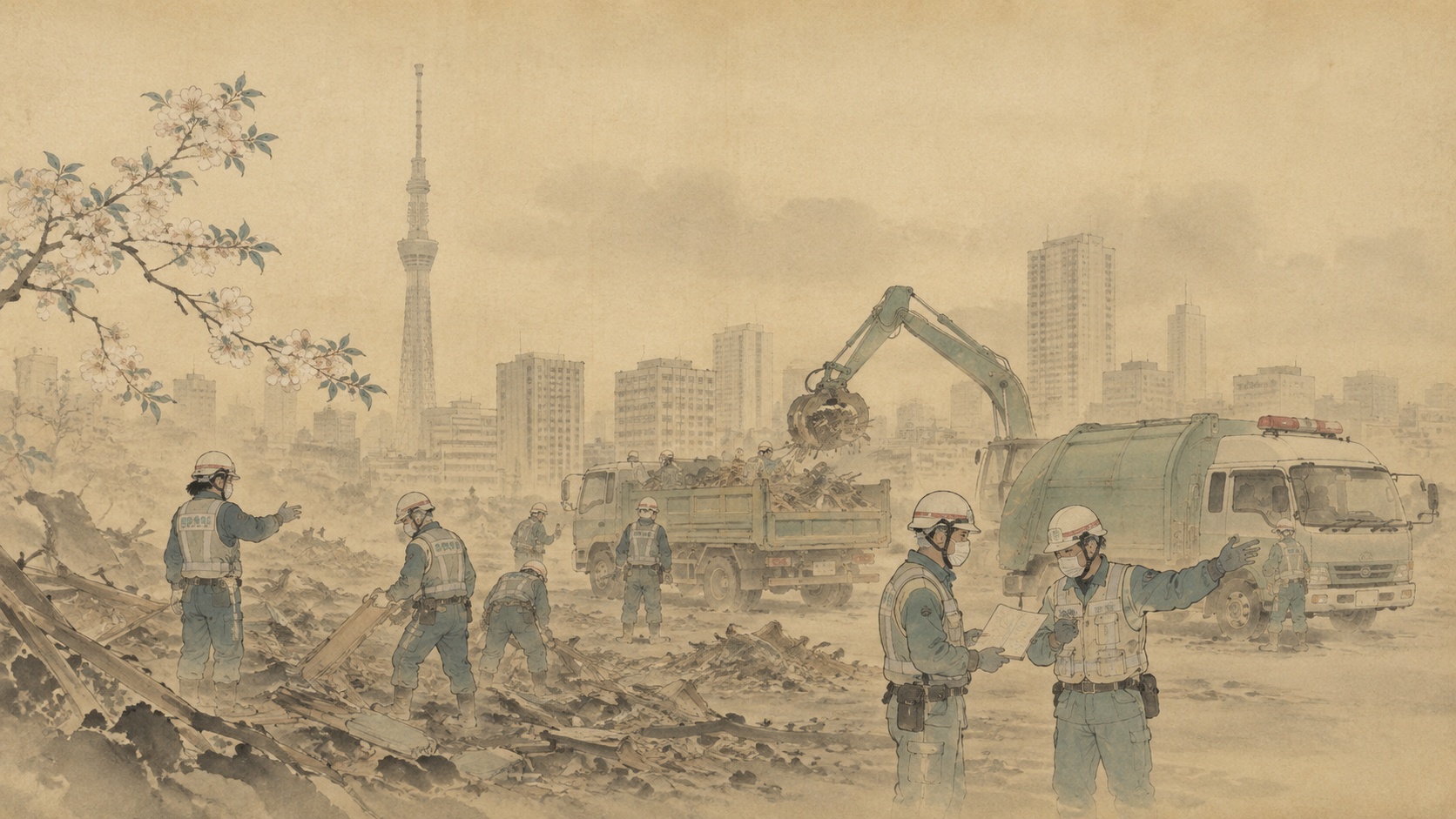
A disaster can produce a second emergency after the shaking, flooding or fire stops: the city begins to drown in its own wreckage. Broken furniture and appliances spill out of homes. Demolished buildings generate timber, concrete, glass, insulation and metal. Floods add mud-soaked belongings. Trucks need somewhere to take it all, but a poorly chosen temporary storage site can become a traffic jam, a fire hazard, a neighborhood nuisance or a sorting nightmare.
Tokyo's answer is not a new fleet of garbage trucks. It is a roster of people who know what to do before the pile becomes unmanageable.
On September 3, the Tokyo Metropolitan Government announced the Tokyo Metropolitan Disaster Waste Management Specialist Registration System — 東京都災害廃棄物処理専門員登録制度 — a program to train and register existing local-government personnel so they can be dispatched to municipalities struggling with disaster waste after a major event.
Debris management is not a cleanup job at the end of recovery
The phrase “disaster waste” can sound like the residue left after the real emergency is over. In practice, it is part of the emergency itself. Debris can block roads needed for rescue and logistics. Uncontrolled piles of household waste can create sanitation problems. If residents are not given clear sorting and collection instructions, improvised dumping sites can appear within hours. If temporary storage areas are laid out badly, trucks cannot circulate and materials that could have been recycled become mixed waste requiring costly re-sorting.
Japan's national disaster-waste guidelines place primary responsibility for disaster waste on municipalities. Prefectures provide technical help and coordinate wider-area treatment, and in some cases can accept delegated tasks. That division has a built-in vulnerability: the municipality expected to organize the waste response may be the same municipality whose offices, staff, contractors, roads and treatment plants have just been hit.
Normal waste management is built around predictable routes, quantities and destinations. Disaster waste is the opposite. Officials must estimate how much material exists before they can see all of it; select temporary storage sites; establish traffic flows; decide how to separate wood, concrete, metals, appliances and hazardous items; organize publicly funded demolition of damaged homes; match incoming waste to treatment capacity; negotiate with private operators; and explain changing rules to residents.
Tokyo is trying to stockpile expertise
The new registration system is aimed at employees of Tokyo's municipalities and wards, partial administrative associations that jointly run services such as waste facilities, Bureau of Environment staff and related personnel. Registration requires completion of a Disaster Waste Management Specialist Human Resources Development Program run by the Bureau of Environment.
Tokyo says that training is scheduled to begin from October 2026. Registration follows completion of the program, which means the first deployments under this specific roster will not be possible until February 2027 or later.
The metropolitan government gives two reasons for creating it. The immediate one is speed: a stricken municipality should be able to receive staff who can strengthen initial and emergency-phase waste operations. The deeper reason is institutional memory. Tokyo wants knowledge and experience to accumulate within the public sector instead of disappearing when individual employees transfer jobs or retire.
That problem has been recognized nationally for years. Japan's Environment Ministry, reviewing lessons from the 2011 Great East Japan Earthquake, warned that hard-earned knowledge could be lost through staff transfers and the passage of time. A registration system turns individual experience into something that can at least be located, maintained and mobilized.
The 32-million-tonne reason Tokyo cares about this
Tokyo's revised 2023 Disaster Waste Management Plan estimates that a major earthquake could generate as much as approximately 32 million tonnes of disaster waste. The previous estimate, based on older earthquake assumptions, had been about 43 million tonnes. Tokyo attributes much of the roughly 11-million-tonne reduction to progress in measures such as seismic strengthening and fire-resistant urban development.
A smaller catastrophe is still a catastrophe. Thirty-two million tonnes cannot be handled as an unusually busy year for municipal sanitation. It would require temporary storage, enormous hauling capacity, multiple treatment routes and assistance extending far beyond the hardest-hit neighborhoods.
And the number is not known precisely on day one. Tokyo's own plan describes disaster-waste estimates as an evolving management tool. Within roughly the first week, officials need an initial sense of scale. From about a month onward, estimates feed an operational treatment plan. Six months to a year later, the amount can be refined toward a more settled figure.
The disaster-waste clock
| Phase | What government has to decide | Where specialist knowledge matters |
|---|---|---|
| Before disaster | Scenarios, candidate storage sites, agreements, exercises | Testing whether plans will work under real constraints |
| First days / first week | Scale of damage, household cleanout waste, collection, temporary sites | Priorities, site layout, traffic, sorting and public instructions |
| From about one month | Operational treatment plan, processing routes, outside assistance | Quantity estimates, contracts, private-sector and intergovernmental coordination |
| Months to a year | Demolition, progress control, revised quantities | Program management, recycling, documentation and reimbursement |
2011 turned disaster waste into a national policy field
Japan's modern disaster-waste system was shaped above all by March 11, 2011. The Great East Japan Earthquake and tsunami generated about 20 million tonnes of disaster waste across 239 municipalities in 13 prefectures, plus roughly 11 million tonnes of tsunami sediment in 36 municipalities. The combined scale — around 31 million tonnes — was unlike ordinary municipal waste management in both volume and composition.
Some local governments had lost administrative capacity at the same moment they were expected to organize debris removal. Waste streams contained collapsed buildings, household contents, concrete, timber and sediment. Treatment required local plants, temporary incinerators, private companies, recycling, cement-industry capacity and wide-area cooperation among governments. Outside parts of Fukushima, the national target of completing treatment by March 2014 was largely met — roughly three years after the disaster.
The institutional response came in stages. The Environment Ministry issued national disaster-waste guidelines in 2014. In 2015 it launched D.Waste-Net, a network of experts, local governments, technical organizations and industry groups. The guidelines were revised in 2018 using lessons from the Kumamoto earthquakes and other events. In 2020, the ministry created a separate Disaster Waste Management Support Personnel System, often described as a human-resource bank, to register experienced local-government officials who could advise disaster-stricken municipalities.
Tokyo's 2026 program fits that lineage, but with an important twist. The national personnel bank grew largely from people who already had disaster experience. Tokyo is making completion of its own training program the gateway to registration. In effect, it is trying to create capacity before the next disaster supplies the experience.
1995: Great Hanshin-Awaji Earthquake produces roughly 15 million tonnes of disaster waste.
2011: Great East Japan Earthquake produces about 20 million tonnes of disaster waste plus 11 million tonnes of tsunami sediment.
2014: Environment Ministry issues the modern Disaster Waste Management Guidelines.
2015: D.Waste-Net begins operations.
2018: National guidelines revised using lessons from Kumamoto and other disasters.
2020: National disaster-waste support-personnel bank established.
2023: Tokyo revises its metropolitan Disaster Waste Management Plan.
2024–25: Tokyo and municipalities support Noto in the field and through wide-area treatment.
2026: Tokyo launches its own specialist registration system.
Noto gave Tokyo a recent laboratory of hard experience
The new roster is not being designed by a government with no field experience. After the 2024 Noto Peninsula Earthquake, Tokyo sent Bureau of Environment personnel to places including Noto Town and Shika Town. Their work included helping draft disaster-waste implementation plans, advising on temporary storage sites for cleanout waste, supporting systems for publicly funded demolition applications and helping manage demolition progress.
Tokyo's 2025 environmental white paper records a cumulative 269 Tokyo staff deployments between January 6 and August 1, 2024, while personnel from 14 Tokyo wards, cities and other bodies added a cumulative 265 deployments to municipalities in Ishikawa. The experience continued beyond field advice. From September 2024 to October 2025, treatment plants in Tokyo accepted 2,927 tonnes of combustible Noto waste. Including 752 tonnes processed in Kawasaki, the wider program handled 3,679 tonnes.
Tokyo also assisted Hachijo Town after Typhoons No. 22 and No. 23 in 2025, supporting initial disaster-waste operations and preparation of an implementation plan. Yet Tokyo's 2026 Resource Circulation and Waste Management Plan still identifies a shortage of personnel capable of serving as the practical core of disaster-waste management inside local governments.
That is the gap the new registration system is meant to close: not the absence of experience, but the difficulty of distributing it and keeping it alive.
What does a disaster-waste specialist actually need to see?
Tokyo's September 3 announcement does not publish a detailed duty list for each future specialist. It would therefore be an overstatement to say that every registered person will be assigned to temporary-storage management, demolition or planning.
But national support guidance and Tokyo's own Noto record show the kinds of problems such personnel have to understand. A temporary storage site, for example, is not simply an empty field. It needs safe truck access, enough space for one-way circulation, separation of combustible material, protection against fire and runoff, room for difficult items, and a plan for moving material out at a rate that keeps the site from filling faster than it can be emptied.
At the strategic level, specialists need to see the entire flow: damaged property → temporary storage → sorting/intermediate treatment → recycling, incineration or final disposal. If one stage is undersized, the whole chain backs up.
They also need to recognize that disaster waste is partly an information problem. Residents need precise instructions about what can be placed where and when. Contractors need specifications. Elected officials need credible estimates. The national government needs documentation for assistance. Neighboring municipalities need to know exactly what type and volume of material they are being asked to receive.
Receiving help is a professional skill too
Major Japanese disasters increasingly trigger layers of outside assistance: Environment Ministry teams, experienced municipal officers, D.Waste-Net organizations, collection and hauling crews, private processors and short-term staff from around the country.
During the Noto response, Environment Ministry figures show the scale of that mobilization. By May 2025, disaster-waste support personnel under the national human-resource bank had provided a cumulative 1,597 person-days of assistance. D.Waste-Net activities amounted to roughly 8,000 person-days, much of it in collection and transport, alongside thousands of person-days from ministry and municipal staff.
That much assistance can overwhelm a receiving municipality if no one is able to organize it. Someone still has to decide who works where, what data is authoritative, which tasks are urgent, how incoming teams are briefed, and how one rotation hands off to the next. In Japanese disaster administration, this is often discussed as juen — the ability to receive assistance effectively.
A useful Tokyo specialist may therefore be as valuable for management as for waste expertise: translating a damaged municipality's needs into specific requests that outside organizations can act on.
Three questions Tokyo has not answered yet
The September 3 announcement establishes the architecture of the program, but not enough detail to judge its ultimate capacity.
First: how many specialists? Tokyo has not announced a target registration total, annual class size or geographic distribution. That matters because a Tokyo inland earthquake would strike many local governments at the same time. A roster that works for dispatching a few people to one outside disaster may need a very different scale when Tokyo itself is the disaster zone.
Second: what exactly will the training contain? The Bureau of Environment says the specialist-development program will begin from October, but the public announcement does not provide a curriculum, duration or completion standard. Classroom instruction, tabletop exercises, site-layout simulations and case work on demolition management would produce different kinds of readiness.
Third: how fast can the roster move? The announcement says dispatch becomes possible from February 2027, but does not spell out the request, selection, travel, accommodation, rotation and handover procedures. Nor does it yet describe in detail how the Tokyo roster will mesh with the national personnel bank and D.Waste-Net.
Those gaps are not evidence that the program is defective; they show that it is at the launch stage. The next test is administrative: whether Tokyo can turn a list of trained names into a mechanism that moves skilled people quickly when a municipality is already overloaded.
The real stockpile is decision-making capacity
A future Tokyo earthquake will not produce one homogeneous mountain of debris. Dense wooden neighborhoods, high-rise districts, industrial zones, reclaimed land, suburban municipalities and island communities will produce different waste streams under different access conditions. Fires, liquefaction, damaged bridges, power outages and disabled incinerators may occur at the same time.
The scarce resource in that situation is not only trucks or land. It is people who can convert incomplete information into a workable sequence of decisions: estimate, prioritize, open a site, control the flow, secure treatment capacity, communicate with residents, ask for the right outside help and revise the plan as the numbers change.
Tokyo's new specialist roster is modest compared with the physical scale of a 32-million-tonne scenario. It is also aimed precisely at one of disaster management's least visible bottlenecks. A single experienced official cannot remove a city's debris. But that official may know how to stop thousands of tonnes of debris from becoming a second disaster.
That is why the roster matters. In the first days after catastrophe, the most valuable thing Tokyo can have stockpiled may not be a machine. It may be a person who knows what has to happen next.
Sources
- Tokyo Metropolitan Government, “Launch of a registration system for personnel supporting disaster-waste treatment in affected municipalities” — September 3, 2026; primary source for the official system name, eligibility, training requirement and deployment timing.
- Tokyo Metropolitan Government, Disaster Waste Management Plan — revised 2023; primary source for the maximum roughly 32-million-tonne estimate and Tokyo's planning framework.
- Tokyo Resource Circulation and Waste Management Plan 2026 — identifies the shortage of core disaster-waste personnel and summarizes Noto and Hachijo support experience.
- Tokyo Metropolitan Government, completion of wide-area treatment of Noto disaster waste — official totals of 2,927 tonnes treated in Tokyo and 752 tonnes in Kawasaki.
- Tokyo Metropolitan Government, Noto Peninsula Earthquake support coordination materials — examples of temporary-storage, implementation-plan and publicly funded demolition support.
- Ministry of the Environment, Disaster Waste Management Guidelines — national framework for municipal responsibility, preparedness, emergency response and recovery.
- Ministry of the Environment, Initial Response Guide for Municipal Waste Management During Disasters — practical framework for the first phase of municipal response.
- Ministry of the Environment, announcement of the 2014 Disaster Waste Management Guidelines — history of the post-2011 national framework.
- Ministry of the Environment, launch of D.Waste-Net — September 16, 2015.
- Ministry of the Environment, Disaster Waste Management Support Personnel System (human-resource bank) — national roster of experienced local-government personnel.
- Ministry of the Environment, support and receiving-assistance record for Noto disaster waste — personnel figures for the national human-resource bank, D.Waste-Net and government support.
- Ministry of the Environment, 2014 Environment White Paper — official record of approximately 20 million tonnes of disaster waste and 11 million tonnes of tsunami sediment after the Great East Japan Earthquake.
- Ministry of the Environment, archive report on Great East Japan Earthquake disaster-waste management — documents the need to preserve operational knowledge despite staff transfers and the passage of time.
This report was checked against public information available by 2:45 AM JST on September 4, 2026. The Japanese primary source's official name, 東京都災害廃棄物処理専門員登録制度, is rendered descriptively in English as the Tokyo Metropolitan Disaster Waste Management Specialist Registration System. The program does not establish a newly hired standing emergency corps; it registers existing municipal, intermunicipal and metropolitan personnel after training. Tokyo had not published a target roster size, detailed curriculum, individual deployment duration or full dispatch workflow as of the reporting cutoff. References to temporary storage, publicly funded demolition and implementation planning describe typical duties documented in national programs and Tokyo's past Noto support; they are not presented as mandatory assignments for every future registrant.
Image rights: © 2026 Japan.co.jp. AI-assisted editorial illustration. Unauthorized republication or reuse is prohibited. For licensing, use the contact page.