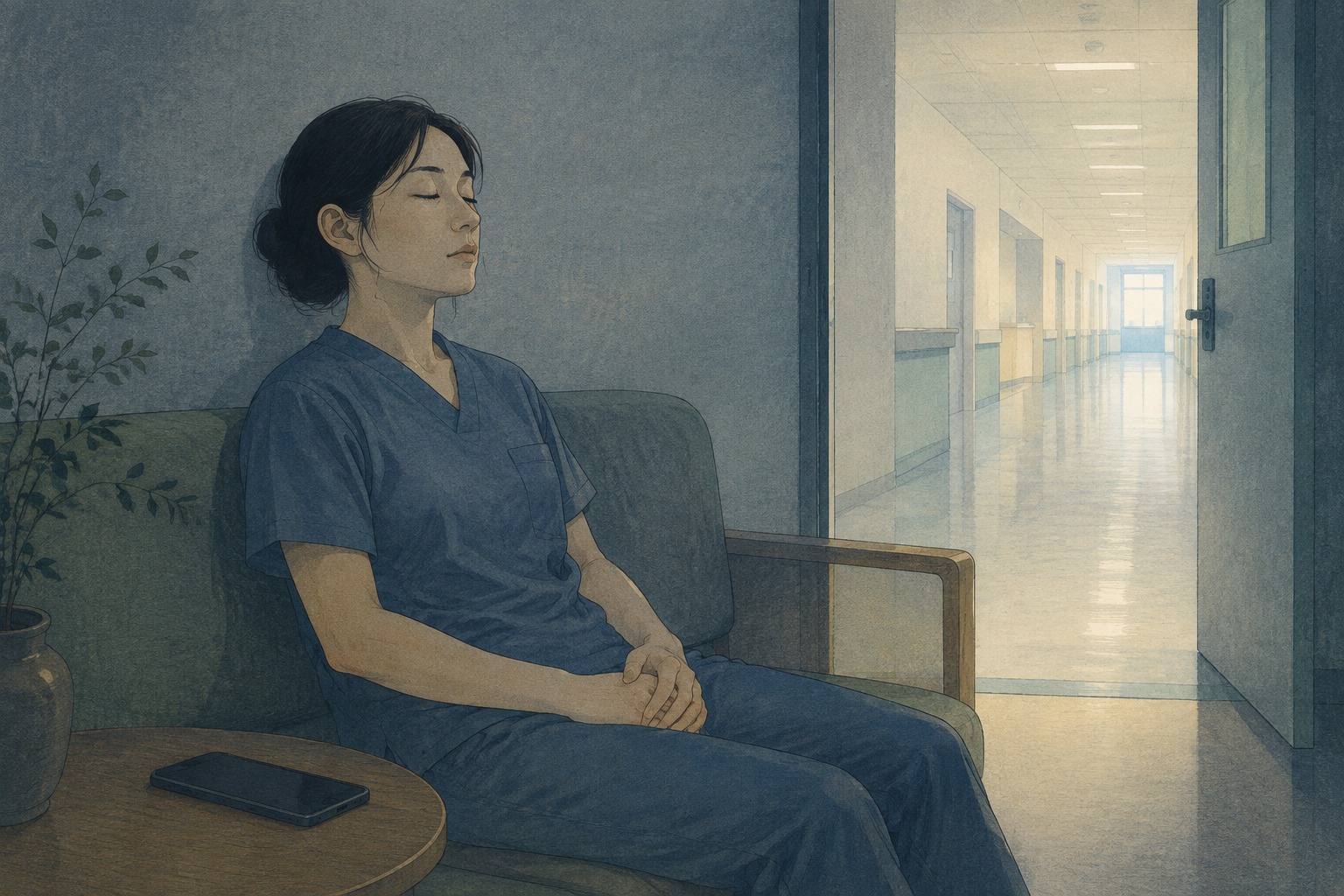
The appeal is easy to understand. A nurse coming off an overnight shift may not be able to attend a weekly class. A resident doctor may hesitate to seek help in person. A breathing exercise or guided meditation delivered privately on a phone can travel into the gaps of a hospital day. Accessibility, however, is not the same thing as effectiveness—and a new systematic review shows how much distance remains between those two ideas.
Researchers at the University of Tokyo’s Graduate School of Medicine, including Associate Professor Natsu Sasaki and Project Associate Professor Kotaro Imamura, searched for randomized controlled trials of self-guided digital mindfulness programs for healthcare workers. Their analysis, published on August 21 in JMIR mHealth and uHealth, found small-to-moderate improvements immediately after an intervention. It also found a thin, uneven evidence base that cannot yet establish durable benefit.
What the review actually isolated
The review was narrower than a survey of every meditation program marketed to hospitals. It included only interventions that participants could complete digitally on their own, without personal, professional or face-to-face guidance. Formats included smartphone apps, web programs and audio delivered through social media. Control groups received usual care or waited for access.
The programs varied substantially. They lasted from roughly a week and a half to 18 weeks, used different exercises and measured outcomes with different questionnaires. The nine studies were conducted in the United States or Canada, England, Australia, Iran, South Korea, Singapore and Thailand. None was conducted in Japan. Three predated the COVID-19 pandemic.
That international range is valuable, but it complicates interpretation. A short app program for one profession in one health system may not operate like an 18-week web course in another. Cultural attitudes toward distress, employment protection, staffing and access to mental-health care differ as well.
The encouraging numbers—and what they mean
| Outcome | Standardized mean difference | 95% confidence interval | Reading the result |
|---|---|---|---|
| Depression | −0.44 | −0.88 to −0.003 | Favored the intervention, but the upper bound came extremely close to no effect |
| Anxiety | −0.29 | −0.51 to −0.06 | A small improvement on average |
| Perceived stress | −0.42 | −0.77 to −0.06 | Favored the intervention, with large variation among studies |
| Well-being | +0.20 | +0.09 to +0.30 | A small improvement on average |
A standardized mean difference allows researchers to combine studies that used different rating scales. It does not mean that 44 percent of participants recovered, nor does it tell an individual worker how likely they are to improve. These are average differences between groups measured with symptom questionnaires.
The pooled results did not show statistically significant improvement in emotional exhaustion or compassion fatigue. Four studies followed participants for only four to 12 weeks after the intervention; the pooled follow-up result for perceived stress was not significant. No included study established long-term effects.
A body of evidence with one very large shadow
The headline total of 3,088 participants sounds substantial. Yet one trial enrolled 2,182 people—about 71 percent of everyone in the review. The smallest study had only 41 participants. That imbalance means the evidence is not nine equally informative confirmations of one finding.
Depression and perceived-stress results also showed very high statistical heterogeneity, indicating that study findings differed more than chance alone would be expected to explain. When the researchers removed an outlying study in a sensitivity analysis, the estimated effects became smaller: −0.18 for depression and −0.25 for perceived stress. The remaining results were more consistent, but more modest.
Completion is another reality check. Reported adherence ranged from 19 percent to 56 percent. A program can be inexpensive to distribute and still fail to fit the lives of the people it is meant to help. Reminders, privacy, length, ease of use and permission to participate during paid work may matter as much as the meditation script.
Statistical significance is a signal to investigate, not a certificate that a hospital program is clinically sufficient. — Japan.co.jp analysis
Why the certainty rating matters
The researchers rated the evidence for the outcomes as low or very low certainty using GRADE, a structured system for assessing confidence in a body of evidence. Every included study carried serious risk-of-bias concerns. Participants generally knew which program they had received, most outcomes were self-reported, and some studies raised questions about allocation concealment or missing data.
Those difficulties are common in behavioral trials. It is hard to make participants unaware that they are meditating, and a convincing placebo for an app is difficult to design. Common does not mean inconsequential. Expectations, attention and disappointment can all influence questionnaire scores.
Program content and app quality were not standardized. “Digital mindfulness” can describe very different products: a few audio sessions, a structured curriculum, automated reminders or social-media delivery. The meta-analysis estimates an average across that variety; it does not validate any particular commercial app.
From a clinical course to a pocket-sized intervention
Mindfulness draws on Buddhist contemplative traditions, but modern clinical research usually defines it more narrowly as training attention toward present experience with less immediate judgment. In the late 1970s, structured stress-reduction programs in the United States helped move mindfulness into clinical settings. Research later expanded into psychotherapy, workplaces and healthcare education.
The delivery system changed alongside communications technology. Group courses and recorded exercises were followed by web programs and smartphone apps. Digital delivery offered scale, privacy and flexibility—particularly attractive for shift workers and institutions unable to provide an instructor for every employee.
Something can be lost in that transition. A trained instructor can notice distress, adapt an exercise or recommend additional care. A self-guided program must rely on design, automated instructions and the user’s judgment. By restricting its review to self-guided interventions, the Tokyo team tested the digital component rather than blending it with the effects of a therapist or teacher.
Late 1970s — Structured clinical stress-reduction programs using mindfulness are formalized in the United States.
1990s–2000s — Research expands across mental-health care, medical education and workplaces.
2010s — Web and smartphone programs make self-guided delivery widely available.
2020 onward — The pandemic intensifies interest in remote support for healthcare workers.
August 2026 — The University of Tokyo team publishes its synthesis of nine randomized trials.
The danger of prescribing resilience to a strained system
Healthcare distress is not produced solely inside an individual mind. Night work, chronic vacancies, violence and harassment, patient deaths, administrative burden and inadequate recovery time are working conditions. A phone exercise cannot hire another nurse or redesign a punishing rota.
This creates an ethical test for employers. If digital mindfulness is offered while workload and staffing go unaddressed, an apparent wellness benefit can become a transfer of responsibility: the institution supplies an app, and the worker is expected to become more resilient. The University of Tokyo release describes these tools as complementary support, not a replacement for organizational measures.
That distinction does not make the programs worthless. A voluntary, private and accessible option may help some people. The question is whether it is placed inside a larger system of prevention, clinical referral and workplace reform—or used as evidence that the institution has done enough.
- Is participation genuinely voluntary, with no penalty for declining?
- Can staff use the program during paid working time?
- Who can see usage records and mental-health questionnaire results?
- What referral route exists if symptoms worsen or a worker needs clinical care?
- Which staffing, scheduling and safety problems are being addressed at the same time?
- How will completion, benefit, unequal access and unwanted effects be evaluated?
What still has to be learned
Future trials need longer follow-up, larger and more representative samples, clearer reporting of program content and stronger handling of missing data. Japan-specific research is also necessary before assuming the results transfer to Japanese hospitals, professions and employment systems.
The paper did not provide a pooled analysis of adverse events. That absence does not establish that the programs are unsafe, but it also does not establish safety. Trials should prospectively record worsening symptoms, distress during practice, reasons for withdrawal and referrals for additional care.
The most defensible reading is therefore measured. Self-guided digital mindfulness has produced a short-term signal across several outcomes. It may widen access to support. But its clinical importance, durability, safety profile and best implementation remain unsettled—and no app should be allowed to turn a problem of work into a test of personal composure.
- The University of Tokyo: Digital mindfulness intervention to support healthcare workers’ mental health
- Sasaki N, et al. Effects of Self-Guided Digital Mindfulness Interventions on the Mental Health of Health Care Workers
- UMIN Clinical Trials Registry: UMIN000051631
- Graduate School of Medicine and Faculty of Medicine, The University of Tokyo: press listings
Editor’s note: This report is based on the university release, peer-reviewed paper and trial registration. Japan.co.jp did not interview the researchers and has not independently tested the intervention or any particular app. Effect sizes describe group averages, not an individual probability of recovery. No direct quotations are used. This article is not medical advice.