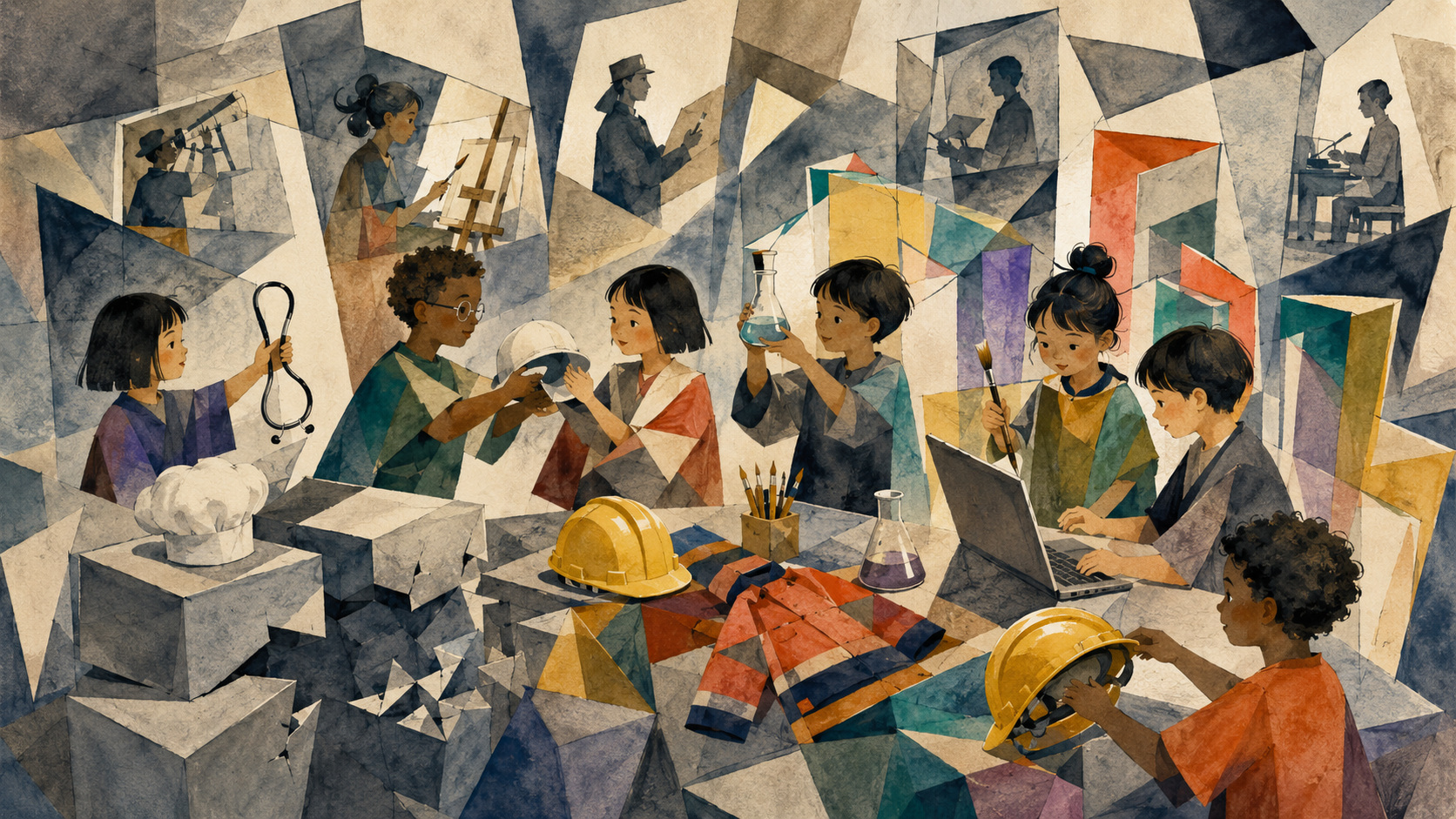
Before a child decides what to become, the world has already supplied a cast list. The engineer has a face. The nurse has a voice. Someone cooks at home; someone leads the meeting; someone fixes the machine. No adult needs to announce a rule. Repetition can make the arrangement feel like nature.
On August 5, approximately 280 elementary-school children entered the seventh floor of the National Museum of Emerging Science and Innovation—Miraikan—in Tokyo’s Odaiba district to examine that feeling. With parents and teachers, total attendance was about 550. The free event, called “Dr. Hattonyaru’s Laboratory 2026 in Tokyo,” had planned for 300 child participants in two sessions. More than 2,800 applications were submitted.
The numerical imbalance was its own first lesson. A program about the limits adults place on children attracted more than nine applications for every child’s place. The organizers had not discovered an obscure concern. They had touched a crowded nerve.
Tokyo Metropolitan Government and the Unconscious Bias Laboratory, a general incorporated association, co-hosted the event for the first time, building on versions the organization had staged in 2024 and 2025. Four-panel cartoons at the opening introduced assumptions linking occupations and gender. Children then drew lots and entered two of five activity rooms, called “doors.” Candy, sport, karuta, Momotaro and frozen-food technology became devices for asking a deceptively difficult question: what did you assume before you looked again?
Five doors, five interruptions
The five rooms did not all teach gender directly. Their common method was interruption: let a quick judgment form, introduce disconfirming information, then make the act of revision visible. That distinction matters. The program treated unconscious bias not as proof that a child is morally bad, but as a normal shortcut that becomes dangerous when it is left unexamined and used to define another person’s possibilities.
| Activity | What children did | The mental habit challenged |
|---|---|---|
| Candy Door Morinaga | Used specially made Hi-Chew candy to encounter differences between appearance and what could be discovered through experience. | The confidence that surfaces tell us everything important about what is inside—or about how another person will experience the same thing. |
| Possibility Door Mizuno | Repeated a sports activity and experimented with ways to improve from their own starting point. | “I am bad at this” or “someone with this body cannot do it” as a fixed identity rather than a provisional description. |
| Karuta Door Panasonic Industry | Played with cards based on assumptions employees had noticed in work and daily life, then discussed cards that felt familiar. | The silence that lets an ordinary phrase pass without asking whom it includes, excuses or diminishes. |
| Momotaro Door Hakuhodo creators | Revisited Japan’s famous folktale from the viewpoint of an oni child and asked how the two sides might coexist. | The tendency to accept the hero’s frame as the whole story and classify the unfamiliar side before hearing it. |
| Frozen Door Nichirei | Used a microwave demonstration to investigate frozen food and how discovery can produce a new idea. | The assumption that a familiar object, technology or category is simple because its complexity is normally hidden. |
These were educational demonstrations rather than measurements. There was no reported random assignment to a treatment and control group, no pre-registered outcome and no published long-term follow-up from the 2026 day. The serious claim is therefore modest: the rooms gave children a vocabulary and a memorable practice for stopping before certainty. Whether that practice survives Monday morning depends on what comes next.
The end of the program offered evidence of possibility, not proof of population-level effect. Two children who had attended the previous year described how they later used the idea. One had assumed a cheer-dance leader must be a sixth-grader until a teacher asked why. Another reconsidered the self-description “I cannot study,” found more pleasure in learning and began thinking differently about a future dream. Their accounts are valuable because they show transfer into daily life; they remain individual stories selected for presentation.
The adults were part of the curriculum
The most consequential design choice may have happened outside the children’s rooms. For the first time at this event, accompanying parents and teachers watched one activity and then entered their own seminar. Tomotaka Moriya, representative director of the Unconscious Bias Laboratory, discussed Tokyo’s surveys and the effects of casual adult language. A private-school teacher described classroom practice. Adults then examined their own words and decisions together.
That structure resisted an easy fiction: that children possess a bias problem that enlightened adults can correct. Children learn categories partly because adults continually make categories legible. “Boys are good at machines” may sound encouraging to one child while announcing exclusion to another. “Girls are kind” appears positive while quietly making care an obligation. Even praise can carry a map.
The map is also drawn without speech. Children notice who leaves work early, who prepares dinner, who is introduced as the boss, who operates the train, who appears in a textbook as a discoverer, and which adult is expected to remember everyone’s needs. If a father tells his daughter she can become anything while she never sees him perform routine care, the explicit sentence and the observed lesson compete. Observation is an exacting teacher.
- Do we assign classroom, household or team tasks by habit before asking who wants to learn them?
- When a child struggles, do we describe a temporary skill gap or a permanent kind of person?
- Do our examples show women only entering male-coded work, or also men doing care, teaching and domestic labor?
- Do we praise a child for crossing a stereotype in a way that makes the stereotype sound even more exceptional?
- Can a child disagree with our prediction without having to carry the burden of representing an entire gender?
Parents and teachers do not need to pretend that sex and gender are invisible or that every person will want the same life. The more workable standard is individual evidence: let ability be demonstrated, interest be explored and skill be developed without using a group average as a verdict on the child standing in front of us.
Tokyo’s numbers: the map hardens with age
The event grew from two large Tokyo surveys. In fiscal 2022, the metropolitan government collected responses from 6,622 fifth- and sixth-graders at public elementary schools, 2,174 parents and 899 teachers. In fiscal 2023, it surveyed metropolitan high-school students and teachers; 10,763 students and 2,549 teachers submitted valid responses.
Among the elementary pupils, 41.1 percent said they sometimes thought in terms of “because someone is male/female” or “because someone is a boy/girl.” Among high-school students the comparable figure was 53.9 percent. Asked whether some future jobs suited one sex and some suited the other, 43.4 percent of elementary pupils agreed. The share among high-school students was 66.2 percent—a 22.8-point rise.
| Tokyo survey item | Elementary pupils | High-school students |
|---|---|---|
| Sometimes thinks “because male/female” | 41.1% Fifth and sixth grades | 53.9% First and second years |
| Believes sex affects which future jobs suit a person | 43.4% | 66.2% |
| Survey response base used in the comparison | 6,622 | 10,648 in the comparable analysis |
These figures do not prove that each individual grows steadily more biased. The elementary and high-school results came from different cohorts, and self-reported agreement is not the same as an indirect measure of automatic association. The Cabinet Office itself cautions that public surveys labeled “unconscious bias” do not necessarily measure implicit bias in the strict academic sense. Respondents can only report a thought they recognize well enough to report.
But the pattern is difficult to dismiss. Older students have had more time to see occupational segregation, hear adult expectations, consume media and confront institutional choices. Tokyo’s high-school analysis found that students who regarded an occupation as belonging to the other sex were less likely to place it among their own desired careers. The effect was particularly clear among girls considering occupations they perceived as masculine.
This is how a social pattern can reproduce itself without a single command. A child observes that construction and software look male, while nursing and early education look female. The child converts frequency into aptitude: people who are there must be naturally suited to be there. Interest then follows familiarity, subjects are chosen, training pipelines separate, and the labor market returns the same image to the next child. Description becomes expectation; expectation helps reproduce the description.
A long history inside a quick judgment
Japan’s occupational map did not emerge from children’s minds. It was built across law, schooling, industrial organization and family policy. The prewar ideal often summarized as ryosai kenbo—“good wife, wise mother”—made women’s education important while directing that education toward domestic management and the raising of citizens. Men were prepared for public production and authority; women were prepared to sustain the household that made it possible.
The postwar constitutional settlement changed the legal foundation. Women first voted in a national election in 1946. The 1947 Constitution guaranteed equality under law, and postwar educational reform advanced equal opportunity and coeducation. Yet law and lived expectation changed at different speeds. During high economic growth, the company-centered male breadwinner and the full-time homemaker became mutually reinforcing ideals, supported by long work hours, seniority employment and tax and social arrangements organized around the household.
Schools sometimes made the division explicit. Earlier curricula steered boys and girls toward different content: technical study for boys, domestic study for girls; martial arts for boys, dance for girls. The 1989 curriculum revision removed sex-specific course language. During the early 1990s, technical and home economics instruction became coeducational in junior high, and home economics became required for both sexes in high school. The reform embodied a simple proposition that once had required a political struggle: running a home is a human competence, not a female destiny.
Other milestones accumulated. Japan ratified the Convention on the Elimination of All Forms of Discrimination against Women in 1985, the same year it enacted the Equal Employment Opportunity Law. The Basic Act for a Gender-Equal Society took effect in 1999. Later policy promoted women’s participation and required more organizational reporting and planning. By 2026, Tokyo’s revised gender-equality plan could describe the objective as a society in which anyone can choose a way of life without being constrained by sex.
Prewar decades Gender-differentiated education and the “good wife, wise mother” ideal organize public and domestic roles.
1946–1947 Women vote nationally; the Constitution and postwar education establish formal equality and equal opportunity.
High-growth era The male company worker and female household manager become a powerful social model.
1985 Japan ratifies CEDAW and enacts the Equal Employment Opportunity Law.
1989–1990s Revised curricula remove sex-specific study prescriptions; home economics and technical learning move toward shared study.
1999 The Basic Act for a Gender-Equal Society takes effect.
2022–2023 Tokyo surveys elementary and high-school communities about gender assumptions and future work.
August 5, 2026 Tokyo and the Unconscious Bias Laboratory co-host the oversubscribed children’s event at Miraikan.
The timeline explains why the workshop was not merely about replacing old-fashioned vocabulary. Institutions can stop saying “girls’ subject” while the remnants remain in who teaches, who advances, whose overtime is assumed, whose parental leave is expected, and whose competence appears ordinary rather than exceptional. A stereotype is history compressed into intuition.
What psychology says—and what it does not
Research outside Japan supports the premise that gendered beliefs can emerge early. A widely cited 2017 study in Science, involving 400 children in the United States, found that by age six girls were less likely than boys to associate being “really, really smart” with their own sex and began avoiding a novel activity described as intended for exceptionally smart children. It is an influential finding, not a universal timetable. It does not prove that every Japanese child forms the same association at six.
Research on counter-stereotypical role models is encouraging but equally resistant to slogans. A review of social-psychological studies found that exposure to women and men in nontraditional occupations can reduce children’s gender stereotypes. Children who met female scientists, or heard workers discuss occupations not conventionally associated with their sex, sometimes drew a wider map afterward.
Yet changes in stated stereotypes do not reliably become changes in aspiration or behavior. Brief effects may fade within a week. A remarkable role model can appear so exceptional that a child admires the person without imagining “someone like me” can follow. Long-term exposure, community involvement, follow-up activity and explicit encouragement appear more promising than a single heroic example.
That finding should not diminish the August 5 event. It clarifies its job. A one-day workshop can name a pattern, create a shared language and produce a first contradiction to the expected story. It cannot supply years of practice, change admissions structures, redistribute unpaid care, redesign work or guarantee a career choice. Awareness is an opening condition, not a complete policy.
Equality is not a new set of boxes
Anti-bias education can fail by becoming another sorting system. If every girl is pushed toward engineering to prove progress, her freedom has not expanded; the approved destination has changed. If every boy who loves machines is treated as a stereotype rather than a person, a lesson about individuality has contradicted itself.
Nor should traditionally female-coded work be discussed as though liberation means escaping it. Nursing, early-childhood education, care work and home-making are indispensable forms of expertise. The question is why they are disproportionately assigned, often undervalued and made difficult for men to enter. Opening software to girls while leaving care closed to boys preserves half the architecture.
The same principle applies beyond a binary understanding of gender. Tokyo’s published comparisons are largely organized into male/female categories because that is how the surveys and policy materials report the issue. Real children include those who do not experience themselves comfortably inside those boxes. A program about possibility should not require a child to disclose or defend an identity before being allowed a wider future.
- Repeated practice: revisit assumptions across subjects and years, not only during a special event.
- Many ordinary examples: show diverse people doing work competently without presenting each as a miracle.
- Shared skill: let every child cook, code, care, build, lead, listen and repair.
- Adult accountability: examine assignments, recommendations, discipline, praise and career guidance for patterned expectations.
- Structural follow-through: connect classroom possibility to safe workplaces, fair pay, parental leave, reasonable hours and unbiased selection.
- Evaluation: measure what children remember and choose months later, while protecting their privacy and avoiding labels.
The door after the door
In the lobby, visitors could view children’s “unconscious-bias karuta” and earlier independent-research projects. At the closing session, former participants did something more important than repeat the day’s definition: they described noticing a thought later, in another place. That is the bridge any awareness program needs—from the staged surprise to the unprompted pause.
The demand for the event creates an immediate policy question. With more than 2,800 applicants and roughly 280 child attendees, most interested children could not participate. A museum program can demonstrate a method; public schooling is the only institution capable of making repeated access ordinary rather than scarce. The sensible measure of success is not whether next year’s lottery becomes even harder to win. It is whether the ideas move into classrooms, teacher education, parent communication and the daily distribution of opportunity.
There is also a democratic reason to teach the skill carefully. Categorization is unavoidable. Human beings need patterns to navigate more information than conscious attention can process. The aim cannot be a mind without assumptions. It is a mind able to notice when a shortcut has become a judgment, seek better evidence, and revise without humiliation.
That is what the five doors offered at their best. The candy was not only candy, the losing attempt was not final ability, the hero’s tale was not the only viewpoint, and a familiar sentence on a card was not harmless simply because everyone had heard it before. Each activity inserted a small space between perception and conclusion.
A child’s future is built in that space. It grows when “I have not tried this” does not become “people like me cannot do this”; when “most workers I see are men” does not become “this work belongs to men”; when kindness is not assigned to girls and courage is not withheld from them; when boys are permitted tenderness without explanation.
The most honest conclusion is neither that one Tokyo afternoon transformed 280 children nor that a workshop is too small to matter. Culture is transmitted through thousands of small moments. It can also be questioned through small moments—provided the questioning is repeated, supported and made real in the institutions children enter next.
The doors at Miraikan closed at the end of each session. The consequential door was the one the children carried away: the possibility that the first story their mind supplied was only a first draft.
Reporting Notes and Principal Sources
Event attendance, program content and participant accounts are based on organizer and Tokyo Metropolitan Government materials. Survey percentages describe self-reported responses and should not be interpreted as direct measurements of implicit association or as causal proof. International studies provide context, not a diagnosis of Japanese children. Public information was cross-checked through August 13 at 9:52 AM Japan Standard Time.
- Tokyo Metropolitan Government: August 12 report on Dr. Hattonyaru’s Laboratory 2026 in Tokyo
- Tokyo Metropolitan Government: event purpose, design and original participation plan
- Dr. Hattonyaru official site: five activities, schedule and application demand
- Unconscious Bias Laboratory: co-hosting rationale and earlier-event context
- Tokyo survey of elementary pupils, parents and teachers
- Tokyo Metropolitan Government: high-school unconscious-bias survey findings
- Tokyo high-school survey summary and elementary comparison tables
- Cabinet Office Gender Equality Bureau: methodological distinction between public surveys and academic implicit bias
- Cabinet Office Gender Equality Bureau: history of sex-specific and shared school curricula
- Cabinet Office Gender Equality Bureau: development of Japan’s gender-equality framework
- Science: Bian, Leslie and Cimpian on early gender stereotypes about intellectual ability
- Frontiers in Psychology: review of counter-stereotypical role models, effects and limitations
- UNESCO: how education can reinforce or challenge gender stereotypes