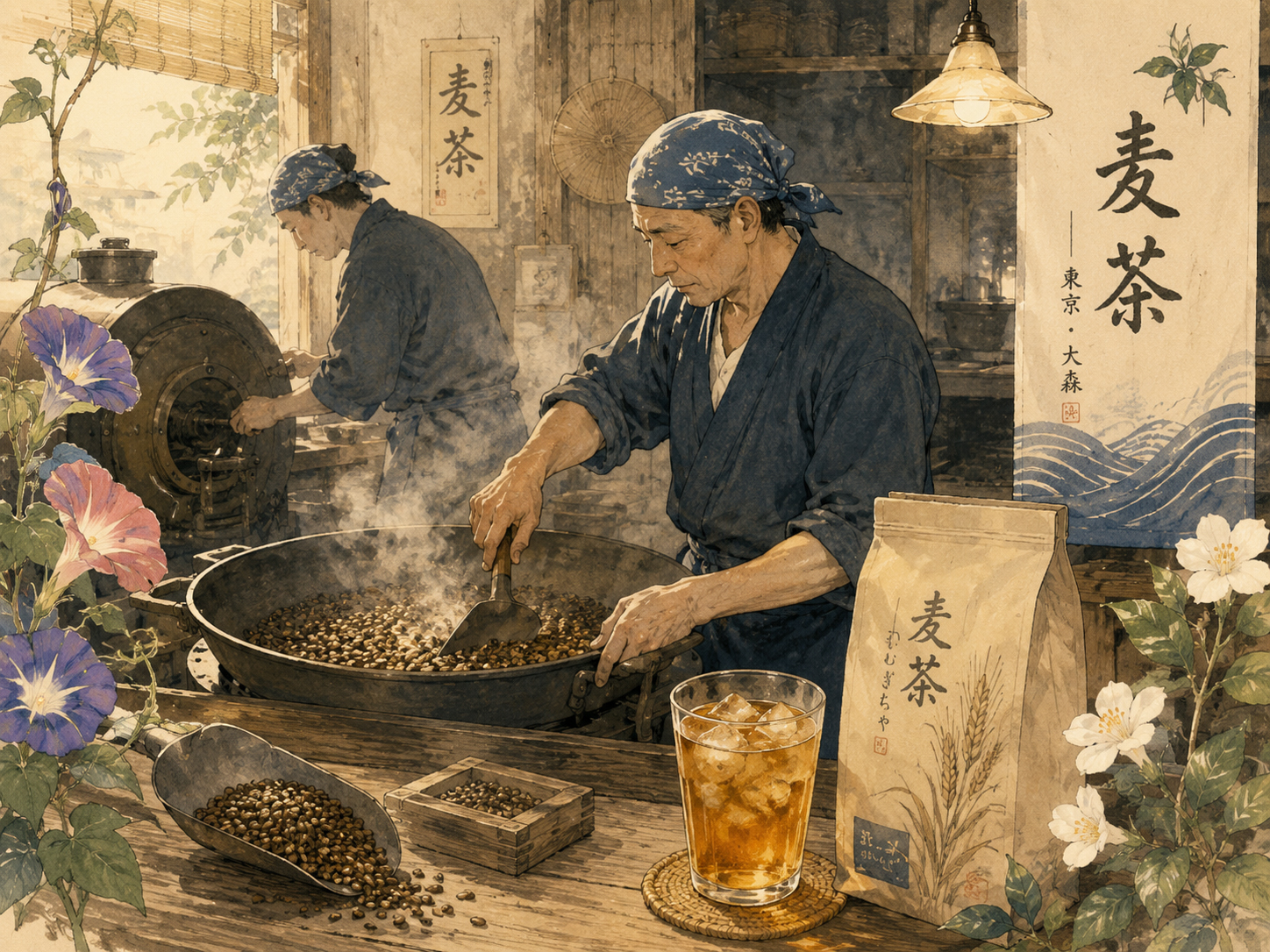
Every summer in Japan, refrigerators quietly fill with brown pitchers. The drink inside is not tea in the strict botanical sense. It has no green leaves, no matcha ceremony, no caffeine kick, no perfume of sencha or gyokuro. It is roasted barley steeped in water. It is mugicha. Children drink it after school. Grandparents pour it over ice. Offices stock it in plastic bottles. Convenience stores sell it by the liter. It is so ordinary that it almost disappears.
That is what makes the latest Tokyo mugicha story so good. SoraNews24 reported that Tokyo has only two barley-tea makers with production facilities inside the metropolis, and visited one of them: Ogawa Sangyo in Edogawa Ward. The factory tour revealed the humble drama behind the drink: domestic barley, heat, smoke, direct roasting, skilled timing, and a craft that looks simple only because the drink has become part of everyday life.
For Japan.co.jp’s July 9 edition, this is the “super boring” story that is not boring at all. It is a story about how a city that seems made of finance, rail lines, skyscrapers, anime, offices and redevelopment still contains a small factory roasting barley for summer tables. It is also a story about the kind of food culture Japan often preserves best: not the rare luxury item, but the daily habit.
The factory behind the pitcher
Ogawa Sangyo is located in Edogawa Ward, eastern Tokyo, an area with waterways, workshops, small factories, family businesses and postwar residential layers. According to the RocketNews24/SoraNews24 factory visit, the company is one of only two mugicha makers that still operate production facilities in Tokyo. The president, Keisuke Ogawa, guided the visit and explained the process.
Mugicha begins with barley, not tea leaves. The grains are cleaned, heated and roasted until they develop the color, aroma and flavor that Japanese drinkers associate with summer. The surprise in the factory report was sensory: during roasting, the barley can smell and taste almost like popcorn. That makes sense. Both are grains transformed by heat. The difference is that mugicha asks the grain to become fragrance rather than snack.
Ogawa Sangyo’s familiar product, Tsubumaru, is sold through retailers including Kaldi, making the company more visible on shelves than by name. That is common in Japanese food manufacturing. A family firm may be invisible to casual consumers, while its product sits in millions of kitchens under a brand, package or retailer context that feels familiar.
Why Tokyo having only two matters
Tokyo is still a manufacturing city, but not in the way it used to be. Land is expensive. Noise, heat, delivery access, labor shortages, succession problems and redevelopment pressure all push small food manufacturers outward. The fact that only two mugicha makers remain with factories in Tokyo says something about the city’s changing industrial metabolism.
Small food factories once made the city smell like work: soy sauce, miso, pickles, rice crackers, roasted tea, noodles, confectionery, fish processing, vinegar, sake, barley, sesame and oil. Much of that production moved to suburbs, regional plants or larger industrial zones. Tokyo kept the branding, shops and consumption, but often lost the production.
That is why a mugicha factory tour feels like urban archaeology. Behind an ordinary drink is a map of the older city: family business, grain trade, direct roasting, neighborhood manufacturing, and summer consumption before bottled drinks turned every station kiosk into a beverage wall.
A drink older than the plastic bottle
Barley has been cultivated in the Japanese archipelago for a very long time, with historians often placing its arrival in antiquity. Mugicha in recognizable form has roots in roasted barley infusions and grain drinks that long predate modern bottled beverages. Some accounts trace versions of roasted barley drinks to the Heian period, when parched barley flour and sugar were simmered in hot water; others emphasize the broader East Asian tradition of roasted grain teas.
In modern Japan, mugicha became strongly associated with summer. Unlike green tea, it contains no caffeine. Unlike soda, it is not sweet. Unlike sports drinks, it does not announce itself as functional. It is cheap, simple, and suited to being made in quantity. The cold-water tea bag, the refrigerator pitcher, and later the plastic bottle turned mugicha into a domestic infrastructure of hydration.
That domestic role is important. Japan’s summer is humid, exhausting and increasingly dangerous. Before every home had a lifestyle brand around wellness, families already had a practical answer: boil or steep barley, chill it, pour constantly. In the soundscape of summer, mugicha belongs with cicadas, fans, shaved ice, school break, fireworks, baseball on television, and the thud of ice in a glass.
Not really tea, but very Japanese
Mugicha complicates the English word “tea.” It is not made from Camellia sinensis, the plant behind sencha, matcha, gyokuro and black tea. It is technically an infusion or tisane. But in Japan, cha is broader in everyday use. Barley tea is tea because it functions like tea: brewed, poured, shared, stored, served to guests, and tied to season.
That flexibility matters culturally. Japanese food language often defines things through use, season and social habit, not just botanical taxonomy. Mugicha is tea because it sits on the table where tea sits. It refreshes where tea refreshes. It enters childhood memory where tea enters memory.
It also travels easily. Korean boricha and Chinese barley tea traditions show that roasted barley drinks are part of a wider East Asian grain-infusion culture. In Japan, however, mugicha became especially coded as a cold summer household drink — a marker of the season as reliable as fans and yukata.
The craft is in the roast
The basic recipe sounds almost too simple: roast barley, steep in water. But simple products often depend on narrow margins. Roast too little and the drink tastes flat, grainy or raw. Roast too far and it turns acrid. The desired flavor is warm, nutty, lightly bitter, clean, amber and refreshing.
Traditional makers emphasize the judgment of the roaster. Heat changes not only color but aroma compounds, body, bitterness and aftertaste. The direct-fire or sand-roasting methods used by old firms can produce deeper fragrance than standardized mass production, but they also require experience. The roaster is watching grain become summer.
That is why the factory visit matters. It turns a commodity back into labor. It reminds readers that a drink sold in a plastic bottle or tea bag was once a grain that someone heated, smelled, watched and judged.
Tokyo mugicha in numbers
The disappearing middle of Japanese food
Japan’s food culture is often represented abroad by extremes: Michelin sushi or convenience-store snacks, kaiseki or instant ramen, ceremonial matcha or vending-machine bottles. Mugicha belongs to the disappearing middle — the humble, serious, everyday craft that does not look like luxury but carries a great deal of social memory.
This middle is where many small manufacturers live. They make the things people do not photograph every day: roasted grains, flour, noodles, sauces, pickles, dashi materials, sweets, crackers, miso, vinegar, tea bags, dried goods. Their work is not glamorous, but it makes daily Japan taste like itself.
The same forces that shape business succession stories also shape mugicha. Owners age. Children choose other careers. Land values rise. Equipment needs updating. Supermarkets demand price discipline. Consumers say they value tradition but often buy the cheapest bottle. A small mugicha factory must therefore survive both nostalgia and indifference.
Why the story feels funny
“Tokyo has only two barley tea makers” is a wonderfully deadpan headline. It is funny because the subject is small. It is funny because the investigation treats mugicha with the seriousness usually reserved for politics or finance. It is funny because readers know the drink so well that they may never have asked how it exists.
But that humor is also the doorway. The best local journalism often begins by taking an ordinary object seriously. What is this? Who makes it? Where? How many are left? Why did no one tell us there were only two? Once those questions begin, the brown pitcher in the refrigerator becomes a report on urban change.
Japan.co.jp view
Tokyo’s mugicha story belongs in a national newspaper precisely because it is quiet. A country is not only summits, markets, elections, defense budgets and stock averages. It is also the seasonal drink children pour after coming home from school. It is the factory in Edogawa that still roasts barley. It is the old knowledge of how far heat should go.
In a July 9 edition filled with Senkaku tension, AI profits, permanent-residency fees, bears, cats, Pokémon and human washing machines, mugicha is the relief. It is the humble counterweight. It says: Japan is also this — a summer glass, an amber color, a roasted smell, a maker few people know by name, and a tradition so ordinary that almost everyone forgot it needed protecting.
The story is not that Tokyo has only two barley-tea makers. The story is that Tokyo still has two.
Reader takeaways
| Item | Meaning |
|---|---|
| What happened | A 2026 factory visit highlighted Ogawa Sangyo, one of only two mugicha makers with production facilities in Tokyo. |
| Why it matters | The story reveals the shrinking but still living world of small food manufacturing inside Tokyo. |
| What mugicha is | A caffeine-free roasted barley infusion, usually served cold in Japan during summer. |
| Historical context | Roasted barley drinks belong to a long East Asian grain-tea tradition and became a Japanese summer household staple. |
| Editorial meaning | The most ordinary drink can reveal craft, memory, city change and the survival of small manufacturers. |
Sources and references
This article draws on SoraNews24/RocketNews24 reporting from Ogawa Sangyo in Edogawa Ward, Japanese-language coverage of the same factory visit, Shun Gate’s feature on Tokyo mugicha and Kawahara Flour Milling, mugicha history summaries, and general background on barley tea as an East Asian roasted-grain infusion.
- SoraNews24: Tokyo has only two barley tea makers, and we visited one to see how mugicha is made.
- RocketNews24: Japanese-language Ogawa Sangyo mugicha factory visit.
- Shun Gate: Tokyo mugicha and Kawahara Flour Milling.
- Unseen Japan: A short history of Japanese barley tea.
- Barley tea overview: roasted-grain infusion context in East Asia.