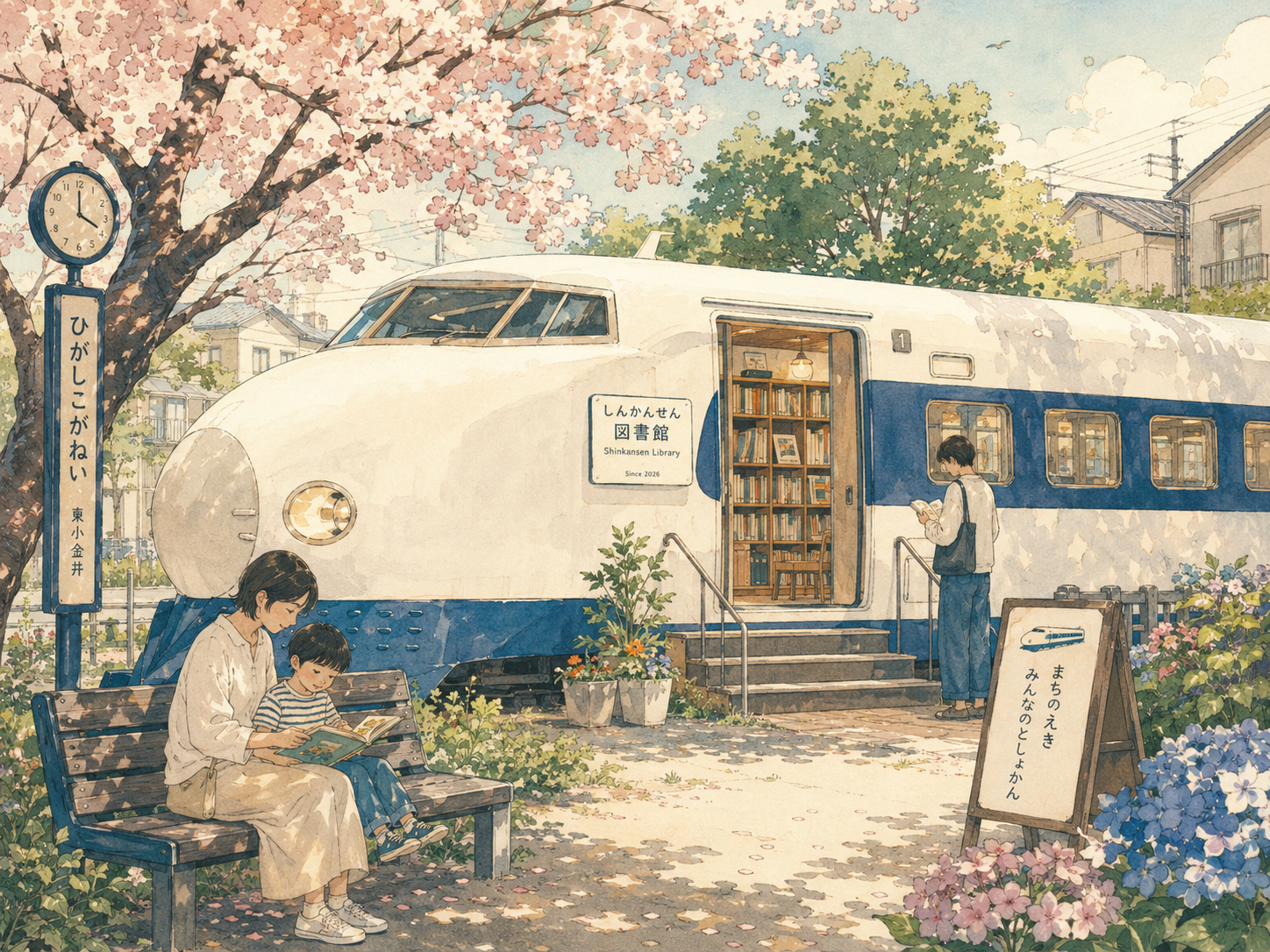
In a Tokyo suburb, a bullet train has stopped running and started reading. There is no platform announcement, no reserved-seat ticket, no green-car upgrade, no rush to Osaka. The white-and-blue 0-series Shinkansen car sits in a park in Akishima, its old aerodynamic nose no longer aimed at the future but at childhood memory. Inside, the machinery of speed has become the furniture of attention: shelves, books, quiet voices, parents, children and the soft public ritual of choosing what to read next.
The Mainichi’s July 2026 feature brought renewed attention to the “Shinkansen Library,” a retired 0-series car in Akishima that began its second life in April 1992. Preservation records identify the car as 21-100, built in September 1973 and withdrawn in October 1991 before being reused by the city as a library reading room. What might have been scrap metal became civic architecture.
The story is charming, but it is also bigger than charm. The 0-series Shinkansen was one of postwar Japan’s supreme symbols: the train of the 1964 Tokyo Olympics, of high growth, of national coordination, of punctuality, of engineering confidence. To find one reborn as a children’s library is to see modern Japan’s memory softened into local life. The future became heritage. Speed became stillness.
The 1964 dream, parked in a neighborhood
The Tokaido Shinkansen opened on October 1, 1964, just ten days before the Tokyo Olympics. It connected Tokyo and Osaka by a purpose-built high-speed railway and turned the round-nosed 0-series into a national emblem. The train did not merely move passengers. It compressed Japan’s geography and projected a message: the country that had rebuilt from defeat could now build the world’s most famous high-speed railway.
For a generation, the 0-series was not nostalgia. It was tomorrow. Its white body and blue stripe appeared on postcards, toy sets, station posters, school notebooks and children’s imaginations. It made technology friendly because it had a face. It looked like a machine, but also like a promise.
That is why the Akishima library feels so poetic. The train that once represented national velocity now represents local continuity. It no longer conquers distance. It gives children a destination close to home.
The life of car 21-100
Car 21-100 belongs to the first great family of Japanese high-speed rail. The 0-series entered service with the Tokaido Shinkansen in 1964 and remained in use in different forms until the final JR West runs in 2008. Thousands were built, but only a small number of vehicles were preserved after retirement.
According to preserved-vehicle listings, 21-100 was manufactured in September 1973 and withdrawn in October 1991. In April 1992, it began operating as the Shinkansen Library in Akishima. The transition is striking: an intercity vehicle designed for the great Tokyo-Osaka corridor became a local reading room for children.
A museum exhibit usually asks visitors to look. A library asks them to use. That is what makes Akishima’s car special. It is not only a relic behind glass. It remains a public room. The body is historic, but the use is alive.
Why a train makes sense as a library
A rail car and a library are more alike than they first appear. Both are public interiors. Both hold strangers in a shared space. Both move people somewhere else — one physically, the other imaginatively. Both require a basic civic trust: that many people can use the same place, quietly and respectfully, without owning it.
For children, the transformation is even more powerful. A conventional library can feel like a rule-filled room. A Shinkansen car feels like an invitation. The child enters a train and discovers books. The vehicle becomes bait for reading; curiosity about machines becomes curiosity about stories.
The design lesson is simple but profound. Public culture works best when it gives people a reason to cross the threshold. In Akishima, the threshold is the doorway of a retired bullet train.
Akishima and the suburban memory of modern Japan
Akishima lies in western Tokyo’s Tama area, beyond the central city’s dense symbolic machinery but very much within the metropolitan story. Suburbs like Akishima are where postwar Japanese life became ordinary: housing complexes, schools, parks, libraries, shopping streets, commuter rail, weekend family routines.
A 0-series car in this setting is not merely transportation heritage. It is a bridge between national history and everyday memory. Children who visit may not know the technical history of the Tokaido Shinkansen, Shima Hideo, Japanese National Railways or high-growth industrial policy. But they know the shape. They know that the train is special. They know it belongs to their town.
That is how heritage actually survives: not only through textbooks, but through repeated small encounters. A child climbs aboard, checks out a book, grows up, remembers the old train in the park, and carries the story forward.
Preservation by use
Japan has many rail-preservation sites: the Railway Museum in Saitama, SCMaglev and Railway Park in Nagoya, Kyoto Railway Museum, Ome Railway Park and smaller local displays. These institutions preserve the history of engineering with seriousness and care. Akishima’s Shinkansen Library belongs to a related but different tradition: preservation by use.
The car is valuable because it is still part of civic life. It is not frozen only as an object. It is assigned a new job. That matters in a country full of aging infrastructure, shrinking communities and public facilities that must justify their continued existence.
Across Japan, old schools become cafés or inns, empty houses become community hubs, closed stations become galleries, and retired vehicles become landmarks. The Shinkansen Library is part of that wider pattern. It says that reuse can be more moving than demolition and warmer than museumization.
What the little library tells us about Japan now
Japan is often described through extremes: neon Tokyo, ancient temples, robotics, population decline, food culture, anime, earthquakes, megaprojects. The Shinkansen Library belongs to a quieter category: the small civic gesture that explains the country better than a skyline does.
It tells us that Japan’s modern symbols are now old enough to become heritage. The 1964 future has become a children’s memory object. The industrial miracle has entered the park. The train that made Japan feel fast now teaches patience.
There is also an economic lesson. Local places compete for attention. A retired rail car gives a neighborhood identity. It becomes a landmark without needing a tower, a theme park or a giant redevelopment scheme. It is modest place-making — the kind that can survive because residents actually use it.
The numbers behind the story
Japan.co.jp view
The Akishima Shinkansen Library is a small story with a large emotional radius. It is not only about a train. It is about what a society does with the objects that once defined its future. Does it discard them? Lock them behind glass? Or let children climb aboard and read?
The best answer may be the Akishima answer: keep the shape, change the purpose, let the memory work. A train that once carried office workers, families and students at high speed now carries picture books, local affection and the civic idea that old public things can still be useful.
The 0-series Shinkansen once made Japan faster. In Akishima, it makes a neighborhood gentler. That is a worthy second career.
Reader takeaways
| Item | Meaning |
|---|---|
| What happened | A retired 0-series Shinkansen car in Akishima has drawn renewed attention as a library and local landmark. |
| Historical layer | The 0-series was the original bullet-train symbol of the 1964 Tokaido Shinkansen and postwar Japanese modernization. |
| Local meaning | The car is not merely displayed; it is reused as a children’s reading room and civic space. |
| Why it matters | The story shows how Japan can turn modern infrastructure memory into living community culture. |
Sources and references
This article draws on The Mainichi’s July 2026 report on the Akishima Shinkansen Library, preserved 0-series vehicle records, CGTN’s earlier report on train-car libraries, Akishima city and tourism context, and railway-preservation information from museum and rail-history sources.
- The Mainichi: From bullet train to library to landmark.
- CGTN: Train carriage turns into a library for children in Japan.
- 0 Series Shinkansen preserved vehicle records.
- Akishima City official website.
- Ome Railway Park / railway preservation context.