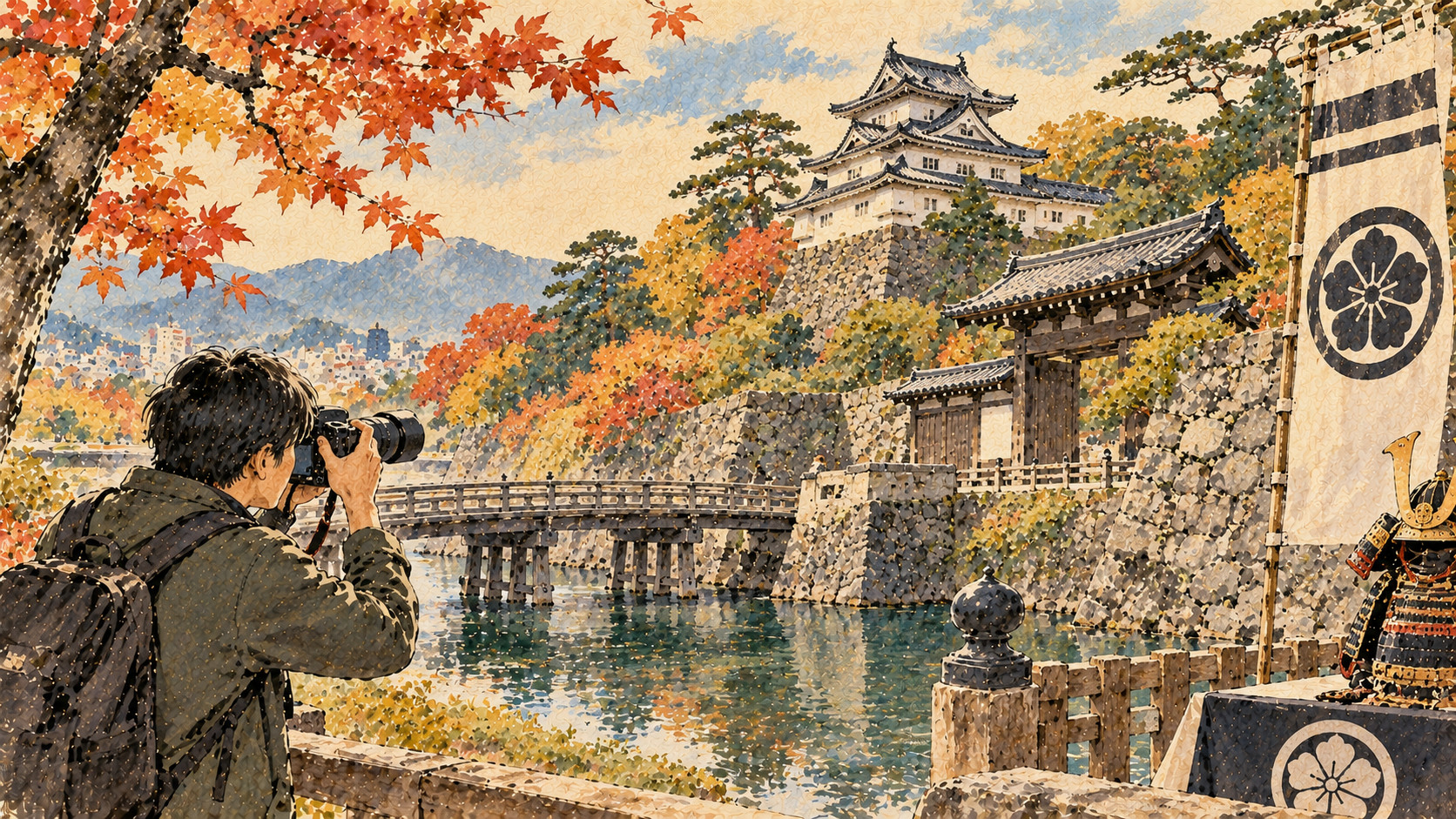
The samurai remembered in stories and the man visible in historical records are not always the same person.
A photograph cannot show five centuries—until the viewer brings them
Tokushima's castle museum is doing something unusual this autumn. Its historical exhibition asks visitors to reconsider the reputation of Hachisuka Masakatsu, a sixteenth-century retainer of Toyotomi Hideyoshi. At the same venue, photographer Shumpei Ohsugi presents contemporary images of the prefecture that invite a different encounter with the family's legacy. The photography presentation runs October 14–25; the separately organized historical exhibition runs October 10–November 23. Both commemorate the 500th anniversary of Masakatsu's birth. The tension between the two is the story: written records can challenge legends, while photographs can show what a place has become.
A meeting between Japan and the diaspora
According to the Tokushima prefectural government, Ohsugi's project grew from his meeting with Masako Hachisuka, whom the organizers identify as the nineteenth head of the Hachisuka family and a resident of the United States. The photographer traveled across Tokushima with her, making images of its scenery and cultural practices. It is a compelling premise: a heritage associated with an old ruling house is revisited by someone who lives an ocean away. Yet public announcements do not identify every photograph, document the complete itinerary or independently establish the family's current genealogy. We describe the relationship as organizers do, not as an independently audited claim.
Who was Hachisuka Masakatsu?
Born in 1526 in Hachisuka village, in what is now Ama, Aichi Prefecture, Masakatsu died in 1586 and is popularly known as Hachisuka Koroku. He served Hideyoshi and became a familiar character in later accounts of Japan's turbulent unification. Some of those accounts describe him as a fearsome outlaw. Tokushima Castle Museum explicitly warns that the popular image was shaped by later narratives and is not an adequate substitute for documentary history. Its special exhibition assembles historical material to reconsider what the man actually did. This distinction—between a colorful tale and evidence—is essential to understanding both the man and the commemorations.
The dynasty and the province are not the same person
Masakatsu is regarded as the ancestral founder of the Hachisuka family associated with Tokushima, but he must not be casually labeled the first lord of the Tokushima domain. Tokushima City's library notes that responsibility for governing Awa passed to his son Iemasa. The family then played a central role in the region from the late sixteenth century through the Edo period and into the Meiji transition. Distinguishing Masakatsu's career from the rule of his descendants is a small but telling exercise in historical care. Heritage tourism often merges generations into one dramatic figure; historical journalism should not.
What survives when a castle loses its political function?
A castle is not only its towers. The Tokushima site encompasses landscape, earthworks, stone structures and the memory of the city that developed around it. Objects preserved by the museum allow scholars to test the stories later generations told. Its Masakatsu exhibition is also the institution's 200th temporary or special exhibition since opening in 1992, according to Tokushima City. That civic milestone raises a broader question: Can a regional museum serve visitors drawn by a popular character while still complicating their expectations with the evidence? It need not choose between accessibility and seriousness.
An unexpectedly physical detail: photographs on Awa paper
The most revealing detail may be under the images themselves. Awagami Factory, which develops papers rooted in Tokushima's washi tradition, says photographs in Ohsugi's exhibition were printed using its AIJP inkjet-paper service, including Bamboo Washi 170g and Bizan Pure White medium-weight paper. The choice ties a contemporary photographic exhibition to an established local craft. Paper affects the way photographs absorb light and how tonal detail is perceived. It is not proof of superior archival durability, and the public material does not map each photograph to a particular stock. But it creates a tangible conversation between what Tokushima's artists depict and what the region makes.
Dance, puppetry and a culture still in motion
The October 17–18 program included Awa Odori dance, Awa puppet theater and opportunities to engage with traditional practices. These were not merely colorful additions to a samurai anniversary. Their continued performance depends on teaching, rehearsal, audiences and the people who maintain the traditions. The prefecture's official account confirms that Masako Hachisuka, Ohsugi and Ama's mayor took part in an October 17 discussion about history, culture and Tokushima's future. It does not supply a full transcript; no direct quotation from that discussion should be invented.
The danger in a phrase such as “last descendant”
Publicity for the project calls Masako Hachisuka the family's “last descendant” as well as its nineteenth head. The former phrase is rhetorically powerful but genealogically imprecise: it can imply there are no other living relations, something the supplied announcements do not establish. Headship, descent and the inheritance of a name are not interchangeable concepts. Japan.co.jp attributes the designation to the organizers and does not independently endorse a conclusion about the complete family tree. Respecting living individuals also means avoiding speculation about private family relationships.
Commemoration is a civic choice, not a verdict
A prefectural procurement document describes the anniversary project as a way to improve public understanding of local history and foster civic pride. Such goals are legitimate, but an exhibition's usefulness depends on what it allows citizens to question as well as celebrate. Feudal government, the lives of ordinary townspeople, and the historical production of heroic legends deserve a place in the conversation. Photography can add a complementary perspective by directing attention to present-day landscapes and communities—rather than depicting a sixteenth-century past it never witnessed.
How to visit, and what you will actually see
Ohsugi's special photo display is scheduled for October 14–25, from 9:30 a.m. to 5 p.m., closed Mondays. Admission to the photo presentation is free but admission to Tokushima Castle Museum is required. The museum's separate fall exhibition, Hachisuka Masakatsu, runs October 10–November 23. Listed museum admission is ¥500 for adults, ¥300 for high-school and university students, and free for children of junior-high-school age or younger. The museum is in Tokushima-chō Jōnai, central Tokushima City. Prospective visitors should consult the museum for updates.
What is inherited, and what is newly seen
The power of this project is not a claim that a photograph can recover an unbroken five-hundred-year memory. It cannot. The photographs are present-day works; the historical exhibits are interpretations built from surviving evidence. Together, they invite a stronger question than nostalgia alone: what parts of a city's past are still visible in its places, traditions and materials, and which parts must be rediscovered by difficult historical investigation? For a reader far from Tokushima, that is an invitation to see regional Japan as more than a picturesque backdrop.
Sources and further reading
Primary Tokushima prefectural and city sources. Organizers’ descriptions of family lineage are attributed, not independently certified.
- 徳島県:蜂須賀正勝公生誕500年記念事業 / Tokushima Prefecture program
- 徳島県:10月17日トークショー記録 / Prefectural event report
- 徳島城博物館:秋の特別展 / Museum historical exhibition
- 徳島市:蜂須賀正勝と記念講演会 / City history and program
- 徳島市:市長会見・史実と伝承 / Mayor’s briefing
- 徳島市立図書館:蜂須賀家特別展示 / Library archival display
- アワガミファクトリー:展示用和紙 / Awagami paper details
- 徳島県:写真展示案内 / Photography announcement