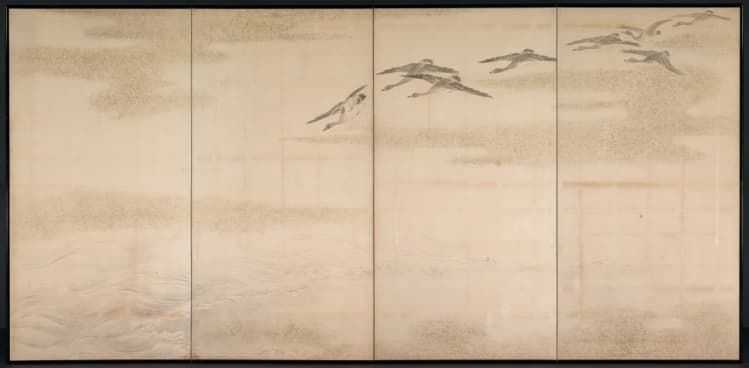
The geese draw the eye, but the intervals around them hold it. In Yamamoto Baiitsu’s Geese, Reeds, and Water, a flock crosses a broad field of pale space, while another screen brings birds close to a tangle of reeds. Dark feathers, thin stems and lightly indicated water give the eye different speeds at which to travel.
For Japan.co.jp’s September 13 Aichi edition, this is a painting to spend time with. Baiitsu was born in Nagoya in 1783 and died in 1856. Cleveland Museum of Art dates the work to the nineteenth century and identifies it as a pair of four-panel screens, painted in ink and colour with cut gold foil on paper. [1] The connection to autumn is our choice of emphasis, rather than a claim that the artist made it for September.
Two kinds of movement
The museum’s combined photograph places one screen above the other. In the upper image, a lone flying goose approaches the visual territory of two birds among reeds. In the lower image, the flock stretches across the upper portion of the composition; water gathers towards the bottom. This stacked presentation is a way of reproducing the pair, not evidence of their original arrangement in a room.
Try following the birds first, then looking at everything except them. The reeds create a dense knot of marks. Beside it, the surface opens. Below the flying flock, the eye has room to move before meeting the water. The sensation of flight comes partly from that contrast between concentration and release.
The resting birds seem to anchor one screen, while the flock carries attention across the other. Read together, the two produce an exchange between arrival and departure, staying and moving. This is a visual interpretation of the surviving work, not a recovered statement of Baiitsu’s intentions.
It is also why the proposed phrase “autumn’s rhythm” suits the selection. The work need not display a blaze of red leaves to prompt thoughts of seasonal change. Its movement and spaciousness offer a quieter register: a season felt through the relationships between living things and their surroundings.
Gold that leaves room
Gold appears in uneven bands and patches, rather than as a continuous field. In the photograph it seems to add another layer between the birds and the pale ground. It does not close off the intervals that make the composition expansive.
A digital reproduction has limits here. It records the distribution of the gold and its relationship to ink, but cannot reproduce every change of reflection as a viewer shifts position before the object. Claims about the work glowing in a particular room would go beyond what this image can establish. There is enough to examine in the visible pattern itself.
For another Baiitsu flower painting, Kyoto National Museum highlights restrained colour and dry ink lines. [5] That description offers a useful prompt for looking closely, without making every work identical. In these screens, compare a bird’s detailed plumage with a lightly drawn stem or a scarcely articulated stretch of water. Different densities of attention coexist.
A Nagoya painter in a wider world
Nagoya City Museum places Baiitsu’s birthplace in Tendō-chō, in the area now known as Ōsu. It describes his study of Chinese paintings in the collection of Kamiya Tenyū, followed by contacts with cultural figures in Kyoto and Edo. Kyoto became an important base; he spent his final years back in Nagoya. [2]
This makes him a particularly apt choice for an Aichi edition, but not a painter whose career can be contained within present-day prefectural boundaries. Local access to a collection opened a route into art from elsewhere. Travel and personal relationships extended it.
The city museum’s account of early-modern Owari culture places Baiitsu and Nakabayashi Chikudō within nanga, a field shaped by study of Chinese Ming and Qing painting. [3] That background matters because it describes a way of learning, as well as a category of pictures. Looking at older works, sharing knowledge and cultivating relationships were part of the environment in which a painter developed.
More than monochrome
The subdued character of these screens should not flatten Baiitsu’s entire career into a single palette. Tokyo Fuji Art Museum describes his detailed, colourful bird-and-flower painting and holds a work dated 1850, Birds and Flowers of the Four Seasons, in colour on silk. [4]
A Japanese cultural-heritage record for his 1844 painting of flowers and insects, held by Nagoya City Museum, provides another perspective. Its commentary connects his work with late-Edo interest in natural history and increasingly precise depictions of insects. [6]
Study of established painting traditions and close attention to living things could therefore operate together. The birds in Cleveland’s screens reward scrutiny, yet scrutiny alone does not explain the result. Selection matters too: where the artist concentrates detail, where the marks thin out, and how much of the surface remains comparatively open.
The uncertainty within the frame
Cleveland adds a significant qualification to the work’s present form. Because the mounting is modern, the museum cannot establish whether the current four-panel format preserves the original design. It raises the possibility that panels were removed to accommodate a modern interior. That remains a possibility, not a documented reconstruction of missing sections. [1]
Consequently, it would be too confident to treat every surviving outer edge as proof of Baiitsu’s initial plan. The object we see has a history after its making. Its present balance is available to admire, while the original configuration remains uncertain.
That uncertainty does not prevent close looking. It changes the language used to describe what is there. We can discuss the rhythms of the surviving screens without pretending to know everything about the room, patron or arrangement for which the painting was first intended.
A pause beside the water
There is no verified basis here for identifying the painted setting as a particular Aichi shore or field. Its relationship to this edition’s countryside and coastal reporting is editorial. After stories about land, cultivation and the sea, the painting offers another way to attend to water, vegetation and the spaces between them.
Cleveland makes the work available through its open-access programme. [7] The image accompanying this article reproduces the museum’s artwork, retaining both screens and their panel divisions. It is not an AI interpretation of Baiitsu’s style.
Look at the geese, then the water, then the distance between them. A picture filled with movement can still slow a viewer down. That is the quality worth carrying into this Sunday: not only the birds’ flight, but the generous space in which it happens.
- Cleveland Museum of Art: object record and mounting uncertainty
- Nagoya City Museum: Baiitsu’s portrait of Hata Kanae and biography
- Nagoya City Museum: early-modern Owari culture and nanga
- Tokyo Fuji Art Museum: Baiitsu and Birds and Flowers of the Four Seasons
- Kyoto National Museum: Flowers, artist reading and style
- Cultural Heritage Database: Flowers and Insects, Nagoya City Museum
- Cleveland Museum of Art: open access and CC0 images