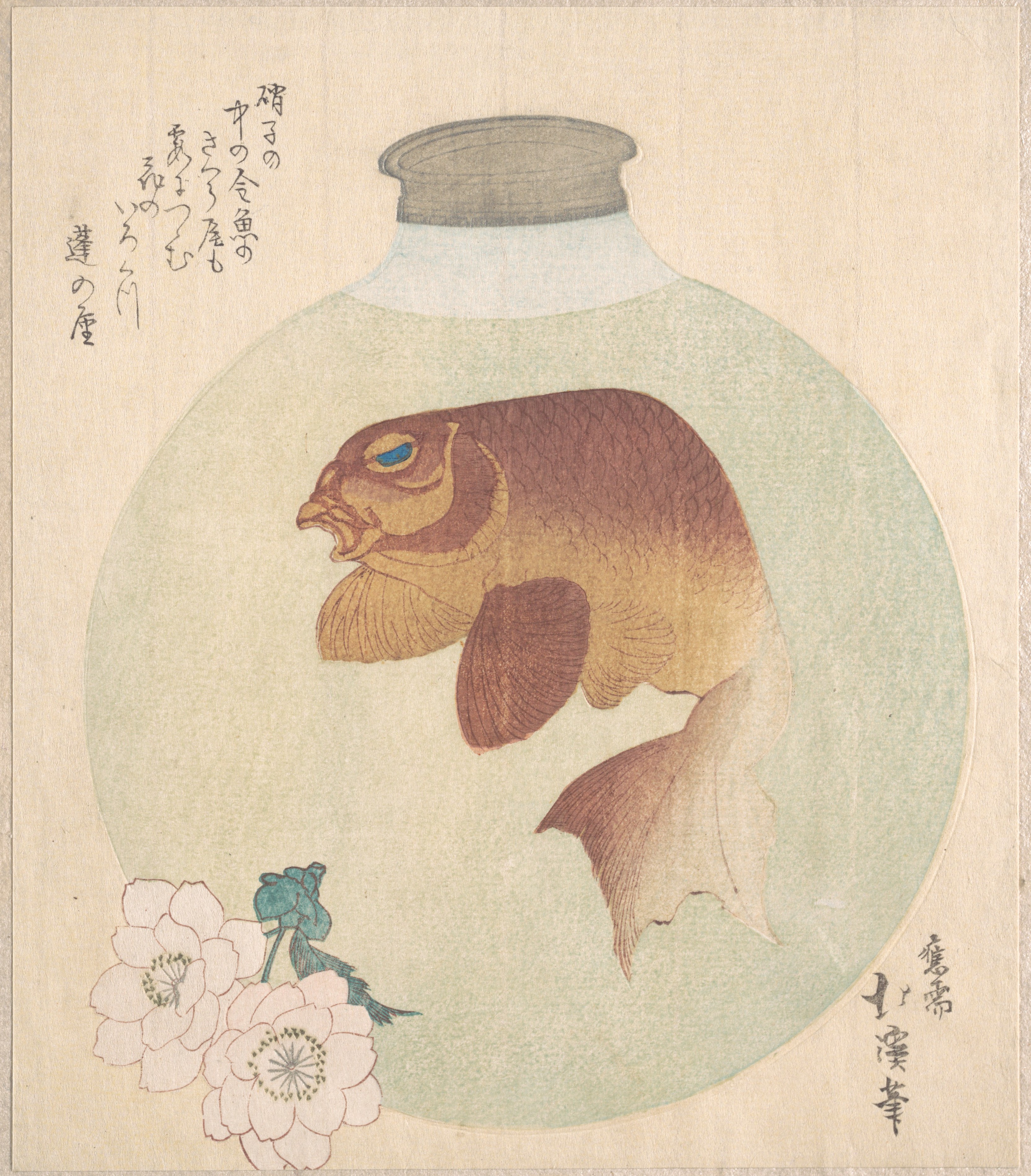
The first thing that catches the eye may not be the fish but the transparent object changing it. The bottle pushes outward into a round belly, then narrows abruptly at the neck. Inside, the red fish seems to have lost its ordinary scale. Its body balloons; its tail spreads; curved glass appears to remake a living creature for the duration of a glance.
Totoya Hokkei (1780–1850) was not drafting a diagram of optics. He was arranging contour, pale water, blank paper and a poem into a single field. The vessel becomes an instrument for seeing. Its enlargement and distortion are best understood not as a calibrated account of refraction but as an artist’s translation of the surprise of looking through a curved surface.
The print measures 7 7/8 by 6 7/8 inches, or 20 by 17.5 centimeters—roughly the space of two open hands. The Met identifies it as a woodblock print in ink and color on paper and, crucially, as a surimono. This was not a landscape series made for broad shop-counter circulation. It belonged to a more intimate economy in which pictures and poems were made to be read close up and exchanged among people who shared the joke.
“Totoya,” not simply “the fish shop”
His name matters. The Tokyo Metropolitan Library records 魚屋北渓 as Totoya Hokkei. Ishikawa Prefectural Museum of Art uses the same reading and says Hokkei first studied under Kano Yosen’in Korenobu before becoming a pupil of Katsushika Hokusai. It traces the art name 魚屋—literally “fish shop”—to Hokkei’s earlier occupation and identifies comic-poetry prints and illustrated poetry books as specialties.
“Pupil of Hokusai” is essential context, but it can also become a lazy substitute for looking. Hokkei’s achievement often operated at another scale and through another social channel. Where Hokusai’s most familiar images can command weather, sea and mountain, this sheet makes a world from a household vessel, one fish and the pressure of a few lines of verse.
A dated comparison helps without pretending to date this print. Chiba City Museum of Art records Hokkei’s Kintaro and the Boar as a shikishiban surimono from 1827, measuring 20.1 by 16.9 centimeters—very close to the Met sheet. The resemblance of format places Gold-Fish comfortably within Hokkei’s practice. It does not justify narrowing the Met’s deliberately broad “19th century” date.
A print that was not ordinary merchandise
Surimono followed a different path through Edo print culture. The Ashmolean Museum describes them as privately produced works exchanged on special occasions, particularly New Year, among members of poetry clubs from the late eighteenth to the mid-nineteenth century. Many paired pictures with kyōka: witty, sometimes playfully subversive poems that retained the classical 31-syllable waka pattern.
Because these sheets were not standard mass-market stock, patrons could support unusually refined paper, carving and printing. Across the genre one finds blind embossing, mica or metallic effects, thick paper and exquisitely cut letterforms. Precision is necessary here: the Met’s object record lists only ink and color on paper for this particular impression. A digital photograph is not enough to declare which costly pigment or special effect it contains.
Luxury does not always announce itself with brilliance. Hokkei’s bottle is almost colorless. To print transparency, he cannot simply fill a shape. He must establish an edge, a waterline and the changes suffered by whatever lies behind the glass. An invisible material becomes visible through its consequences. That restraint is this sheet’s extravagance.
When goldfish became an Edo summer
The National Diet Library’s history of the goldfish boom supplies the seasonal ground beneath this image. In the early Edo period, goldfish were ornaments for wealthy merchants, daimyo and aristocrats. Aquaculture later lowered prices. A husbandry manual, Kingyo sodategusa, appeared in 1748, and the craze peaked in the Bunka and Bunsei eras, 1804 to 1830. Goldfish vendors and goldfish scooping came to signal summer’s approach in the streets.
The same account makes an important distinction about looking. Large glass tanks were unavailable. Goldfish were generally kept in ceramic bowls and viewed from above—a practice called uwami. Prints also preserve the sight of small round glass vessels, kingyodama, hung up to create a feeling of coolness. Hokkei exploits the comparative novelty of the side view. The fish is no longer observed across the open surface of a bowl. It faces us through a transparent wall, and that wall refuses to remain neutral.
“Traps summer” is therefore an interpretation, not a claim about the month in which the sheet was printed. It names the seasonal associations goldfish carried in Edo visual culture and the concentration of water, coolness and red movement within the bottle. Pale flowers at the bottom invite further seasonal reading, but the Met’s record does not identify their species; neither will this article.
Refusing to pretend the poem has been settled
Several lines of calligraphy occupy the upper left. On a surimono, they are not a label pasted into spare space. They are half of the event. The verse appears to draw glass, the fish’s spreading tail and flower color into a verbal play that answers the image.
Yet the Met’s public entry supplies no transcription, poet attribution or translation. Moving cursive Edo script into modern type is itself an editorial act, and secondary transcriptions available online are not fully consistent. We have therefore not printed an unverified text as though it were settled. An article that looks carefully at Hokkei’s picture should not become careless the moment it reaches the writing.
That limit is revealing. The poets, artist, carvers, printers and first recipients shared references that do not automatically open for a modern audience. A surimono is both a beautiful object and a piece of private correspondence. We stand outside the bottle, peering into a conversation whose visual half remains clearer than its words.
The curved vessel becomes a theater
The fish occupies the center but has little apparent room. The pinched neck, rounded bottom and sloping waterline make enclosure palpable. A contemporary viewer may also register discomfort at a living animal confined in such a small space. That reaction is legitimate, but this image alone cannot document an actual long-term method of husbandry or settle Edo attitudes toward animal welfare. It is a composed poetic scene, not an aquarium inspection.
What it does establish is that the bottle is more than a container. Its perimeter becomes a frame; its curvature acts like a lens; the water performs as stage light. The fish is at once an animal and an actor enlisted to reveal transparency, scale and distortion.
Exactly when in the nineteenth century was the print made? Which poetry circle ordered it? How many impressions were pulled? The Met’s public record does not say. Those absences should remain absences. Around them, paper, color, calligraphy and the sensation of curved glass still speak with uncommon force.
A small summer travels to New York
The sheet is now in the Met’s Asian Art collection as JP2160. Its credit line records the H. O. Havemeyer Collection and a 1929 bequest from Mrs. H. O. Havemeyer. The museum designates the image Public Domain and makes public-domain images available under its Open Access policy for unrestricted use without fee or permission.
A high-resolution screen lets us enlarge the fish far beyond anything Hokkei or his first recipients encountered. That access is valuable, but it can erase scale. On a 20-centimeter sheet, the tremor of a contour, one pale passage of blue and a single character in the poem work within the same intimate reach. After zooming in, it is worth shrinking the image again until it could be held.
At that distance, summer is not a panorama. It consists of a transparent wall, a thin tint of water, one red fish and a poem intended for someone. Hokkei did not merely seal a season in glass. He used glass to bend the act of seeing a season.
- The Metropolitan Museum of Art, “Gold-Fish in a Glass Bottle” — title, artist, dates, period, medium, dimensions, credit line, object number and rights status.
- The Met Open Access — policy for public-domain images.
- Tokyo Metropolitan Library, TOKYO Archive — official Japanese reading of Hokkei’s name, life dates and print classification.
- Ishikawa Prefectural Museum of Art, “Totoya Hokkei” — teachers, origin of the art name and principal fields.
- Chiba City Museum of Art, Kintaro and the Boar — comparative dated shikishiban surimono record.
- National Diet Library, “The Arrival and Boom of Goldfish” — diffusion, Bunka-Bunsei boom, summer associations, overhead viewing and glass goldfish globes.
- Ashmolean Museum, “Surimono and Poetry” — private production, poetry clubs, kyōka and gift exchange.