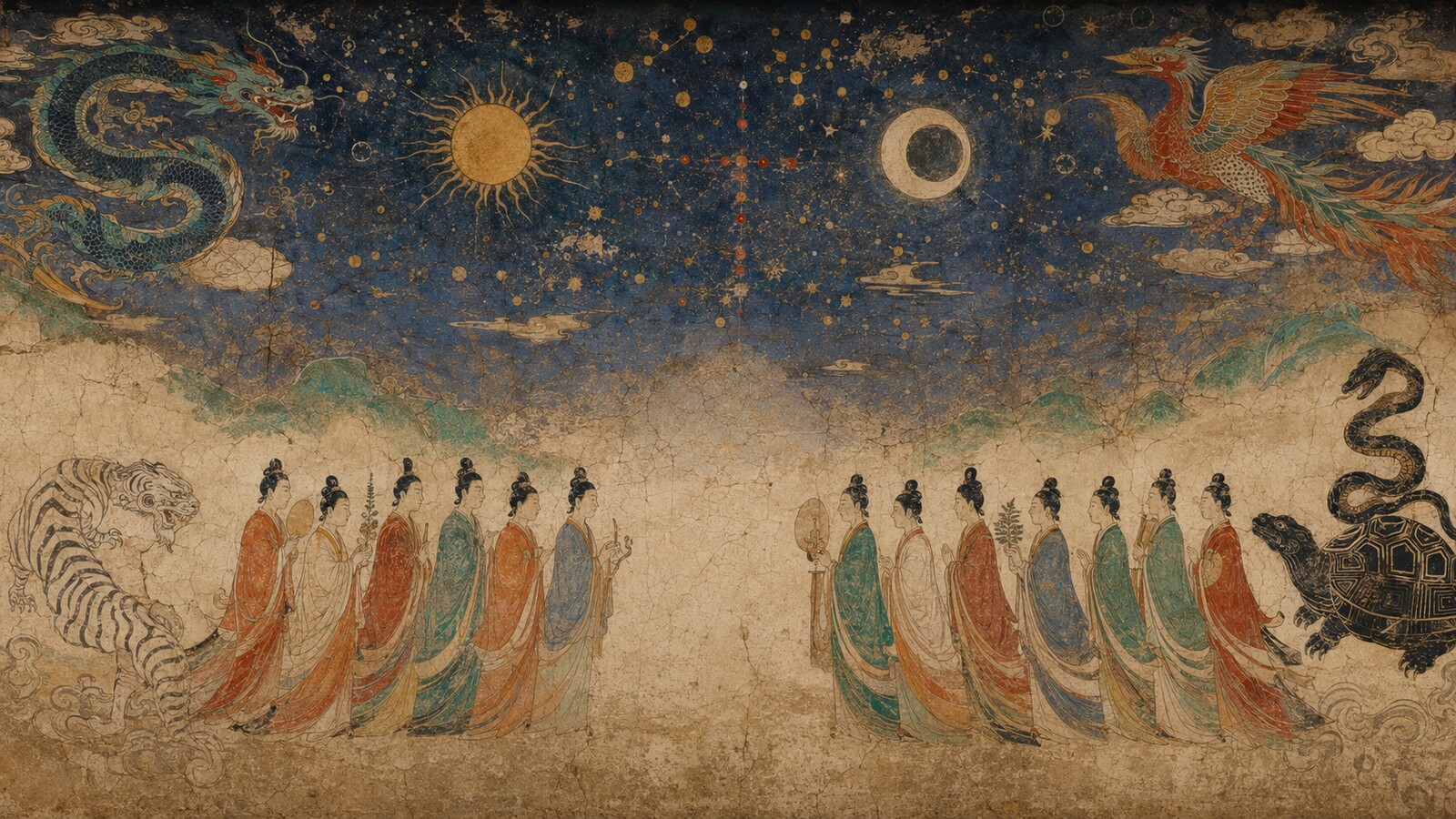
Begin with the dimensions, because they overturn the image that fame has made. Takamatsuzuka does not contain a painted hall. Its burial chamber is roughly 2.65 meters long, 1.03 meters wide and 1.13 meters high. An adult cannot stand upright. Two people would struggle to pass. The artists worked on plaster only millimeters thick, spread across sixteen fitted slabs of pale tuff, in a room that narrowed every gesture.
Then they made it immense.
On the east wall they painted male attendants, the Azure Dragon beneath the sun, and female attendants. On the west they balanced that sequence with men, the White Tiger beneath the moon, and women. At the north end, a tortoise and coiling snake formed the Black Warrior. Above, round pieces of gold leaf became stars linked by vermilion lines. The south wall and doorway were violated by medieval robbers; the Vermilion Bird expected there is gone.
The resulting work is not a landscape in the modern sense and not a sequence of incidents. It is an environment. Human service occupies the lower world. Guardian creatures fix the four directions. Sun and moon establish east and west. The ceiling turns masonry into heaven. A lacquered wooden coffin once lay at the center. The unnamed dead person was not shown traveling through the cosmos. The cosmos was organized around the dead.
The faces that made a nation look backward
Millions of Japanese know four of the figures even if they have never visited Asuka. The west-wall women—wearing yellow, pale pink, red and green—became the “Asuka Beauties.” Their rounded faces, dark hair, striped skirts and overlapping silhouettes appeared in schoolbooks and exhibitions. They are small, roughly forty centimeters high, but modern reproduction detached them from the claustrophobic wall and enlarged them into national icons.
The nickname is affectionate and dangerous. “Beauties” encourages us to read the women as portraits posed for admiration. They are probably better understood as members of an ordered retinue. The four figures do not look out to meet the spectator. They turn toward and away from one another, carry implements and form a group through staggered bodies and intervals of empty plaster. Their subject is attendance.
Early eighth-century Tang tombs help explain that social role. The tombs of Princess Yongtai and Prince Yide, both completed in 706 near the Tang capital, contain processions of court women and male officials. Nara researchers note that those figures served the dead royal person in imagery as attendants had served in life. Takamatsuzuka’s groups are not copies of those murals, but the comparison makes their courtly logic legible.
The official Japanese National Treasure description is appropriately nuanced. It links Takamatsuzuka’s themes and overall composition to Goguryeo tomb painting, while identifying spatial depth, shading, layered color and brushwork with newer Tang painting. Scholarship has long debated which route mattered most: direct contact with China, knowledge transmitted through the Korean Peninsula, immigrant-descended artists in Japan, or some combination. The painting itself argues for combination. Cultural forms traveled, accumulated histories and were remade in a Japanese court society.
How to read the room
| Surface | Surviving image | Work within the chamber |
|---|---|---|
| East wall | Male attendants; Azure Dragon; sun; female attendants | Associates east, daylight and the dragon while presenting a courtly retinue |
| West wall | Male attendants; White Tiger; moon; female attendants | Balances the east wall with west, night and the tomb’s most famous figure group |
| North wall | Black Warrior: tortoise entwined by a snake | Guards north and closes the chamber behind the coffin |
| South wall | Painting lost after tomb robbery | The Vermilion Bird of the south is inferred from the directional system, not preserved at Takamatsuzuka |
| Ceiling | Gold-leaf stars joined by red lines | Changes the flat ceiling into a schematic celestial canopy |
The four guardian creatures are older than the tomb and larger than any one religion. In Chinese-derived cosmology, the Azure Dragon belongs to the east, the White Tiger to the west, the Vermilion Bird to the south and the Black Warrior to the north. They were directions made animate—protective presences that could orient cities, palaces, banners and graves.
At Takamatsuzuka, the system does more than decorate. If the animals merely filled empty wall, placing each in its proper direction would not matter. Here orientation is the content. The sun appears in the east above the dragon; the moon in the west above the tiger. The north wall receives the dark tortoise-and-snake deity. The damaged south is understood because the other walls construct an expectation.
The ceiling requires another caution. It is often called an astronomical chart, but Takamatsuzuka’s seishukuzu is a schematic design of star lodges rather than a measured map of the sky. The nearby Kitora Tomb preserves the far more systematic celestial chart, with circles for the celestial equator and ecliptic. Confusing the two takes something away from each. Kitora displays technical astronomical ordering; Takamatsuzuka makes the stars ornamental, symbolic and spatially overwhelming.
The round gold-leaf points would have answered light in a chamber meant eventually to become dark. Red lines made relations visible between them. The paradox is essential: almost no living viewer was intended to spend time inside this sky. The labor and precious material were committed to an audience of the dead, the ritual participants who briefly saw the chamber, and whatever powers the images addressed.
Color made from earth, metal—and an insect
“Mineral pigment” is a useful description of much of Takamatsuzuka’s palette, but not the whole story. Early scientific work on tiny fallen fragments identified vermilion, an intense mercury sulfide red; red iron oxide; copper-bearing greens and blues associated with malachite and azurite; yellow earth; and gold leaf. Later portable X-ray fluorescence allowed conservators to examine specific painted locations without taking samples. Lead was found widely, and subsequent work identified lead white in layered white passages.
Those names can make the process sound like a recipe. It was closer to engineering at the scale of a brush hair. Cut stone first had to carry a thin lime-plaster skin. Artists established outlines, controlled overlaps and built color in layers. Gold leaf had to adhere in tiny circles. Dense pigments behaved differently from translucent colorants. Every choice was made in a chamber scarcely wider than the painter’s shoulders.
It is also misleading to call the work simply “fresco” and stop there. Conservation scientists have compared evidence for painting into wet lime plaster—the method called buon fresco in Europe—with painting on a dry surface, or a secco. Takamatsuzuka’s stratigraphy, underlayers and later condition do not collapse neatly into one imported Western category. The responsible description is the physical one: pigments and metal leaf were applied over a very thin plaster ground, sometimes in layered structures, with the exact sequence still studied.
In February 2026, the Culture Agency’s mural-conservation panel presented a particularly vivid result. Non-destructive spectral study of the pale-pink garment on one west-wall woman found an organic crimson colorant consistent with lac dye, used together with a white ground. Lac comes from scale insects native to warmer parts of South and Southeast Asia. Researchers had proposed the identification in earlier work; the new report brought it back into the conservation record with stronger analysis.
A color that looks local to a textbook page therefore contains a long route. The pink joins imported mirror technology, continental cosmology and trans-Asian painting practice as material evidence of circulation. It also revises the phrase “mineral palette.” Takamatsuzuka’s color world included stone and metal, but also an insect-derived substance that had traveled toward the Japanese court.
- Red: vermilion and iron-oxide red are securely identified; earlier suggestions of additional lead reds require attention to sampling and contamination.
- Green and blue: copper is present, supporting mineral greens and blues such as malachite and azurite; not every colored passage has the same level of identification.
- White: lime plaster forms the ground, while lead-white layers occur in painted white areas.
- Gold: thin circular pieces of gold leaf form stars; gold was also associated with the sun image.
- Pink/crimson: 2026 reporting identified lac-derived organic color in one west-wall woman’s garment, a reminder that not all of the palette was mineral.
A ginger hole, a cut stone and a national sensation
The modern story began without grandeur. Around 1962, according to the official park history, a resident digging a hole about sixty centimeters wide to store ginger struck a squared tuff stone on the mound’s south side. A planned footpath later prompted archaeological investigation. In March 1972, under archaeologist Masao Suenaga, a team centered on Zenkyō Aboshi of Kansai University, with researchers and students from Kansai and Ryukoku universities, opened the excavation.
On March 21, color appeared. The find was announced to newspapers five days later and became front-page news across Japan. Asuka Village records that a color image of the mural was the first cultural-property discovery to occupy the color front page of a national newspaper. “Asuka Beauties” entered popular language. Tourism, television and publishing turned a small mound into the center of an archaeology boom.
The discovery changed more than taste. It expanded public understanding of the final phase of mound building, when elite burials were becoming smaller and more geometrically controlled even as their interiors acquired sophisticated images. It encouraged comparative study across East Asia. It strengthened calls to preserve Asuka’s historical landscape, a movement that later contributed to the special legal framework known as the Asuka Law.
Yet the room had already suffered. Robbers, probably in the medieval period, breached the south side, disturbed the lacquered coffin and removed much of the burial wealth. What remained included coffin fittings and nails, glass and amber beads, sword fittings and a bronze “marine-beast and grape” mirror. A mirror cast from the same model was recovered from a tomb in Xi’an dated to 698, helping place Takamatsuzuka in the early eighth century. Excavation of the mound in 2005 further assigned construction to the Fujiwara-capital years, 694–710.
The person at the center is still missing
The tomb’s patron commanded expensive materials, court painters and a burial program intelligible across East Asia. That makes the absence of a name irresistible. Candidates have included sons of Emperor Tenmu, the high official Isonokami no Maro and elite people of immigrant ancestry. The nearby area contains burials closely connected with the Tenmu court, and the surviving goods imply high status. None supplies an inscription that closes the case.
The uncertainty is not a failure of archaeology. It is a limit that improves the looking. If one prince were securely named, every figure might become an illustration of his biography. Without that name, the chamber is forced to speak through its own structure: rank, attendance, direction, celestial order, material reach.
Nor should “court” be mistaken for documentary realism. The figures may preserve aspects of contemporary fashion—the National Treasure record calls their look a reflection of current style—but they also perform ideal service. The four guardians do not prove a private religious creed. The stars do not show the night of burial. The room is a constructed image of how power wished eternity to be arranged.
Discovery altered the thing discovered
For roughly thirteen centuries the sealed chamber maintained an extreme but comparatively stable underground environment. Opening it introduced air, equipment, human heat and new biological risks. The interior remained near 100 percent relative humidity. Even a short visit could raise temperature and lower humidity. A conservation facility completed in 1976 tried to match the conditions of an antechamber to those within the tomb, and multiple repair campaigns followed.
Mold appeared in force in 1980 and was treated. More serious discoloration, fungal growth and plaster weakness became evident in photographs taken in 2002 and 2003, then publicly known in 2004. The painted skin was not stone. It was a fragile layer only millimeters thick, increasingly detached from its support. Preservation in place—the principle archaeologists normally prefer—had become a threat to the object it was meant to respect.
The crisis also exposed a failure of governance. A 2006 external investigation examined inadequate mold precautions during earlier work, accidental damage to the west wall in 2002, retouching and failures to disclose what had happened. The report did not conclude that an organized cover-up had occurred. It did say that missed opportunities, poor coordination and a lack of routine openness created the impression of concealment and damaged public trust.
That history belongs inside the aesthetic story. Conservation is not invisible housekeeping performed after art. It changes what can be seen, where it can be seen and whose judgment is trusted. Takamatsuzuka’s beauty survived through extraordinary technical work, but its management also became a national lesson in documentation and accountability.
Taking a tomb apart to keep it whole
In 2005, authorities chose the radical option: dismantle the chamber and move its painted stones for treatment. Excavation and disassembly began in 2006. By 2007, the slabs had been transferred to a purpose-built temporary facility in the national park. Conservators removed mold and dirt under magnification, stabilized weak plaster, rejoined fragments, recorded minute change and managed the stones in a controlled environment.
The principal thirteen-year conservation campaign was completed in fiscal 2019, reported in 2020. The original plan had imagined returning the chamber after treatment, but research and official review concluded that stable preservation outside the mound should continue. The earthwork visitors see today is reconstructed; it shelters the archaeological place, not the original paintings reassembled in their burial darkness.
This separation produces a philosophical wound. A mural is made for a wall, and Takamatsuzuka’s meaning depends unusually strongly on direction and enclosure. Removing the stones saved material while breaking the experience for which it was made. Replicas can restore layout but not original substance. The conserved originals provide substance but no longer provide burial space. There is no solution without loss; there are only better documented choices about which losses prevent larger ones.
c. 694–710 — Tomb and painted chamber made during the Fujiwara-capital period.
Medieval period — Robbers breach the south side; the presumed Vermilion Bird and many grave goods are lost.
March 21, 1972 — Full-color murals discovered; national archaeological and Asuka boom follows.
1973–74 — Mound designated a Special Historic Site; murals designated a National Treasure.
1976 — Environmental conservation facility completed; repair campaigns proceed through 1985.
2002–04 — Severe mold, discoloration and plaster instability become clear; management controversy intensifies.
2006–07 — Chamber excavated, dismantled and moved to a temporary conservation facility.
2020 — Completion of the main thirteen-year conservation campaign announced.
July 26, 2026 — Takamatsuzuka becomes one of 19 components of the inscribed Ancient Capitals of Asuka and Fujiwara World Heritage property.
The masterpiece during its closed-door years
The last scheduled viewing in the temporary conservation workroom was the 52nd, held January 17–23, 2026. The Culture Agency suspended the recurring public openings because the adjacent park building is being closed and demolished as part of redevelopment; vibration and other construction effects must be controlled around the paintings. Planning documents aim to bring a new conservation, management and public-access facility into service by fiscal 2029.
That means the original “Asuka Beauties” cannot currently be treated as a normal museum stop. The mound and surrounding national park remain meaningful, and the Takamatsuzuka Mural Museum has displayed full-scale copies, present-condition copies and reconstructions that let visitors understand the chamber’s arrangement. But schedules and access conditions should be checked with official sources before travel as redevelopment advances.
The pause is frustrating, especially after UNESCO inscribed the Ancient Capitals of Asuka and Fujiwara on July 26 and placed Takamatsuzuka among the property’s nineteen components. Yet closure can itself be an honest heritage act. A National Treasure does not owe every generation unlimited exposure at the cost of the next one.
UNESCO’s decision makes that responsibility international without changing ownership. Its recommendations ask Japan to continue research into the conservation and possible future relocation or reinstallation of the removed Takamatsuzuka and Kitora paintings. The language recognizes the unresolved problem: how to reunite image, orientation and place without recreating the conditions that once endangered them.
Why this is today’s Art Choice
Takamatsuzuka is easy to reduce to four women. They are graceful, immediately human and already famous. But the full artwork begins where the textbook crop ends. Walk mentally from women to moon, from moon to tiger, across the coffin to dragon and sun, then upward to gold stars. The chamber is not a gallery of separate motifs. It is one spatial sentence.
Its grammar is authority. The retinue says the deceased remains served. The guardians say the directions remain secure. The paired lights say time and opposition remain ordered. The stars say the world above has a pattern. Art here does not express private feeling; it manufactures permanence for a political elite facing the absolute disorder of death.
And still, permanence failed in revealing ways. The name disappeared. Robbers entered. Gold was scraped or lost. Water moved through plaster. Mold fed on the altered environment. Conservators dismantled the architecture to rescue its painted skin. What remains is not untouched antiquity but a collaboration—unequal and unchosen—between ancient painters, medieval intruders, modern archaeologists, microbes, chemists, administrators and the public.
That does not diminish the work. It makes its small room larger. Takamatsuzuka contains the world imagined by the early Japanese court, the maritime routes by which pigments and ideas reached it, the modern nation that fell in love with its rediscovered faces, and the difficult ethics of carrying a fragile image forward. One meter of width is enough, it turns out, for a universe—and for thirteen centuries of consequence.
Reporting Notes and Sources
Historical, scientific, conservation and access information was checked through July 30, 2026, at 10:12 a.m. JST. Chamber dimensions follow the detailed Japanese official park account; one older English Culture Agency page contains a conflicting width that appears inconsistent with current Japanese records. Pigment identifications are stated at the level supported by analytical reports, which distinguish secure compounds from tentative inference. The tomb’s occupant remains unidentified, and the lost south-wall Vermilion Bird is an inference from the directional program. The hero is contemporary conceptual art, not the original mural.
- Asuka Historical National Government Park: discovery, chamber plan, mural layout, objects and conservation history
- Agency for Cultural Affairs: official overview of Takamatsuzuka and Kitora tumuli
- Cultural Heritage Online: National Treasure record and Goguryeo–Tang artistic context
- Agency for Cultural Affairs: official chamber elevation and painting guide
- Asuka Village: 50th anniversary history and public impact of the 1972 discovery
- Takamatsuzuka Mural Museum: replicas, name, occupant theories and marine-beast grape mirror
- Nara National Research Institute for Cultural Properties: Tang royal mural tombs and the role of attendants
- Journal of Korean Art and Archaeology: Takamatsuzuka, Kitora and their relationship to Goguryeo cultural traditions
- Tokyo National Research Institute for Cultural Properties: portable X-ray fluorescence pigment study
- Tokyo National Research Institute for Cultural Properties: history and reassessment of mural-material investigations
- Agency for Cultural Affairs: February 25, 2026 conservation panel and mural-material reports
- Mainichi Shimbun: 2026 report on lac-derived crimson detected in the west-wall women’s garments
- Agency for Cultural Affairs external investigation: damage, disclosure failures and conservation governance
- Agency for Cultural Affairs: suspension of temporary-workroom viewings during redevelopment
- Agency for Cultural Affairs: permanent facility plan and fiscal 2029 service target
- UNESCO World Heritage Centre: Ancient Capitals of Asuka and Fujiwara, official list entry
- UNESCO World Heritage Committee: inscription decision and conservation recommendations