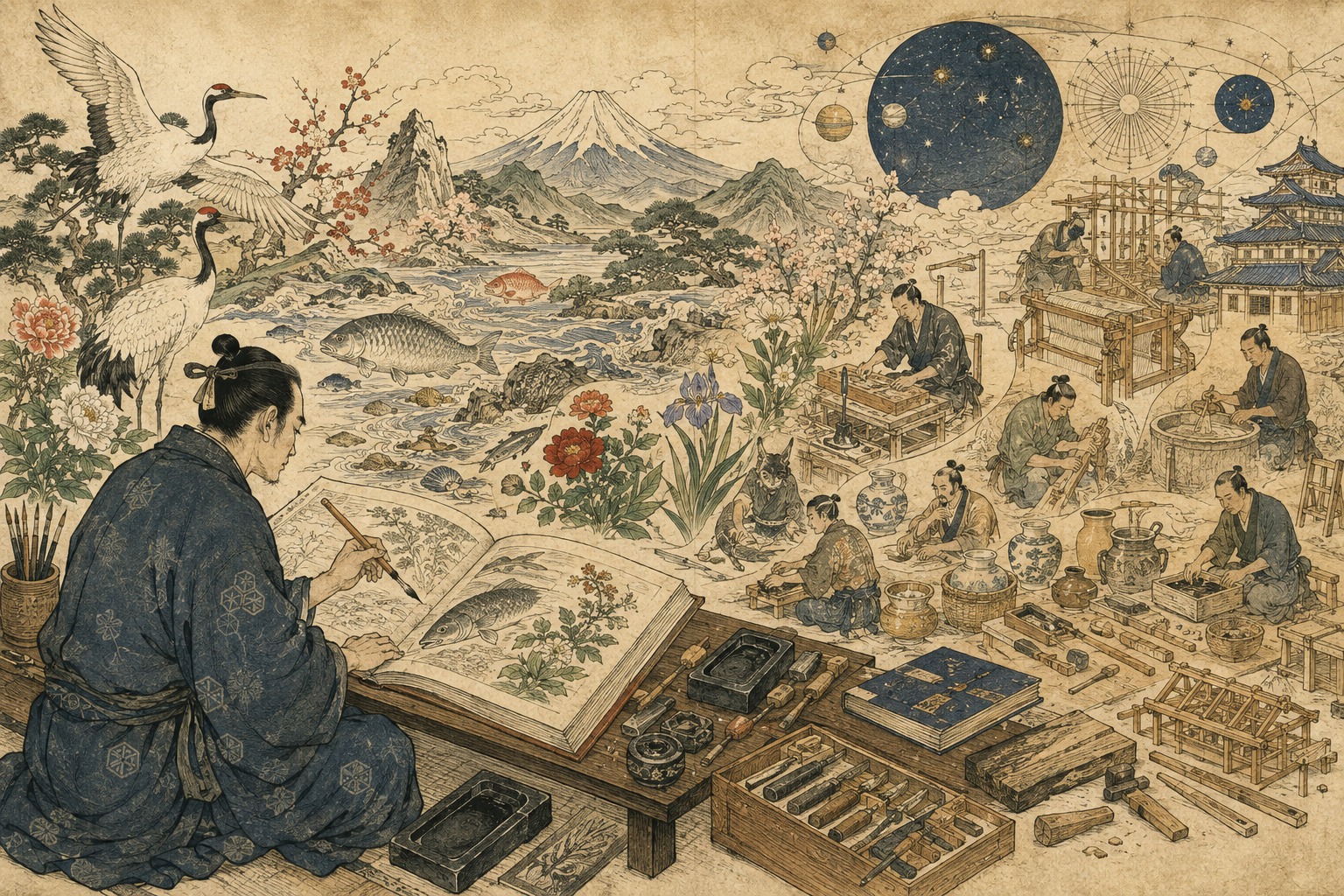
Open the book and animals wake in a world of black ink. A tiger and leopard give way to an elephant, bear, fox, raccoon dog, cat, dog, mouse, horse and ox. Elsewhere, people soak seed rice in a pond, lift and dry it, sow a nursery bed, level the paddy, transplant seedlings, harvest, thresh and pack grain into bales. Fishing boats occupy the waves. A forge has hammers and bellows; a palace has gables. Mythic beasts and farm tools, immortals and workers inhabit the same paper universe.
This is not a modern field guide. It does not unite taxonomic identification, measurement, dissection and direct observation into a scientific system. Yet it answers another question with extraordinary discipline: what lines make a world intelligible? In Morikuni’s pages, a picture is not merely an object to admire. It is an instrument for memory, explanation, production and reuse.
The 15 reported stories in Japan.co.jp’s August 13 edition range from earthquakes nearly 700 kilometers deep to hereditary tumors in cats, urban raccoons, Bizen ash glaze, ocean carbon capture, flood-rescued documents and the legend of Xu Fu. To give such different subjects one visual language, Morikuni’s comparative page is more honest than staged pseudo-photography: it can place processes, creatures, materials and stories together while asking the reader to observe their relations.
A vocation wider than “painter of nature”
Morikuni resists a single modern job title. He was a painter, an editor of images, an author of drawing manuals and a designer of pages that other specialists would transfer to wood. The Tokyo Metropolitan Central Library describes him as an Osaka artist trained by Kanō Tanzan. Scholarship identifies that teacher as Tsuruzawa Tanzan, a pupil of Kanō Tan’yū, and places Morikuni’s many manuals within rising demand for models among town painters.
The Kanō school had long served shoguns, daimyō and temples with authoritative painting on screens, walls and sliding doors. Its education depended heavily on funpon: accumulated models, subjects and procedures transmitted through workshops. Morikuni’s change was not the complete liberation of knowledge from cost. It was the conversion of workshop material into books that could be purchased and circulated beyond a master’s room.
His line therefore carries two forces at once. It conserves Kanō precedent, and it opens that precedent to recombination by readers the workshop cannot identify in advance. It is more accurate to call him a practical transformer of access than a romantic rebel exposing every secret.
Osaka as a publishing machine
Early-eighteenth-century Osaka moved rice, credit and goods, but also planned, cut, printed and sold books. Morikuni’s page was never the product of one brush alone. The artist prepared a block-ready design. A carver translated lines—reversed—into wood. A printer controlled ink and pressure. A publisher assembled capital, commissioned work, coordinated production, marketed the set and decided whether a title should live again.
Kanazawa College of Art’s bibliographic record for Ehon tsūhōshi names the author and draftsman “Tachibana Sōbei of Naniwa,” carvers in Kyoto, and bookseller Shibukawa Seiemon of Shinsaibashi Junkeimachi in Osaka. A modern KAKEN research project likewise argues that Morikuni’s books must be studied with the publishing house Kashiwara-ya: the publisher’s intentions helped determine what a book became.
Remove publishers, cutters and printers from the story and the nature of woodblock books disappears. If blocks survived, printing could continue after the artist died. If booksellers obtained blocks or cut new ones, texts could move across decades and cities. Morikuni’s reach arose not only from style but from this machinery of reproducibility.
In Edo Japan, an ehon was not only a children’s book
Today the Japanese word ehon usually suggests a picture book for children. In the Edo period it encompassed a wider field of image-centered printed books: subject collections, drawing manuals, narratives, guides and pictorial compendia used by artists, artisans, amateurs and readers. A Morikuni volume could be read, viewed, copied and consulted during production.
The title Ehon shahō bukuro—often rendered “Picture Book: Treasure-bag of Sketches”—suggests a bag of pictorial resources for copying. The British Museum calls the 1720, ten-volume work an encyclopedic illustrated book, says some designs derive from Kanō copybooks, and notes its influence on later artists. Waseda University’s copy is a 1770 reprint in ten physical books, approximately 23 centimeters tall, jointly published with an Edo bookseller. Half a century after the original, it was still useful merchandise.
Its value did not reside only in a handful of autonomous masterpieces. Hundreds of designs became a searchable accumulation in which someone could locate a tiger, wave, armor, tree or figure; turn back; compare; and try the form with a brush. It was a working database of pictures.
1715 or 1761: a bibliographic mystery inside one book
The Metropolitan Museum of Art owns a three-volume, Japanese-bound Ehon shoshin hashiradate from 1794. The museum’s English title, “A Beginner’s Pictorial Encyclopedia of Natural History,” supplied the starting point for this Art Choice. Its pages move among tigers, elephants, rhinoceros, boars, bears, deer, foxes, raccoons, cats, dogs, horses, cattle, dragons, birds and plants.
But the date of the original edition is not settled across catalogs. The Met gives 1761. Waseda calls the 1794 copy a recut of a Shōtoku 5 publication, meaning 1715. Kanazawa College of Art transcribes the recut edition’s colophon: a new block in the eleventh month of 1715 and a recutting in the eleventh month of 1794. It consequently catalogs the work as first published in November 1715 and republished in November 1794.
This article cannot adjudicate the question by inspecting all surviving copies, blocks and institutional files. The colophon supplied by the two Japanese catalogs is, however, substantial evidence against a casual 1761 assertion. The responsible choice is to expose the disagreement. An authoritative digital catalog is a research entrance, not the final word on edition, impression, recutting, rebinding, missing volumes or later covers.
1719: making China visible in Japan
The Met’s Morokoshi kinmō zui, or Illustrated Encyclopedia of China, was published in 1719 with a preface dated 1718. It survives there as two woodblock-printed books. Kinmō implies instruction for beginners; zui is a gathering of pictures. It belongs to a Japan deeply populated by imported Chinese texts, stories, figures, objects and geographic imagination—something the blunt idea of an entirely “closed country” cannot explain.
The China on these pages is not transparent on-site reportage. It passed through Chinese books, Japanese knowledge, inherited imagery and editorial choice. Morikuni translated another culture into reproducible line, but the translation also records what Japanese makers selected and believed.
That double character survives in every encyclopedia. A picture describes an object while disclosing the classifier’s point of view. Morikuni’s book should not be used as a simple window onto “accurate old China.” Read critically, it reveals how eighteenth-century Japan assembled China as a profound source of cultural and pictorial authority.
1720: the treasure bag opens the workshop
Ehon shahō bukuro is central to Morikuni’s career: ten volumes published in 1720, filled with figures, Japanese and Chinese stories, birds, beasts, plants, landscapes and objects that painters might need. The British Museum calls the compilation encyclopedic and connects part of its imagery to the Kanō models Morikuni studied.
He was not simply reducing finished precedents onto small pages. Research on his working method finds combinations of multiple conventional forms, reconfigured for the needs of his readers. Reverence for precedent and invention were not opposites. A model became new through selection, combination and adaptation to the printed opening.
The book was reissued in 1770, 22 years after Morikuni’s death; the British Museum also catalogs copies around 1800. The artist’s hand had stopped, but the lines continued to work in the market. Reprinting is evidence not merely of old fame but of sustained demand for the book as a learning resource.
Ehon tsūhōshi: the time of farming across the page
Surviving records assign editions or impressions of Ehon tsūhōshi to the 1720s and around 1730. The British Museum catalogs material dated 1721 and 1729. Kanazawa College of Art describes its copy as a later impression published in 1730, comprising nine textual volumes in ten books. Rather than treating every date as interchangeable, the differences signal editions and states that require care.
The first volume offers an extraordinary sequence. Seed rice is soaked, lifted, dried, sown and guarded from birds. Oxen plow; harrows level the field; seedlings are pulled and transplanted; weeds are removed; water is raised; rice is cut, threshed, winnowed, hulled, packed and carried to storage. Agriculture is not picturesque background. It becomes a process one can follow.
Fishing, hunting, court dance, kickball, smithing, architecture, Noh and historical tales follow. Working bodies and legendary bodies occupy the same visual order. These are not photographs of a representative society; convention, hierarchy and idealization shape them. Yet they preserve rare relationships among tools, roles, seasons and techniques.
Line compresses information
Monochrome woodblock forces color, texture, distance and motion into a restricted system of signs: the weight of a contour, short strokes for fur, repeated curves for water, wrinkles for rock, dots for bark, a fold in cloth. Line is not ornament. It instructs the eye what to distinguish.
For a cat, the curve of spine and tail may matter; for a raccoon dog, volume and coat; for a wave, direction; for a mineral, fracture and crystalline plane; for a tree, the branching structure; for farm work, the point where a hand, implement and ground meet. A plate can increase understanding by refusing to render everything with atmospheric shading. In that sense, Morikuni’s page anticipates the logic of a technical diagram, field guide or icon.
Clarity, however, is not the same as unmediated fact. A block cutter interprets a drawing into carveable form. A printer changes the density of ink. A later recutter remakes the line. Today a digitized page passes through photography, cropping, color correction and screen resolution. Legibility is always the product of decisions.
Natural history and mythic history share the shelf
Morikuni’s animals include cats and dogs beside lions, qilin, dragons and the red-haired spirit known as shōjō. Chinese auspicious beasts, Buddhist and Daoist images, Japanese tales and observable animals coexist. A modern science library would separate them; for the painter, they all belonged to the world of necessary subjects.
Calling Morikuni a zoologist, geologist or agronomist would therefore be anachronistic. His achievement should not be measured by proximity to modern taxonomy. The books show a society organizing nature, technology, classical literature and belief as parts of one visible knowledge system.
That mixture makes the language well suited to this edition’s article on the Xu Fu legend. Historical possibility, regional tradition, festival practice and hope can be placed together without being assigned the same evidentiary status. Classification need not erase unlike things; it can arrange their relationships.
Harunobu, Hokusai and the picture meant to be used
The Tokyo Metropolitan Central Library says ukiyo-e artists including Suzuki Harunobu drew subject ideas from Morikuni’s books. It presents one design in the 1745 Ehon Jikishihō—a nine-volume, ten-book continuation containing sericulture, Chinese children, sages, immortals, warriors, landscapes, poets and plants—as a source for Harunobu’s image of the immortal Qin Gao.
The Metropolitan Museum links Katsushika Hokusai’s prints and visual encyclopedias to Morikuni’s wide-ranging depictions of the world. This need not mean a one-way trail from one copied figure to another. The model itself endured: collect the world, break motion into legible parts and place the painter’s visual resources into a market for books.
Art history often treats originality as resemblance to nobody else. A manual succeeds by another standard: people use it. Its figures are copied, corrected, migrated and recombined. Morikuni’s lines were finished works and, simultaneously, a shared grammar for works that did not yet exist.
An influence completed after the artist’s death
Morikuni died in 1748. Ehon shahō bukuro was reissued in 1770. Ehon shoshin hashiradate was recut in 1794. Whatever the unresolved original date of the latter, the secure 1794 printing came 46 years after his death. Blocks and markets extended the artist’s lifespan.
A recutting is not a modern facsimile. If worn blocks are replaced, another hand determines subtle thicknesses and omissions. Binding, sequence, title slips and colophons may change as well. A page labeled “Morikuni” can therefore contain the originating design, the first cutter’s translation, a later cutter’s judgment and a publisher’s commercial decision.
That layering is not contamination of an otherwise pure artwork; it is the history of how art travels. Morikuni endured because his material was changed while it was used. Digital archives now allow a reader anywhere to open the pages, but they can flatten edition differences. The high-resolution image needs a companion question: which copy, volume, edition and impression is this?
How Morikuni might arrange this edition’s 15 stories
The deep-earthquake article invites a section through mineral lattices, migrating water and a descending slab. Ocean carbon capture can place sea, machine, carbon pathway and ecological uncertainty on one opening. The feline cancer study needs not only an appealing cat but pedigree, cell and diagnosis. Kobe’s raccoon response joins city, house, field, native ecology and human regulation. The native Japanese raccoon dog (tanuki) pictured in Edo books and the invasive North American raccoon in Kobe are different species; an old-fashioned visual vocabulary must not collapse them.
Bizen ceramics can follow a cut railway tree into flame, ash, glaze and vessel. The Okayama flood archive and Tohoku memory story can make processes of wet paper, rescue, drying, restoration, cataloging and access visible. The Xu Fu festival can align boat, Kumano landscape, legend, remembrance and fireworks while keeping tradition distinct from established history.
The direction is therefore more than “make 2026 look old.” It takes complicated reporting apart into objects, stages and relations that readers can compare. Black line and warm paper establish the atmosphere. Morikuni’s deeper legacy is editorial clarity.
- Let black line lead: Favor contour, repetition and sequence over photographic shading.
- Use several scales: Arrange animal, landscape, tool, section and human activity like a book opening.
- Show transformation: Connect tree to ash, seawater to carbon and damaged document to archive.
- Separate evidence: Do not draw science, historical record and regional legend as if they carry equal proof.
- Keep modern facts modern: Do not disguise present equipment as Edo technology; borrow composition, not false history.
- Label inspiration honestly: The images are editorial interpretations, not Morikuni originals, official diagrams or news photographs.
A small guide to looking
When viewing Morikuni online, begin with the full opening and remember the gutter. Bound paper dips in the center; an image divides across left and right. A single digital crop can remove the order of pages, the speed of turning and the comparison with what comes before and after.
Then ask what each line does. How do fur, wave, cloud, soil, wood and cloth receive different signs? Look where a worker’s hand meets a tool. Does adjacent text identify the figure, prescribe color, restrict meaning or add a story? Compare the same subject in another volume, edition or later ukiyo-e print.
Finally, read the catalog record: institution, object number, number of volumes, publisher, carver, dimensions, missing books, recutting and later impression. The “life of the book” hides in fields that an image search usually omits. The disagreement among the Met, Waseda, the British Museum, Kanazawa College of Art and other repositories is not a reason to abandon the record; it is where research begins.
Inside one line, a system of circulation
Morikuni’s pages can appear quiet: little color, no theatrical illusion of space. Follow the book, however, and a city starts moving. An artist selects and redraws. A publisher commissions. A carver reverses the design in wood. A printer moves it onto paper. A shop sells the volumes. Painters and artisans open them and alter what they find.
Nature also refuses to sit as a cabinet of isolated specimens. The cat is compared with the dog on the next page. Waves carry fishing labor. Trees become landscape and material. Implements operate inside seasons. Knowledge is organized not only as a list of nouns but as relations among creatures, objects, people and time.
That is why his language belongs with news in 2026. A complex world does not need simplistic pictures. It needs legible pages that preserve the elements of complexity and allow readers to trace the connections.
- Metropolitan Museum of Art, Ehon shoshin hashiradate (1794 copy, three volumes, English title, first-edition claim and discussion of Hokusai)
- Metropolitan Museum of Art, Morokoshi kinmō zui (1719, preface 1718, two volumes and public-domain images)
- British Museum, Ehon shahō bukuro, volume 10 (1720, ten-volume structure, Kanō copybook sources and later influence)
- British Museum search records for Ehon shahō bukuro (1720 examples and editions around 1800)
- British Museum search records for Ehon tsūhōshi (volumes cataloged to 1721 and 1729)
- Waseda University Library, Ehon shahō bukuro (1770 reprint, ten books, joint publication and provenance)
- Waseda University Library, Ehon shoshin hashiradate (1794 recut edition, three books and catalog note identifying a 1715 original)
- Kanazawa College of Art Edehon Database, Ehon shoshin hashiradate (colophon transcription, 1715 new blocks, 1794 recutting and indexed subjects)
- Kanazawa College of Art Edehon Database, Ehon tsūhōshi (volumes, artist, cutters, publisher and page-level index of farming, fishing, performance and architecture)
- Tokyo Metropolitan Central Library, Ehon Jikishihō (1745, nine volumes in ten books, contents and later influence including Harunobu)
- KAKEN project on Morikuni and early-modern Kanō literary influence (funpon, publisher Kashiwara-ya, instructional books and the publisher’s role)
- Tatsuki Komeiji, “Drawing Method of Ehon Tsuhoushi by Tachibana Morikuni” (2019; combined conventional forms and the transformation of Kanō knowledge for town painters)
- Art Institute of Chicago, Ehon shahō bukuro, and Ehon tsūhō shi (collection records as woodblock-printed books)
- British Museum, Ehon ōshukubai (1740 woodblock-printed illustrated book)
- Union Catalogue of Early Japanese Books, Ehon shahō bukuro (records for the 1720 preface, 1770 postscript and surviving copies)
Editor’s note: This article cross-checked museum and library object records, early-Japanese-book databases, a KAKEN research project and institutional or peer-reviewed scholarship available by August 12, 2026 at 9:18 a.m. JST. Japan.co.jp did not independently interview curators, conservators or researchers. We use 1679 as Morikuni’s birth year following the principal museum and Japanese institutional records. The Met’s 1761 claim for the first Ehon shoshin hashiradate conflicts with Waseda and Kanazawa’s 1715 record; we do not resolve it by assertion and instead reproduce the secure 1794 recut-edition evidence. Differences in dates for Ehon tsūhōshi are treated as potential edition, impression and volume differences. “Encyclopedia,” “natural history” and “information technology” are modern analytical descriptions of function, not claims that Morikuni was a modern scientist. We avoid a solitary-genius account by naming publishers, block cutters, printers and recutters as makers in the book’s life. The hero is an editorial illustration inspired by Morikuni’s page design, not a reproduction of his work.