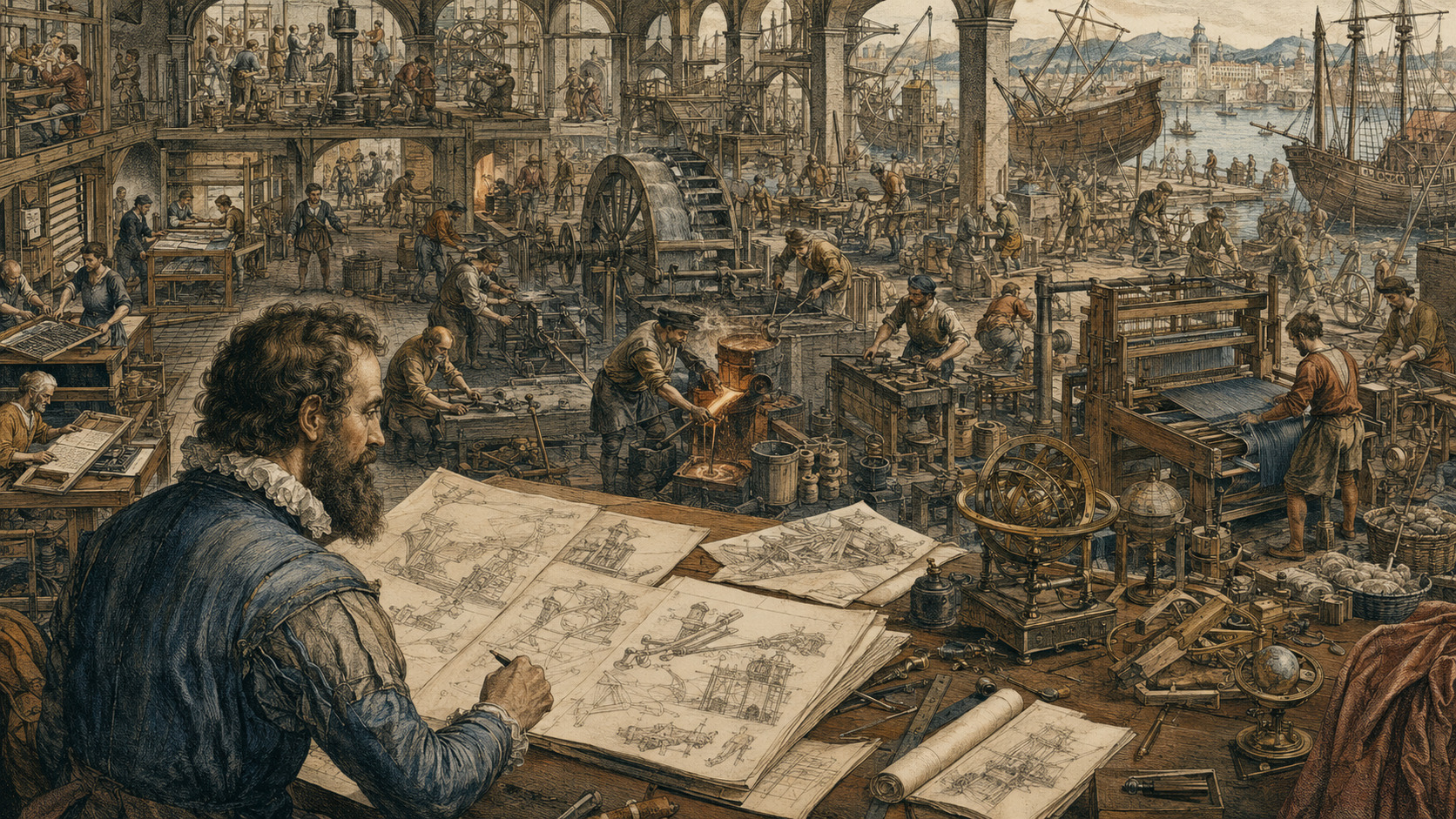
Stand at the edge of a Stradanus workshop and the eye begins to travel. It follows a belt, a shaft, a flow of water, a row of hanging sheets, a flame beneath a vessel. A labourer bends over a press. Another checks a gauge-like instrument. An apprentice carries material toward a process already underway. In the distance, carts, mills or ships connect the room to a world beyond it. No person entirely commands the scene, yet the scene is intensely organised.
This was a startling choice of subject in the late sixteenth century. The grand visual arts had long given their largest spaces to scripture, saints, classical gods, rulers and battle. Jan van der Straet—born in Bruges in 1523, celebrated in Florence as Giovanni Stradano and known in Latin print culture as Johannes Stradanus—made printers, distillers, metalworkers, clockmakers and mill operators inhabitants of history.
His most famous project, Nova Reperta, is commonly translated as New Discoveries or New Inventions of Modern Times. The complete cycle consists of a title page and nineteen subject plates. Designed in Florence and issued through Antwerp’s print industry around 1591, it surveyed what Europeans of Stradanus’s generation believed distinguished their “modern” age from antiquity: America, the compass, gunpowder, printing, mechanical clocks, distillation, silk, water and wind power, lenses, navigation, industrial processes and copper engraving itself.
From Bruges into the Medici machine
Stradanus learned first from his father and then from Maximiliaen Francken. In Antwerp he trained with Pieter Aertsen, a painter famous for crowded market and kitchen scenes in which ordinary objects possess monumental weight. He became a master of the Guild of Saint Luke around 1545, then travelled south through Lyon and into Italy.
His migration mattered. Flanders offered close observation, surface detail and Europe’s most advanced commercial print culture. Italy offered monumental composition, classical learning and ambitious court patronage. Stradanus carried one into the other. By the late 1540s he was working in Florence; after a period in Rome, he returned to the city that would remain his base.
Cosimo I de’ Medici employed him in the Arazzeria Medicea, the ducal tapestry works. Tapestry design taught an artist to think at architectural scale and to coordinate specialised hands: cartoon designer, dyer, weaver, metal-thread supplier, workshop manager. From 1557 Stradanus worked under Giorgio Vasari on the enormous decorative programme of the Palazzo Vecchio. He later held office in Florence’s Accademia del Disegno.
This was not the biography of an isolated easel painter. It was a career inside production systems. Court art required design offices, workshops, material supply, division of labour and political storytelling. When Stradanus later pictured a refinery or printing shop, he already understood how a large idea passes through many hands before it becomes an object.
1523 Born in Bruges to an artistic family.
1537–1540 Trains in Antwerp with Pieter Aertsen.
c. 1545 Becomes a master and travels toward Italy through Lyon.
1546–1550 First Florentine period; designs for the Medici tapestry works.
From 1557 Works under Vasari on the Palazzo Vecchio decorations.
1563 onward Holds offices in the Accademia del Disegno at several points.
1570s–1580s Designs print series circulated through Antwerp publishers.
c. 1589–1593 Nova Reperta takes printed form; the usual first-edition date is around 1591.
1605 Dies in Florence after a career spanning painting, tapestry, fresco, drawing and print design.
“Inventor” did not mean what it means today
Early modern prints divided authorship into roles. An inscription might identify the inventor, the person who conceived or designed the image; the sculptor, who cut it into copper; and the excuditor, who published or issued it. On the America plate, for example, the names tell us that Stradanus invented the design, Theodoor Galle engraved it and Philips Galle published it.
Stradanus therefore did not personally engrave every line now associated with his name. His sketches and finished models travelled from Italy to Antwerp. An engraver used a burin to incise the image in reverse into a copper plate. Ink was worked into those channels, the surface wiped, damp paper placed over the plate, and enormous pressure transferred the design. Publisher, press worker, paper supplier, colourist, dealer and buyer completed the circuit.
The word reperta is equally elastic. It can mean things found, devised or discovered. Some items were not recent in an absolute sense; silk production, the stirrup and the watermill were centuries old. Their “newness” meant post-classical, useful to a culture that admired antiquity yet increasingly believed it had surpassed the ancients in important domains.
The title page is a manifesto for modern time
The Rijksmuseum dates one impression of the title page to approximately 1589–1593 and classifies its subject as “invention, discovery—science and technology.” The composition behaves like a visual contents page. Beneath the title stands a printing press. Around it are a mechanical clock, cannon and gunpowder, distilling apparatus, medicinal wood, stirrup and silkworm. Above, a young female figure associated with the new age points toward a map of America; an older male figure associated with antiquity turns away beside a compass rose. Both hold the circular, self-consuming serpent called the ouroboros.
The symbolism is not shy. The old world exits; the new enters. Printing occupies the centre because it multiplies every other claim. The press can distribute navigation, medicine, mechanics and the image before us. Nova Reperta announces modernity with a technology that then reproduces the announcement.
Its confidence is also unstable. The ouroboros implies cycles as much as progress. Cannon and gunpowder sit beside medicine and clocks. America is treated as something Europe “found,” although millions of people already lived there. From the opening sheet, innovation carries creation, violence and possession in the same inventory.
Nineteen ways to declare the age new
The sequence is not a modern patent register. It mixes devices, processes, materials, geographical claims, observational techniques and even a supposed cure. That mixture is precisely why it is so revealing: Renaissance “technology” was not yet separated from natural philosophy, commerce, art, navigation, warfare or empire.
| Realm | Plates in the cycle | What Stradanus makes visible |
|---|---|---|
| World, navigation and measurement | America; magnetic compass; longitude; astrolabe and Southern Cross | Ships, scholars, instruments, maps and the political claim to discovered space |
| Information and precision | Book printing; mechanical clock; eyeglasses; copper engraving | Type, presses, inspection, timekeeping, corrected sight and reproducible images |
| Power and warfare | Gunpowder; watermill; windmill; stirrup; armour polishing | Stored force, rotating power, transport, cavalry and military manufacture |
| Transformation of matter | Distillation; olive oil; sugar refining; oil painting | Heat, crushing, separation, vessels, pigments and staged production |
| Biological and medical transfer | Silk production; guaiacum as a supposed syphilis remedy | Living material, imported knowledge, treatment and the risks of mistaken certainty |
The list also exposes historical attribution as mythmaking. Oil painting was not literally invented by Jan van Eyck, although Northern European tradition credited him. The problem of finding longitude was not solved by the magnetic method shown. Guaiacum did not cure syphilis. The “discovery” of America is presented from a Florentine-European perspective favouring Amerigo Vespucci. Nova Reperta is evidence of what an elite network wanted modernity to mean, not a neutral technical encyclopedia.
The workshop becomes a theater
Stradanus’s scenes persuade through choreography. In the printing shop, typesetters work at the left, a child handles a freshly printed proof, and the press operates at the right while sheets hang to dry. The image explains production as a sequence. It also gives the viewer several places to stand mentally: beside the compositor, at the proof, under the press screw.
The distillation plate surrounds a heated stove with connected vessels. A bespectacled man consults a thick manual while assistants grind, tend heat and handle apparatus. Book knowledge does not float above labour; it sits inside the room. The clock shop moves from metal heated over fire to small spring-driven components and larger weight-driven clocks. The olive-oil scene begins in the grove, proceeds through millstone and press, then ends with collection and transport.
These are cutaway-like spaces without being engineering cutaways. Walls, arches, receding rooms and outdoor views let several moments coexist. A single sheet compresses a supply chain into a believable place. The viewer is not shown one heroic machine against emptiness. The machine has inputs, attendants, waste, heat, maintenance and an exit.
That is the “theater” in today’s title. Stradanus stages work so that process can be watched. The eye moves through time while remaining in one picture. Renaissance perspective becomes a form of systems explanation.
Knowledge passes between the hand and the page
Many technology images turn labourers into scale figures. Stradanus gives them verbs. They carry, grind, read, pour, fit, inspect, heat, pull and teach. Boys appear as apprentices, making knowledge intergenerational. Animals turn mills or carry goods. Supervisors and scholars coexist with workers whose bodies supply force and dexterity.
The final plate, copper engraving, is deliberately self-referential. It shows a press, a worker warming a plate, another inking it, a teacher guiding boys who draw on metal, and finished impressions hanging on the wall. The series closes by revealing the workshop that made the series possible. Image production joins printing, distillation and clockmaking as a mechanical art.
Modern distinctions between “creative” and “technical” labour are weakened here. Design requires process knowledge. Execution requires judgment. The engraver must understand how Stradanus’s lines will print; the designer must anticipate reversal in the copper plate. A successful object is an agreement between imagination and manufacture.
Florence conceived it; Antwerp multiplied it
Nova Reperta was itself a cross-border production line. Stradanus drew in Florence. His collaborator and dedicatee Luigi Alamanni belonged to Florentine intellectual circles and helped shape a programme attentive to navigation, history, artillery and Vespucci. Drawings or models travelled north. Philips Galle’s Antwerp enterprise coordinated engraving, publishing and sale. Later editions and states involved members of the Galle and Collaert families.
Antwerp was not incidental. It was an international centre for books and prints, with the skilled cutters, presses, paper networks and distribution channels needed to turn a Florentine idea into portable images. Prints could travel much farther than Medici tapestries or Palazzo Vecchio frescoes. Cooper Hewitt notes that Stradanus’s engraved designs circulated across Europe, Asia and the Americas.
The system makes authorship both clear and collective. Stradanus’s name anchored the designs, but the printed object depended on translators of line, business capital and commercial routes. In that sense, the series’ subject and manufacture agree: modern invention is a network.
The dark matter inside technological optimism
Nova Reperta is compelling because it is not innocent. The gunpowder plate shows cannon manufacture and, in the distance, weapons tested against fortifications. It records technical mastery and the expansion of destructive power in the same space. Newberry’s modern exhibition on the series emphasised that Renaissance Europeans embraced technology while fearing its disruptive, destructive and destabilising effects.
The first subject plate, America, is more troubling. An armoured, clothed Vespucci arrives with ships, sword, cross-topped banner and astrolabe. A sexualised female personification of America rises from a hammock. Behind her, a cannibal scene and unfamiliar animals construct the continent as available, exotic and uncivilised. The composition converts invasion into awakening and European possession into discovery.
Sugar refining appears as an orderly chain of cutting cane, milling, boiling and forming loaves. What the image does not account for is as important as what it diagrams: the coercive plantation regimes and Atlantic slavery that would make sugar one of the early modern world’s most violent commodities. Guaiacum, a New World wood marketed in Europe for syphilis, is staged as a therapeutic discovery although it was ineffective.
These are not reasons to discard Stradanus. They are reasons to read him fully. His images show how a culture makes technology desirable: by arranging complexity into order, placing confident experts in control and moving costs toward the background. A responsible modern homage must bring those hidden costs back into the foreground.
Why this visual language fits hydrogen
Hydrogen is almost invisible. The important action occurs inside stacks, pipes, pressure vessels, compressors, cryogenic pumps and catalytic reactors. A publicity photograph often shows a clean box and smiling executives; it cannot explain where electricity enters, where water goes, what pressure changes, who maintains the machine or how the product reaches a customer.
Stradanus offers a better grammar. His crowded architecture can place renewable power, electrolyzer, storage, truck bay, furnace, ammonia reactor and ship in one legible field. Pipes and vessels create pathways for the eye. Workers establish human scale. Arches and cutaway rooms allow production stages to coexist. A distant port makes the local workshop part of international trade.
For the fifteen hydrogen stories in this edition, Japan.co.jp therefore used intricate Renaissance copperplate linework on warm ivory paper, with black-brown marks, restrained mineral colour and selective pale blue-green accents for water, hydrogen and energy flow. Small celestial or alchemical signs make an otherwise invisible molecule traceable. The mood is observational and serious: ingenious without pretending that every apparatus is commercially triumphant.
| Stradanus device | Hydrogen translation | Editorial purpose |
|---|---|---|
| Multi-stage workshop | Electrolyzer, compression, storage and end use share one scene | Show that no single machine constitutes a hydrogen economy |
| Workers distributed through space | Operators, drivers, engineers and maintenance crews at human scale | Keep labour, safety and operation visible |
| Furnaces, mills and flowing material | Ammonia synthesis, industrial heat, pumps and energy flow | Make transformation and energy cost visually legible |
| Ports, carts and distant rooms | Import corridors, tankers, trucks and clustered customers | Connect local equipment to logistics and demand |
| Fine engraved density | Detailed infrastructure without futuristic gloss | Invite slow inspection rather than instant promotion |
| Allegory beside mechanism | Pale symbols for hydrogen, water and risk | Represent an invisible molecule while signalling that the image is interpretive |
Not a technical drawing, not a costume pasted on a machine
The art direction works only if it borrows Stradanus’s method rather than copying one plate. A modern electrolyzer should not be disguised as a sixteenth-century still. Its essential contemporary form must remain recognisable. The Renaissance architecture supplies spatial logic; engraving supplies attention; the workers supply scale; selective colour supplies flow.
Nor should the scenes become retro-futurist advertisements. Smoke, heat, hoses, waiting vehicles, idle equipment and ledger work belong in the picture. The empty passenger-car forecourt in the reality-check illustration is as important as the busy truck lane. A machine under repair can tell more truth than a machine glowing with impossible light.
Our Art Choice hero imagines Stradanus at a drawing table overlooking a composite world of printers, smiths, mills, looms, instruments and ships. No such single workshop existed, and the image is not attributed to him. It is an editorial argument about his achievement: he made design look outward into manufacture and made manufacture worthy of sustained looking.
A living field of research, four centuries later
Stradanus is not a closed historical file. Cooper Hewitt holds 143 sheets of his drawings and inscriptions. Since 2021, conservators and curators have been separating later backings, reconstructing sheets and revealing inscriptions and drawings obscured for more than a century. A dedicated symposium in November 2025 brought new research together; recordings were announced for 2026.
The project also clarifies how ideas moved toward print. Cooper Hewitt preserves preliminary sketches for nine Nova Reperta subjects. Researchers can compare an initial arrangement with the engraved result, observing additions, reversals and the moment an intellectual programme becomes a printable composition. The evidence replaces the myth of effortless invention with revision, translation and collaboration.
Museums now classify the series across categories that Stradanus himself would have allowed to overlap: print, machine, laboratory, navigation, science, technology, allegory and global encounter. The Rijksmuseum’s record, the British Museum’s complete-set commentary, the Met’s open-access plates, the Newberry’s exhibition and Cooper Hewitt’s conservation project together make the cycle more accessible—and more critically legible—than at any point in generations.
The invention is the whole room
Stradanus lived before the steam engine, electrical grid or modern corporation, yet he understood something our age repeatedly forgets. A technology is not only its central device. It is a room of trained people, a chain of inputs, an instrument of measurement, a method of reproduction, a route to market and a story society tells about why the result is new.
That insight makes him an unusually honest guide to hydrogen. Japan has built remarkable central devices. The decisive question is whether the surrounding room can be completed: low-carbon power, affordable production, pumps and storage, dependable transport, skilled maintenance, certified emissions and customers who return. Stradanus would have drawn all of them.
He would also have placed a cannon near the clock and empire behind the compass. His optimism was real, but the plates preserve the costs and distortions of novelty even when they do not acknowledge them. We can borrow his wonder without borrowing his blindness.
The best image in a technology edition should not say, “Behold the future.” It should say, “Look carefully at everything required to make this work.” That is the enduring power of the Renaissance theater of invention. The true subject is not the machine at centre stage. It is the whole room.
Reporting notes and principal sources
Nova Reperta survives in different editions, states and institutional catalogues. This article follows the complete-cycle convention of a title page plus nineteen numbered subject plates and describes the first publication as around 1591; individual museum records date impressions somewhat differently. “Engraving” refers to the printed medium, not necessarily Stradanus’s own hand: he was principally the designer or inventor, while specialist engravers and publishers produced the impressions. The Japan.co.jp hero and the edition’s hydrogen illustrations are contemporary editorial homages, not works by Stradanus.
- Rijksmuseum: Nova Reperta title page, makers, subjects and public-domain status
- Rijksmuseum Research Library: Renaissance Invention contents and scholarship
- British Museum: Jan van der Straet biography and Medici career
- British Museum: title page and complete-series context
- British Museum: Impressio Librorum, the printing shop
- British Museum: Distillatio, laboratory and machinery
- British Museum: Sculptura in Aes, the engraving workshop
- British Museum: Saccharum, the sugar refinery
- British Museum: Astrolabium, Vespucci and the Southern Cross
- Metropolitan Museum of Art: Nova Reperta title plate
- Metropolitan Museum of Art: invention of book printing
- Metropolitan Museum of Art: invention of distillation
- Metropolitan Museum of Art: invention of clockwork
- Metropolitan Museum of Art: invention of the watermill
- Metropolitan Museum of Art: allegory of America and critical collection description
- Folger Shakespeare Library: full contents and production record
- Cooper Hewitt: Stradanus Project, 143 sheets, conservation and research
- Cooper Hewitt: Nova Reperta, novelty and the drawing-to-print process
- Cooper Hewitt: Florence–Antwerp production and printmaking collaboration
- Newberry Library: technology, colonisation, warfare and disruption
- Newberry Library: digital Nova Reperta time machine
- Cleveland Museum of Art: Sculptura in Aes object record and open-access image
- Smarthistory: critical reading of the America engraving
- Deutsches Museum: the series as a source for cultural and technological history