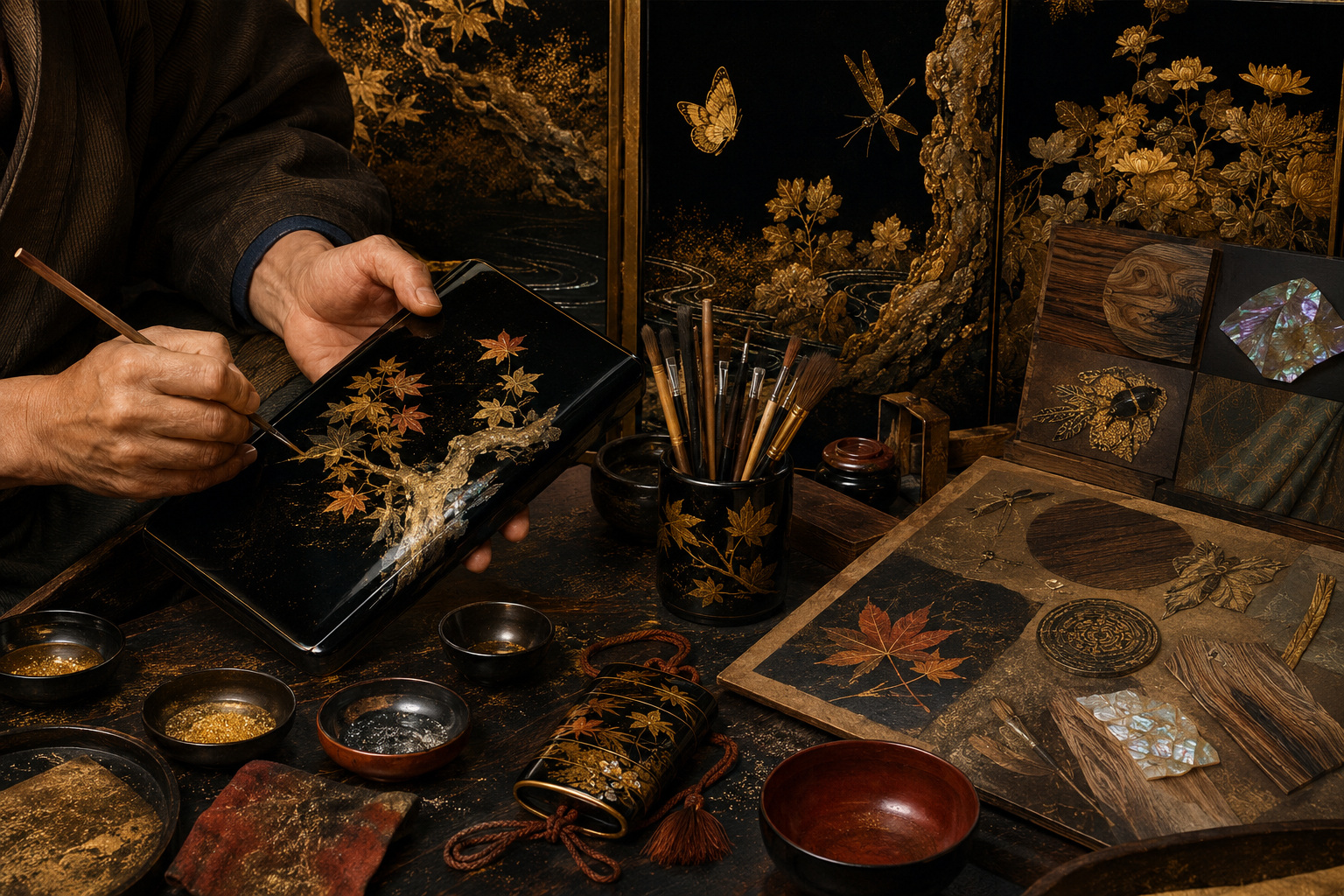
Shibata Zeshin — The Art of Craft, Texture and Invention
It looks like wood but is not wood. It resembles corroded iron but contains no iron plate. The carp swimming down paper was formed not in oil paint but in lacquer refined from tree sap. Zeshin made materials impersonate one another not to conceal the truth, but to make seeing itself the subject.
Look obliquely across one of Zeshin’s dark lacquer surfaces. Black refuses to remain a single color. The dullness of smoked iron, the depth of polished wood, the chill of wet stone and the soft weave of cloth appear as the light moves. Just before a hand reaches out, the eye decides what the material must be. Zeshin quietly changes the answer.
Lacquer is not simply a decorative skin. Sap is tapped from the lacquer tree, refined, spread in thin layers and cured under controlled humidity. English often says that lacquer “dries,” but it does not merely lose solvent; moisture supports the chemical hardening of urushi. Raw sap can cause severe dermatitis, while the properly cured surface becomes durable, light and profoundly lustrous. Dust, a layer applied too heavily or the wrong air can reveal failure days later as clouding or cracks. This was painting inseparable from time and materials engineering.
Zeshin’s distinction was not only that he mastered this difficult substance. He brought together several ways of thinking in one pair of hands: the lacquerer who constructed objects, the painter who worked on paper and silk, the print designer who understood outlines and repetition, and the Edo sophisticate who loved poetry and visual jokes. In doing so, he made the hierarchy between “fine art” and “craft” look inadequate.
A carpenter’s family taught him how to look at material
Zeshin was born in Edo on March 15, 1807. The Saint Louis Art Museum records the alternate name Shibata Junzō and gives his death as July 13, 1891. His family background included shrine carpentry and wood carving; his father is also said to have known the design of popular prints. To a carver, grain is not a picture pasted on wood. It is evidence of the structure within: direction, fiber, density and light. One cannot convincingly make lacquer behave like wood without understanding what wood does.
In nineteenth-century Edo, the categories of artist, designer and artisan did not divide as neatly as later institutions would make them. Architecture, shop signs, clothing, books, inrō medicine cases, festival equipment and domestic furnishings met in the daily life of the city. Zeshin’s starting point was not an isolated white canvas. It was a world of things held, worn, opened, closed and repaired.
At eleven, the apprentice first learned to obey lacquer
At eleven, he entered the workshop of Koma Kansai II, head of a lacquer lineage with a long reputation. Before an apprentice could sign a finished object, he prepared a substrate, built the ground, applied layers, polished and handled powders while reading temperature and humidity. Lacquer did not care about the maker’s inspiration. One particle of dust, an over-thick application or dry air could rewrite the result.
Apprenticeship can look like the enemy of invention. For Zeshin, its constraints became experimental coordinates. How thin could a layer become? Which admixture altered gloss? Where did hardness give way to useful flexibility? Only someone who had repeated the normal process thousands of times could turn an anomaly into a reproducible technique.
To become a better lacquerer, he left the workshop to paint
Koma Kansai reportedly understood that his student needed to compose, not merely transfer other people’s designs. Zeshin studied Shijō-school painting with Suzuki Nanrei and later with Okamoto Toyohiko in Kyoto. The Minneapolis Institute of Art says he left lacquer training after five years to study painting and returned to Edo nearly a decade later as an accomplished painter.
The Maruyama–Shijō tradition prized looking closely and converting observation into economical brushwork. The point was not to count every feather, but to compress a bird’s weight, posture and next movement into a small number of marks. Zeshin carried that method of attention back to lacquer. To imitate a surface, he had to understand more than its surface.
He made “artist or craftsman?” the wrong question
Back in Edo, Zeshin made lacquer objects, hanging scrolls, folding screens, surimono prints and book designs. The Cleveland Museum of Art holds a screen combining ink, color, lacquer and gold on silk for a scene from The Tales of Ise. Another eight-panel screen assembles the familiar characters of popular Ōtsu folk paintings with urban wit. The British Museum’s collection likewise ranges across paintings, prints and lacquer.
Classification helps museums preserve and research objects, but cutting Zeshin into separate occupations hides the circuit that produced his ideas. From painting came negative space and the energy of the brush; from prints, decisive contour and knowledge of multiplication; from lacquer, layers, abrasion, touch and durability. He did not abandon specialization. He made specialties speak to one another.
Wood, iron, bronze, rosewood: lacquer begins to act
By altering pigments, metallic powders, charcoal, particulate matter, grounds and polishing, Zeshin gave lacquer the memory of other substances. Paris Musées highlights his imitation of iron, bronze and the delicate texture of rosewood. These effects were not merely cheaper stand-ins for expensive materials. He deliberately made fresh work resemble oxidized metal, used timber, dry textile and other states normally called age or damage.
The pleasure of trompe-l’œil does not end after the viewer is fooled once. It exposes the cues by which the eye recognizes “woodness” even when looking at actual wood. Material is not only chemical composition; it is a relationship among sight, touch, memory and use. Zeshin’s surfaces were nineteenth-century user interfaces.
The paradox of making age brand new
We expect craft to finish a new object beautifully. Zeshin worked in the opposite direction. He built controlled new surfaces resembling damaged boards, oxidized metal or worn textile. He observed what time produced accidentally and reconstructed it through layer thickness, grain, polishing and variations in sheen.
This belongs to the Edo ideal of iki: sophistication without loud display, a joke and a feat visible to those who know how to look. Rather than spreading gold across every inch, Zeshin could hide extravagant labor in a dead leaf, insect or battered utensil. Restraint and simplicity are not the same thing.
Reviving a lost technique was itself invention
Zeshin is credited with researching and reviving difficult lacquer processes such as the combed wave pattern known as seigaiha-nuri. Drawing a tool through lacquer as it begins to set and keeping a sequence of waves regular demand exact coordination of speed, viscosity and spacing.
Preserving tradition is rarely a matter of reading old instructions literally. Materials change, tools disappear and the people carrying tacit knowledge die. A restorer must reverse-engineer a process from traces, becoming historian and experimentalist at once. The same problem faces a regional contractor moving electrical knowledge into a training laboratory today.
Making hard lacquer into a picture that could roll
Lacquer performs beautifully on a rigid body. A paper or silk scroll must bend, roll and open. The two systems appear incompatible. Zeshin adjusted preparation and formulation until thin lacquer paintings could remain flexible. Both the Minneapolis Institute of Art and San Antonio Museum of Art identify his rollable lacquer painting as a crucial innovation.
This was more than substituting lacquer for ink. It required treating support movement, curing, adhesion, pigment and storage as one system. Zeshin brought transparent amber, profound black, physical relief and polished light into painting without surrendering paper’s portability. Change the material, and one also changes how a picture is transported, stored and displayed.
A carp makes us feel water that is barely painted
The Smithsonian National Museum of Asian Art explains that Zeshin’s Carp uses lacquer made from toxic tree sap to create the sensation of a fish moving through water. His nature painting often grows stronger as information is removed. Empty paper becomes water; modulations across the body, a wavering contour and the material’s gloss supply moisture and motion.
Paris Musées compares his concise compositions to the haiku he loved. Haiku is not shallow because it is short. Season, cut and silence recruit the reader’s experience. Zeshin’s material illusions operate similarly: the viewer’s tactile memory completes what the artist leaves unstated.
Tenpō austerity moved luxury beneath the surface
During Zeshin’s maturation in the 1830s and 1840s, shogunal austerity campaigns discouraged conspicuous consumption among townspeople and pressured decoration dependent on gold and silver. The details and enforcement varied by year and status, so it is too simple to say a ban directly created his inventions. The market nevertheless rewarded complex effects that did not announce wealth too plainly.
Scarcity does not automatically cause creativity; more often, it simply lowers quality. Zeshin’s achievement was to refuse to treat a substitute as an inferior copy. Bronze-toned lacquer did more than conceal a shortage of gold. It could speak of patina and age in a way brilliant gold could not.
In 1868, patrons, government and the definition of art changed
Zeshin was about sixty-one when the Tokugawa shogunate ended and the Meiji state began. Workshops supported by daimyo houses and the old order lost patrons. Western categories of “fine” and “decorative” art entered official debate. The abolition of sword wearing contracted markets for fittings, while changing clothes and interiors altered the place of inrō and traditional furnishings.
Zeshin neither sealed himself inside the old world nor converted wholesale to Western oil painting. The Edo artisan who had worked for merchants, temples and urban residents accepted government commissions, produced work for export and eventually served the Imperial Household. He crossed the institutional rupture by carrying not a frozen form but a core of material knowledge and observation.
At the world’s fairs, craft became a language of the state
The Meiji government used international exhibitions as export market, national theater and industrial classroom. Zeshin’s work received attention in Vienna in 1873, Philadelphia in 1876 and Paris in 1889. Some older museum summaries conflict over the Vienna and Paris years; this article follows the chronology presented by Paris Musées and the dates of the fairs themselves rather than combining incompatible accounts.
To foreign visitors, lacquer signified both extreme technical achievement and a desired Japanese difference. Paris Musées says the Scottish designer Christopher Dresser and Samuel Bing, a central promoter of Art Nouveau, admired and collected Zeshin. That enthusiasm included the West’s own simplifying appetite for Japonisme. Even so, his asymmetry, abbreviation and movement between media materially changed European design vocabulary.
Was export craft merely made to please Westerners?
It is easy to describe Meiji craft as either gaudy export ware or the betrayal of an untouched national tradition. Zeshin fits neither story. He made astonishment legible to a new audience while retaining Edo poetry, seasons, commoner subjects and understated jokes. He adapted to a market yet offered value that the customer did not already know how to request.
Small companies face the same tension now. A product simplified for investors or foreign buyers can lose the complexity that made it local. A tradition treated as sacred and inexplicable can lose its market. Zeshin’s answer was translation. The surface delivered immediate surprise; technique and culture deepened the longer one stayed.
In 1890, the Imperial system recognized both sides of his work
In 1890, near the end of his life, Zeshin was selected for the newly established class of Imperial Artists. A Smithsonian collection record notes that his mastery extended through lacquer and painting and that he eventually served the Imperial Household. The new state’s honors also reorganized skilled traditions as national cultural capital.
The title did not make Zeshin important. The institution, rather, had to recognize that neither the box marked “painter” nor the one marked “lacquerer” could contain him. He continued working across that boundary until his death on July 13, 1891.
The range of Zeshin at the British Museum
The British Museum holds paintings, prints and lacquer works associated with Zeshin. An 1848 handscroll, hanging paintings from the late Edo and early Meiji years, and decorated objects show a single maker moving among urban life, classics, animals, plants and religious subjects through different media. These are neither paintings that happened to be a lacquerer’s hobby nor craft objects decorated by a visiting painter.
Database dates and attributions can change as research advances. Zeshin’s name may also identify school, workshop or collaborative production rather than his unaided hand. Responsible looking therefore checks inscription, box records, provenance and technique object by object instead of treating every work bearing the name as an isolated masterpiece produced alone.
What connects Zeshin to today’s fifteen small companies
A Ginza lighting company converts audience movement into part of a jazz performance. A Fukuoka XR team translates virtual magic into physical recoil. A cosmetics company starts design with perspiration—the condition in which makeup fails. A Shimane electrical contractor turns tacit expertise into a training environment. Small AI firms reorganize information about neighborhoods, education, salons and athletes for new decisions.
The shared quality is not smallness itself but a position at the boundary: lighting and performance, medicine and booking, festival and youth, sport and science, cleanout and care, driving and family life. Zeshin stood between lacquer and painting, object and art, Edo and Meiji, Japan and the world. A small company has fewer resources than a conglomerate, but often thinner departmental walls. Different skills can meet at the same table.
- What can a material or technology do outside its customary setting?
- Have you observed touch, time, safety and mood that customers cannot easily name?
- Can a substitute become a new advantage instead of a cheaper imitation?
- Can an old skill be preserved as a reproducible process, not only a record?
- Does the product, interface or service leave useful space for the user?
- Can immediate international legibility coexist with local depth?
- Are failures, formulations, conditions and update dates being accumulated with finished results?
Do not turn “craftsmanship” into magic
Calling Zeshin a genius can erase eighty years of learning. Repetition from age eleven, teachers in other fields, workshop collaboration, material suppliers, patrons, government export policy, students and storage conditions all supported the objects. Invention was not a solitary flash. It grew from an ecosystem capable of holding long observation and failed experiments.
Nor can every process be transferred merely by recording numbers. The craftsperson sees viscosity, smells a change, hears the sound of polishing and feels resistance through the fingers. The task is to avoid both mystification and oversimplification: document what can be articulated, and provide practice, time and mentorship for what must be learned bodily.
The surface is not superficial
We dismiss things as “only appearance,” yet the surface tells a hand whether something is hot, slippery, sanitary, aged, fragile or trustworthy. It is where function meets feeling. Zeshin placed that boundary at the center of invention rather than applying it as final decoration.
Wood that is not wood, iron that is not iron, a painting that is not paint: these are not fakes but hypotheses about what a material might do. That is why Zeshin belongs with this edition’s small companies. Those who cannot win by volume can rearrange existing materials, skills, data and places into different relationships. Invention does not always add a new substance to the world. Sometimes it asks an old one to perform a job nobody had thought to request.
Reporting notes and principal sources
This article draws chiefly on museum object records and exhibition research checked through Aug. 5, 2026 at 9:41 a.m. Japan Standard Time. Dates, attribution and technical terminology can vary among institutions and change with scholarship; qualified language is used where appropriate.
- British Museum: Shibata Zeshin hanging painting
- British Museum: Shibata Zeshin handscroll, 1848
- Minneapolis Institute of Art: The Genius of Shibata Zeshin
- San Antonio Museum of Art: Zeshin lacquerware and paintings
- Paris Musées / Musée Cernuschi: Lacquer Dreams
- Metropolitan Museum of Art: Writing Box with Gourd, school of Zeshin
- Smithsonian National Museum of Asian Art: Carp
- Smithsonian National Museum of Asian Art: Ashinaga and Tenaga
- Cleveland Museum of Art: Nagisa Palace from The Tales of Ise
- Cleveland Museum of Art: Gathering of Ōtsu-e Subjects
- Cleveland Museum of Art: Inrō, ojime and netsuke
- Saint Louis Art Museum: Shibata Zeshin artist record