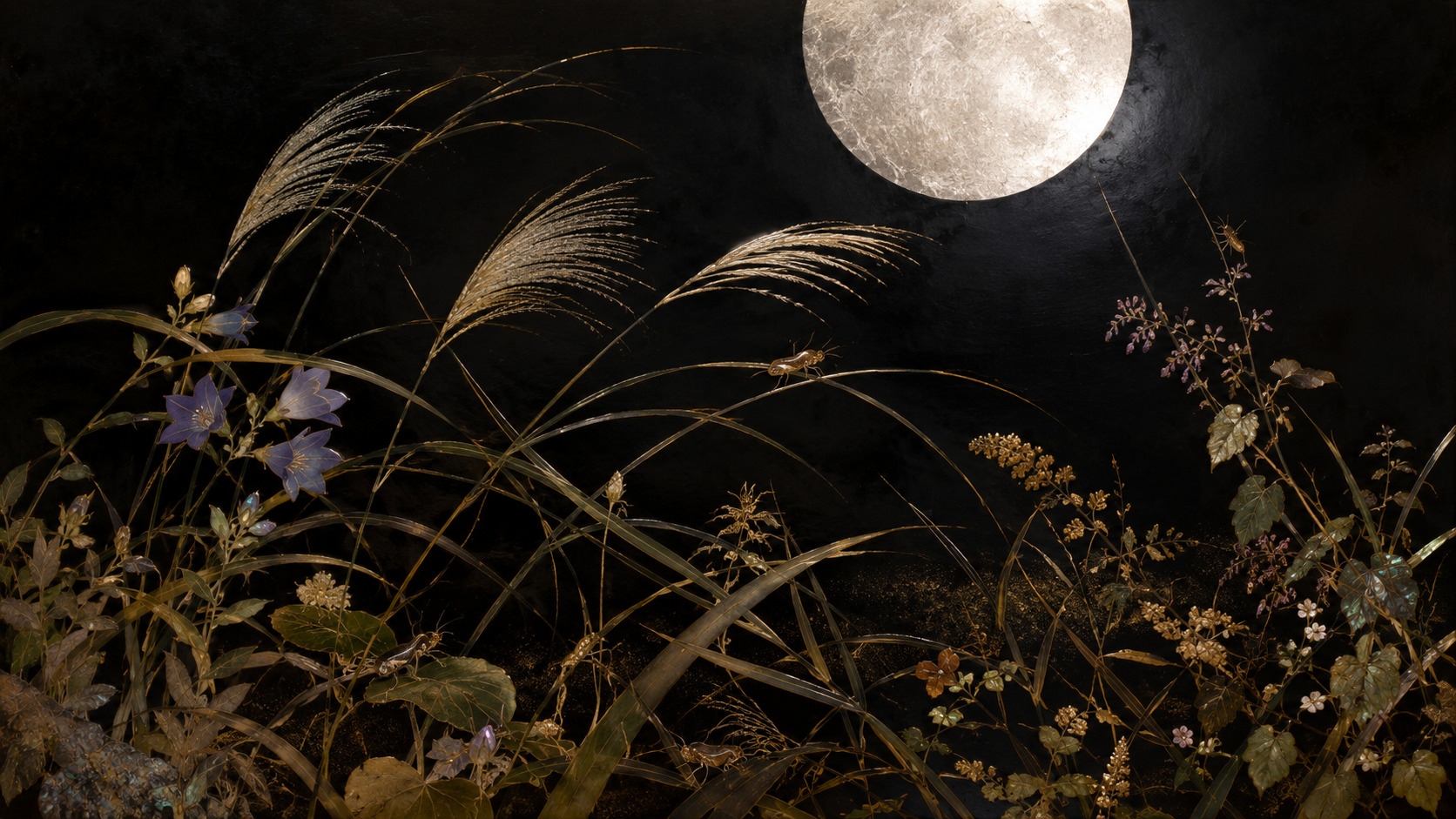
Nothing in a folding screen makes a sound. Yet this one seems loud with small lives. A rust-colored cricket appears where several stems cross. Another waits beneath a leaf. Once the eye learns what to seek, the silver field stops being empty and the grasses stop being decoration. They become an acoustic landscape: cover, distance, interruption and the imagined source of a call.
Shibata Zeshin’s Autumn Grasses in Moonlight—recorded in Japanese as 月に秋草図屏風—is a two-panel screen from the second half of the nineteenth century. The Metropolitan Museum of Art lists its materials as ink, lacquer, silver and silver leaf on paper. Each painted panel measures 45.7 by 84.5 centimeters; the framed screen as a whole is 66.4 centimeters high and 175.3 centimeters wide.
The dimensions matter. This is not a monumental room-surrounding panorama. The Met describes it as a small type of screen used at tea gatherings. Its image field sits near the eye level of a person seated on tatami. The moon is cosmic, but the encounter is intimate.
Begin at the moon, then lose it
The Met instructs viewers to read the work from right to left. That direction produces a narrative. On the right, a vast round moon is partially veiled by leaves and long grasses entering from the upper edge. Stems slice across its disc. The eye then moves left, where the moon has vanished and the vegetation loosens into a more open silver field.
A left-to-right digital viewer can easily reverse that experience. Starting in the sparse panel makes the moon a destination. Starting where Zeshin intended makes it an origin: first overwhelming light, then the patient investigation of what the light reveals. The composition moves from certainty to search.
The insects are crucial to that change in scale. The Met says various kinds of crickets are highlighted with shiny lacquer pigment. It does not identify species, and neither does this article. Their biological names are less important to the work than the way they flash against quieter ink and metallic ground. The moon can be apprehended in one glance. An insect requires attention.
Silver refuses to remain a background
The present high-resolution photograph shows a field that is mottled, reflective and tonally unstable. It can appear gray, pale gold, blackened silver or bright metal depending on the region. The catalog identifies silver and silver leaf but does not provide an object-specific conservation history explaining every stain and change. It would be too easy to label the entire surface “oxidized” from the photograph alone.
What can be said is more interesting. Silver is not simply the color assigned to night. It is a surface that receives light. A flat reproduction freezes one lighting condition; an actual metallic screen changes as a viewer moves and as two hinged panels meet the room at different angles. The night is therefore never entirely painted. Part of it is produced between object, illumination and body.
Zeshin uses that active field to control visibility. Some stems nearly dissolve into it. Dark leaves form blunt masses. The lustrous insects sit slightly forward in the visual hierarchy. Luxury material becomes a system of attention: not just brightness, but the calibrated loss and recovery of detail.
Lacquer is doing the work of paint—but not merely imitating it
Zeshin was trained in maki-e, the lacquer art in which designs made with wet lacquer receive sprinkled metallic powder. Urushi-e, or lacquer painting, is related but not interchangeable. Japanese museum records describe Zeshin building a distinctive practice of painting in colored lacquer on paper. The Met calls his difficult use of lacquer on album leaves, hanging scrolls and screens his own invention.
The difference in wording is worth preserving. “Invented” can suggest a technique appearing from nothing. “Developed a distinctive practice” keeps visible the lacquer traditions, workshop knowledge and painting education on which he relied. Zeshin’s achievement was not to abandon those systems but to make them meet on a sheet of paper.
Lacquer is physically demanding. It has viscosity; it cures under humid conditions; its tone and gloss require practiced anticipation. Paper behaves differently from a wooden box or an inrō. The screen’s catalog does not map every line to a specific material. The Met explicitly identifies the crickets’ lustrous lacquer pigment, but assigning every grass to ink or lacquer by visual guesswork would create false precision.
The object sits productively between categories. The museum classifies it as a painting. Its form is furniture-like and architectural. Its technique draws on lacquer craft. Modern filing systems ask whether it is painting or decorative art; Zeshin’s surface answers that the division is less stable than the filing cabinet.
An artist formed in Edo and recognized by Meiji
Japanese public museum sources give the name as 柴田是真, read Shibata Zeshin. He was born in Edo’s Ryōgoku district in 1807. At 11, he entered the studio of inrō lacquer master Koma Kansai. He later studied painting with Suzuki Nanrei and Okamoto Toyohiko of the Maruyama-Shijō lineage. The training joined exact observation and assured brushwork to technical command of lacquer.
His career then crossed a political and economic rupture. The Tokugawa shogunate ended in 1867–68; Japan reorganized its institutions, industries and international presentation under the Meiji government. In 1873, Zeshin exhibited a lacquer panel at the Vienna World’s Fair and received a Medal for Progress, according to Tokyo National Museum material. He continued to participate in exhibitions at home and abroad.
In 1890 he became one of the first Imperial Artists. Tokyo National Museum describes the new distinction as a system created to protect and encourage artists in fine and applied arts through imperial patronage. Zeshin died the following year. His appointment should not be read simply as the state rewarding an unchanged old craft. It marked an era trying to define what counted as Japanese art while artists such as Zeshin were already moving across those boundaries.
His observational foundation survives in extraordinary quantity. The University Art Museum, Tokyo University of the Arts, holds material transferred by his family in 1975, including 112 ceiling-design studies for a room in the Meiji Palace and 95 sketchbooks. The museum praises the precise, flowing plant lines made through close observation. In Autumn Grasses in Moonlight, that fluency prevents “autumn grass” from becoming a neat botanical label. Stems bend under weight, collide and enter from beyond the frame.
1807 — Born in Ryōgoku, Edo.
Age 11 — Begins studying maki-e with Koma Kansai.
1873 — Receives a Medal for Progress at the Vienna World’s Fair.
Second half of the 1800s — The Met’s date for this screen.
1890 — Appointed among the first Imperial Artists.
1891 — Dies in Tokyo.
1975 — The screen enters The Met from the Harry G. C. Packard collection.
Moon-viewing is relevant; a Mid-Autumn date is not proven
A full moon in autumn invites the phrase “harvest moon” or “Mid-Autumn moon.” The object record does not. Neither the title nor the museum’s account assigns the scene to the fifteenth night of the eighth month in the old lunisolar calendar. The screen participates in a moon-viewing culture without documenting a specific festival date.
That culture has a long history. Japan’s National Astronomical Observatory traces the custom of viewing the Mid-Autumn moon to practices introduced from China around the ninth century. Aristocratic gatherings, poetry and garden design cultivated ways of seeing the moon directly, reflected in water or joined to a landscape. In 2026, the traditional Mid-Autumn moon falls on September 25—23 days after this article’s publication. It need not coincide exactly with the astronomical instant of full moon.
Listening to insects forms a second history of attention. Japan’s National Museum of Japanese History notes that people in the Edo period went to see fireflies in summer and to hear insects in autumn. The National Diet Library identifies Dōkan-yama in Edo as a celebrated insect-listening place where literary visitors watched the moon while attending to the calls of bell crickets and pine crickets.
Zeshin compresses those practices without illustrating an event. There are no poets, guests, cups or musicians. Moonlight makes the plants legible; plants hide the insects; visible insects prompt imagined sound. Season enters through a chain of perceptions rather than a caption saying “autumn.”
A screen behaves differently from a picture on a wall
The wooden lower sections and pierced decorative forms are easy to ignore when focusing on the painted field. They identify the work as an object that stands, folds and divides space. Its hinges create an angle. Its silver receives different light on each side. Its low height places a monumental moon close to seated bodies.
The Met says the screen is of a kind used at tea gatherings. That statement supports a spatial context, not a biography of use. No public record identifies a particular tea host, room or gathering for this object. A responsible reconstruction stops before inventing one.
Even so, the tea-room scale changes interpretation. The viewer does not look up at an official panorama. The grasses occupy a neighboring zone. A screen may block a draft, define the area near a brazier or direct movement while remaining visually permeable. Its art is inseparable from its work in a room.
The tempting date of 1874 remains a question
The Met dates the artwork broadly to the second half of the nineteenth century. Its record also transcribes writing that includes a lucky day in the eleventh month of Meiji 7, equivalent to 1874, and words identifying a Zeshin-painted moon-and-autumn-grass screen. That can look like a precise date waiting to be promoted.
The museum adds a crucial parenthetical question: the inscription may be on a wooden panel of the packing box. A box can be made, labeled, altered or paired with an object at a different time. The public record does not establish that its date is the date of painting. This article therefore retains the museum’s broad official date instead of calling the screen an 1874 work.
The object page records a Zeshin signature and transcribes the seal as “Tairyūkyo.” It does not fully explain the Japanese seal text in the accessible record. The Japanese edition does not reverse-engineer a reading from the English transcription. That restraint is not a gap to hide; it is part of reporting what the catalog can and cannot support.
From Packard’s Tokyo collection to a CC0 image
The screen belonged to Harry G. C. Packard, an American collector based in Tokyo. It entered The Metropolitan Museum of Art in 1975 through a combination of gift and purchase supported by several funds and bequests. Its accession number is 1975.268.137. As of September 1, 2026, the online catalog says it is not on view.
Its digital life is unusually open. The object page marks the work Public Domain, and The Met’s collection API flags the image accordingly. Under the museum’s Open Access policy, images of public-domain works and core collection data are released under Creative Commons Zero. They may be copied, modified and used commercially or noncommercially without permission or fee.
The lead image on this page is that official Open Access photograph, not an AI reconstruction in Zeshin’s style. Legal freedom does not erase scholarly credit. Naming the artist, work, collection and object number lets readers reach the museum’s current record and separates a documented object from the frictionless stream of unattributed images online.
Artwork record
- Title: Autumn Grasses in Moonlight / 月に秋草図屏風
- Artist: Shibata Zeshin (1807–1891)
- Period and date: Meiji period; second half of the nineteenth century
- Form and medium: Two-panel folding screen; ink, lacquer, silver and silver leaf on paper
- Image: 45.7 × 84.5 cm per panel
- Overall with frame: 66.4 × 175.3 cm
- Collection: The Metropolitan Museum of Art, New York
- Object number: 1975.268.137
- Display status: Not on view as of September 1, 2026
- Image rights: Public Domain / Open Access / CC0
Return to the right panel. The moon is still the most obvious form, but it no longer owns the screen. A stem interrupts it. A leaf covers it. The hand of the painter moves into a cricket’s polished body, then disappears into ink and metal. Looking becomes slower.
The screen’s seasonal intelligence lies in that change of pace. Autumn is not a color palette or a list of seven plants. It is a practice of attention: watching light change on silver, allowing grass to conceal as much as it shows, and giving a tiny painted insect enough silence to be heard.
Sources and documents
- The Metropolitan Museum of Art: Autumn Grasses in Moonlight (Japanese title, artist, date, medium, dimensions, viewing direction, interpretation, signature and inscription record, provenance, status, object number and Public Domain designation) and Flower Baskets and Farmer's Hat (the museum’s account of Zeshin’s lacquer-painting technique)
- The Met Collection API: Object 45080 (official image URLs, public-domain flag, catalog data and February 9, 2026 metadata date)
- The Met: Open Access and Image and Data Resources (CC0 and unrestricted commercial and noncommercial use)
- Agency for Cultural Affairs/Tokyo National Museum: lacquer container by Zeshin and ColBase: lacquer-painting album (Japanese name and reading, Ryōgoku birth, apprenticeship at 11, Koma Kansai, Vienna award, lacquer painting and Imperial Artist status)
- University Art Museum, Tokyo University of the Arts: Shibata Zeshin collection exhibition and Tokyo National Museum: Imperial Artists (Maruyama-Shijō and Edo lacquer training, sketches and studies, 1890 institution)
- National Astronomical Observatory of Japan: the Mid-Autumn moon (ninth-century transmission, viewing culture and September 25 date in 2026)
- National Museum of Japanese History: insects in Edo life and National Diet Library: Dōkan-yama (autumn insect-listening and moon-viewing)
Reporting was checked against material available by noon JST on September 1, 2026. Japanese names, readings, titles and technical terms were verified in Japanese museum or government sources. This English edition was written independently and does not reconstruct Japanese quotations from English. The work is not labeled as a depiction of the Mid-Autumn festival; plant and insect species are not supplied beyond the museum’s record. The account of visual movement, imagined sound and material attention is Japan.co.jp analysis.
Image rights: The official image of Shibata Zeshin’s Autumn Grasses in Moonlight is identified by The Metropolitan Museum of Art as Public Domain and distributed through its Open Access program under CC0. See the museum object page for the current record and high-resolution download.