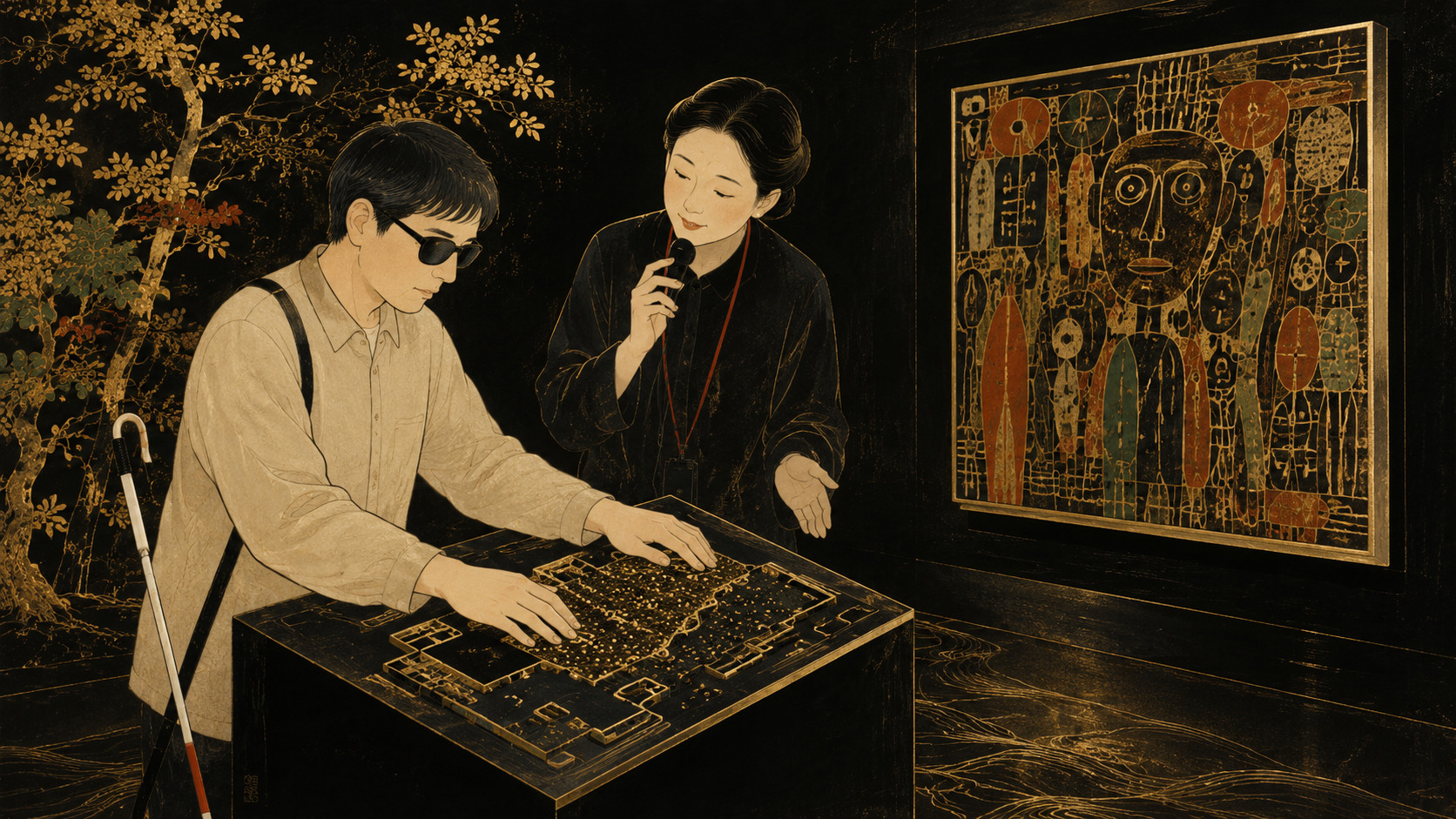
The gallery rule has not disappeared. Visitors will not place their hands on the original works. What changes in Shibuya on November 22 is the route into them: selected pieces from an Art Brut exhibition will be interpreted as tactile diagrams, and visually impaired participants will explore those diagrams with their fingers while a curator and companions join the discussion.
Tokyo Shibuya Koen-dori Gallery opens applications at midnight on September 2 for two free, 90-minute sessions. One runs from 10:00 to 11:30 AM and the second from 1:30 to 3:00 PM. Each has room for approximately five groups. A participant may attend alone or with a companion; if applications exceed capacity, places will be allocated by lottery.
The application window closes at 11:59 PM on October 15. The gallery plans to notify successful applicants by email or telephone by October 17. Its web form asks for a name and contact details, but applicants who find the form difficult may apply by telephone or email instead. That choice of channels makes accessibility part of the event before anyone enters the building.
The act of translation is the experience
A tactile diagram is often described as if it were a picture converted into raised lines. That is only the beginning. A two-dimensional work can contain color, depth, overlap, texture, gesture, visual rhythm and references that do not map neatly onto the fingertip. The maker of a diagram must decide which contours matter, what can be simplified, how separate surfaces will be distinguished and in what sequence the information can be encountered.
Too much relief can be as confusing as too little. Scale affects how much the hand can hold in memory. Labels and spoken description may be needed to connect one region with another. The resulting object is therefore not a neutral copy and cannot be judged solely by how closely it resembles the source to a sighted observer. It is an interpretation designed for use.
The 2026 notice specifically says a curator will guide the group. That matters. A diagram left on a table may offer information; a diagram used in conversation can generate questions. Where did a participant begin? Which interval felt unusually wide? Did the hand find a rhythm that a verbal account overlooked? What does the work’s material or making process add to the shape under the fingertips?
This also changes the curator’s role. If the exchange merely transfers a sighted expert’s “correct” visual reading, touch remains subordinate. The more consequential encounter allows an interpretation formed through touch to alter the group’s understanding. Viewing becomes reciprocal rather than remedial.
Why this particular exhibition needs more than one way in
The tour belongs to the seventh annual Art Brut touring exhibition organized through the gallery. Its official English title is Sozo Training! —Drawing Out Imagination and Creation, Connecting, Being Here—; the Japanese 「ソウゾウ」 plays on imagination and creation. It opens in Shibuya on October 10 and runs through December 27 before moving to Takanawa Civic Center Gallery in January 2027 and Koganei City HAKENOMORI Art Museum from late January into February.
Tokyo’s gallery has co-curated the exhibition with the Hajimari Art Center in Inawashiro, Fukushima Prefecture. The Japanese exhibition page names curators 岡部兼芳, 小林竜也 and 大政 愛. It does not supply readings, so this edition does not invent romanizations for them.
The curatorial premise focuses on makers drawing out urgent inner thoughts and connecting them through expression. The venue becomes a place to exercise imagination rather than passively receive a fixed explanation. A tactile tour is not extraneous to that idea. Participants reconstructing form through hand, language and memory enact it.
The seven exhibitors are KAGAWA Daisuke, SHIMIZU Chiharu, SUGIURA Atsushi, TAGUCHI BOSS, NUCA Tsukurutoko, HONDA Tadashi and MORI Haruka. Six are individual makers; NUCA Tsukurutoko is a day-support welfare service and creative setting founded in Okayama in 2013. Their practices resist a single biographical formula. Kagawa’s intricate yet forceful compositions mix figurative and abstract forms. Shimizu repeats rounded handwriting and small boxes. Sugiura touches favored photographs for years until their surfaces and corners wear into new forms. Taguchi began drawing at 75 and made roughly 400 works in six years.
Honda began making work at 26. Mori, who has congenital cerebral palsy, holds a brush with her toes. Those facts can explain a process, but they cannot substitute for criticism of composition, material, repetition or pace. Nor has the gallery announced which exhibitors’ works will be represented by tactile diagrams. It would be irresponsible to infer the selection from an artist’s body or biography.
Art Brut is not shorthand for disability
The French artist Jean Dubuffet developed the concept of Art Brut and began assembling his collection in 1945. A Paris exhibition site followed in 1947 and the Compagnie de l’Art Brut in 1948. In 1971, Dubuffet donated approximately 5,000 works by 133 creators to Lausanne. The Swiss city opened the Collection de l’Art Brut as a museum in 1976.
Dubuffet was interested in work made at a distance from academic culture and the established art market. The boundaries he proposed were never politically neutral, and the term has expanded and changed across countries and institutions. Tokyo Shibuya Koen-dori Gallery today describes Art Brut broadly as work by people without professional fine-art education, among others, whose distinctive ideas and methods have attracted attention.
The qualification matters. Art Brut is not a synonym for “art by disabled people,” and disability is not an aesthetic category. Some creators work within welfare settings, some do not. Some identify as artists, some may not. Exhibitions, collectors, families, institutions and support workers affect which objects survive and how they are presented. Romanticizing a maker as entirely outside society hides those relationships; reducing a work to a welfare narrative hides the work.
The tactile tour adds another necessary distinction. Accessibility concerns who can encounter the exhibition. Art Brut concerns how works are described and situated. Conflating the two would turn the visually impaired visitor into a theme of the exhibition rather than a member of its audience.
A gallery designed around display and exchange
Tokyo Shibuya Koen-dori Gallery opened on February 8, 2020, on the ground floor of the Shibuya Labor Welfare Hall in Jinnan. Tokyo and the Tokyo Metropolitan Foundation for History and Culture established it as a hub for exhibitions and exchange that foster understanding of diversity and an inclusive society. It is administered through the Cultural Coexistence Section of the Museum of Contemporary Art Tokyo.
The institution contains two exhibition rooms and an exchange space. The tactile event uses all three. That spatial arrangement reflects its public mission: showing objects and convening people are not separate programs when discussion is part of viewing.
The gallery’s archive documents similar tours on November 10, 2024, and November 16, 2025. Each offered one morning session for approximately five groups, was free, used a lottery and permitted solo attendance. In 2026 the gallery has scheduled morning and afternoon sessions. Within the three-year official record, that doubles the number of sessions for the first time. Capacity is measured in groups because companions may attend, so the announcement does not establish the exact number of individual participants.
1945 — Dubuffet develops the Art Brut concept and collection.
1976 — The Collection de l’Art Brut opens in Lausanne.
2020 — Tokyo Shibuya Koen-dori Gallery opens.
2024–25 — The official archive records one tactile-diagram tour each year.
2026 — The program expands to two sessions on November 22.
Japan’s tactile experiments show why process matters
Other Japanese institutions provide context, but not a template that can be attributed to the Shibuya event. A Cultural Affairs Agency case study from Ehime describes tactile diagrams, audio, Braille and tools for people with low vision developed with blind-school students and visually impaired adults. Prototypes were tested and revised; staff training and wayfinding were treated as part of the work.
Another agency-backed project brought together an artist, specialists and visually impaired participants to devise a viewing program for flat artwork through sight, touch, dialogue and imagination. Fourteen tactile tools were developed around Hasegawa Saburo’s Trail of the Butterfly. The roughly three-month presentation drew more than 20,000 visitors, according to the project report.
Those examples show that tactile interpretation is a developing practice rather than a solved technical conversion. Co-development can expose problems a sighted designer would miss. Staff language affects whether a device invites exploration or prescribes a route. The journey to the museum can determine whether the work inside is usable at all.
They do not prove that Shibuya’s 2026 diagrams were co-designed or tested with visually impaired people. The gallery has not published that information. Keeping the distinction visible is essential: an admirable method elsewhere cannot be silently credited to this program.
Access is a stack, not a single feature
The wider exhibition offers several routes. Actor and dancer MORIYAMA Mirai provides a free Japanese-language audio guide. A tour will use the OriHime remote avatar robot. An Easy Japanese viewing guide and an artist talk with sign interpretation are also planned. These measures address different barriers—vision, hearing, language, mobility and distance—and none can stand in for all the others.
The tactile tour itself demonstrates that stack. A person must learn about it, complete an application, reach the gallery, find the reception point, use the diagram, hear or otherwise receive the curator’s information and travel home. A successful object inside the room cannot repair every failure before or after it.
The gallery’s route guide for visually impaired visitors is unusually direct about Shibuya. It identifies tactile paving on a recommended route from JR Shibuya Station but warns that the station remains under construction and that visitors should ask station staff for current directions. The Hachiko crossing has no audible signal and is heavily crowded. Koen-dori includes an incline of about four degrees. The building entrance has steps, with tactile paving at the left edge, and a wheelchair lift is available.
The event notice does not promise a station meeting point, escort service or arrival assistance. Applicants needing a specific accommodation should ask the event desk before travel. Publishing a route is useful; it is not the same as guaranteeing that the route is navigable for every person.
About ten groups: intimacy and scarcity
Small-group design is not a flaw. Touch takes time, and a curator needs room to respond to each participant instead of delivering a lecture at speed. A session that allows silence, repetition and disagreement can produce richer interpretation than a large group gathered around an inaccessible object.
Yet the two sessions offer only about ten groups in total, and a lottery will decide oversubscribed places. The event is meaningful but cannot be described as universal access. Its public value will depend partly on what travels beyond November 22: whether the diagrams remain available on other dates, whether they move with the exhibition to Minato and Koganei, whether participant feedback changes future practice, and whether any interpretation is preserved for people who could not attend.
The official pages do not answer those questions. Japan.co.jp’s analysis is that a small experiment becomes institutional capacity when its methods and lessons survive the day. That does not require turning a private participant conversation into content. It does require treating the tools, staff knowledge and operational changes as more than a one-off event.
How to apply
Tactile Tour for Blind and Visually Impaired Visitors
- Date: Sunday, November 22, 2026
- Sessions: 10:00–11:30 AM and 1:30–3:00 PM
- Venue: Exhibition Rooms 1 and 2 and the Exchange Space, Tokyo Shibuya Koen-dori Gallery
- Eligible participants: Visually impaired people and companions; solo attendance permitted
- Capacity: Approximately five groups per session; lottery if oversubscribed
- Fee: Free
- Language: The gallery says the event will be conducted in Japanese
- Apply: September 2, 12:00 AM–October 15, 11:59 PM, by web form or, when the form is difficult to use, by telephone or email
- Results: Successful applicants contacted by October 17
- Event desk: 03-5422-3151
The gallery warns that an automatic-reply problem affects Gmail and iCloud addresses and says staff will respond individually in sequence. Applicants who receive no confirmation should contact the desk. The same route is appropriate for questions about accommodations or details that the public notice does not specify.
English often treats “viewing” as a visual act. Museums have learned that the word can hold more: attending, testing, interpreting and sharing attention. The Shibuya tour preserves the boundary around fragile originals while changing the boundary around meaning. A finger traces; a curator supplies context; another participant offers a different account. A picture does not become touch. It becomes a conversation.
Sources and documents
- Tokyo Shibuya Koen-dori Gallery: Japanese tour notice and official English notice, “Tactile Tour for Blind and Visually Impaired Visitors” (titles, diagrams, date, sessions, language, eligibility, capacity, fee, application, lottery and contact procedure)
- Gallery: Japanese exhibition page and official English page for Sozo Training! —Drawing Out Imagination and Creation, Connecting, Being Here— (titles, venues, dates, premise, exhibitors, curators and related access programs)
- Gallery: About the institution and barrier-free route for visually impaired visitors (mission, definition of Art Brut, operator, spaces, address, equipment and route warnings)
- Tokyo Metropolitan Government: February 8, 2020 opening notice and opening ceremony report (opening date and public mission)
- The 2024 tactile-diagram tour and the 2025 tour (previous dates, capacity, eligibility and lottery format)
- Agency for Cultural Affairs: Ehime museum-accessibility case and Innovate MUSEUM: creating a new art-viewing program (Japanese examples of co-developed and tested tactile interpretation)
- Collection de l’Art Brut, Lausanne: History and What is Art Brut? (Dubuffet’s collection, the Lausanne donation and the 1976 museum opening)
Reporting was checked against material available by 11:50 AM JST on September 1, 2026. The event, exhibition and institution names; exhibitors; dates; eligibility; application terms; operator; related programs; and prior tours were verified in Japanese primary sources, then checked against the gallery’s official English pages. This English edition was written independently and does not reconstruct Japanese quotations from English. Official English event and exhibition titles are used where the gallery provides them. Analysis of tactile mediation, access and limited capacity is Japan.co.jp’s; other Japanese projects provide context and are not evidence of Shibuya’s unpublished fabrication process.
Image rights: © 2026 Japan.co.jp. This AI-assisted editorial illustration may not be republished or reused without prior written permission. For licensing, use the contact page.