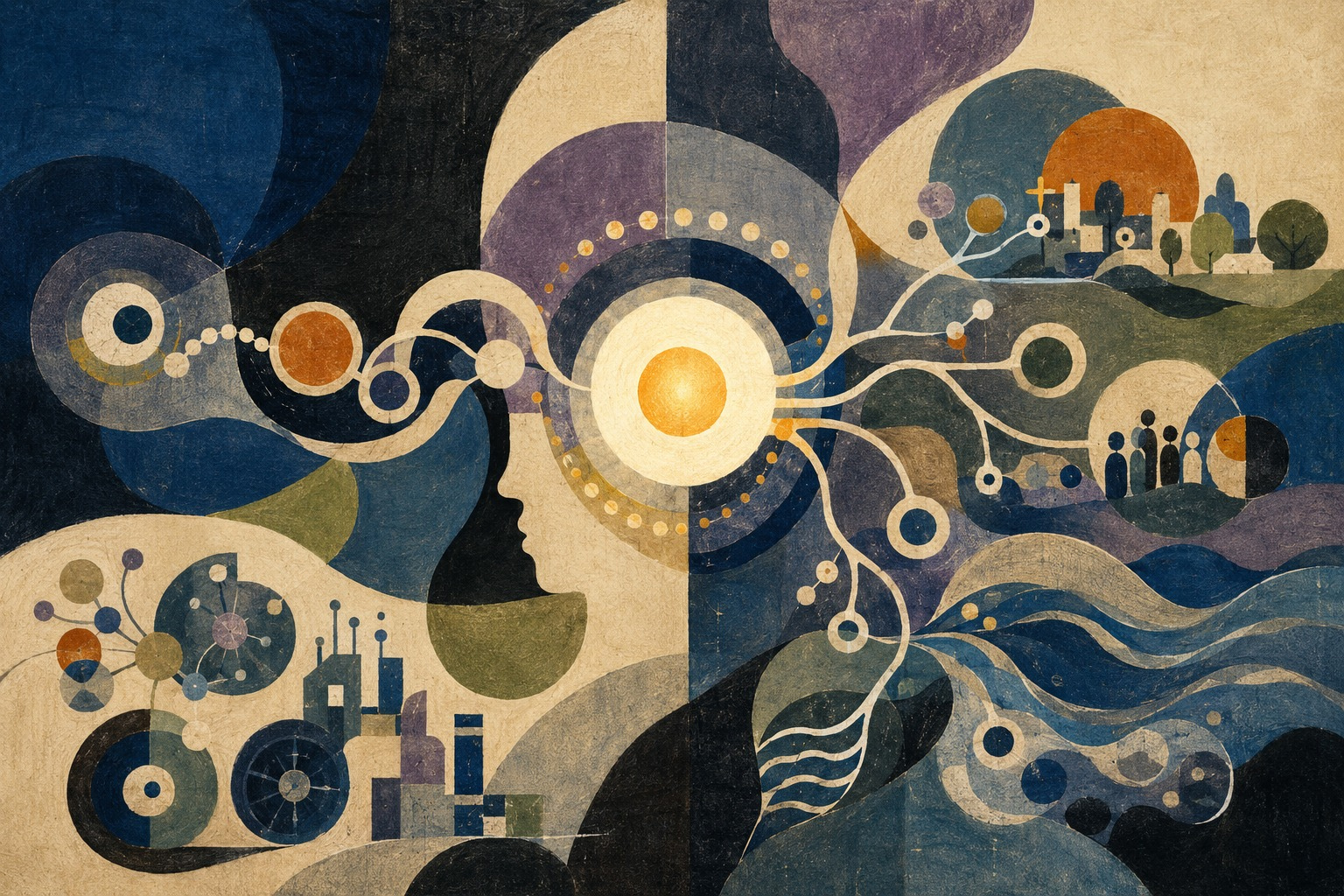
The first thing to emerge is a face. It looks left from the center of the picture, but the border that ought to separate mind from world has been swallowed by a great circle. At its center, a burnt-orange form could be an eye, a sun, a cell nucleus or a processor. Ivory paths run outward. To the left, circles form a chain above block-like machines. To the right, branches reach a city, trees, small groups of people, waves and particles that seem cellular.
This is not a diagram. It is not a map of the prefrontal cortex, a stained image of a macrophage or the organizational chart of a venture fund. Its useful quality is that no circle can be permanently assigned to “the AI model” or “the cell.” The same form can operate as a neural node inside a brain, an organelle inside a body, a financing round inside a company or a moving person inside society. The picture changes scale without announcing the border.
That is why Onchi Kōshirō is the historical reference. Onchi did not pursue the exact outline of visible things alone. He searched for forms adequate to music, grief, memory, time and other states that have consequences but no stable contour. Abstraction, for him, was not a way to say less. It was a way to show relationships that resemblance could not reach.
How Onchi Printed the Inner World
Born in Tokyo, Onchi passed through training in painting and sculpture at the Tokyo School of Fine Arts without settling inside a single discipline. He made prints, wrote poetry, designed books, worked with photography and photograms, edited little magazines and built a meeting place for younger artists. The National Museum of Modern Art, Tokyo describes him as a pioneer of Japanese abstraction and a master of the sōsaku-hanga, or Creative Print, movement. “Printmaker” is accurate, but it is not large enough.
At the beginning of the twentieth century, woodblock printing in Japan carried an immense inheritance. Edo-period ukiyo-e had produced extraordinary images through a sophisticated division of labor: publishers organized projects, artists supplied designs, carvers cut the blocks and printers controlled the transfer of color to paper. Modern art institutions, however, increasingly valued the singular author. A new generation sought to establish printmaking not as the mechanical reproduction of an image or an appendage of craft, but as an independent art in which the artist's decisions remained alive at every stage.
The Creative Print ideal was condensed into three phrases: jiga, jikoku, jizuri—self-drawn, self-carved, self-printed. That should not be read as a declaration that collaborative ukiyo-e was aesthetically inferior. The radical proposition was that drawing, cutting and printing were not neutral steps between idea and result. The cut of a blade, the pressure on paper, a displaced color and an imperfect edge could each carry expression.
Nor should the phrase become a purity test. Not every impression associated with Onchi was made entirely by his own hand. Some editions were printed with the involvement of others; later impressions were made after his death, including work printed by his son, Kunio. The ideal changed the status of process even when the historical practice remained more complicated.
Tsukuhae: Great Abstraction in a Small Magazine
Onchi's beginning is inseparable from Tsukuhae, the private print-and-poetry magazine he made with Tanaka Kyōkichi and Fujimori Shizuo in 1914 and 1915. It had none of the scale of commercial publishing. Its circulation was small, its pages hand-printed, its poetry and images held close together. That smallness created freedom. Beyond a publisher's market and the conventions of illustration, the young artists could turn illness, loneliness, fear and hope into distorted bodies, black spaces and drifting shapes.
The National Art Museums collection record places works with titles such as Lyric I, Drifting Being, Suffering at the Bottom and Not Abandoning Hope within those early issues. The titles do not explain a scene; they unlock a condition in the viewer. The 1915 color woodcut commonly rendered in English as Lyric: The Clear Hours is only 13.5 by 10 centimeters. Its importance as an early Japanese abstract work lies not only in its unfamiliar forms, but in the shift of subject—from an object outside the artist to an event within experience.
Onchi later developed “lyriques” on musical themes. Harvard Art Museums dates the original version of his Debussy-inspired Poisson d'or to 1933 and records woodblock printing with ink, color, mica and brass. Music cannot be pictured literally. Its repetition, silence, emphasis and resonance can, however, be translated into distance, weight, interval and rhythm on paper. “Circuits of the Mind” follows that method rather than copying an old composition: it translates the pulse and connection shared by today's stories, not their outward appearance.
1910s Studies at the Tokyo School of Fine Arts and enters print-and-poetry coterie activity.
1914–15 Publishes Tsukuhae with Tanaka Kyōkichi and Fujimori Shizuo, developing an early lyrical abstraction.
1918 The Japanese Creative Print Association is established and the movement gains an organization.
1930s Moves among book design, photography and abstract prints, including his musical “lyriques.”
From about 1939 Opens his home to the First Thursday Society, supporting younger printmakers and exchange.
After 1945 Creative prints win new attention abroad through exchanges with American patrons and collectors.
1955 Dies in Tokyo; his abstract prints and artist-centered conception of printmaking continue to shape later practice.
More Than Wood: Materials Leave the Trace of Thought
Onchi's mature surfaces have a tremor absent from perfectly smooth geometry. Museum accounts describe his use of everyday materials such as waxed paper, corrugated cardboard and string as printing matrices, as well as natural forms including leaves and shells. “Block” no longer meant wood alone. Grain, absorption, irregular pressure and accidental scuffing entered the image.
Chance did not release the artist from responsibility. A leaf vein will not print evenly under identical pressure. Paper changes with moisture; overlapping colors cloud or brighten. The artist decides which difference is an error and which difference makes the image breathe. Small editions can therefore contain slight variations from sheet to sheet. Printmaking multiplies an image while refusing perfect identity.
Today's picture is not a physical woodblock print. Its rubbed surface, uneven color and borders suggestive of misregistration nevertheless resist the frictionless cleanliness of a digital file. They try to give a computer-generated image a memory of paper. That effort has both power and danger. If texture is only a filter that makes something look old, history becomes decoration. Historical reference becomes meaningful only when texture, interval, shape and restraint work together as a method of thought.
Reading the Image: Circles, Paths, Profile, Four Fields
The central profile appears to divide the picture, but left and right are not enemies. Ivory lines cross the border and move in several directions. This is not a command chart in which a brain rules a body or a company transforms society. Inputs return, routes branch and one scale becomes another.
| Visible element | Editorial reading | What it does not establish |
|---|---|---|
| Burnt-orange and ivory circles at the center | Attention, judgment, a model core, the center of life | One fixed identity as an eye, sun, nucleus or chip |
| Ivory lines running left and right | Paths for neurons, communications, capital, migration and research | An accurate neural map or data-flow diagram |
| Urban rectangles and nodes at lower left | Data centers, cameras, companies and computing infrastructure | A real facility or the logo of a particular company |
| Waves and organic particles at lower right | Cellular aging, immunity, metabolism and passing time | A microscopy image or evidence of a treatment effect |
| Buildings, trees and people at upper right | Regions, founders, residents and the social passage of research | A map of one city or a demographic chart |
| Deep blue, black, burnt orange, ivory and muted green | Uncertainty, tension, ignition, connection, life and social ground | A fixed historical color code in Onchi's work |
The final distinction matters. These meanings belong to this essay's close reading; Onchi did not use blue to signify AI or orange to signify a neural impulse. A historical artist should not be reduced to a dictionary of symbols. What can be inherited is not a permanent code, but an attitude: the conversion of an invisible state into a relationship among colored forms.
Four Circuits of Today: Machine, Brain, Cell, Company
The technology and science reports in the July 30 edition occupy different fields but share a set of verbs. A signal passes. Information is selected. Repetition becomes structure. Resources gather at one node and move to another. Each story contains a circuit rather than a solitary genius.
KDDI and Google's program for Japanese AI startups combines as much as $2 million in co-investment, up to $350,000 in AI and cloud credits, early access to models, domestic GPU capacity, expert support and routes to customers. The design recognizes that money alone does not build a company. It is also a strategic circuit, carrying implications for equity ownership and technological dependence.
IIJ and Alpha Vision's “physical AI” is intended to search camera footage in natural language, analyze people and vehicles, detect dangerous conditions and convert findings into spoken warnings or reports. Cameras, edge processing, networks, cloud services and human decisions become one line. A second, less comfortable circuit appears beside it: who is watched, how a false inference is corrected and where the video travels.
Kyoto University's habit study separated two circuits in mice. A projection from the anterior cingulate cortex to the retrosplenial cortex helped determine whether behavior crossed from goal-directed action into habit; a lateral orbitofrontal-to-striatal pathway regulated how much habitual behavior was performed. Becoming a habit and being performed frequently are not the same operation. The picture's branching line acquires a scientific echo precisely because it does not converge on a single switch.
The early taurine and senescent-cell experiment is an in-vitro result involving macrophages whose senescence was induced by a drug. A pattern suggesting selective clearance is scientifically interesting, but it is not evidence that taurine rejuvenates animals or people. The particles at lower right should therefore be read as an editorial meditation on a paradox—the body's cellular cleaners may themselves age and become candidates for removal—not as an advertisement for an effective treatment.
- AI: Corporate investment and product plans. Practical value, surveillance risks and market effects remain to be tested.
- Neuroscience: A peer-reviewed mouse study using causal interventions. It is not a demonstrated treatment for human addiction.
- Cellular aging: Limited in-vitro findings. Dose, mechanism and effects in animals or people remain unresolved.
- Startup policy: Selection, meetings, grants, acceleration and investment. Outcomes must later be measured in survival, customers and social effect.
Startups Need a Place Like the First Thursday Society
To tell Onchi's story as individual talent alone is to miss another center of Creative Print history. From around 1939, printmakers gathered at his home on the first Thursday of the month. The group became known as the Ichimokukai, or First Thursday Society. Amid wartime controls and material shortages, younger artists shared techniques, paper, blocks, criticism and opportunities to publish. In 1944, members produced the first Ichimoku-shū portfolio. The ideal that artists carve and print for themselves did not contradict the network. Community made independence possible.
Founders live with the same paradox. They are asked to be original, but cannot be independent without capital, computing, regulation, manufacturing, clinical trials or customers. At HVC KYOTO, the 125 individual business meetings held before the public pitches may have mattered more than the stage. Without a circuit connecting research, drugmakers, medical-device companies, investors, regulation and patient needs, discovery cannot cross the “valley of death.”
The 11 social-impact startups selected by Fukuoka do not fit the myth of the lone hero either. They address older people's work, school refusal, support for families with multiple births, transport for care and circular consumption—problems to which markets do not easily attach a price. Donation-linked grants and roughly eight months of acceleration are an attempt to build a route. The small figures and buildings at upper right can be read not as a city already made prosperous, but as a place where social need is translated into an organization capable of acting.
Foreign residents moving across prefectural borders remind us that circuits carry people as well as data and money. Recruitment may bring someone to a region once. A place will continue to be chosen only when housing, schools, health care, language, friendship and work connect. A migrant becomes a resident through infrastructure that is social as well as physical.
Onchi the Book Designer: Giving Information a Body
Onchi belongs in a contemporary newsroom for a reason beyond abstract printmaking. Book design was central to his practice. He treated the cover, title page, text, type, photograph, margin and texture of paper not as separate decorations but as the design of a duration: how a book is held, opened and read. If a print makes one image, a book gives order and relation to many pieces of information.
The principle survives in digital editing. A news image need not merely decorate an article. It can become the reader's threshold into a difficult day and a way to sense relations among headlines. Today's Art Choice is a sixteenth, independent art-and-ideas story, but it is also an index to the fifteen reports around it. Before the circles and paths signify brains or cells, they direct a reader's eye through the page.
The gaze can move from the concentric circles at far left to the luminous center, then upward toward society or downward toward organic life. It is not forced in one direction; it can loop back. Like links on a page, each entrance leads toward another story. As Onchi's designs turned a stack of paper into one experience, this image tries to turn a stack of articles into an intellectual landscape of a day.
In the Age of Self-Drawn, Self-Carved, Self-Printed, Whose Hand Is AI?
The hardest question should not be hidden. If Creative Print asked an artist to take responsibility for every part of production, can an AI-generated image honestly be connected to that history? A model does not behave as an artist holding a carving knife. Training data, software, compute, prompts, selection, revision and publication form a layered system. In some ways, the division of labor is less visible than the workshop behind an Edo print.
Saying only that “AI is another tool” erases the important issue: responsibility. The useful questions are where human judgment enters, what was referenced, what was accepted, and which failures were rejected. For this picture, the editorial conditions included the day's stories, an explicit reference to Onchi, abstraction rather than illustration, interlocking circles and paths, organic forms, a constrained palette and an intellectual, experimental mood. After generation came the decision to select this image as the day's unifying work, give it a distinct title and subject it to criticism.
None of that makes it equivalent to Onchi's creation. There is no pressure of hand-printing, no immediate negotiation with a physical material and no scarce edition of variable impressions. That is why the origin is stated directly. Respect does not mean claiming sameness. It means refusing to conceal difference. What AI-era publishing can carry forward from Creative Print may be less the literal form of “one person made everything” than the demand to return process to the domain of expression and accountability.
Where It Resembles Onchi—and Where It Does Not
The image refers to Onchi through restrained color, rubbed paper, overlapping circles and abstraction used for invisible states. Burnt orange rises against deep blue and black; ivory paths establish the beat; muted green gives machine and body a common ground. The limited palette keeps the many themes from disintegrating into a catalog.
It is also more explanatory than many of Onchi's mature abstract prints. A clear human profile occupies the center, and recognizable suggestions of a city, trees and people remain. Its 16:9 horizontal format is adapted to a website hero image rather than a book or intimate print. The screen is densely populated with a narrative where Onchi often allowed large, quiet intervals to carry weight. This is not a comparison designed to hide a deficiency. It shows how a reference changes when it enters a new use.
Onchi should not be enclosed within the label “Japanese-style abstraction.” He absorbed stimulation from the Western avant-garde, music, photography and typography while rebuilding it through Japanese traditions of wood, paper and books. After the war, American collectors and writers including James Michener and Oliver Statler helped bring attention to Creative Prints abroad. The Honolulu Museum of Art now describes its Onchi holdings as the largest outside Japan. His modernity lay not in choosing East or West, but in making multiple routes collide on his own paper.
There Is No Single Way to Look
The picture first attracts the eye to its bright center. Then the profile appears, and the viewer may follow it toward the mechanical nodes at left or the organic waves at lower right. But the direction can be reversed. Starting with the small people at upper right makes social need and entrepreneurship flow inward toward the mind. Starting with the particles makes cellular aging expand into body, decision and industry. Starting at lower left allows compute and sensors to alter human perception from outside.
That reversibility prevents a simple celebration of technology. AI may be designed to assist people, but people may also be made to fit its conditions. Humans make habits; habits then move humans. Immune cells remove damaged cells; those cleaners can themselves become senescent and persist. Startups gain power from networks and become dependent on the choices of capital and platforms. A circuit transmits power while creating dependency.
Onchi's idea of the lyric remains useful because it does not diagram an answer. Translating music into shape does not make the shape identical to music. In the same way, bringing AI, brain, cell and city onto one surface does not become a scientific explanation. It can, however, make us notice that a similar structure is pulsing beneath separate reports.
What unifies today's news is not a vague promise of “the future” or “innovation.” It is the more concrete question of pathways. Who connects to whom? Where does a signal weaken? Which company receives capital? What does a cell remove? To which prefecture does a person move? Through what institution does research reach a patient? “Circuits of the Mind” places those questions inside and outside one profile. It does not make the invisible visible. It gives the invisible a surface on which its relationships can be felt.
Reporting notes and primary sources
This article draws on museum scholarship and collection records, primary materials from research institutions and companies, and the long-form reports in today's edition, all checked through July 29, 2026, 11:30 a.m. JST. The published image is not an Onchi original but a new Japan.co.jp editorial work. The meanings assigned to colors and motifs are this essay's visual interpretation, not a fixed Onchi symbolism. The account also avoids reducing Creative Print to a claim that every impression of every work was made wholly alone, recognizing the difference between the movement's ideal, workshop realities and later printings.
- National Museum of Modern Art, Tokyo: Onchi Kōshirō retrospective
- National Museum of Modern Art, Tokyo: Onchi Kōshirō and Tsukuhae
- National Art Museums collection: Lyric: The Clear Hours and early works
- National Museum of Modern Art, Tokyo: Creative Prints and the Japanese Creative Print Association
- Art Institute of Chicago: Onchi Kōshirō's affection for abstraction
- Art Institute of Chicago: Affection for Shapeless Things and experimental materials
- Smithsonian National Museum of Asian Art: Onchi Kōshirō
- Smithsonian National Museum of Asian Art: the materiality of Creative Prints
- Honolulu Museum of Art: Lyrically Rebellious: The Prints of Onchi Kōshirō
- Museum of Modern Art, New York: works by Koshiro Onchi
- Museum of Modern Art, New York: Lyric No. 14 (Ode to the Spring)
- Harvard Art Museums: Debussy, Poisson d'or
- British Museum: Onchi Kōshirō biography
- Kyoto University: two brain circuits in habit formation
- Nature Communications: prefrontal plasticity and habitual behavior
- Taisho Pharmaceutical: taurine and senescent macrophages
- Cell: minimum information guidelines for cellular-senescence research
- KDDI: AI startup support with Google AI Futures Fund
- IIJ: investment in AGI7 and cooperation with Alpha Vision Japan
- JETRO: HVC KYOTO 2026 and 125 business meetings
- Fukuoka City: Fukuoka Social Startup Package
- Japan.co.jp: KDDI and Google AI startup program long-form report
- Japan.co.jp: IIJ and Alpha Vision long-form report
- Japan.co.jp: two habit circuits long-form report
- Japan.co.jp: taurine and senescent cells long-form report
- Japan.co.jp: HVC KYOTO long-form report
- Japan.co.jp: Fukuoka social-impact startups long-form report