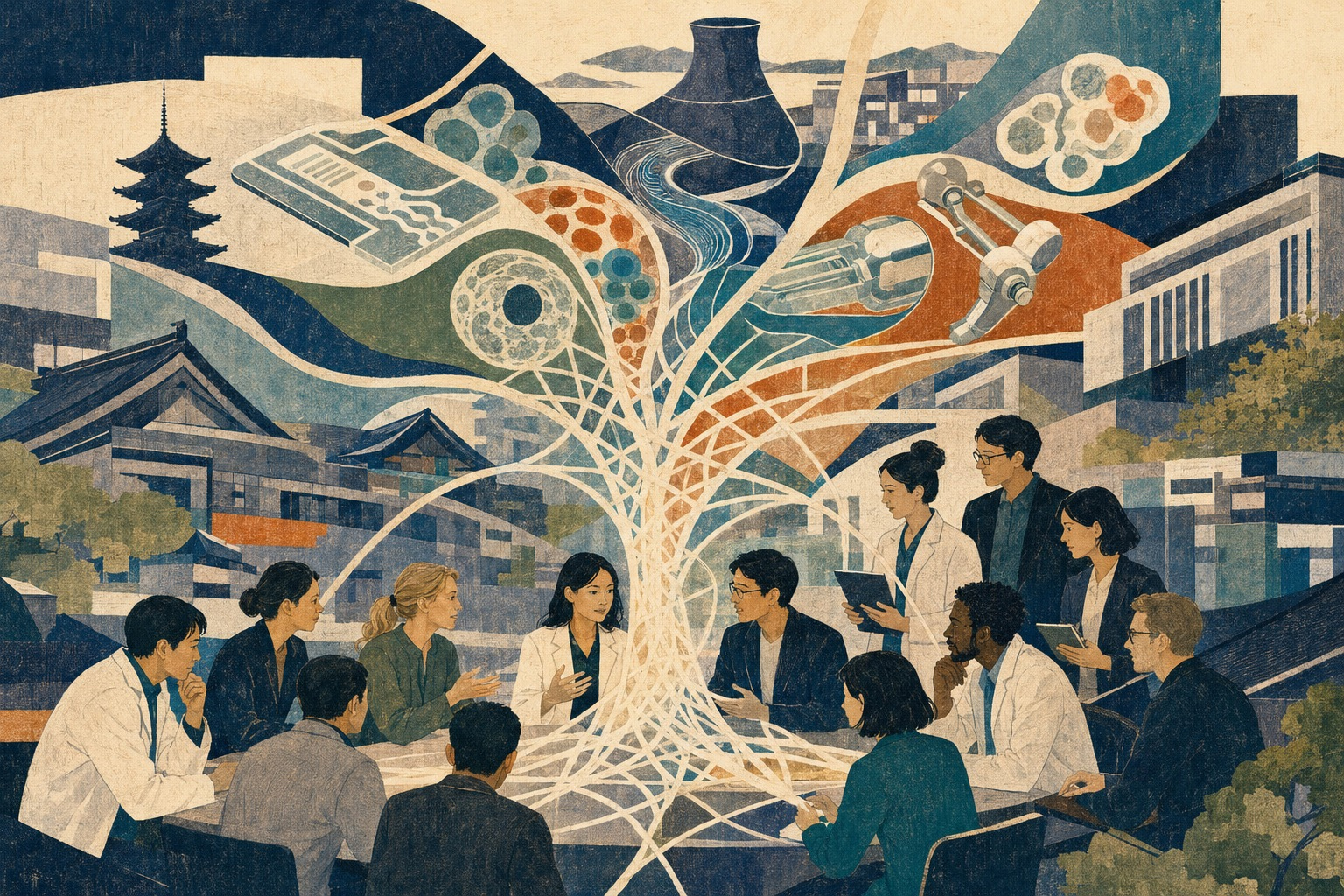
One meeting probably lasted no more than a few dozen minutes. The scientist wanted to explain why the technology was novel. A pharmaceutical executive wanted to know whether the biological target mattered in patients. A device company was thinking about hospital workflow. An investor was calculating what could be proved before the next financing. A regulatory specialist would ask whether today’s experiment could support tomorrow’s application.
They were looking at the same invention and seeing different ways it could fail. HVC KYOTO’s 125 private meetings on July 13 were designed to force those perspectives together early. The following day’s lights, slides and applause attracted attention. But in drug and device development, the question that changes a company’s fate often arrives offstage: Which patient problem do you solve better than anyone else—and what evidence can you create, for how much money, by when?
HVC KYOTO 2026 took place July 13 and 14 at Kyoto Research Park. Kyoto Research Park, Kyoto Prefecture, Kyoto City and the Japan External Trade Organization, or JETRO, have organized the program annually since 2016. Its 11th edition divided participants into Biotech—drug discovery, bioscience and regenerative medicine—and MedTech, including digital health and devices. The program operated in English. That was not merely a presentation choice. It made the working language match the patents, trials, financing, licenses and regulatory markets the ventures hope eventually to enter.
Why the Official Record Says 20, 23 and 15
Three different cohort figures appear in the public record because they describe different doors. Kyoto Research Park announced 20 Japanese selections in April. JETRO’s event report breaks that group into 11 incorporated startups and nine researchers, some still at the pre-company stage. Three British startups were invited separately, bringing the wider participating group to 23.
From the Japanese cohort, 12 finalists were chosen for the public stage. They were joined by all three British companies, producing 15 English-language pitches. “Selected” therefore meant access to development and partnering; “finalist” meant access to the public stage. Japanese teams received roughly two months of mentoring from large pharmaceutical companies and specialists before Demo Day. HVC’s product was not a single contest. It was the sequence: selection, translation, challenge, revision and contact.
| Layer | 2026 record | What it means—and does not |
|---|---|---|
| Japanese selections | 11 startups and nine research teams: 20 total | Includes pre-incorporation projects; not every selection was a company. |
| International invitees | One UK Biotech and two UK MedTech startups | A separate channel designed to create cross-border contact. |
| Public pitches | 12 Japanese finalists plus three UK companies | Stage selection signals interest, not investment, approval or adoption. |
| Private partnering | 125 meetings on July 13 | Exploratory conversations; the number of resulting deals is undisclosed. |
| Audience | 285 participants on July 14 | A measure of attention, not a clinical or commercial outcome. |
Begin With the Unmet Need, Not the Technology
In the MedTech keynote, Stanford University’s Fumiaki Ikeno argued that device development should begin with an unmet clinical need rather than a technology. A sophisticated sensor or algorithm may still fail if it adds work for clinicians, has no reimbursement route or cannot generate the comparative evidence a regulator requires. Innovation that does not fit the clinical system remains an impressive prototype.
That advice is not meant to cool entrepreneurial ambition. It is a method for making failure cheaper. Observe the patient, clinician, hospital, payer and regulator before freezing the product, and a team is less likely to finish engineering only to ask who will buy it. Ikeno also urged ventures to build evidence in Japan while considering U.S. Food and Drug Administration approval and global market entry from an early stage. Internationalization cannot be a plug-in attached after domestic success.
Drug discovery has the same structure. A biological target can be correct while a program fails in toxicity, formulation, patient selection, intellectual property, clinical recruitment, manufacturing, pricing or licensing. A university paper mainly asks whether a phenomenon is real. A medical product must also show that it can be manufactured consistently, that benefit exceeds risk in a defined population and that a health system can adopt it. The missing institutions between those questions form the famous “valley of death.”
- Scientific: Establish mechanism and reproducibility; define an advantage over alternatives.
- Clinical: Identify whose problem improves and how it compares with current care.
- Regulatory: Work backward from the evidence needed for approval.
- Manufacturing: Preserve quality while moving from experimental batches to commercial scale.
- Economic: Align intellectual property, financing, reimbursement and distribution.
- International: Design trials, partnerships and market entry that do not stop at Japan’s border.
Kyoto Was a City of Discovery. Can It Become a City of Delivery?
Kyoto University was established in 1897 as Japan’s second imperial university. Its College of Medicine and university hospital opened in 1899. More than a century of basic research eventually yielded two defining stories in modern biomedicine: Shinya Yamanaka’s induced pluripotent stem cells and Tasuku Honjo’s PD-1 pathway.
Yamanaka and Kazutoshi Takahashi reported in 2006 that a small set of transcription factors could return mature mouse cells to a pluripotent state; the work was extended to human cells in 2007. The discovery, recognized with the 2012 Nobel Prize in Physiology or Medicine, showed that cellular identity was not a one-way journey. But making the discovery useful required a second mountain of work: cell-line quality, tumor risk, differentiation, manufacturing, intellectual property, ethics and clinical testing. Kyoto University formed the original center in 2008 and established the Center for iPS Cell Research and Application, CiRA, as an independent department in 2010. The first clinical study using iPS-derived retinal cells began in 2014; application has advanced one carefully controlled step at a time.
Honjo’s laboratory identified PD-1 on T cells in 1992. It was first found in research on cell death. More than a decade of work was needed to understand it as a brake on immunity and to turn blockade of that brake into cancer treatment. A PD-1 antibody received the world’s first approval, in Japan for malignant melanoma, in 2014. Honjo shared the 2018 medicine Nobel. That chain—serendipitous basic finding, mechanism, corporate antibody development, clinical trials and regulation—is the long-form version of the relationships HVC tries to compress into short meetings.
Kyoto Research Park supplies a physical middle ground. It opened in 1989 as Japan’s first privately operated research park and says it now hosts more than 510 organizations and roughly 6,000 people across biotechnology, information technology, electronics, machinery and other fields. It is neither a university campus nor one corporation’s laboratory. That neutrality lets competitors, governments, scientists and capital share a venue.
1897 — Kyoto Imperial University is established; medicine and the university hospital open in 1899.
1989 — Kyoto Research Park opens as Japan’s first privately operated research park.
1992 — Honjo’s laboratory identifies PD-1.
2006 — Yamanaka’s team reports induced pluripotent stem cells in mice.
2010 — CiRA becomes an independent Kyoto University department.
2014 — Japan approves a PD-1 antibody for melanoma; an iPS-derived retinal-cell clinical study begins.
2016 — HVC KYOTO launches.
2025 — HVC wins the economy minister’s award in the Japan Open Innovation Prize.
2026 — Its 11th edition holds 125 meetings and 15 public pitches.
English as a Stress Test, Not Stage Decoration
HVC operated in English, with simultaneous interpretation for the public program. That choice creates its own inequity. Fluency is not scientific quality; it reflects language training, overseas exposure and money. A first-rate researcher can be underrated because the explanation is delivered in a second language. Two months of mentoring and live interpretation are therefore infrastructure, not hospitality.
Yet avoiding English would avoid the operating environment of global healthcare. International patents, research contracts, investor due diligence, multicountry trials, FDA and European regulation, contract manufacturing and licensing all require teams to translate the core technology into another legal and commercial system. A vague claim of “world first” quickly becomes: compared with what, in which population, measured against which endpoint?
Program partners in 2026 included AbbVie, Astellas, AstraZeneca, Chugai, Daiichi Sankyo, Eisai, Johnson & Johnson, Boehringer Ingelheim, Siemens Healthineers and Takeda, among others. University-affiliated funds, independent venture firms and corporate investors also participated. The useful feature is not the wall of logos. It is option density. One pharmaceutical company may decline while another sees a use in a different disease; one investor may call the round premature while another partner proposes the experiment that would make it financeable.
An Artificial Blood Vessel Contains the Whole Problem
JETRO gave its 2026 award to Decelink Bio, which is developing a decellularized ultra-small-diameter artificial blood vessel intended to help patients at risk of lower-limb amputation, including people with diabetes. The company describes its device as a world first. That is the developer’s characterization, not an independently adjudicated market ranking.
The project is a concise picture of why HVC exists. A vessel is not a treatment because a team can fabricate one. It must resist thrombosis and infection, tolerate pressure and flexing, and remodel appropriately inside the body. The company must control biological material, sterilization and storage; move from animal models into people; give surgeons a practical product; navigate device regulation; and manufacture at a cost that reimbursement can support. Biology, surgery, materials science, regulation, production and payment all meet inside one narrow tube.
An award does not prove those problems have been solved. JETRO’s benefit is global-expansion support: another connection, not a declaration of clinical victory. A serious accelerator does not announce who has won the future. It identifies the next risk that can kill a company and finds someone equipped to help remove it.
¥83 Billion Is Large. It Is Not Causal Proof
Organizers say HVC selected 194 projects and companies, including pre-incorporation research, during its first ten years. Based on public information for Japanese companies, those teams raised more than ¥83 billion after selection as of January 2026. Alumni have opened international bases, entered large partnerships, been named to the government’s J-Startup program and won projects from the Japan Agency for Medical Research and Development. In February 2025, HVC received the minister of economy, trade and industry prize within Japan’s national Open Innovation awards, with judges citing international collaboration and fundraising and matching results.
Three cautions belong beside the total. First, a public-information tally can miss both undisclosed financing and quiet failures. Second, post-selection funding is not funding caused by HVC. Strong teams are more likely to be selected and more likely to attract support elsewhere. Third, capital raised is an input, not patient benefit. Healthcare companies often stop development after large rounds.
Even so, repeated convening over a decade creates something a single showcase cannot. An investor remembers last year’s researcher. A pharmaceutical company re-evaluates an alumnus after new data. A founder who succeeded advises the next cohort. The region accumulates tacit knowledge about development. HVC’s most valuable balance-sheet item may be not cumulative money but the ability to meet again.
Japan Has Made the Bridge a National Policy
Japan’s 2022 Startup Development Five-year Plan set a goal of increasing annual startup investment more than tenfold to ¥10 trillion by fiscal 2027, with longer-term ambitions of 100 unicorns and 100,000 startups. The healthcare problem is more urgent than a venture count. The Ministry of Health, Labour and Welfare has identified “drug lag” and “drug loss”—medicines reaching Japan late or not being developed for the country—as policy failures. Its response includes people and facilities that move discovery into trials, GMP manufacturing, international cooperation and support for startups.
A 2024 ministry strategy explicitly argued that Japan needs cooperation among entrepreneurs, academia, government, investors and established companies while drawing on overseas capital and talent. Healthcare-venture measures for 2026 include support for turning academic discoveries into companies and funding infrastructure such as animal-testing facilities and incubation laboratories. HVC is one regional mechanism that makes the connections described in those national documents tangible.
More public support should bring harder evaluation. How many of the 125 introductions led to second meetings, confidentiality agreements or joint validation? How long did partnerships, investments or international trials take? Did women, younger researchers, regional universities and pre-company teams receive comparable access? Did rejected applicants receive useful feedback? Can the ecosystem learn from dormant and dissolved ventures rather than displaying survivors only? Those questions measure more than a crowded auditorium.
| What to watch over the next 12–36 months | Why it matters |
|---|---|
| Second meetings, NDAs and joint validation from the 125 introductions | Shows whether contact became a working relationship. |
| Domestic and international investments or partnerships—and time to close | Tests whether English and cross-border access accelerated capital and market entry. |
| Regulatory consultations, preclinical studies and clinical-trial starts | Measures reduction of healthcare-development risk, not pitch success. |
| Status of every selected project, including dormant and dissolved teams | Limits survivorship bias in program reporting. |
| The point at which patients and clinicians shaped development decisions | Reveals whether teams truly moved from technology push to unmet need. |
Medicine Is Invented as a Network
The public program on July 14 offered a row of compelling futures. In a few minutes, each founder had to communicate disease burden, novelty, competition, development milestones and capital needs. For 285 attendees, it was a window onto possible medicine.
The consequential work begins after the last slide. A pharmaceutical question changes an animal study. A surgeon’s comment changes the shape of a product. An investor’s refusal forces the financing plan to be rebuilt around the next value inflection point. A regulatory adviser changes the control arm. An overseas meeting changes which country becomes the first market. The 125 conversations only opened those possibilities; the results are still in the future.
Kyoto knows the glory of basic science. iPS cells and PD-1 can look, in hindsight, like papers that changed the world. In reality, each paper was followed by years of institution-building, patents, manufacturing, partnerships, trials and regulation. Discovery happens in a laboratory. Medicine is invented as a network.
That is why HVC KYOTO 2026 should not be remembered only as a pitch competition. Its more telling image is a science park in an old capital where researchers, corporations, investors and governments sat at the same table 125 times. Whether those bridges reach patients will take years to know. But a valley of death is not crossed until people begin walking from both sides.
Reporting Notes and Principal Sources
This article uses information publicly available by July 29, 2026, 11:30 a.m. JST. Participation, meeting and fundraising figures are primarily organizer or JETRO reports, not audited statistics. Labels such as “one of Japan’s largest” and “world first” are treated as claims by their originating organizations, not independently certified rankings. The number of contracts or investments resulting from the 125 meetings had not been disclosed at the information check.
- JETRO: HVC KYOTO 2026 event report, cohort, meetings and award (Japanese)
- Kyoto Research Park: Twelve Japanese finalists and three UK presenters (Japanese)
- Kyoto Research Park: Twenty domestic selections, ten-year results and partners (Japanese)
- HVC KYOTO 2026 application: mentoring, awards and follow-up support
- LINK-J: HVC KYOTO 2026 public agenda and speakers
- Kyoto Research Park: History, tenants and mission
- Kyoto University: Historical sketch and 1897 foundation
- Kyoto University: Medicine and university hospital chronology
- Nobel Prize: Shinya Yamanaka and cellular reprogramming
- Kyoto University CiRA: iPS-cell history and clinical translation
- Nobel Prize: Tasuku Honjo, PD-1 and immune-checkpoint therapy
- Kyoto University CCII: From PD-1 discovery to cancer immunotherapy
- Cabinet Secretariat: Startup Development Five-year Plan (PDF)
- Ministry of Health, Labour and Welfare: Global health and drug-discovery ecosystem strategy (PDF)
- Ministry of Health, Labour and Welfare: Healthcare-venture measures for 2026 (PDF, Japanese)