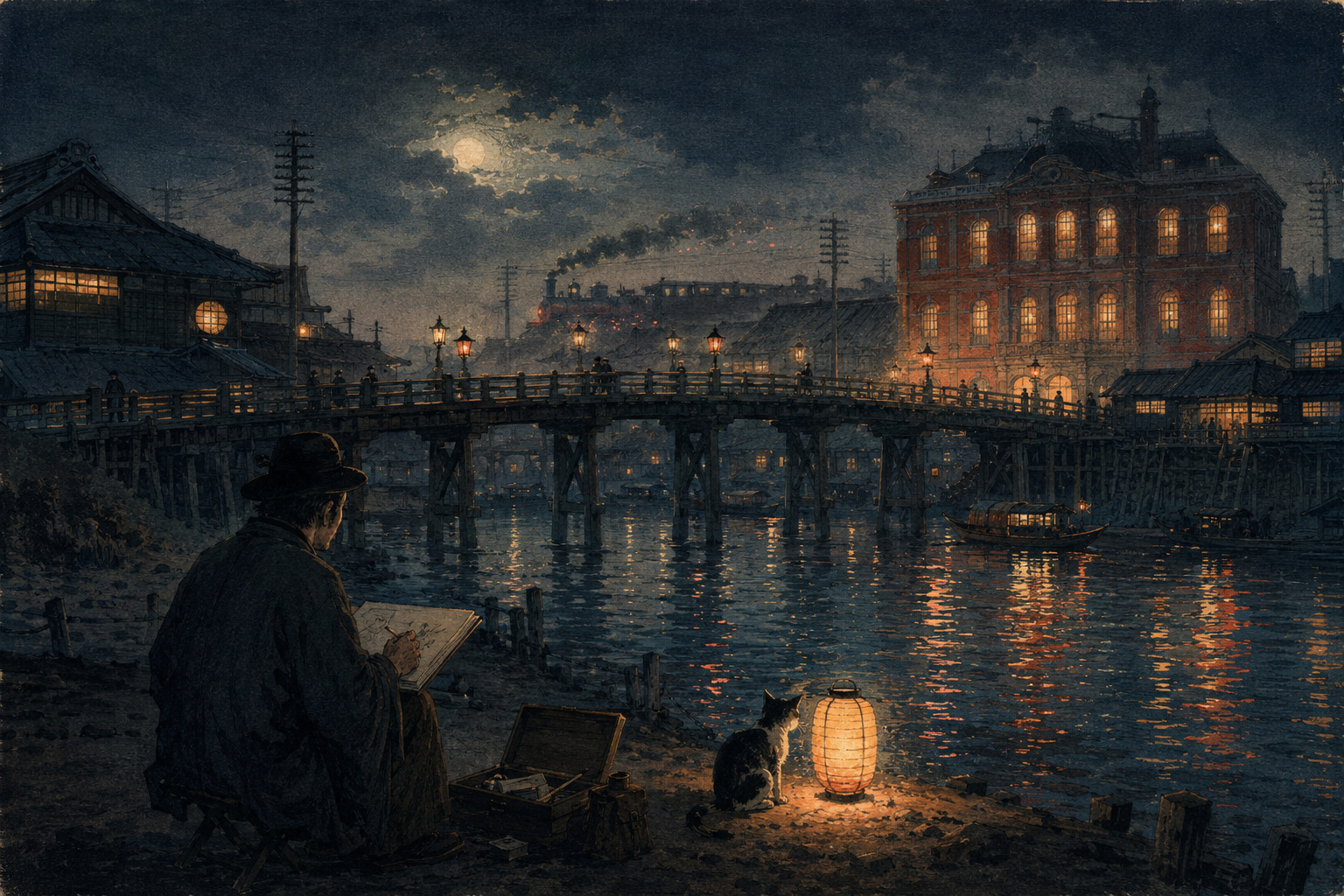
The locomotive comes out of the dark before the city does.
In Kobayashi Kiyochika’s 1879 View of Takanawa Ushimachi, under a Shrouded Moon, a black engine runs along Tokyo Bay. Controlled fire breathes from its stack. The headlamp throws a blade over the track; windows hold small rectangles of human-made light; passengers become nearly bodiless silhouettes. Above them, a moon is veiled by a sky whose illumination no engineer can regulate.
The print looks like eyewitness modernity. It is also an act of imaginative assembly. The Smithsonian notes that the locomotive type had not yet appeared in Japan: Kiyochika borrowed it from a Currier & Ives lithograph. A railway that was physically transforming Tokyo entered the print through an imported image of another railway. Old woodblocks, Western perspective, reproductive media and a machine partly seen at second hand meet under one moon.
That contradiction is Kiyochika’s country. He could make new technology feel unprecedented and haunted, factual and dreamlike. His Tokyo is not the simple darkness before electric light, nor the triumphant brightness after it. Light comes from incompatible systems: moon, gas, oil, lantern, firework, furnace, lightning, station, locomotive. Each source reveals something and makes the surrounding darkness deeper.
This is why Kiyochika is the art choice for the August 15 Obon edition. Lanterns guide families toward graves; damaged temples stand after disaster; expressway lamps and train windows carry millions home; remembrance of private dead meets remembrance of national war. Kiyochika’s visual world can hold all of those stories. But his career also warns what happens when beautiful illumination turns battle into spectacle.
A Retainer Returns to a City with a New Name
Kiyochika was born in Edo in 1847, twenty-one years before the Tokugawa order collapsed. The Smithsonian describes him as a minor retainer of the deposed shogun. When the old regime fell in 1868, he followed his lord into exile. This was more than a change of employer. The social structure that had defined his place—and the name of his birthplace—was dismantled.
On September 3, 1868, Edo formally became Tokyo, the Eastern Capital. When Kiyochika returned in 1874, the city was an experiment conducted at metropolitan scale. Railways, steamships, telegraph wires, gas lamps and brick buildings occupied a landscape whose moats, waterways, shrines and entertainment districts still carried Edo memory. The map had not been replaced all at once; new systems had been inserted through it.
That personal history does not prove that every shadow in his art is anti-Meiji grief. Biography can become an easy key that locks a complicated image into one meaning. Kiyochika was not simply a dispossessed samurai painting revenge against progress. His art depends on fascination with new technology and new ways of seeing. He was largely self-taught and outside the new academic art system, yet he absorbed the effects of oil painting, copperplate prints, lithography, hand-tinted photographs and linear perspective.
He was therefore both displaced by modernity and visually empowered by it. That double position matters. The new Tokyo gave him subjects that Edo artists could not have known; the loss of Edo gave those subjects emotional pressure. His greatest works do not resolve the conflict. They make it visible.
Ninety-Three Views, 1876–1881
In August 1876, the publisher Matsuki Heikichi began issuing Kiyochika’s images of Tokyo. The National Diet Library places the first examples of what came to be called kōsen-ga—“light-ray pictures”—in this project. Over the next several years, Kiyochika designed 93 completed prints, according to the Smithsonian’s reconstruction.
The number can suggest a tidy, predetermined set. The surviving project is messier and more alive than that. Museum titles and dates sometimes differ; impressions vary in color; publishers responded to commercial demand. A print was not simply the artist’s private vision transferred intact to paper. The designer, carver, printer and publisher all shaped the result. Kiyochika could even annotate one exposition image to apologize that oversized fountain figures had been drawn at the publisher’s request.
What unifies the Tokyo views is less a checklist of famous places than a discipline of looking. Kiyochika often lowers the viewpoint to human eye level. He chooses transitional weather and transitional hours. He lets poles, wires, umbrella ribs, railings and bridge spans organize space. The familiar landmark may recede or disappear while reflection, smoke or a figure’s silhouette takes control.
This was a sharp alternative to kaika-e, the brightly colored “enlightenment pictures” that celebrated Western-style architecture, fashionable dress and machinery. Kiyochika also depicted those things. The difference was tonal and temporal: he waited until the red brick sank into rain, until gaslight acquired a halo, until progress had to share the frame with uncertainty.
| Light source | Representative work | What the light does |
|---|---|---|
| Gaslight | Mount Fuji from Edobashi at Dusk, 1879 | Sets a steady enclosed flame against older, flickering oil torches |
| Railway light | View of Takanawa Ushimachi, under a Shrouded Moon, 1879 | Makes the train a vehicle of modernity without mastering the sky |
| Fireflies | Fireflies at Ochanomizu, 1880 | Two yellow tones structure deep urban twilight |
| Station lamps | Shinbashi Station, 1881 | Break into separate reflections on wet earth and oil-paper umbrellas |
| Fire | Great Ryōgoku Fire at Asakusabashi, 1881 | Turns illumination into panic, flight and destruction |
| Electric searchlights | Use of Electricity during the Siege of Pyongyang, 1894 | Converts technological light into a weapon and propaganda device |
How a Woodblock Learned to Glow
“Light-ray picture” sounds almost photographic, as if illumination struck a sensitized surface. Kiyochika’s glow was made through carved wood, water-based pigment, damp paper and repeated pressure. The effect depended on disciplined labor.
The decisive technique was bokashi, graded printing. Instead of covering a block with one even value, the printer brushed pigment so it faded from dense to thin, then transferred that gradient to moistened paper. In Kudanzaka at Night in Early Summer, the Smithsonian describes a sky moving from dark to light with unusually rich nuance. A flat black would have named “night.” Bokashi lets night arrive.
Kiyochika also weakened the hard contour that had structured many earlier color prints. In Along Shinobazu Pond in the Rain, the key line can be soft brown instead of black; lotus colors loosen from contour. In variant impressions of Koromogawa River at Tennōji-shita, black outlines make darkness feel cloaking, while brown ones make it warmer and more restful. The same design could carry a different emotional climate through printing decisions.
Silver mica could make rain flash. Cross-hatching could recall copperplate engraving. Hand-tinted photography suggested unexpected color accents. Vanishing-point perspective drew the viewer down a canal or street. Kiyochika did not abandon the woodblock to become Western. He made the old collaborative medium metabolize competing visual technologies.
That is the real modernity of the work. The subject may be a locomotive, but the innovation is also in how a familiar material learned to represent unstable atmosphere. Modernization happens in the city and inside the print.
Gaslight Does Not Defeat the Dark
Tokyo’s first gasworks began operating in 1874, the year Kiyochika returned. In Mount Fuji from Edobashi at Dusk, a gas lamp stands near a pine while open oil torches line an embankment. The gas flame is enclosed and steady; the torches tremble. Farther away, Fuji and a towering cloud survive as silhouettes. The print is not a diagram of one technology replacing another. Multiple times coexist.
Night at Nihonbashi is stranger. Traditional views of the commercial center advertised authority and prosperity with Edo Castle, the fish market and Mount Fuji. Kiyochika omits those anchors. In their place comes a purplish gaslit haze. Buildings lose their identities; strolling people become ghostlike; a horse-drawn carriage occupies a route that trolley cars would soon supersede.
At Shinbashi Station, the Renaissance-style building celebrated elsewhere as a national achievement appears to sink into shadow. The visual event is below: interior light breaks across rain-wet ground; lanterns and station lamps differ; oiled paper umbrellas catch and diffuse the glow. The Smithsonian calls the result a “polyphony of luminosities.” The city’s progress is not one beam aimed forward. It is a chorus of reflections, each altered by the surface it meets.
Even artificial light can expose loss. In Summer Moon at Imado, a kerosene lamp illuminates a geisha preparing her shamisen. Candlelight and moonlight had long veiled the erotic scene; the new glare throws hard shadows across her face and body. More illumination does not automatically mean more intimacy or truth. It can mean surveillance, disenchantment, the collapse of privacy.
The Train Under a Borrowed Moon
Japan’s first railway opened between Shinbashi and Yokohama in 1872. Artists immediately found in it a perfect icon: straight track, steam, speed, imported engineering, scheduled time. Kiyochika made the machine compelling without placing it in a celebratory daylight.
In the Takanawa print, the borrowed American locomotive matters because it breaks a simple opposition between Japanese tradition and Western modernity. The image is itself networked. An American commercial lithograph informs a Japanese woodblock of a Japanese railway whose infrastructure came through international exchange. Kiyochika’s “Tokyo” is already connected to a global circulation of machines and pictures.
Yet the train does not fill the composition. The sky remains enormous. Passengers appear as pale absences. The human-made light is directional and useful; the moon’s light is dispersed and unknowable. A schedule advances through weather that refuses a timetable.
That is why the image still speaks to a 2026 Obon travel edition. A Shinkansen is incomparably faster, brighter and safer than the Meiji train, but a night carriage still contains small, temporarily shared rooms of light. Travelers going home sit together while looking at separate screens, carrying private memories through public infrastructure. Kiyochika saw that modern transport does not eliminate solitude. It organizes it.
Together—and Alone
The figures in Kiyochika’s cityscapes are rarely heroic protagonists. The Smithsonian describes them as observers rather than actors, sometimes as solitary people “sleepwalking” through a new landscape. This is most evident when a spectacle should produce collective excitement.
At Asakusa’s night stalls, carbide lamps command the center and the crowd appears transfixed. At the year-end market of Sensōji, telegraph pole, streetlamp and Western-style building meet paper lanterns, temple silhouettes and performers. Instead of joining the noise, the viewer stands behind a row of dark figures and observes people observing. The city has become an image consumed in public.
Fireworks at Ike-no-Hata stages the same relationship more playfully. Spectators line Shinobazu Pond and climb a willow to see colored fireworks, themselves newly possible through imported chemicals. Branches echo the falling “weeping willow” sparks. The people share the event, but Kiyochika keeps their faces hidden. Attention, not identity, binds the crowd.
In Fireflies at Ochanomizu, the public city nearly disappears. A covered pleasure boat moves through the Kanda River at twilight. Perspective recedes toward darkness; the insects are printed in two yellows, tiny points that make the surrounding blue and black feel vast. Nature is not outside the metropolis. A fragile seasonal light flickers within its infrastructure.
This human scale may be Kiyochika’s most contemporary trait. He understood the experience of being one anonymous body among many systems: transit, commerce, entertainment, communication. The modern city connects people physically before it knows how to make them feel less alone.
The Fire That Ends the Sequence
Fire is light without reassurance. On January 26, 1881, a great fire swept through Ryōgoku. Kiyochika designed views of buildings consumed, small figures fleeing across a bridge, and ghostlike people moving through a smoldering aftermath where the telegraph office stood burned out. The LACMA collection preserves one work under the blunt title The Great Fire at Ryōgoku Bridge, Viewed from Asakusa Bridge on January 26, 1881.
The prints look immediate, but one of them complicates documentary truth. For Great Fire in Ryōgoku Drawn from Hamachō, the Smithsonian says Kiyochika added flames to a sketch made months earlier on a clear day, despite an inscription presenting it as drawn from nature. The image records a real disaster by reconstructing it. Its truth lies partly in design.
Another fire on February 11 savaged Kiyochika’s own Hisamatsu neighborhood. The quieter Tokyo project effectively ended in 1881. It is tempting to make the fire a single dramatic cause, but the evidence supports a more careful statement: disaster became a culminating subject, while commercial and artistic priorities shifted. The sequence did not simply fade; it was overtaken by a light too violent to contemplate at leisure.
Kiyochika’s fire scenes are therefore essential to an edition that includes earthquake-damaged temples and graves. They show the difference between making catastrophe aesthetically legible and making it beautiful. The strongest compositions do not erase panic, flight or ruins. Their light is terrible because it reveals what is being lost.
Was This a Critique of Modernity?
Later viewers wanted Kiyochika to answer that question. Interest in the Tokyo series revived in the 1910s. In a 1914 essay on woodblock prints, writer Nagai Kafū interpreted one of Kiyochika’s fog-bound Ryōgoku scenes as a commentary on modernization’s failures. Kafū’s own writing mourned Tokyo places vanishing under redevelopment, and the silhouette couples and dim rivers of Kiyochika offered a powerful genealogy for that feeling.
The interpretation is persuasive, but it should not become a ventriloquist’s script. Kiyochika did not write a manifesto beside every lamp. Some prints are wistful; others are excited by technical novelty; some are comic, commercial or documentary. The publisher could direct details. Variant impressions alter mood. “Ambivalence” describes the images better than a single political program.
Nor should “one of the last ukiyo-e artists” mean that he merely closed a door. The phrase, used by the Mitsubishi Ichigokan Museum of Art, identifies his place near the end of one print economy. But his prints also open forward. Their twilight, atmospheric gradients and emotionally charged landscapes became part of the inheritance later artists and publishers transformed into shin-hanga.
When Light Becomes a Weapon
The most difficult Kiyochika print may be the one in which darkness loses its moral ambiguity. Use of Electricity during the Siege of Pyongyang, published during the Sino-Japanese War in 1894, shows Japanese forces operating electric searchlights while Chinese troops and the city burn. The Metropolitan Museum of Art identifies the triptych directly as propaganda celebrating military technology.
The subject reprises everything Kiyochika had mastered: night, modern machinery, distant fire, light directing attention. But the searchlight does not invite contemplation. It finds a target. Technology and vision are organized into military superiority. The luminous modernity of Tokyo has traveled outward as imperial force.
Other designs go further into dehumanization. Library of Congress records preserve an 1895 print in which a Japanese “white boat” attacks a Chinese “black boat” amid animal caricature, and another mocking Chinese clothing and grooming. During the Russo-Japanese War, the series Long Live Japan: One Hundred Victories, One Hundred Laughs turned Russian defeat into inexpensive comic spectacle. One image makes the Russian fleet into blind men limping home; others picture a Japanese hand crushing Port Arthur or a soldier smashing a grotesque Russian bodhisattva’s weapons.
Calling these images “satire” describes their format, not their innocence. They participated in a mass culture that converted Chinese and Russian people into types, jokes and bodies available for defeat. Their humor depends on hierarchy and humiliation. The exact beliefs Kiyochika privately held cannot be read directly from a commercial print, but his authorship and the propagandistic work of the designs cannot be detached from his legacy.
This later chapter does not cancel the Tokyo views, and admiration for the Tokyo views does not excuse it. The same artist could make an urban stranger exquisitely vulnerable and make a foreign enemy grotesquely disposable. Art history becomes useful when it keeps both facts in the room.
An Afterlife from Kafū to Hasui—and 2026
Kiyochika’s early Tokyo prints acquired their afterlife through people who saw in them more than topographical records. Kafū associated their riverbanks and shadows with the city that redevelopment erased. Later landscape printmakers explored rain, snow, dusk and isolated illumination through the renewed publisher-carver-printer system of shin-hanga.
Earlier in 2026, the Mitsubishi Ichigokan Museum of Art made that genealogy the subject of Twilight, Shin-hanga: From Kobayashi Kiyochika to Kawase Hasui. Co-organized with the Smithsonian’s National Museum of Asian Art and the Asahi Shimbun, the exhibition ran from February 19 to May 24. Its curatorial premise was exact: Kiyochika’s 1876 Tokyo prints transformed Meiji landscape imagery, and their twilight feeling passed into the effort by Yoshida Hiroshi, Kawase Hasui and others to discover a new Japanese landscape.
“Passed into” need not mean a straight line of imitation. Hasui’s quiet station, snow and rain scenes belong to another generation, another print market and another historical crisis. What continues is a problem: how can a reproducible image make a fleeting atmosphere feel singular? How can a modern landscape carry memory without pretending the modern world is absent?
The exhibition’s date gives Kiyochika an unusual immediacy for this August edition. He is not being chosen as a remote, safely canonical master. Tokyo audiences were invited only months ago to see his work as the opening movement in a history of modern twilight.
1847 — Kobayashi Kiyochika is born in Edo.
1868 — The shogunate falls; Edo is renamed Tokyo; Kiyochika follows his lord into exile.
1872 — Japan’s first railway opens between Shinbashi and Yokohama.
1874 — Kiyochika returns to a city of railways, gasworks, steamships and telegraph lines.
August 1876 — Publisher Matsuki Heikichi begins issuing the Tokyo views later associated with kōsen-ga.
1881 — Great fires become culminating subjects; the 93-print Tokyo project effectively ends.
1894–1895 — Kiyochika designs celebratory and propagandistic prints of the Sino-Japanese War.
1904–1905 — Russo-Japanese War prints turn military victory and enemy defeat into mass satire.
1914 — Nagai Kafū reads Kiyochika’s work through the losses of modernization.
1915 — Kiyochika dies in Tokyo.
2014 — The Smithsonian presents Kiyochika: Master of the Night.
2026 — Tokyo’s Mitsubishi Ichigokan Museum traces a line from Kiyochika’s twilight to shin-hanga.
How to Look at a Kiyochika Night
Begin by resisting the lamp. The brightest point is an invitation, but Kiyochika’s real subject is the distribution of visibility. Ask what the light cannot reach. At Shinbashi, the building recedes while wet ground becomes articulate. At Nihonbashi, public illumination makes landmarks less, not more, certain. At Takanawa, the headlamp controls a narrow path while the sky controls the picture.
Then count the systems. Natural and manufactured illumination rarely merge into one atmosphere. Moon, star, firefly, firework, gas lamp, oil torch, kerosene lamp, furnace and train window carry different temperatures and social meanings. The comparison is historical: which light is new, who paid for it, what activity can now continue after dark?
Look at the people last. Are they working, fleeing, watching, walking, riding? Can you see a face? Kiyochika often withholds identity so posture becomes legible. A hat marks Western dress. An umbrella becomes a translucent screen. A queue of silhouettes makes the viewer another member of the crowd.
Finally, remember the print is an object, not a transparent window. Color differs between impressions. A printer graded the sky by hand. A carver translated a drawing into blocks. A publisher selected and sold the design. A borrowed lithograph could supply a locomotive; a pre-fire sketch could become a record of flames. The night feels immediate because mediation has been carefully hidden in it.
- Make darkness structural: deep indigo, smoke and rain should occupy real space; they are not a filter laid over daylight.
- Use one local light: a lantern, window, headlamp, brake light or memorial flame should reveal only what the story needs.
- Keep the human scale: favor solitary or grouped observers over monumental heroes.
- Let systems collide: old stone and new rail, ritual fire and LED, damaged temple and emergency lamp can share one frame.
- Do not copy a print: borrow visual principles, not Kiyochika’s composition, signature, seals or false historical authority.
- Label the image: every commissioned illustration must be identified as editorial art, never as an original print or documentary view.
- Frame war critically: do not aestheticize destruction or repeat dehumanizing caricature as nostalgic decoration.
Why Kiyochika Holds This Obon Edition Together
Obon is an argument about presence. The dead are absent, yet families prepare light, food, paths and time as if presence can be received. Modern transport is crowded, yet each traveler carries a private destination. A grave is fixed, yet memory travels. Kiyochika understood the visual equivalent: a silhouette can be nearly nothing and still organize the whole scene.
His lanterns and windows suit night grave visits because they make care local. They suit damaged temples because fire and ruin in his work are never merely background. His trains and bridges suit the annual migration because infrastructure becomes emotional space. His August war imagery forces a necessary limit: remembrance cannot stop at beautiful national light; it must ask whom that light exposes, targets or leaves outside the human frame.
The strongest art choice is not the artist whose biography supplies a mood board. It is the artist whose work changes how the edition can think. Kiyochika lets this issue move between household lantern and state searchlight, between the shared dark of mourning and the dangerous brightness of certainty.
In 2014, the Smithsonian titled its exhibition Kiyochika: Master of the Night. The phrase is deserved, but mastery here does not mean conquest. His finest nights are not defeated by lamps. They remain large enough to contain progress and grief, fascination and estrangement, homecoming and exile.
That is luminous darkness: not darkness made decorative, but darkness made capable of memory.
Research notes and principal sources
This article prioritizes museum, library and collection records. Titles are translated differently across institutions, and dates sometimes refer to a design, publication or a particular impression. Interpretive statements—especially about ambivalence, solitude and this edition’s visual program—are identified as analysis rather than quotations from Kiyochika.
- Smithsonian National Museum of Asian Art: Kiyochika: Master of the Night, exhibition history, 93 Tokyo views and detailed object notes
- Smithsonian Institution: collection snapshot for Kiyochika: Master of the Night
- National Diet Library: Kobayashi Kiyochika’s kōsen-ga and the 1876 beginning of the Tokyo project
- Los Angeles County Museum of Art: View of Umaya Bridge, biography and the 1876–1881 Tokyo series
- LACMA: The Great Fire at Ryōgoku Bridge, Viewed from Asakusa Bridge on January 26, 1881
- Metropolitan Museum of Art: Fireworks at Ikenohata and the play of light against darkness
- Metropolitan Museum of Art: Use of Electricity during the Siege of Pyongyang, 1894 propaganda
- Metropolitan Museum of Art: Triumphant Arrival of the Emperor at Shinbashi Station, 1895 nationalism
- Metropolitan Museum of Art: Long Live Japan: One Hundred Victories, One Hundred Laughs, 1904–1905 propaganda
- Library of Congress: Chinese black boat—Japanese white boat and the pig’s big wound, 1895
- Library of Congress: Sino-Japanese War caricature of Chinese clothing and grooming, 1895
- Library of Congress: One Thousand Armed Russian Bodhisattva of Mercy, 1905
- Library of Congress: Pressure from a Heavy Hand, Russo-Japanese War print
- British Museum: Aimless Boats, from Long Live Japan, March 20, 1904
- Edo-Tokyo Museum: Tokyo—Birth of a Modern City, kōsen-ga, photography and Western visual media
- Edo-Tokyo Museum: Nagai Kafū and the landscapes of Hiroshige and Kiyochika
- Mitsubishi Ichigokan Museum of Art: 2026 Twilight, Shin-hanga—From Kobayashi Kiyochika to Kawase Hasui
- National Diet Library: Kiyochika’s One Hundred Views of Musashi, 1884–1885
- National Diet Library: Famous Views of Japan, 1896–1897
- Art Institute of Chicago: The Dawn of Modernity: Japanese Prints, 1850–1900