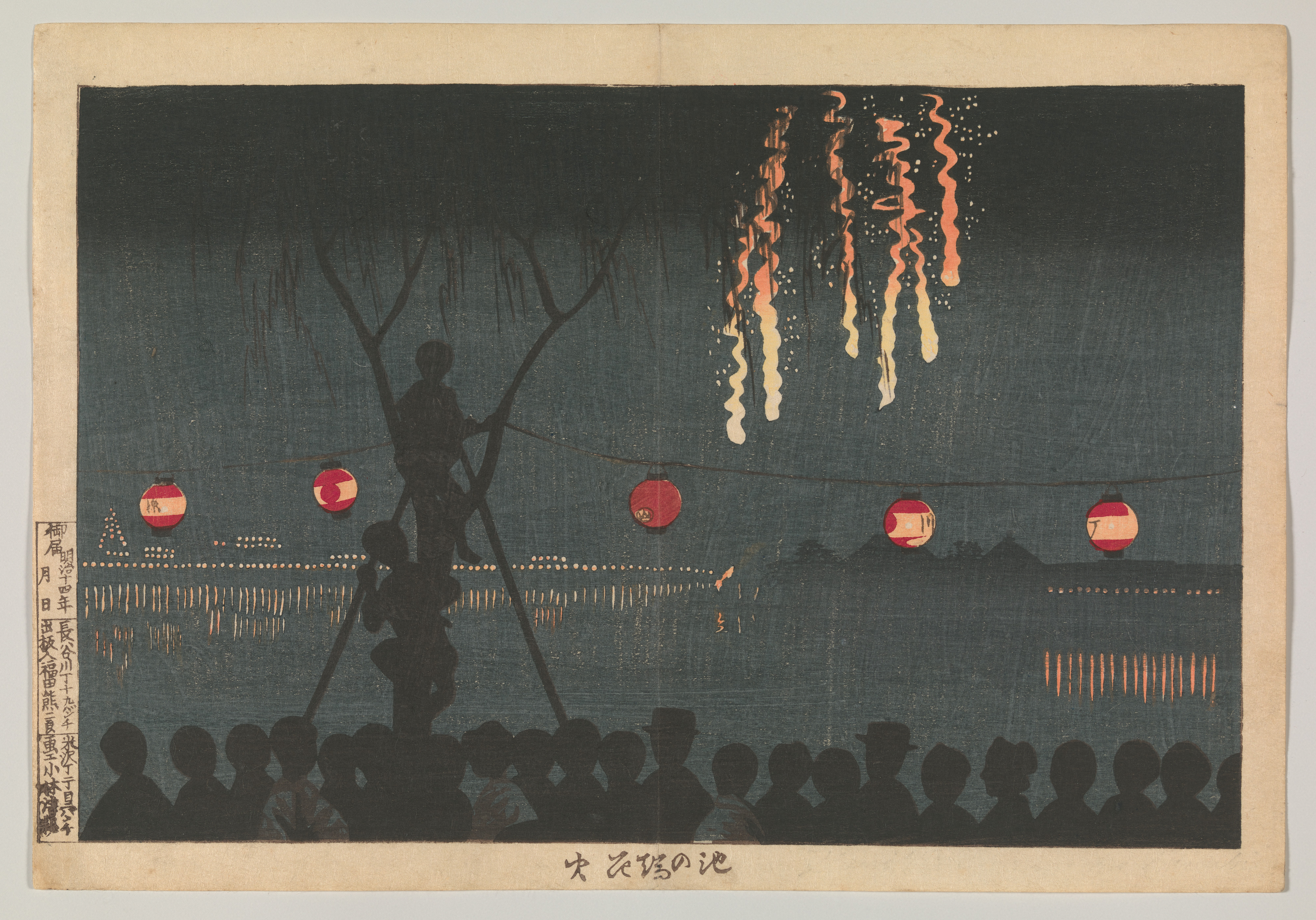
A conventional fireworks picture gives us a climax: the instant of expansion when light owns the sky. Kiyochika chose what comes after. In the upper right of this print, red and yellow trails have begun to sag. Their edges wobble; small sparks separate from the larger streams. The originating burst may already be outside the frame. What remains is gravity.
That decision changes the subject. We are not looking at a diagram of pyrotechnic beauty. We are standing behind a crowd, waiting for a temporary light to reveal a permanent place. The next explosion has not arrived. The last one is dying. Between them, the pond, trees, distant buildings and human bodies settle back into blue-black layers.
Fireworks at Ikenohata is one of the works associated with Kiyochika's kōsenga—literally “light-ray pictures.” The label can make them sound like celebrations of illumination. This print suggests something subtler. Light interests Kiyochika because it draws a boundary around what cannot be seen.
A public event with no public faces
The crowd occupies the bottom fifth of the composition. Kiyochika did not individualize it. Heads overlap without eyes or mouths. One outline resembles a Western-style hat; another suggests a traditional topknot. Meiji fashion and Edo hair coexist, then lose their distinctions inside the same silhouette.
This anonymity is not empty. It makes the crowd legible as pressure: bodies packed close enough that the viewer must look over them. We do not watch the spectators from a detached angle. Our own eye line begins just behind theirs. The print quietly recruits us into an audience assembled 145 years ago.
A string of paper lanterns hangs above the heads. Human forms are entangled visually with the central trees. The Met identifies them as children who have climbed up for a better view. Kiyochika reduces even that small act of ingenuity to silhouette: a way of escaping the crowd becomes one more shape in the night.
The denial of faces performs another task. A portrait absorbs light in order to reveal a person. Here, people absorb light and become darkness. The display remains visible because the audience does not.
The pond completes what the sky begins
The Ōta Memorial Museum of Art identifies the setting as the edge of Shinobazu Pond in Ueno. The large dark shape on the right horizon is Benten Island, while lights on the opposite bank are repeated below as short red and yellow vertical strokes. Kiyochika does not need to describe every distant building. The reflections prove that a shore exists.
Shinobazu was already an old leisure landscape. In the early Edo period, the monk Tenkai planned the religious geography of Ueno through mitate, a practice of imaginative correspondence. Kaneiji's own history says he treated the natural pond as Lake Biwa and its island as Chikubu Island, where Benzaiten was worshipped. Benten Hall was built there, and a bridge later replaced the need to approach by boat. The present hall was reconstructed in 1958 after the wartime destruction of its predecessor; it is not the building in Kiyochika's 1881 view.
By the time of the print, the pond was also part of Ueno Park. Tokyo planning records date its incorporation into the park grounds to 1875. An Edo pleasure and pilgrimage landscape had entered a Meiji public institution. Kiyochika's image does not stage that administrative change. It allows the same water to hold religious silhouette, urban crowd and commercial fireworks at once.
| Source | Printed form | Duration | What it reveals |
|---|---|---|---|
| Fireworks | Falling red and yellow ribbons with separated sparks | Seconds | The scale of the unlit sky |
| Candle lanterns | Red cylinders suspended in a horizontal rhythm | An evening | The edge between crowd and open air |
| Distant buildings | Small points across the shore | As long as interior lamps remain lit | A settlement Kiyochika otherwise withholds |
| Reflections | Broken red and yellow vertical marks | Until the water moves | The pond's surface and distance |
| Darkness | Several blue, gray and black densities | The underlying condition | The limit of every light source |
Tokyo did not become bright all at once
Seven years before this print, Tokyo's first 85 gas street lamps were lit along the route from Kanesugi Bridge through Ginza to Kyobashi. Tokyo Gas records that by about 1877 the number had increased to 356. Gaslight became a favored emblem of “civilization and enlightenment,” joining brick buildings, railways and Western clothing in the popular imagery of the new capital.
But infrastructure spreads unevenly. The Met identifies the lanterns in this picture as candle-lit, not gas. The fireworks are combustion without permanence. Lamps across the pond may be domestic or commercial, but the published object records do not specify their fuel. This is a city where different centuries of light still operate side by side.
Kiyochika repeatedly painted and printed new infrastructure: stations, bridges, brick architecture and gas lamps. He did not present them as a catalogue of achievements. A station mattered because its lamps shone through rain. A gaslight mattered because it lengthened a human shadow. Snow muted buildings; smoke obscured distance; water displaced a fixed light into a trembling mark.
Modernization in these works is less an inventory of machines than a change in perception. The city is becoming visible at new hours and from new angles. At the same time, illumination divides space into privileged patches and abandoned dark. The brighter Tokyo becomes, the more carefully Kiyochika notices what the brightness cannot reach.
An artist formed by a government that disappeared
Kiyochika was born in 1847 in the Honjo area of Edo. The National Diet Library gives his full dates as September 10, 1847, to November 28, 1915, and confirms the reading Kobayashi Kiyochika. His father was an official responsible for Tokugawa shogunate storehouses. As a young retainer, Kiyochika experienced the military collapse of the order that employed his family and took part in the fighting at Fushimi.
When the shogunate ended, he followed the Tokugawa household to Shizuoka. The Shizuoka Prefectural Museum of Art traces his years through Shimizu, Shizuoka and Washizu before his return to Tokyo. He came back not to Edo restored, but to a capital being rebuilt under another name.
Official biographies say he learned Western painting from the British illustrator Charles Wirgman and photography from Shimooka Renjō, later studying Japanese painting in relation to Kawanabe Kyōsai and Shibata Zeshin. Other museum accounts qualify parts of that education as tradition rather than fully documented apprenticeship. The cautious conclusion is stronger than the heroic one: Kiyochika encountered multiple new image systems—oil painting, watercolor, photography, lithography and copperplate printing—and tested their spatial and tonal possibilities inside Japanese woodblock production.
In August 1876, publisher Matsuki Heikichi issued the first five landscapes. Production later shifted to publisher Fukuda Kumajirō. Japanese museums now treat the 93 designs made through 1881 as a sequence called Tokyo Meisho-zu, or “Pictures of Famous Places in Tokyo,” although the series title is a later organizing convention rather than a uniform title printed across every sheet.
How a water-based woodblock print learned new darkness
Kōsenga were not oil paintings converted into souvenirs. The National Diet Library describes them as multicolor woodblock prints made with water-based pigments from sketches. Their innovation came from reorganizing what carved blocks, absorbent paper and hand printing could do.
Traditional ukiyo-e often relied on a key block to establish firm outlines. The Ōta Memorial Museum notes that Kiyochika's light-ray pictures minimized those enclosing lines, defining figures and nature through areas of color. Multiple blocks and bokashi gradation turned skies into transitions rather than flat fields. Fine repeated strokes carried light and shadow across water. Dark blue and gray could be layered without surrendering clarity.
That method also means the object is collaborative. The artist designed the image, but a publisher organized and financed production; carvers translated shapes into wood; printers registered separate blocks and controlled moisture, pressure and pigment. A dark print is unforgiving. Too much density collapses pond, island and crowd into one mass. Too little destroys the night. A red lantern printed too strongly competes with the fireworks; printed too weakly, it fails to measure the crowd.
Different impressions therefore carry different nights. Keio University records an impression measuring 24.3 by 36.5 centimeters. The Smithsonian's National Museum of Asian Art records another overall sheet at 25.4 by 37.6 centimeters. The Met's sheet is 23.5 by 34.3 centimeters. Trimming, paper, state, inking and preservation can vary. “The image” exists, but it exists through multiple physical survivors.
- Count the densities of darkness before counting the bright objects.
- Find where a form exists without a containing outline.
- Separate a source of light from its reflection.
- Compare the time scales of moonlight, gaslight, candles, windows and fire.
- Remember that artist, publisher, carver and printer all shaped the result.
The hinge year
In 1881, the year of Fireworks at Ikenohata, Kiyochika stopped producing the Tokyo landscape sequence. The surviving institutional accounts agree on the transition but do not establish a single motive. His home was lost in a major fire; publishing conditions and demand changed; periodicals offered a different field of work. Those circumstances overlap. None should be promoted into a definitive explanation without stronger evidence.
By around 1883 he had turned decisively toward current-affairs images, cartoons and illustrations. He contributed political satire to Marumaru Chinbun. During the Sino-Japanese War of 1894–95, he redirected his command of illuminated darkness into war triptychs. He also made realistic bird-and-flower prints, historical subjects, bijin imagery, lithographs, copperplates and paintings.
That later work complicates the familiar label “the last ukiyo-e artist.” It is useful as a description of historical position, not as a literal closing date. Ukiyo-e did not vanish the day Kiyochika changed genres. His student Inoue Yasuji continued to translate Tokyo into light and weather. Curators have since traced affinities from Kiyochika through Oda Kazuma, Yoshida Hiroshi and Kawase Hasui, whose twentieth-century landscape prints renewed collaborative woodblock production under the banner of shin-hanga.
Kiyochika was both an ending and a transmission. The transferable element was not merely his taste for night. It was a method of watching a changing city without allowing novelty to erase atmosphere.
1847 — Born in the Honjo area of Edo to a shogunate official's family.
1868 — Moves to Shizuoka with the Tokugawa household after the shogunate's collapse.
1874 — Tokyo's first 85 gas street lamps are lit along Ginza.
1876 — Matsuki Heikichi publishes Kiyochika's first five Tokyo landscapes.
About 1879 — Fukuda Kumajirō becomes publisher of the sequence.
1881 — Fireworks at Ikenohata; Kiyochika leaves the Tokyo landscape sequence.
About 1883 — Current-affairs drawings, cartoons and illustration become central.
1894–95 — Produces prints about the Sino-Japanese War.
1915 — Dies on November 28, aged 68.
Why this is the late-August choice
Fireworks belong to summer, but this is not a midsummer picture of abundance. It is an image of expenditure. Powder has burned, color is falling and smoke has dissolved into the sky. The paper lanterns will be taken down. The crowd will separate. Reflections will disappear before the lamps that made them.
Kiyochika captured neither the beginning nor the climax. He selected the interval when an event becomes a memory while it is still visible. That is what gives the print its late-August temperature. The season has not ended, but the image already knows that it will.
The smallness of the object intensifies the effect. The Met's printed image is only 20.3 by 31.4 centimeters. Kiyochika creates the sense of an enormous night by refusing to fill it. The empty upper left is not unfinished. It is the pressure that makes the sparks seem fragile.
A public-domain print on a glowing screen
The Metropolitan Museum of Art identifies its impression as object 2016.577, a 2016 gift from Sebastian and Miki Izzard, and releases the image in the public domain. Other impressions survive at the Ōta Memorial Museum of Art, Keio University, the Smithsonian's National Museum of Asian Art and elsewhere.
Open images can flatten those objects into apparent duplicates. They can also make comparison possible. Enlarged files reveal a fold, a different margin, a softer gradation, denser black, abrasion in the sky or slight shifts in registration. A reproducible design does not produce identical lives.
There is an irony in viewing Kiyochika on a luminous display. A screen supplies more steady light than every paper lantern in the scene. Raise its brightness too far, however, and the distinctions among blue-black sky, black trees and gray water begin to disappear. More illumination produces less information.
That reversal is the print's continuing intelligence. Fireworks at Ikenohata is not nostalgic because it preserves an old Tokyo untouched. It is modern because it understands that every new way of seeing creates a new way of overlooking. The sparks fall. The city remains. The work begins in the interval between them.
- The Metropolitan Museum of Art — object record, measurements, provenance, public-domain image and lighting description
- Keio University Media Center — Japanese title, date, publisher, seal, format, measurements and signature
- Ōta Memorial Museum of Art — Shinobazu Pond, spectators, Benten Island and reflected shore lights
- Ōta Memorial Museum of Art — Kiyochika's kōsenga, realism and satire
- National Diet Library — the 1876 beginning, water-based woodblock production, gradation and shadow
- National Diet Library — official name reading, dates, alternate names, training, satire and Inoue Yasuji
- Machida City Museum of Graphic Arts — samurai background, Tokyo landscapes and post-1881 career
- Yamaguchi Prefecture / Hagi Uragami Museum — 93 designs, 1876–81 chronology and publisher change
- Shizuoka Prefectural Museum of Art — Shizuoka migration, return to Tokyo and Western influence
- Tokyo Gas — the first 85 Tokyo gas lamps and expansion by about 1877
- Shinobazu Pond Benten Hall — Tenkai, Lake Biwa and Chikubu Island correspondences, island and bridge history
- Smithsonian National Museum of Asian Art — record, provenance and dimensions for another impression