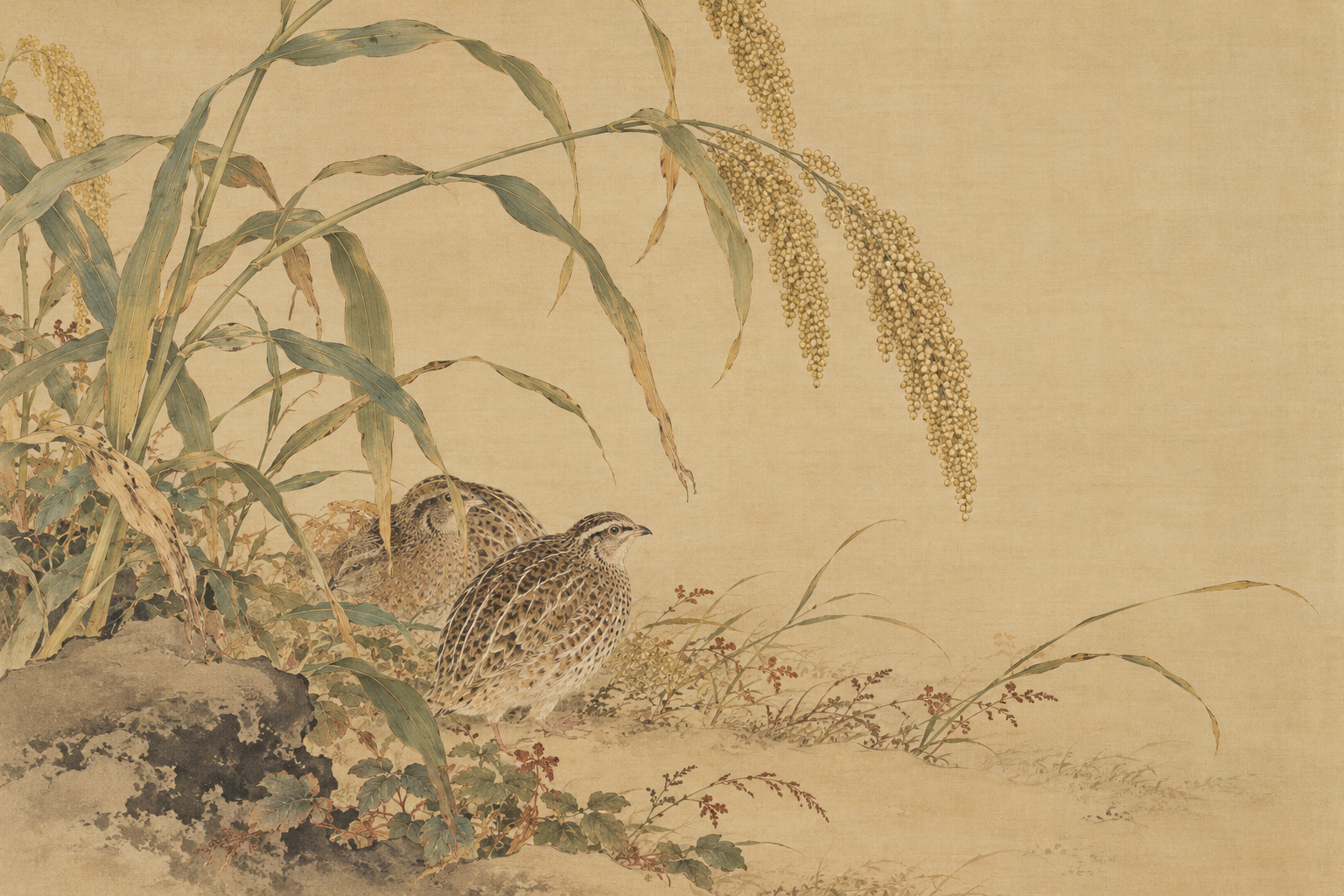
The first thing to notice in Kiyohara Yukinobu’s Quail and Millet may be how much of the painting she leaves open. Two birds occupy the lower part of the hanging scroll. Grain bends down from the right. Above them stretches a large field with almost no descriptive incident. The eye can rest there, but the arrangement never feels accidental.
The Metropolitan Museum of Art dates the work to the late seventeenth century and identifies its medium as ink and color on silk. For today’s art choice, it offers a quiet encounter with a painter whose accomplishment deserves attention both within the Kanō tradition and within the history of women’s artistic work in Japan.[1]
View artwork: Quail and Millet at The Metropolitan Museum of Art
A composition that controls the pace of looking
One bird is pale and rounded; the other holds its darker, patterned body more upright. Their different postures establish a small exchange of forms near the ground. The millet occupies a much taller space, its long leaves and drooping heads making a sequence of curves. There is no centered emblem, no rigid balance between left and right.
The painting instead connects areas of different intensity. Feather patterns reward close inspection, while the long leaves carry the eye over larger distances. The grain’s downward movement returns attention toward the birds. Above this activity, the open silk gives the lower scene room to remain small. Magnifying the image reveals workmanship; seeing it whole reveals the discipline of the arrangement.
The contrast between the birds need not be converted into a confident claim about their sex, their relationship or the artist’s household. A viewer may experience companionship in their proximity. That response is different from establishing a biographical meaning. The painting can be intimate without serving as a document of Yukinobu’s private life.
An artist inside a powerful tradition
Japanese museum sources place Yukinobu within a substantial artistic family. Her father was Kusumi Morikage. Her mother, Kuni, was a niece of Kanō Tan’yū, and Tokyo National Museum records the tradition that Yukinobu herself studied with Tan’yū. These connections situated her close to experienced painters and an established body of artistic knowledge.[2][3]
The Kanō school was a network of professional studios rather than a single unchanging visual style. The Met’s historical survey describes its development from the fifteenth century, its varied patrons, and its transmission through family ties, apprenticeships and painting models. Its repertoire encompassed ink painting as well as richly colored architectural decoration.[6]
That background changes what originality can mean. A painter did not have to reject inherited subjects to make a distinctive work. Decisions about spacing, contour, scale and emphasis could transform familiar material. Yukinobu’s association with the school helps explain the resources available to her; it does not remove her agency in deciding how to use them.
Family access should also be understood materially. To learn painting was to gain contact with brushes, materials, examples and people able to assess a developing hand. An artistic household could supply opportunities that desire alone could not. Recognizing that advantage does not diminish the painter’s achievement. It makes the circumstances of achievement more visible.
A subject with a long memory
The Met links the work’s asymmetry and naturalistic handling to twelfth-century Chinese academic precedents. This is a curatorial account of an artistic lineage, not proof that Yukinobu copied a particular surviving picture or encountered it directly.[1]
The distinction matters because inherited subjects can become useful tools for comparison. Once the theme is familiar, small departures become easier to see. Imagine the birds moved into the middle of the scroll, or the upper space filled with foliage. The same ingredients would produce a different rhythm. Here, much of the picture’s character rests in the allocation of attention rather than in the novelty of its subject.
The bending grain also makes the painting an apt autumn choice. Yet seasonal association need not become a rigid symbolic code. Weight, direction and distance are visible before a viewer consults a dictionary of motifs. Beginning with those qualities allows interpretation to grow from the painting rather than replacing the experience of looking at it.
Visibility, opportunity and the woman painter
Denver Art Museum’s Her Brush guide describes Yukinobu as a professional painter known during her lifetime. Its section on daughters of artistic households considers how women could continue workshop traditions while developing distinctive interpretations. This framework locates women inside the institutions of painting, as participants in their transmission.[5]
It also leaves room for unequal opportunity. One identifiable career cannot establish that women generally had the same access to instruction, patrons or recognition. Nor can a shortage of surviving biographies tell us exactly how many women painted. Making an object, preserving it, retaining its attribution and including it in later histories are separate processes.
Calling a brushstroke feminine can obscure these questions. Fine contours and restrained color are choices in a medium, not self-explanatory consequences of the artist’s sex. Gender is relevant to Yukinobu’s historical position. It is a less useful substitute for explaining how her pictures work. Her quietness should be examined as a compositional effect, not assigned as a personality trait.
Beyond one delicate scroll
Itabashi Art Museum preserves Yukinobu’s Flowers and Birds, a pair of six-panel screens executed in ink on paper with scattered gold. Each screen measures 87.2 by 254.6 centimeters. The horizontal format offers a reminder that her work was not confined to the tall, intimate field of the Met scroll.[3]
A screen and a hanging scroll establish different relationships with a room and with a viewer’s body. One extends sideways; the other encourages a movement between lower and upper zones. Their coexistence in her surviving work should keep us from making a single admired painting stand for every aspect of her practice.
Kyoto National Museum holds a Kannon painting on silk and transcribes its inscription as 清原氏女雪信筆. The wording identifies Yukinobu and associates her with the Kiyohara name as a woman of the lineage. It supplies concrete evidence of named authorship in a religious subject, extending the picture beyond bird-and-flower painting.[4]
Denver’s discussion similarly draws attention to the use of uji-me, a designation relating the woman artist to her clan or family. Such wording makes identity visible within an inherited artistic structure. It does not, by itself, reveal a commission’s price, a patron’s social position or the exact terms under which the artist worked.[5]
The limits of a recoverable biography
Yukinobu’s dates require care. The familiar lifespan 1643–1682 appears in overseas museum records, but Tokyo National Museum marks both years as uncertain, while Itabashi gives her birth and death dates as unknown. Japanese accounts also qualify traditions concerning her marriage and residence. The secure starting point is her work as an early-Edo painter, not an elaborately reconstructed private story.[2][3]
Acknowledging those limits need not make an article evasive. It redirects attention toward the evidence that can be examined: surviving works, their formats, inscriptions and documented institutional holdings. There is a difference between making an overlooked artist visible and supplying her with experiences that the record cannot establish.
The same care applies to our emotional response. We can describe the picture as peaceful without claiming that the painter’s life was peaceful. We can admire control without concluding that she was personally reserved. The work may invite a feeling while withholding the narrative that a modern viewer would like to attach to it.
Seeing the whole painting
The lead image is a Japan.co.jp AI-generated illustration inspired by Yukinobu’s style, rather than a reproduction of her painting. The visual analysis in this article concerns the original work in the Met’s linked collection record. The full vertical composition matters: cropping it into a wide banner would change the relationship between the small birds and the space above them. A useful way to look is to begin with the whole, enlarge the lower details, and then return to the whole again.
The Met’s Open Access program makes eligible public-domain images and collection data available under CC0. That access allows a reader far from New York to examine this painting and follow connections to works elsewhere. It also makes it easier to encounter an artist through an actual object rather than through a short biographical label alone.[7][8]
The quiet power of Quail and Millet lies in its command of attention. Yukinobu makes a few birds, leaves and grain heads sufficient for a sustained encounter. Taking that control seriously places her neither outside tradition nor beneath it. It recognizes an artist working with inherited knowledge and making consequential decisions of her own.
Artwork details
Quail and Millet (粟に鶉図), Kiyohara Yukinobu, late seventeenth century. Hanging scroll; ink and color on silk; 118.4 × 47.6 cm. The Metropolitan Museum of Art, accession 36.100.45. The Howard Mansfield Collection, Purchase, Rogers Fund, 1936.[1]
View the artwork and museum record. The record listed it as not on view when checked; online access should not be read as a promise of a current gallery display.[1]
Sources and references
- The Metropolitan Museum of Art: Quail and Millet, accession 36.100.45
- Tokyo National Museum: biographical entry on Kiyohara Yukinobu
- Itabashi Art Museum: Flowers and Birds screens, updated December 9, 2022
- Kyoto National Museum: Kannon, inventory A甲407
- Denver Art Museum: Her Brush, Daughters of the Ateliers
- Department of Asian Art, The Met: The Kano School of Painting, October 2003
- The Metropolitan Museum of Art: Open Access policy
- The Met Open Access API: object 45734
Evidence reviewed September 14, 2026, Japan time. This feature draws on the Met’s object record and public image, Japanese museum records and institutional art history. Visual observations concern the reproduction, not firsthand inspection of the original. Interpretations are Japan.co.jp analysis unless otherwise attributed.