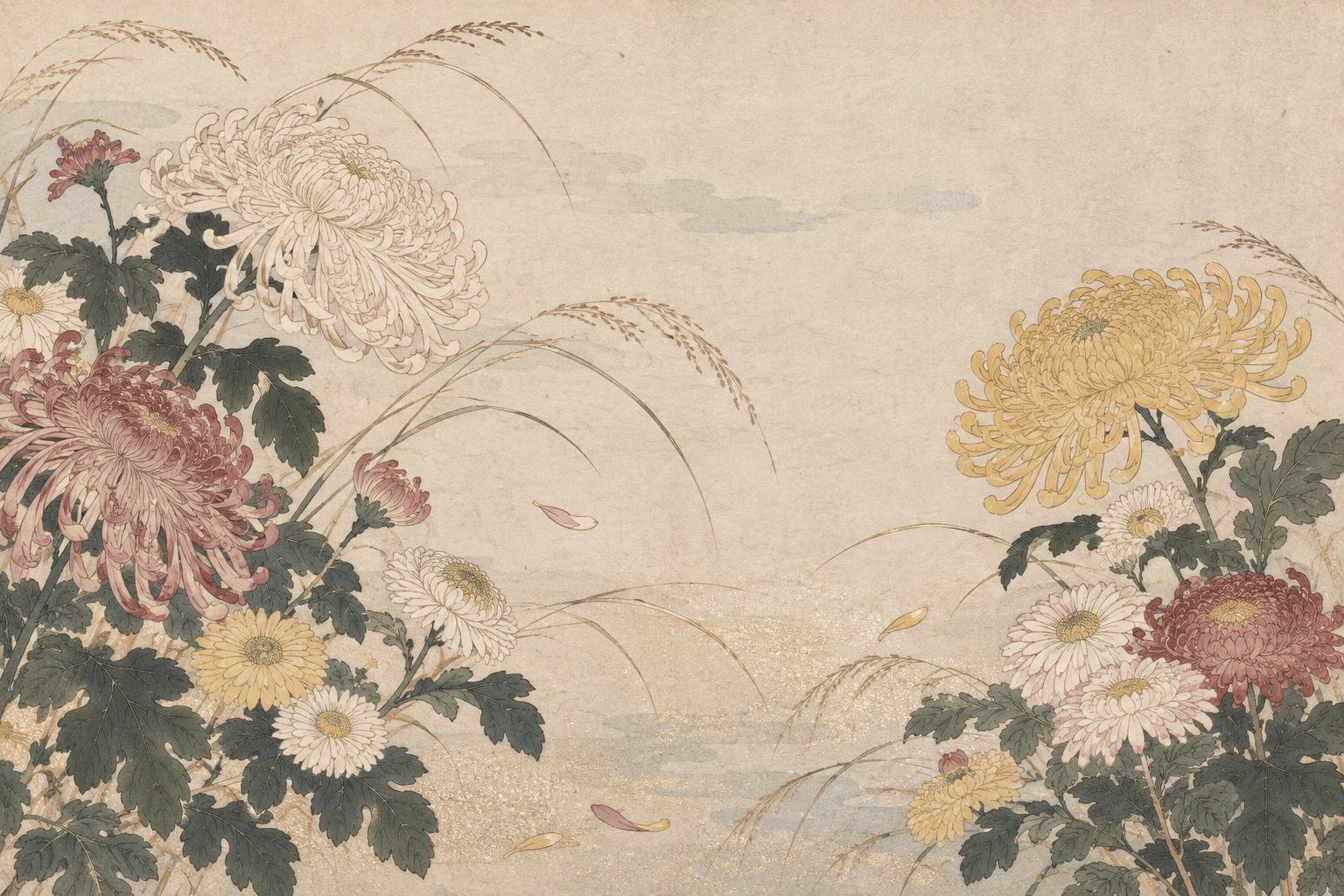
The blossoms do not hold formation. Their pink, orange and pale-yellow heads crowd together, but fine petals wander, curl and fall in different directions. One flower opens like a burst of light; another keeps its energy close to the centre. Stems carry the grouping sideways across the long sheet. The scene is abundant without becoming loud.
Katsukawa Shunsho’s Chrysanthemums, held by the Art Institute of Chicago, is a colour woodblock print dated to the early 1780s. The museum classifies it as a surimono. It measures only 19.8 by 37 centimetres, a format that rewards closeness rather than spectacle. Its reference number is 1950.1505, and its credit line is the Frederick W. and Nathalie C. Gookin Endowment.
The spare catalogue title leaves important questions unanswered. The public record does not identify the chrysanthemum cultivar, the patron or a particular occasion. “Early 1780s” is a range, not a securely documented year. The picture can be read within the histories of the Double Ninth, Edo horticulture and surimono exchange, but none of those contexts should be presented as a recovered statement of Shunsho’s intention.
for the work
format
Double Ninth
reference
Why this picture belongs to September 9
The ninth day of the ninth month is Chōyō, the Double Ninth, also known in Japan as the Chrysanthemum Festival. The National Diet Library explains the numerical logic: odd numbers were treated as yang numbers in China, and nine was the largest. Two nines made an auspicious conjunction. People displayed chrysanthemums, drank sake scented with the flowers and wished for health and long life.
The custom crossed to Japan and became a court observance. By the Edo period, the Tokugawa shogunate celebrated it formally, while wider urban culture cultivated competitions, displays and chrysanthemum figures. A flower associated with medicinal longevity also became an object of connoisseurship and popular invention.
There is a calendar trap. The classical observance followed the lunisolar calendar; its ninth month fell later in the seasonal year, around October by the modern calendar. September 9 now often arrives before autumn chrysanthemums reach their full display. Selecting Shunsho today therefore does not reproduce an eighteenth-century flower date. It uses the surviving name of the observance to look forward to autumn—and acknowledges that Japan has lived with more than one seasonal clock.
The artist who made the actor recognisable
Shunsho is remembered first for people, especially Kabuki actors. His birth year is disputed: the Ota Memorial Museum of Art cautiously gives 1726 with a question mark and lists his death in 1792, while another Japanese museum record uses 1743. His mature public career emerged relatively late, around the middle of the Meiwa era, 1764–72.
Working alongside Ippitsusai Buncho, Shunsho changed the logic of the actor print. Earlier viewers often relied on crests and labels to identify performers rendered through inherited types. Shunsho pursued distinctions in faces, bodies, costumes and stage manner. The Katsukawa school made recognisability itself into a visual event.
That achievement can clarify the flower sheet without turning it into a disguised actor portrait. Each chrysanthemum belongs to the same botanical and pictorial family. Yet each carries its petals differently. Repetition establishes the type; deviation gives the type life. This parallel is Japan.co.jp’s interpretation, not a claim documented by the museum.
A career larger than the theatre
Shunsho’s range matters because modern fame can narrow an artist retrospectively. He designed sumo prints, pictures of warriors and images of women as well as theatrical subjects. In later years, he was particularly admired for meticulously painted, one-off images of beautiful women.
The Idemitsu Museum’s large hanging painting Women Appreciating Paintings is thought to have been made for Yanagisawa Nobutoki near the end of Shunsho’s life. Eleven women inhabit an interior and garden associated with Rikugien. Their garments, gestures and positions are differentiated with exceptional care. The work demonstrates that Shunsho’s powers of observation were never confined to a performer’s face.
Chrysanthemums belongs to another scale and another collaborative process. A woodblock designer supplied an image that had to survive transfer into carved lines and carefully registered impressions. There is no sweep of unique brushwork to celebrate. Precision emerges from decisions that could be repeated—and from small variations introduced whenever ink, paper, pressure and condition changed.
The private register of surimono
The Art Institute catalogues this sheet as a surimono, literally a “printed thing.” In art-historical use, the word usually identifies deluxe colour woodblock prints commissioned privately in small editions and circulated as gifts rather than sold through the ordinary print market. The British Museum notes their connections to poetry gatherings, New Year greetings and commemorative exchange.
Surimono invited resources that mass-market prints could not always afford: refined papers, subtle embossing, metallic effects, exact registration and close conversation between image and verse. Their audience was expected to handle them, inspect them and understand the social occasion.
That general history must remain general here. The accessible Art Institute record does not name a poetry circle, patron or distribution event for Shunsho’s Chrysanthemums. It would be tempting to supply a Double Ninth commission because the subject fits so well. Evidence does not permit it.
What the scale does support is intimacy. At 19.8 centimetres high, the flowers ask the eye to approach. Petal tips matter. Empty paper between blossoms matters. This is not a garden reconstructed at a distance; it is a garden converted into the reach of two hands.
Line before symbolism
Chrysanthemums arrive burdened with meaning: longevity, the ninth month, cultivated refinement, court culture and, in later national usage, imperial association. Those histories are real. They are not a licence to call every chrysanthemum image an imperial allegory.
The museum record offers no political programme for this sheet. The picture’s strongest evidence is visual. Long, narrow petals bend away from their centres. Leaves and stems counter the circular flower heads with diagonal movement. The horizontal paper allows multiple centres of attention rather than declaring one sovereign bloom.
| What is on the sheet | What it does | Japan.co.jp reading |
|---|---|---|
| Fine, curling petals | Distinguish each head by direction, density and reach | Strength appears as flexibility and persistence, not stiffness |
| Horizontal format | Lets stems and blossoms advance across the page | The work balances a collective rhythm with individual portraits |
| Warm flower colours | Separate the blooms without isolating them | Colour suggests changing autumn light rather than heraldic fixity |
| Open paper | Keeps intricate petals legible | Silence becomes room for movement |
The colours also demand caution. Woodblock impressions are not identical photographs of an original design. Pigments fade; paper darkens; impressions vary; digitisation introduces its own display conditions. Pink, orange and yellow describe the Art Institute’s surviving object as presented online. They should not be treated as a scientific reconstruction of how the sheet appeared when first printed.
The first “Shun” in Hokusai’s career
Shunsho’s longest shadow falls through one student. According to the Sumida Hokusai Museum, Hokusai entered Shunsho’s studio at nineteen and worked under the name Katsukawa Shunro. The shared character shun marked his place in the school.
Hokusai later left and pursued Kano, Tosa, Western and Rinpa methods, continually changing names and styles. His mature flower-and-bird prints cannot be reduced to an apprenticeship influence. Yet the young Shunro first learned professional print design within a school that demanded recognisable bodies, decisive contours and action compressed into a sheet.
That lineage changes the historical scale of this modest flower work. The artist holding these petals apart also led one of the most powerful ukiyo-e studios of his day. The habits of looking and designing developed there passed through pupils including Shunko, Shun’ei and Shuncho—and through Shunro into a career the world would know as Hokusai.
Survival, Chicago and the digital second life
The Art Institute credit line tells us how the sheet entered the collection in 1950, but its public record does not provide a complete chain of earlier ownership. We should not invent a journey from Edo to Chicago. What survives is a work, an institutional reference and the evidence carried by paper.
The museum’s digital infrastructure gives that evidence a new kind of circulation. Its collection page supplies object data and a IIIF manifest, while the Art Institute’s Open Access programme allows unrestricted use of images specifically marked with its CC0 Public Domain Designation. Readers should use the official object page to inspect the original museum image and its current rights label.
Japan.co.jp’s hero image is deliberately not that museum reproduction. It is an AI-generated editorial illustration inspired by Shunsho, disclosed as such in the caption and structured metadata. It can set a mood; it cannot support claims about the exact impression, pigments, paper, carving or condition. The historical object remains the source.
Quiet is not the opposite of force
The conventional language of chrysanthemums can flatten them: noble, enduring, autumnal. Shunsho’s sheet resists that flattening because its flowers do not behave like emblems. Their petals are too wayward. Their centres exert different pulls. The cluster keeps its unity by permitting irregularity.
This is where the headline’s “quiet strength” resides. It is not an inscription translated from the sheet, nor an attributed intention. It is a critical response to how the image holds motion without drama. Nothing needs to break, blow apart or dominate for the composition to feel alive.
On the Double Ninth, tradition asks the chrysanthemum to promise long life. Shunsho gives a more persuasive image of endurance: not a flower preserved outside time, but many flowers opening at their own rates while the season changes around them.
The actor specialist knew that identity becomes visible through small departures from a type. Here, every bloom remains unmistakably a chrysanthemum. Not one agrees to be merely the same.
- Title: Chrysanthemums
- Artist: Katsukawa Shunsho
- Date: early 1780s
- Medium: colour woodblock print; surimono
- Dimensions: 19.8 × 37 cm
- Collection: Art Institute of Chicago
- Reference number: 1950.1505
- Credit line: Frederick W. and Nathalie C. Gookin Endowment
Sources and editorial distinctions
Title, date, medium, dimensions, collection, reference number and credit line follow the Art Institute of Chicago. Japanese names and career history were checked against the Ota Memorial Museum of Art, Idemitsu Museum of Arts and Sumida Hokusai Museum. Double Ninth history follows the National Diet Library. The patron, occasion, cultivar and intended symbolism remain unverified. “Quiet strength,” the comparison between actor individuality and the flowers, and the formal readings in the table are Japan.co.jp analysis.
- Art Institute of Chicago, Chrysanthemums
- Art Institute of Chicago, Open Access Images
- Ota Memorial Museum of Art, Katsukawa Shunsho retrospective (Japanese)
- Idemitsu Museum of Arts, Women Appreciating Paintings (Japanese)
- Sumida Hokusai Museum, Hokusai biography (Japanese)
- National Diet Library, “Nagatsuki” and the Double Ninth (Japanese)
- British Museum, surimono collection record