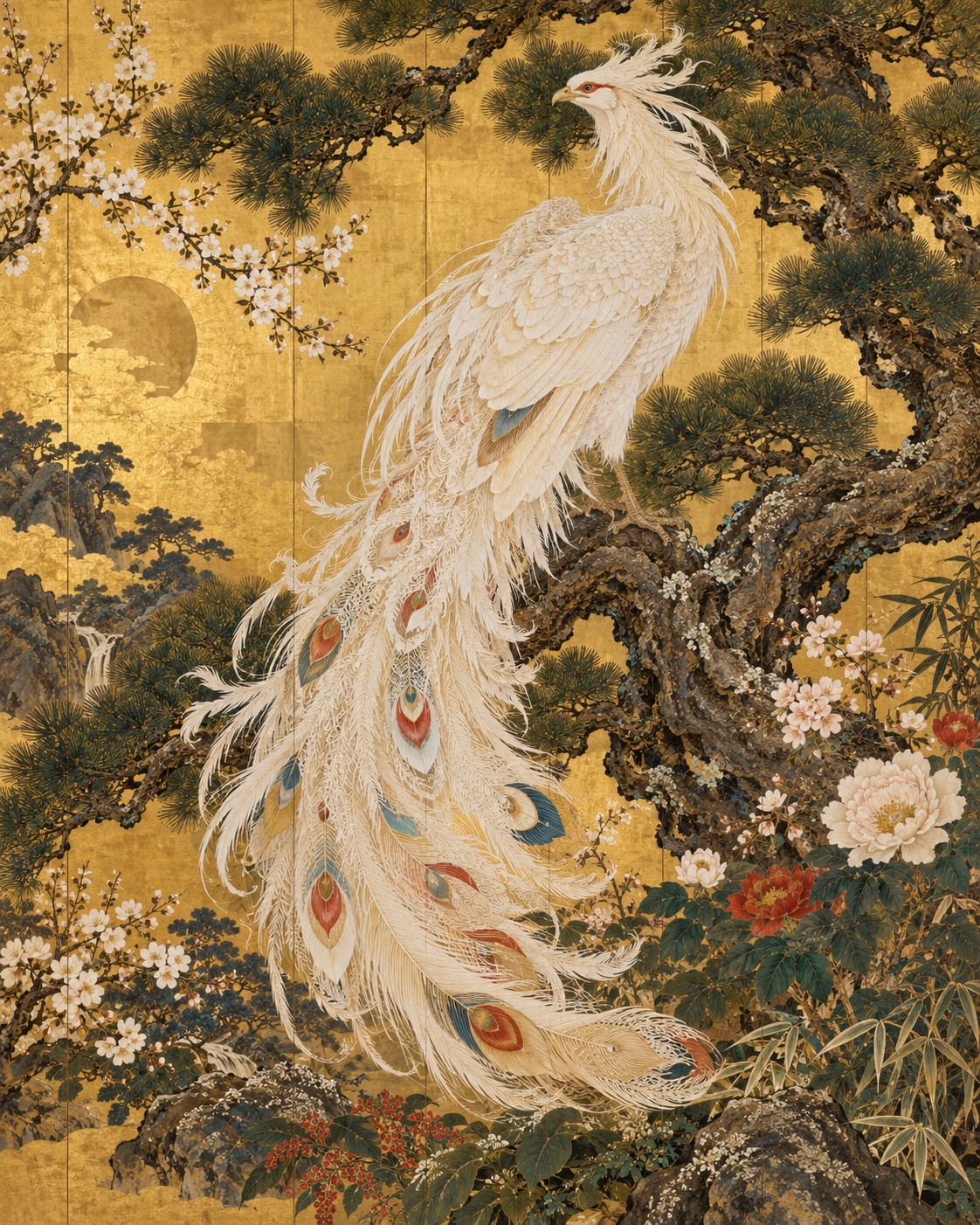
An impossible bird, rendered with extraordinary conviction
The bird is fantastical, but its feathers seem almost touchable. A great white phoenix occupies an old pine, its elaborate plumage catching the light against the intricacy of the surrounding branches. This is the paradox at the heart of Itō Jakuchū (1716–1800), one of Kyoto’s most singular Edo-period painters: his art is extraordinary not because it ignores nature, but because disciplined attention to the natural world gives his inventions such startling force. The work that provides today’s Art Choice is White Phoenix and Old Pine, known in Japanese as Rōshō Hakuhō-zu (老松白鳳図).
A closer look at the actual painting
The original is an approximately 1766 hanging scroll, color on silk, measuring 141.8 by 79.7 centimeters. It forms part of the thirty-scroll series Dōshoku sai-e, commonly rendered Colorful Realm of Living Beings, held by the Museum of the Imperial Collections, Sannomaru Shōzōkan. The composition contains an old pine, paulownia blossoms and a rising sun. The phoenix is an auspicious mythical bird, not an identifiable specimen from ornithology. Its realism belongs to the rendering of feathers, surfaces and botanical forms, not to an assertion that the creature literally existed.
The astonishing science of white
Technical investigation provides an illuminating answer to why the white feathers appear so luminous. Researchers at the Tokyo National Research Institute for Cultural Properties found layers of ocher and gofun, a white pigment derived from shells, applied behind the silk in portions of the phoenix, with minute white strokes and color added from the front. The translucent weave and the reflective quality of silk work together to produce an effect that the researchers liken to delicate lace. The blue paulownia blossoms also show sophisticated combinations of pigment and dye. This was painterly brilliance grounded in the behavior of physical materials.
The merchant who became a painter
Jakuchū grew up in the world of Kyoto’s Nishiki produce market. His family operated a vegetable wholesale business, and he inherited responsibility for it before handing leadership to a younger brother in 1755. The familiar story describes a man who exchanged commerce for art. Historical research in Kyoto, however, presents a more complicated personality. Records indicate that he continued to serve in community affairs, acting as a town elder even after he was no longer running the family shop. The practical dealings of an urban merchant were not simply erased by his artistic calling.
How Jakuchū helped defend Nishiki Market
A guide issued by Kyoto Prefecture’s historical archives recounts a market dispute that began in 1771, when vegetable wholesalers elsewhere in the city challenged the operation of Nishiki’s market. Jakuchū helped organize support from nearby farming communities and pressed the case with the city magistrate’s office. The resulting history, recorded in Kyoto Nishikikōji Aomono Ichiba Kiroku, chronicles the struggle that led to the market’s reopening in 1774. This does not make him a modern political activist; it demonstrates that the painter of exuberant plants also understood the precarious human economy behind the produce market.
Thirty paintings, one extraordinary vision
The Colorful Realm series occupied about a decade of Jakuchū’s working life. Its thirty silk paintings assemble chickens, smaller birds, insects, fish, shellfish, flowers, foliage and other forms of life into compositions of incredible density. He did not produce a neutral inventory. Pattern, contrast, scale and placement become as important as close observation. In this sense, the paintings sit between natural history and visual invention. The series even contains a work devoted to shellfish—an apt but carefully limited point of connection to Japan.co.jp’s report on newly distinguished genetic lineages among tiny Japanese marine clams.
A religious gift, not a museum commission
The paintings were not originally conceived as a gallery attraction. Jakuchū donated them to Shōkoku-ji, the Kyoto Zen temple where they accompanied his paintings of the Shakyamuni Triad in religious use. In 1889, the temple presented the series to the imperial household. The complete thirty-scroll work was designated a National Treasure in 2021. That passage—from devotional setting to imperial collection to contemporary public heritage—explains why any serious account of Jakuchū must include the institutional and religious history of the works, not only their spectacular appearance.
Imagination built upon observation
What distinguishes White Phoenix and Old Pine is its balance between the credible and the impossible. The viewer cannot encounter this mythical bird in a forest, but the surface of the feathers, the structure of the pine and the placement of the blossoms persuade the eye. Jakuchū harnesses visual evidence in the service of something that cannot be verified as a biological reality. It is a useful warning against describing the artist as a mere scientific illustrator—or, conversely, as a painter whose achievements were only eccentric fantasy. His originality arises from precisely the tension between the two.
The pigments under examination
Modern conservation research adds another story beneath the visible picture. Joint investigations conducted from 2001 to 2008 examined the Colorful Realm through optical documentation and materials analysis. X-ray fluorescence testing identified different classes of red pigment and dye, while close examination of painting from the back of the silk disclosed labor-intensive effects that can be missed in photographs. The project reminds us that historical art can yield new information through careful methods even centuries after the artist’s death. Scholarship continues to refine, rather than merely repeat, the account of his techniques.
A rare chance to see the whole series
The Museum of the Imperial Collections has announced an exhibition of all thirty Colorful Realm paintings from February 4 through March 14, 2027, tied to its grand opening. The museum describes it as the first full Japanese presentation in roughly a decade and the first since the group’s National Treasure designation. Those are announced future arrangements, not a claim that the exhibition has already occurred. Readers contemplating a visit should check current admission and schedule information through the museum.
An illustration inspired by Jakuchū is not a Jakuchū original
The leading image on this Japan.co.jp page is a newly generated editorial interpretation inspired by Jakuchū’s feather textures and luxuriant contrasts. It is not a photograph, a licensed facsimile or a reliable visual record of the original White Phoenix and Old Pine. For the authentic painting, readers should consult the museum’s object entry linked below. The Tokyo National Research Institute for Cultural Properties also makes technical images available for scholarly use, but explicitly sets restrictions on reproduction and directs ordinary image-use inquiries to the museum. A transparent distinction between illustration and source object is essential when cultural heritage is presented online.
Why this is today’s Art Choice
Our October 13 edition includes a Kyoto University investigation that distinguished three genetic lineages among minute marine clams once assigned to a single species. That scientific discovery does not owe anything to Jakuchū, and his art is not molecular evidence. Yet the pairing asks an enduring question: what happens when people look harder at the ordinary? The painter found inexhaustible visual complexity in feathers, leaves and shells; scientists now find unsuspected biological differences in similarly modest creatures. A phoenix may be imaginary, but the discipline of looking is real. That is why Jakuchū belongs alongside today’s journalism: he teaches us that the astonishing world often begins with attention.
Sources and original artwork
- 皇居三の丸尚蔵館「老松白鳳図」作品情報
- 皇居三の丸尚蔵館「動植綵絵」解説
- 文化庁 国指定文化財等データベース「動植綵絵」
- 京都府立京都学・歴彩館 資料ガイド「若冲と壬生菜」
- 東京文化財研究所「老松白鳳図」光学調査
- 東京文化財研究所「動植綵絵」の彩色材料
- 皇居三の丸尚蔵館・2027年「国宝 動植綵絵 いろどりの世界」
- 皇居三の丸尚蔵館 英語作品目録
Primary records checked October 10, 2026. The February–March 2027 exhibition is announced, not yet held.