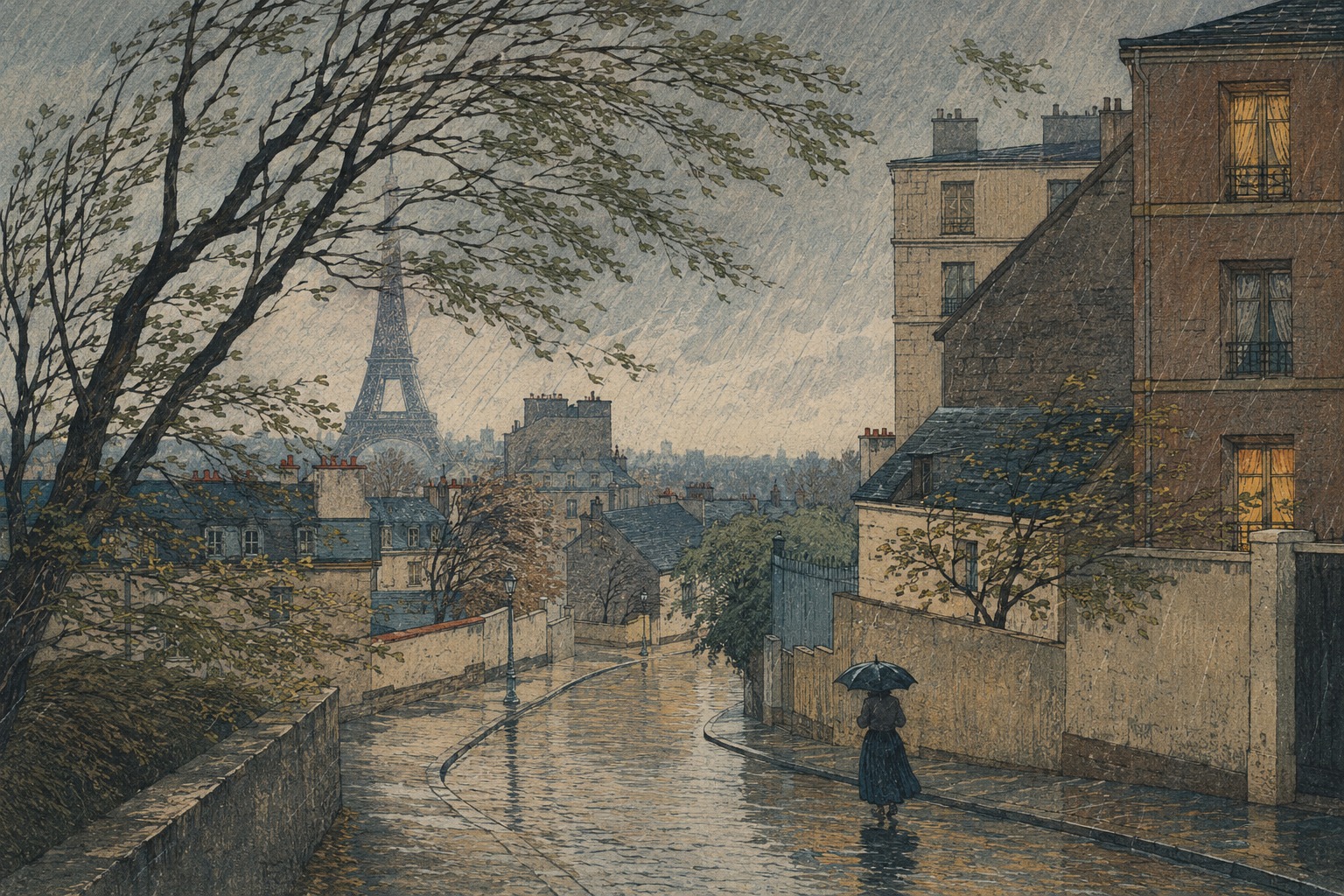
The Eiffel Tower is not always the largest thing in Henri Rivière’s picture. It thins into the distance at the end of a rain-darkened street, peeks between roofs and chimneys, or retreats behind laundry, trees and construction. In Thirty-Six Views of the Eiffel Tower, the subject is not only the tower. It is Paris learning to see the tower.
Japan’s National Museum of Western Art dates the project to 1888–1902 and its publication to 1902. Its signed frontispiece is numbered 19 from an edition of 500. The Bibliothèque nationale de France likewise describes 36 lithographs printed in five tones and issued in 500 copies. The title openly points to Katsushika Hokusai’s Thirty-Six Views of Mount Fuji.
He borrowed a system, not simply a mountain
Hokusai’s Fuji series appeared in the early 1830s. Sometimes the mountain dominates; elsewhere it is tiny, framed by a wave, bridge, barrel or roofline. Each change of place, season, weather and work changes the mountain’s role. Repetition produces difference.
That is the most consequential thing Rivière borrowed. He kept one landmark fixed and moved the eye. Japan’s Sagawa Art Museum identifies the influence not only of Hokusai but also of Utagawa Hiroshige in Rivière’s color, composition, subjects and handling of atmosphere.
Saying that Rivière merely replaced Fuji with the tower misses the historical tension. Fuji carried centuries of religious and cultural meaning. The Eiffel Tower was a newly built industrial structure that many Parisians had opposed. The two were not equivalents. Hokusai’s format gave Rivière a way to observe how an unfamiliar machine entered an old city’s visual life.
A modern landmark begins as a construction site
The tower was built for the 1889 Exposition Universelle, which marked the centenary of the French Revolution. The Eiffel Tower’s official history dates the beginning of foundation work to January 26, 1887, and completion to March 31, 1889—two years, two months and five days later.
Before completion, critics argued that the enormous iron structure would disfigure historic Paris. What now looks inseparable from the skyline entered it as an intruder. Rivière’s early images belong to that unstable period before familiarity had settled the argument.
He did not observe construction only from street level. Sagawa Art Museum reports that Rivière climbed the unfinished tower, photographed workers and views from its structure, and used some photographs as working material. In images made from within the ironwork, the tower stops being a silhouette and becomes intersecting members, suspended bodies and labor.
Shadow theater taught him what not to show
Born in Paris in 1864, Rivière spent years designing shadow plays for Le Chat Noir, the Montmartre cabaret that joined entertainment, satire and experimental art. Sagawa dates this work to an eleven-year period. The medium trained him to make silhouettes, flat tones and intervals of light carry narrative weight.
That discipline helps explain why weather matters so much in the Eiffel series. Rain, dusk, snow and backlight do not conceal the subject; they make recognition active. A building or tree that blocks the tower creates distance. The viewer completes what Rivière withholds.
The BnF presents Rivière as an innovator in late nineteenth-century color printmaking who worked across woodcut, lithography, etching and watercolor. The artist’s studio materials preserved by the library include finished prints, preparatory work and Japanese prints from his own collection, providing material evidence for sustained study rather than a passing taste for Japanese decoration.
Imagined as woodcuts, realized in lithography
The finished portfolio is color lithography, even though Japanese multicolor woodblock printing was a central model. According to Sagawa Art Museum, Rivière initially planned woodcuts and completed two before shifting to lithography, which allowed a different level of detail and practical control.
The BnF catalogue identifies Eugène Verneau’s Paris workshop as the printer. Five printed tones turn gray skies, wet stone and red-brown accents into a coherent Parisian atmosphere. Restraint is not merely a technical limit; it is the portfolio’s weather.
The NMWA frontispiece carries Rivière’s signature and the number 19/500. Its book form and seal-like marks evoke Japanese print culture, but the production belongs to the French lithographic trade. Japanese serial design and Parisian industrial printing meet inside the same object.
Look at the laundry before the tower
In the Cleveland Museum of Art’s From Lamarck Street, a wet road bends away while a figure leans into the wind. The tower is a thin line in the far distance. Cleveland dates the color lithograph to 1902 and makes its high-resolution image available through open access.
The plate shows why Japonisme was more than decorative fans, kimonos and exotic props. Cropping at the edge, an oversized foreground barrier, a steep or elevated viewpoint, and weather that weakens contours could reorganize how a European city was pictured. Lessons taken from Japanese prints became tools for seeing Parisian workers, housing, boats and streets.
Yet the exchange should not be reduced to Japan teaching a passive West how to become modern. Japan’s National Diet Library explains that Western perspective contributed to the development of ukiyo-e landscapes and that Hokusai used imported Prussian blue in ten designs from Thirty-Six Views of Mount Fuji. Rivière, in turn, combined Japanese prints with photography, French shadow theater and commercial lithography. Influence crossed borders more than once.
How iron became landscape
When Rivière began the project in 1888, the tower was under construction. When the portfolio appeared in 1902, thirteen years had passed since the Exposition. Across the series, a worksite becomes a distant outline glimpsed through ordinary weather.
One flattering portrait would have been enough to celebrate an engineering triumph. Thirty-six views were necessary because the tower did not have one meaning. It was industrial achievement, visual intrusion, workplace, spectacle and navigational marker at once.
Today’s conviction that the Eiffel Tower looks naturally Parisian was made, not born. Photographs, posters, films and prints slowly inserted its outline into collective memory. Rivière’s portfolio records an early stage of that process. By borrowing Hokusai’s serial vision, he showed not a machine replacing a mountain, but a machine becoming landscape.
- National Museum of Western Art: portfolio frontispiece
- Bibliothèque nationale de France: the 36-view portfolio
- BnF catalogue: publication and printer
- Sagawa Art Museum: Hokusai and Rivière
- National Diet Library: perspective and Prussian blue in ukiyo-e
- Cleveland Museum of Art: From Lamarck Street
- Official Eiffel Tower history
- Official Eiffel Tower account of the early controversy