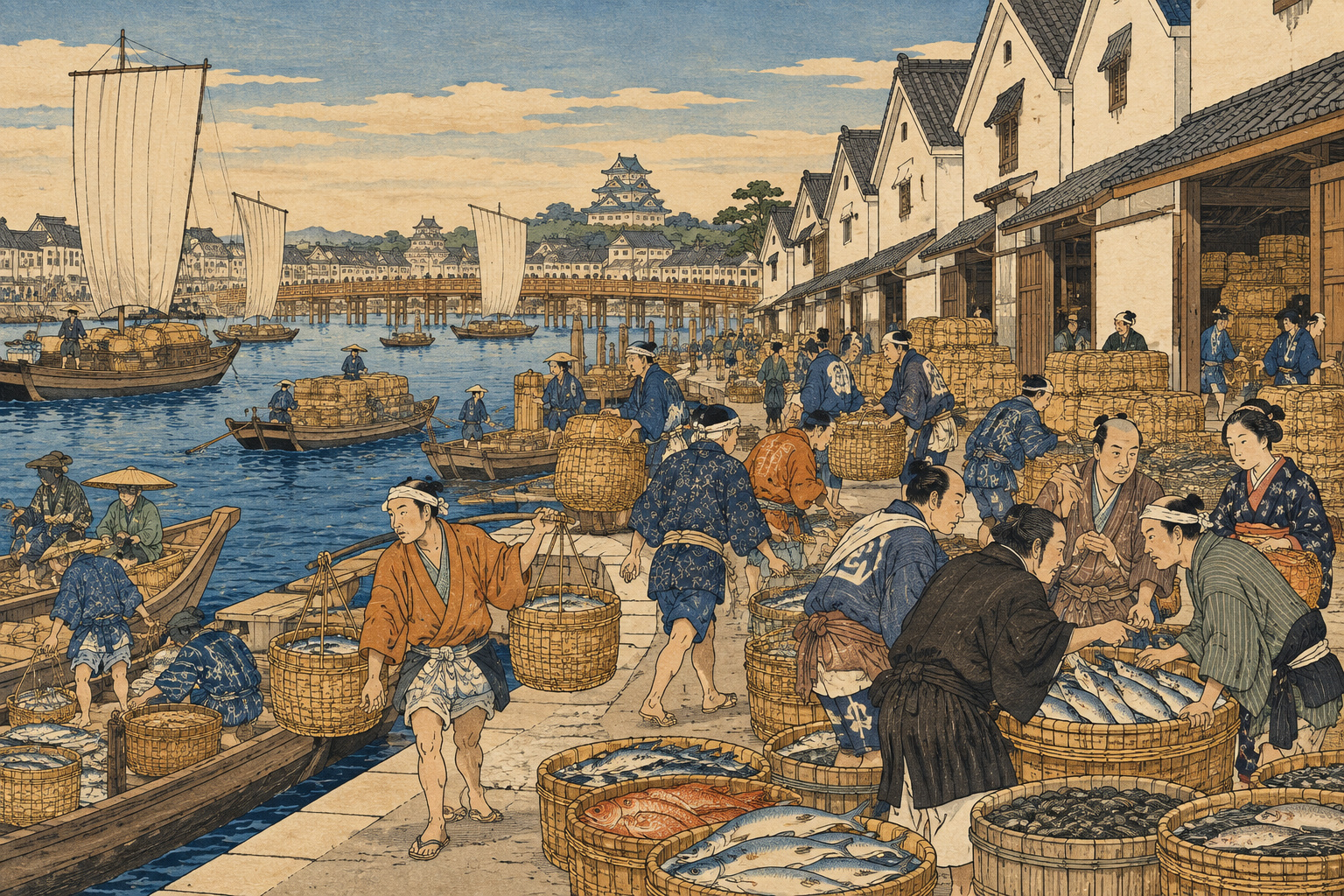
In Hasegawa Sadanobu I’s Zakoba, the eye finds work before it finds a hero. Baskets repeat across a crowded market frontage. Figures carry loads, turn toward one another and move beneath long dark roofs. A place becomes recognizable through the activity that fills it. Today’s Art Choice takes this fish-market print as a way into Osaka’s merchant spirit—understood through work, rather than a supposed shared personality.[1]
A precise starting point
Sadanobu I, written 初代長谷川貞信 and read Hasegawa Sadanobu, lived from 1809 to 1879. Osaka Prefectural Library identifies its Zakoba as his work under catalogue number 02-0000202. That number matters: the collection also holds a different print of Zakoba by Yoshitaki. A familiar place-name is not enough to establish an attribution.[1],[8]
The library’s digital image offers a direct opportunity to look. A reddish sky sits above broad roof planes, while the human activity is compressed into a richly detailed band below. Yellow-toned baskets recur among the figures. Nearer roofs partly interrupt the view, placing the spectator outside the bustle rather than giving an unobstructed plan of the market.[1]
Follow those baskets and the composition becomes a sequence of gestures. The repeated objects connect otherwise separate figures. Architecture supplies a comparatively stable framework; the smaller changes of posture and direction supply movement. The market is not simply a backdrop. It is what the people are doing.
From a trading household to Osaka’s print world
The prefectural library places Sadanobu’s birth in an Osaka household trading in tea cloths and wrapping cloths. His training crossed several artistic connections, beginning with the Shijō-school painter Ueda Kōchō and continuing with Utagawa Sadamasu and Ryūsai Shigeharu. The library describes an early concentration on actor prints and a turn toward landscapes around the Tenpō reforms.[1]
Osaka Museum of History situates the city’s actor-print culture in the enthusiasm surrounding kabuki and the theaters of Dōtonbori. Supporters of actors and performances helped form the audience for these images. Prints belonged to a local culture of attention: people wanted pictures of performers and places that mattered to them.[4]
That background is useful without being a complete explanation of Sadanobu’s choices. Birth into a commercial household does not prove why he depicted a market, and a career in actor prints does not establish that he intended market workers as theatrical characters. Biography supplies questions to bring to a work; it should not become an invented statement of intention.
The market as an urban connection
Osaka City’s account places the Zakoba fish market at Sagishima on the eastern bank of the Hyakkenbori waterway. It identifies Zakoba alongside Tenma’s produce market and Dōjima’s rice market as one of the city’s three major markets. Its significance lay in feeding urban life through a concentrated place of exchange.[5]
A fish market joins activities that happen in different places. Goods arrive, are handled and leave again. Freshness gives time a practical importance. Sadanobu’s print cannot tell us every route, transaction or price, but its repeated carriers make movement a conspicuous part of the scene.
This is a more specific way to read commercial vitality than merely calling the image lively. The bustle consists of tasks. Someone supports a load; someone makes space to move; someone faces another person. The composition allows the accumulated effect of these small actions to stand for the activity of a larger city.
A second view: Shinsaibashi opens the year
Sadanobu’s Shinsaibashi-dōri hatsuuri no kei—a view of the first sales of the year on Shinsaibashi Street—provides a revealing companion. Osaka Museum of History dates the work broadly to the late Edo or early Meiji period and explains that it depicts the second day of the New Year, near the intersection with Andōjibashi Street.[2],[3]
In the digital image, lanterns punctuate a dark sky and a row of shops recedes strongly into the distance. Figures and large loads occupy the foreground. Where the fish market emphasizes a spreading frontage, this scene draws the eye along a street. Commerce has different pictorial rhythms in the two locations.
The New Year setting gives an ordinary activity a calendrical meaning. Opening shops and moving goods become signs of a shared beginning. The city can mark time through its work, not only through official ceremonies or monumental buildings.
What the bustle does—and does not—prove
Crowded prints are not economic statistics. They do not establish how profitable a shop was, how much a carrier earned or whether prosperity reached everyone in the scene. The artist selected a viewpoint and arranged a legible world. The apparent energy of that world cannot answer every historical question.
Nor should a pleasurable image make physical labor disappear into nostalgia. Carrying goods involves weight, effort and time. The print gives us gestures to examine, but not a complete account of working conditions. Looking closely includes recognizing what the image leaves unresolved.
Its achievement can be understood on more modest, firmer ground: the commercial workplace becomes a subject worthy of sustained attention. People do not merely decorate a city view. Their activity helps give the place its identity. Shops become a shopping street through use; a market becomes visible through exchange.
The city’s arrangements did not stand still
Long after Sadanobu’s death, Osaka reorganized its food distribution. The city records the opening of the central wholesale market at Noda, Fukushima Ward, on November 11, 1931, incorporating most of the earlier private wholesale markets. The library’s Zakoba account links the old market’s disappearance to that opening.[6],[1]
The print consequently preserves a way of arranging work that did not survive unchanged. A continuing need—to bring food into the city—could be served through different sites and institutions. The image is valuable partly because continuity and change can be considered together.
It would be misleading to treat the market as the direct ancestor of every modern Osaka business habit. What can travel across the historical distance is a question: what relationships and practical arrangements make exchange possible?
Reading alongside Brian Lim
In his written responses for this edition’s interview, Brian Lim argues that overseas startups and Japanese partners need shared pilot objectives, documented knowledge and relationships reaching more than one person inside an organization. His subject is contemporary collaboration, with its own technologies and institutional constraints.
Sadanobu’s print is not evidence for Lim’s advice. The pairing is editorial: both invite attention to what people actually do together. In the interview, that means agreements, information and continuity across teams. In the print, it means bodies, goods and a shared physical setting. Keeping the differences visible makes the comparison more useful.
A name inherited, a picture available to look at again
Sadanobu passed his name to his eldest son Konobu in 1875. The prefectural library has subsequently examined the artistic lineage in a historical exhibition. Identifying the first generation remains essential when encountering later works signed with the same name.[1],[7]
Open the library’s original Zakoba image and choose one basket. Follow the figure carrying it, then move your attention to the rooflines and the people nearby. That small exercise brings the idea of a merchant city back to observable work. The picture’s lasting interest is not that it proves an unchanging Osaka character. It shows how the activity of ordinary people can become the form, rhythm and subject of art.
