
For an overseas startup, the decisive question about Japan may be less about where to raise money than where to find a customer. Brian Lim, COO and Cross-Border Innovation Partner at encognize G.K., argues that Osaka’s appeal lies in the businesses that can buy, test and help deliver a new technology.
In written responses to Japan.co.jp, Lim describes the work behind those relationships: agreeing what a pilot must prove, building connections beyond a single executive and adapting an overseas business model to local conditions. His advice also carries a message for Kansai companies: international partnerships depend on the knowledge, operating networks and continuity that the Japanese side contributes.
The interview follows a September 24 feature distributed by Osaka Prefectural Government. Lim’s company advises businesses on international expansion; his assessments below reflect that professional perspective.
Two routes into an operating business
Asked for examples, Lim points to passenger-accessibility software company Transreport and hot-food vending business Wada FoodTech. Both illustrate a partnership built around a practical operating need.
According to Lim, Transreport met Hankyu Railway through Startupbootcamp Osaka and began with a limited proof of concept to test the system’s usefulness for railway operations and passenger service. Transreport’s published case study records a staff application launch in April 2024, followed by a passenger-facing web application in April 2025. The applications help coordinate assistance and allow passengers to request support before travelling. [1]
Wada FoodTech’s opportunity was different: distributing warm meals through vending machines. Lim says the founder’s familiarity with Japan, an established vending-machine culture and concentrations of office workers made the market attractive. Harada Corporation brought local relationships and operating resources that could complement the technology.
Harada’s own announcement confirms an investment in Wada FoodTech’s Japanese company and a business alliance, following cooperation on Japanese food-distribution challenges dating from 2020. The Calidus service website identifies Wada FoodTech and Harada as its operating companies and records the service’s launch in Osaka’s Kitahama district in March 2024. [2] [3]
Lim offers six to 18 months as an indicative period for reaching a commercial agreement in many cases. He explicitly says that this range does not describe the timelines of the two examples above. The interview does not disclose their contract values or payment terms.
Why a successful pilot can still go nowhere
A working technology does not automatically produce an ongoing contract. Lim identifies two recurring obstacles: mismatched assumptions and an overly narrow approach to relationships.
One party may judge a trial by technical performance, while another expects a particular operating result, timetable or level of readiness. Without an agreed definition of success, the same project can appear complete to the startup and unfinished to its prospective customer.
The second risk is organizational. Founders may concentrate on the most senior person in a meeting while overlooking the employees responsible for carrying a project forward. When those staff move departments or take overseas assignments, accumulated knowledge can disappear. Lim says a previously promising project may then quietly lose priority.
His response is practical: document the objectives, processes and evidence throughout the pilot, and build working relationships with several people across the organization. He also recommends negotiating milestones and decision points in the pilot agreement, including the terms on which demonstrated results could lead to a commercial contract.
For both sides, that means discussing what happens after the trial before the trial begins.
Adapt the offer, not just the presentation
When asked for a business that needed to change its approach to Japan, Lim cites IKEA. He emphasizes differences in consumer behaviour and service expectations as reasons an imported formula can struggle.
IKEA Museum’s account of the company’s early Japanese venture also describes a mismatch between bulky furniture and compact homes. The example is a large retailer rather than a startup, but it supports the broader question Lim wants founders to ask: does the offer fit how the customer actually lives or works? [4]
For a technology business, the answer requires more than translating a sales deck. The discovery trip needs to test assumptions about the customer’s problem and the conditions under which a solution would be used.
A first visit designed to learn
Lim reframes the first 90 days as a process for a founder who has not yet established whether Osaka is the right market. Preparation starts a month before arrival, and the initial visit is followed by deliberate, continuing contact.
- About 30 days before arrival: research the sector, prospective customers and relevant people; request introductions and arrange meetings. Lim encourages using AI as a research aid.
- On arrival: rest, observe and become familiar with the surroundings.
- By roughly day 14: complete key meetings, including discussions with experts who may not be customers. Send thanks and record the agreed next steps, such as a presentation or technical brief.
- Around day 45: follow up where necessary, seek an online meeting and propose an agenda for the next in-person discussion.
- Around day 90: return or arrange further in-person discussions to demonstrate commitment.
“Founders should approach the trip with a validation mindset instead of a ‘hard sell’ mindset.”Brian Lim, written response to Japan.co.jp
This is Lim’s suggested planning framework, not a fixed schedule for every company. He names FUTRWORKS, O-NEXUS operated by CIC Osaka, IBPC Osaka and Osaka Innovation Hub as places to explore for connections and support. Costs, eligibility and the scope of assistance should be checked directly with each organization.
What Kansai companies bring to the partnership
Lim sees value for Japanese businesses in exposure to technologies, working methods and lessons already tested overseas. The local company, in turn, brings knowledge of its customers, market conditions and operating constraints.
He also proposes that Kansai businesses, including smaller firms, pool their problem statements through representative business organizations to reach potential overseas partners. This is a suggestion for further development, not an announcement of a new program.
Introductions alone are insufficient, he stresses. The work of defining the problem, adapting the solution and establishing a viable relationship remains with the participants.
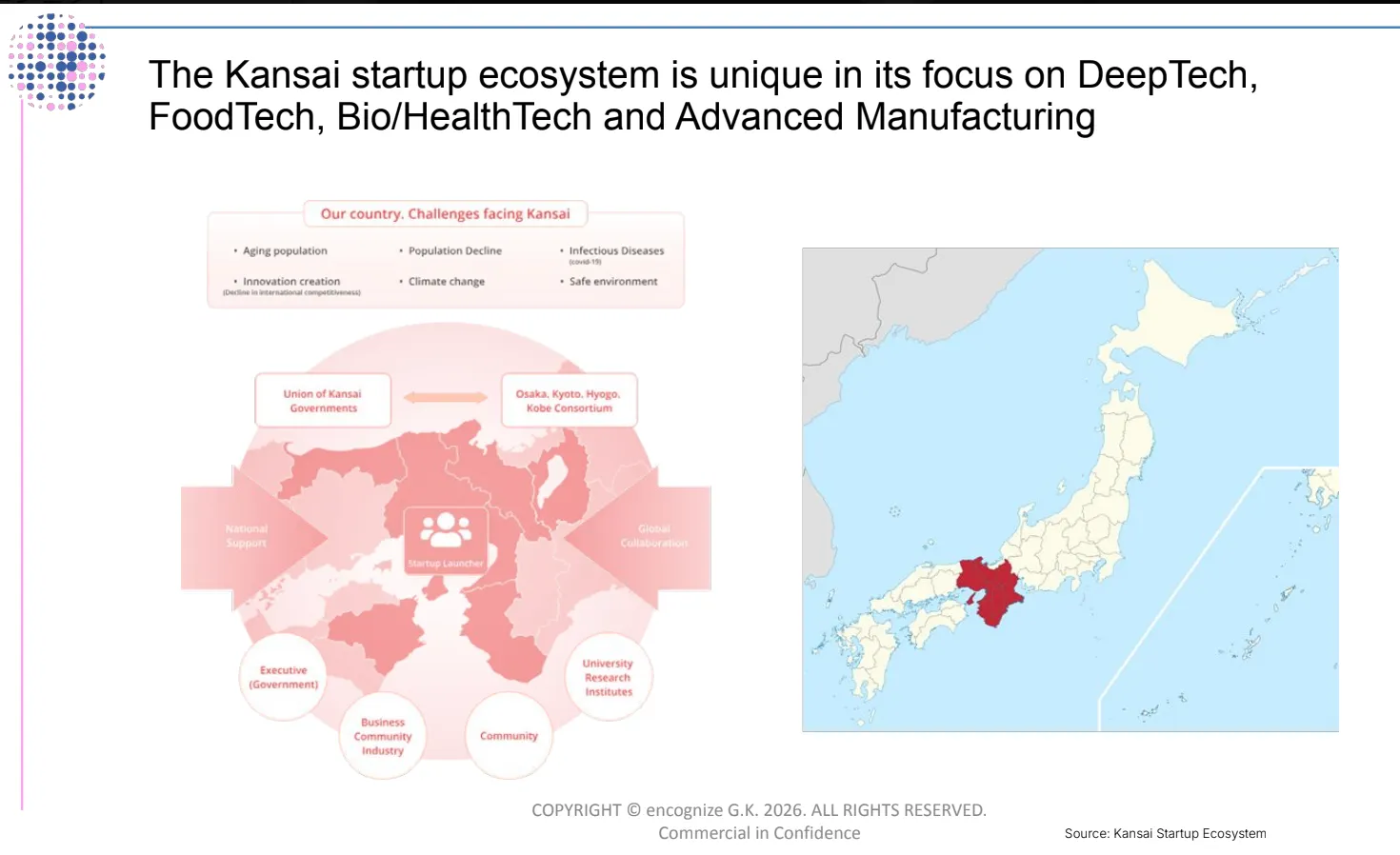
Osaka’s competition extends beyond Tokyo
Asked about Osaka’s weakness, Lim offers a criticism of positioning rather than infrastructure. In his view, comparisons with Tokyo can encourage Osaka to present itself as an alternative version of the capital instead of articulating its own strengths.
He considers its people, culture, living costs and corporate openness favourable to international startups. Those are his assessments, rather than a measured city ranking. His wider point is that the contest for founders also includes Singapore, Seoul, Shanghai and other Asian cities.
For Osaka, the argument returns to customers: a distinctive industrial base matters most when an arriving company can find a specific problem to solve, a partner equipped to work on it and a route from trial to continuing business.
