Two women meet on a landing. The staircase seems to rise toward nowhere. Walls advance and withdraw; darkness occupies the room like a third person. A narrow blade of light divides architecture into possibilities. Is this a private encounter, a memory, a stage set, a dream—or a trap?
In Meeting at the Staircase, the National Gallery of Modern Art sees the defining elements of Gaganendranath Tagore’s semi-abstract work after 1922: architecture, light, shadow and narrative uncertainty. The painting has geometry, but geometry is not the destination. Every plane redirects attention. Every opening proposes a space and withholds it. The scene is simultaneously solid and unstable.
This is why calling Tagore an “Indian Cubist” is both illuminating and insufficient. The label rescues him from an art history that once treated modernism as a package exported from Europe. It can also reduce an artist of ink, wash, landscape, book illustration, photography, theater, design and savage comedy to the moment when his pictures look most familiar to Western eyes.
His real achievement lies in the passage among those practices. Japanese brushwork taught him the force of omission. Illustration taught him how image and memory can occupy the same page. Theater taught him that architecture can wait for an entrance. Caricature taught him to deform appearances until social truth emerged. Cubism gave him a vocabulary of interpenetrating planes. He recombined them into rooms where light became actor, architecture became emotion and India’s modernity could appear fractured because it already was.
Jorasanko was not a quiet studio
Gaganendranath was born into the Tagore family at Jorasanko in north Calcutta, now Kolkata. The word “family” hardly conveys the institution. The sprawling house was a domestic compound, theater, literary workshop, musical laboratory, salon and political-cultural meeting place. His younger brother Abanindranath would become the central artist of the Bengal School; his younger sister Sunayani Devi developed an independent modern language drawn partly from folk and popular imagery. Their uncle Rabindranath wrote poetry, fiction, songs and plays, won the Nobel Prize in Literature and later became a painter himself.
Privilege gave Gaganendranath time, materials, rooms and access unavailable to most colonial subjects. It did not hand him a finished artistic identity. National Gallery records describe little formal training and a serious commitment to painting beginning relatively late. Victoria Memorial Hall’s chronology finds the earliest known Puri postcards in 1907. The National Gallery points to works from around 1905 and to the 1911 illustrations for Rabindranath’s memoir as the point when he began painting seriously.
“Self-taught” therefore requires care. He did not pass through an academic curriculum in the ordinary way. Yet no person at Jorasanko learned alone. He watched artists work, collected objects, practiced photography, designed stages, acted, read, traveled and used a lithographic studio. Visiting intellectuals and artists crossed the household. The absence of an academy did not mean the absence of teachers; it meant education was distributed across practice, kinship and encounter.
Gaganendranath and Abanindranath were closely involved in the Indian Society of Oriental Art, established in Calcutta in 1907 amid the nationalism stirred by opposition to the 1905 partition of Bengal. The society organized exhibitions, discussion, teaching and publications; its journal Rupam later became a channel for international art debate. It provided institutional ground on which an Indian modern art could be exhibited and argued about rather than merely certified by colonial schools.
That history contains a productive contradiction. The Bengal School sought cultural autonomy from British academic naturalism by recovering Indian and Asian resources. Gaganendranath helped sustain that project, then made cartoons that disturbed its idealized cultural consensus and paintings that accepted lessons from European modernism. His independence was not a departure from every tradition. It was a refusal to let any one tradition close the argument.
When Japan came through the door
The Japan–India connection was personal before it became stylistic. Okakura Kakuzō—known as Tenshin in Japan—came to Calcutta in 1902 and entered the Tagore circle. His Pan-Asian vision proposed cultural solidarity against the dominance of Western academic taste, even as the idea of a unified “Asia” simplified enormous differences. After returning to Japan, he sent Yokoyama Taikan and Hishida Shunsō to Calcutta in 1903.
Taikan and Hishida were not custodians of an untouched old Japan. They were modern Nihonga painters themselves, working through Japan’s confrontation with Western art. They showed artists around the Tagores how ink, brush, graded wash and softened contours could make atmosphere without academic modeling. The exchange also moved in the other direction: the Japanese visitors studied Indian imagery and encountered the subcontinent’s traditions. This was not an East teaching another static East. It was modern Asia making itself through contact.
Gaganendranath absorbed calligraphic speed, tonal economy and the capacity of blank paper to function as space. In his river landscapes, mist does not merely cover detail; it allows distance to breathe. In studies of crows, the stroke performs wing, weight and alertness without patiently enclosing every feather. In the illustrations to Rabindranath’s Jeevansmriti—My Reminiscences—a few densities of black can summon rain, a banyan tree, a boat or a tutor’s arrival from the pressure of memory.
The Victoria Memorial account emphasizes that he did not adopt a single formula. Some works use sumi-e-like ink, others thin color wash, nocturnal effects associated with Whistler, gold grounds or multiple brush languages at once. Around 1910, the Indian Society of Oriental Art assembled a major exhibition of Japanese work. Reproductions in the Japanese art journal Kokka offered another route of study. By about 1914, the museum argues, Tagore had synthesized these resources into his own handling of ink.
| Encounter | What entered Tagore’s practice | What he made from it |
|---|---|---|
| Japanese brush and ink | Decisive gesture, variable pressure, tonal wash and active empty paper. | Crows, trees, rivers, rain and figures that exist through economy rather than exhaustive description. |
| Morotai atmosphere | Softened contours and graded tonal fields associated with Taikan and Hishida. | Hazy Bengal, Puri and Himalayan landscapes where distance becomes mood. |
| Whistler and photography | Nocturnal tone, cropping, illumination and strong dark-light relations. | Night scenes and interiors in which a source of light reorganizes the whole composition. |
| Jorasanko theater | Stage, entrance, costume, comic timing and expectation. | Architectural scenes that feel ready for an unseen drama to begin. |
To call this influence “Japanese” is not to claim ownership of wash or ink by one nation. It identifies a documented relationship among particular artists at a particular historical moment. The more important fact is what followed: Tagore did not preserve the encounter as a borrowed accent. He made it a method for thinking about atmosphere, absence and light—concerns that later survived inside his geometry.
Painting memory instead of illustrating words
The Jeevansmriti project, published in Bengali in 1912, placed Gaganendranath inside another person’s recollection—though that person was his uncle and the remembered world overlapped his own. A conventional illustrator might translate each episode into an explanatory scene. Tagore often did something more elusive. He gave memory a climate.
A vast stretch of river can occupy a small sheet because scale is psychological. A dark banyan carries the density of childhood presence. A rainy arrival is constructed from motion and weather more than portrait likeness. The image does not duplicate the text; it produces a parallel sensation. This capacity to leave narrative incomplete would later make his staircases and shadowed palaces so charged.
Between roughly 1911 and 1915, he also produced the Chaitanya series, pilgrim scenes and religious or literary compositions. Many were imagined rather than observed. Temple doors, processions and the ecstatic movement of the Bengali Vaishnava saint Chaitanya gave him a reason to stage bodies against architectural thresholds. Black ink could be spiritual atmosphere, mass, opening and obstruction at once.
His Himalayan watercolors from the following years are often described as sublime. Peaks loom through blue shadow and layers of saturated pigment; in some works mountain form suggests the profile of Mahadeva. Gold grounds become light rather than decoration. The transformation is important: nature is not copied and then spiritualized by title. Perception itself crosses into apparition.
Several motifs of the Cubist period are already present before the label arrives: temple architecture, crowded passages, the compression of scale, dramatic illumination, memory’s freedom from optical fact. Cubism did not replace an “Asian phase.” It entered an artist who had already learned to make space unstable.
The lithographic room of laughter
From about 1915 to 1921, the dreamer became a formidable satirist. Gaganendranath installed a lithographic press at Jorasanko, reproduced drawings and sometimes hand-colored them. Two portfolios, Birup Bajra—often translated as Play of Opposites or Strange Thunderbolts—and Adbhut Lok, Realm of the Absurd, appeared in 1917. Naba Hullod, known in English as Reform Screams, followed in 1921. Titles and publication histories vary in later sources, one reason to identify individual editions carefully.
His targets crossed camps. He mocked wealthy Bengali men straining to pass as British sahibs, Europeanized ballroom behavior, patriarchal hypocrisy, religious pretension, shallow reform and colonial politics. The National Gallery identifies Deficit as an ironic response to the ineffective Montagu–Chelmsford reforms. He caricatured national figures as well as colonial mimicry. This was not a comforting nationalist picture in which authentic India stood pure opposite corrupt Britain.
The body carried the argument. A belly could overwhelm a heroic pose; clothing could become social disguise; an orator’s gesture could inflate until it exposed emptiness. The deformation was not an escape from realism but a more aggressive account of what polite appearance concealed. Scholar Sanjukta Sunderason describes these cartoons as a colonial aesthetic of rupture, joining rhetoric to body, politics to play and the satirical eye to modernist form.
Their sources were also hybrid. Calcutta already possessed rich traditions of Kalighat social satire, popular prints and Bengali comic writing. British Punch and its colonial descendants supplied another language of caricature. Jorasanko’s stage gave Gaganendranath timing and farce. Lithography gave multiplicity. He did not have to choose between vernacular and imported forms because colonial Calcutta itself was built from their unstable coexistence.
Contemporary anger at Birup Bajra, recorded in the Bengali periodical Prabasi and discussed in later scholarship, suggests the jokes reached people who recognized themselves. That matters. Satire becomes historically interesting when it is more than a modern viewer’s charming record of old fashions. Tagore’s images intervened in the status negotiations of their own present.
Calcutta meets the Bauhaus—but not for the first time
In December 1922, the 14th annual exhibition of the Indian Society of Oriental Art brought works connected to the Bauhaus into Calcutta. The encounter now seems astonishing: Paul Klee, Wassily Kandinsky, Lyonel Feininger and Johannes Itten appeared within the exhibition’s international field alongside Indian artists including Gaganendranath, Sunayani Devi, Shanta Devi and Uma Prosad Mookerjee.
Art historian Stella Kramrisch was central to the exhibition. She had studied in Vienna, taught at Santiniketan from 1921 to 1923 and maintained contact with Johannes Itten. In Rupam, she urged Calcutta viewers to recognize that European art did not equal naturalism. That proposition punctured a colonial hierarchy: the academy had often presented Western naturalistic representation as universal progress, while Europe’s own avant-garde was abandoning it.
The show did not place all art in one seamless room of global modernism. The original display separated Bauhaus and Bengali works, with an additional international category. Nor did it introduce a culturally isolated Gaganendranath to geometry overnight. Victoria Memorial Hall identifies his Cubist phase as 1921–25, says an initial group was reproduced in Rupam in 1922, and notes Kramrisch’s article “An Indian Cubist.” The exhibition was a crystallizing encounter within an existing development, not a simple origin story.
Its historical meaning is larger. European artists disillusioned after the First World War were looking beyond academic realism and toward spiritual, supposedly “primitive” or non-Western resources—often through unequal, appropriative categories. Indian artists under British rule were seeking languages that could reject colonial instruction without freezing India in a picturesque past. They did not meet from equal political positions, but neither side possessed modernity alone.
The 1922 exhibition therefore complicates the familiar map. Modernism was not made entirely in Paris, Berlin and Weimar and later delivered to a waiting periphery. Journals, reproductions, exhibitions, letters, travel and friendships created simultaneous arguments in many places. Calcutta was not merely receiving an answer. It was one of the cities asking the question.
What was reinvented
European Cubism had already challenged single-point perspective, stable volume and the idea that a picture should imitate one view at one instant. Picasso and Braque fragmented objects and reassembled signs of them across a shallow field; other artists extended Cubist geometry toward architecture, spirituality, movement and abstraction. Tagore drew from this expanded language rather than enrolling in a doctrine.
His difference is clearest in the sentence attributed by Victoria Memorial Hall’s account of art historian Ratan Parimoo: Gaganendranath was fundamentally interested in “light,” not “volume.” The distinction should not be made absolute—European Cubists also used light, and Tagore’s planes also make volume—but it directs the eye correctly. His forms behave like prisms. Black is not a background left after objects are drawn; it is a force that swallows, divides and reveals space.
Architecture gave this light something to strike. Temples, roofs, stairs, walls, arches, streets and imaginary palaces become systems of receding and advancing planes. In Temple Cubistic, the subject is not dissolved into neutral geometry. The temple remains culturally and spatially charged. Refraction makes it at once monument, vision and moving construction.
Theater remains inside the work. A stair is an entrance; an opening is a source of revelation; a dark wall is a curtain. Photography remains too, in the dramatic exposure of a lit face or a square window cut through black. Japanese wash survives in graduated darkness and the confidence that an unpainted or lightly washed area can carry space. Satire survives in the knowledge that a surface may tell one story while its structure tells another.
| If you see… | Do not stop at… | Look for… |
|---|---|---|
| Faceted planes | “This resembles European Cubism.” | Which planes emit, reflect or extinguish light; whether they build a real, remembered or theatrical place. |
| Deep black | “The artist used a limited palette.” | Black as active architecture, psychological pressure, night, curtain and interval. |
| Stairs and doors | “These organize perspective.” | Thresholds that promise narrative while refusing to disclose what lies beyond. |
| Figures reduced by space | “The people are secondary.” | How built form expresses power, isolation, encounter, pilgrimage or dream. |
| Indian subjects in modern form | “Tradition has been Westernized.” | A new language produced through several modernities—Indian, Japanese and European—rather than a contest between purity and contamination. |
This reinvention was Indian not because every formal element had an ancient local origin, but because the work answered to Indian sites, stories, politics, institutions and modes of seeing. Cultural specificity is not the same as isolation. Tagore’s achievement is cosmopolitan precisely because the exchange did not erase location.
After the planes, the darkness
Victoria Memorial Hall places a post-Cubist phase between 1925 and 1930. Geometry remained, but black and white deepened into private fantasy. Works such as Fairy in the Moonlight, Palace of Snow, The Cave of Mystery, City in the Night and Somnambulist inhabit a world of sleepwalkers, distant palaces, moonlight, death and passage.
These pictures resist the heroic story of modernism advancing steadily toward pure abstraction. Tagore did not purge narrative in order to become more modern. He made narrative stranger. The room after Cubism is not empty; it is haunted by theater, folklore, memory and mortality. Geometric form has become an instrument for dreaming.
Illness curtailed the experiment. Museum sources describe his last decade as incapacitated; other accounts date a cerebral stroke and paralysis to around 1930. Exact medical chronologies differ, but the artistic fact is clear: his concentrated period of mature production ended years before his death in 1938. That short span partly explains the feeling of several careers compressed together.
It may also explain his relative international unfamiliarity. He lacked a long late career, school of disciples or easily repeated signature. His brother Abanindranath occupied the canonical story of nationalist art. His uncle Rabindranath’s fame eclipsed almost everyone around the family name. Gaganendranath’s cartoons, washes and Cubist experiments were often placed in separate categories when their continuity is the most revealing thing about them.
Collection history matters as well. Important works remain concentrated in Indian institutions and Tagore-family collections. Titles, dates and transliterations vary. Works on paper are sensitive to light and harder to keep continuously displayed than durable oil painting. A modern art history organized around European movements could admit him as a curious “Indian Cubist” without rebuilding its larger account of where modernism happened.
A modernism of crossings, not purity
There are two inadequate ways to tell Gaganendranath’s story. One says that a Bengali artist discovered European Cubism and made a local version. The other, reacting against that hierarchy, tries to prove that everything important was already purely Indian. Both mistake cultural exchange for a contest over first ownership.
His work asks a better question: what happens when a form crosses into a different field of experience? Cubist planes entered an art already altered by Nihonga’s reinvention of Japanese painting, Pan-Asian anti-colonial thought, Bengali religious and popular imagery, Victorian and Bengali satire, household theater, photography and the spatial life of Calcutta. Nothing arrived unchanged.
The Japanese connection is especially meaningful for a Japan-focused publication because it was neither decorative Japonisme nor government diplomacy. Artists met, watched hands move and changed how paper could hold air. Japanese visitors were themselves modernizers negotiating Western pressure. Bengali artists were challenging colonial academic rules. Their exchange produced no single “Asian style,” but it created permission to treat Asia as a site of artistic invention rather than a reservoir of motifs for Europe.
That permission did not erase power. The Tagores were elite; Pan-Asian rhetoric could romanticize an internally diverse continent; nationalist revival could marginalize practices that did not fit its image; modern art institutions could reproduce their own exclusions. Gaganendranath’s satire is valuable partly because it prevents the story from becoming too noble. He saw absurdity inside reform, nationalism, westernization and tradition alike.
His Cubism is therefore not a flag planted on a borrowed movement. It is a record of thought under pressure. A colonial city claims and mocks metropolitan manners. An Asian solidarity movement borrows across real differences. A revivalist circle produces an artist who refuses revival as a final style. A dark room is divided until its architecture admits more than one truth.
Why he is the artist for this edition
The August 14 edition moves repeatedly between systems that cannot be understood from one viewpoint: satellite measurements of earthquake deformation, homes and water networks broken below the visible surface, autonomous vehicles reading a city, identity chips separating a person from a forged document, ocean currents bending around an island, children rebuilding assumptions and communities in digital space.
Tagore’s visual language is unusually suited to such subjects because his geometry is explanatory without pretending to be a diagram. It can place ground movement, a shelter, a factory, a pipe and a human figure in one fractured field. It can show technology as one plane of life rather than the whole picture. Light can move through the composition as data, water, current, route or hope. Shadow can preserve uncertainty.
The connection must not become a superficial filter. His social satire was aimed at specific hypocrisies in colonial Bengal; his religious architecture and figures carry histories that cannot simply decorate unrelated news. An editorial homage should borrow principles—economy of brush, active darkness, layered architecture, refracted light, unstable viewpoint—without reproducing a particular museum work or pretending that Tagore illustrated a 2026 event.
- Fractured space: several consequences can occupy one field without a false single viewpoint.
- Architectural planes: streets, shelters, courts, laboratories and studios become structures of social relation.
- Active shadow: uncertainty, loss and hidden infrastructure remain present rather than polished away.
- Refracted light: satellite sensing, water, routes, screens and starlight travel as luminous connections.
- Human scale: figures remain legible inside systems larger than themselves.
- Ink economy: restraint leaves room for dignity, especially in disaster and legal stories.
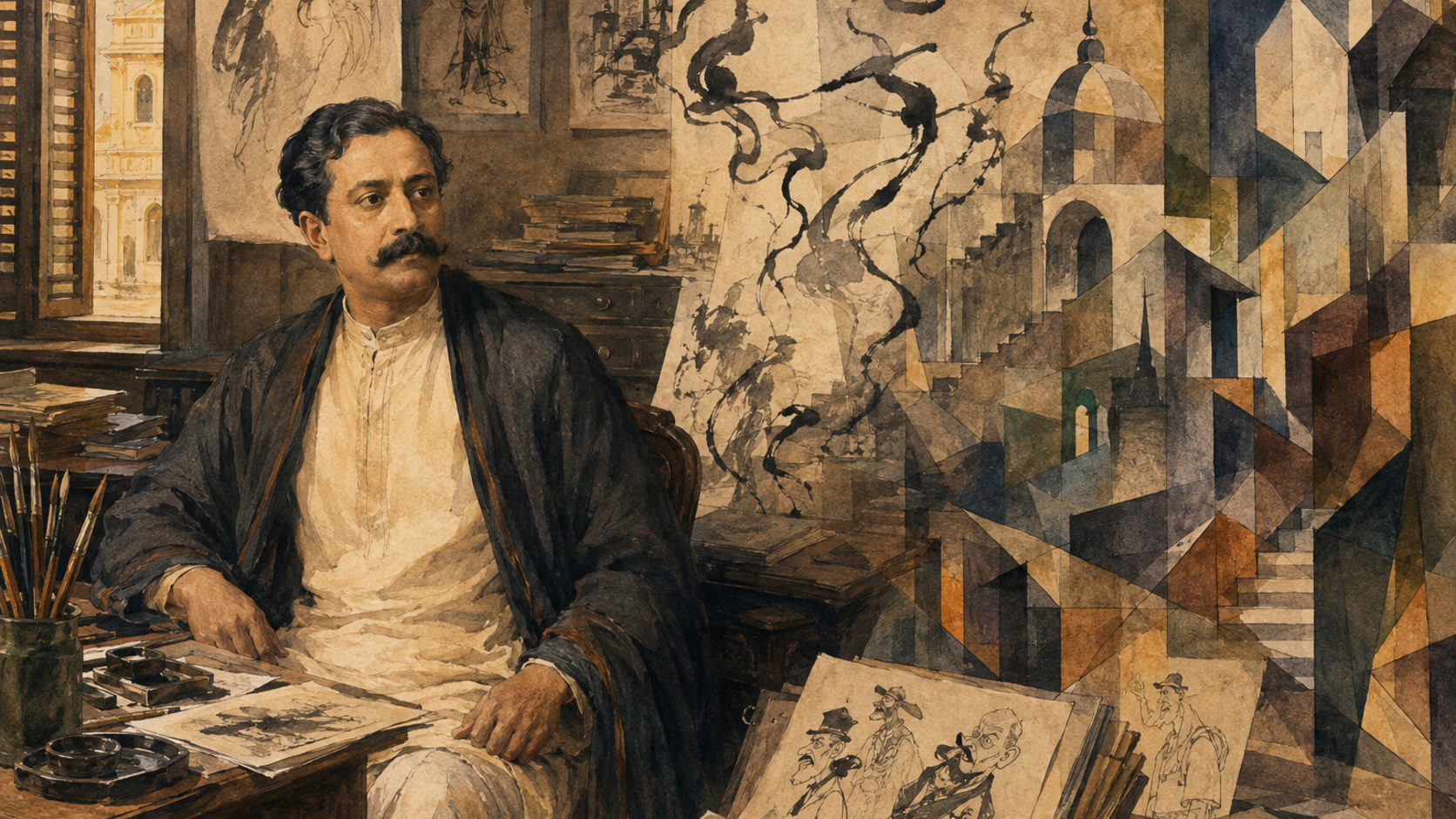
This is also why the final image in the series returns to the artist’s studio. A brush lies beside a satirical sheet. A pool of wash becomes a wall. The wall divides into prisms, then settles back into shadow. The portrait should not imply that artistic development was a ladder from an “Eastern” beginning to a “Western” modern end. The same ink runs through every room.
The staircase still leads somewhere
Return to the two figures on the landing. Their meeting remains unreadable because Tagore understood that ambiguity is not the absence of meaning. It is meaning held open by form. The staircase’s destination is withheld, but its angle directs the body. The darkness conceals, but the light makes concealment visible.
That is the power of Gaganendranath Tagore’s reinvention. He did not use Cubism to announce that India had caught up with Europe. He used it to reveal that the modern world had never possessed one center, one timeline or one stable room. Calcutta, Jorasanko, Puri, Darjeeling, Tokyo, Weimar and Paris existed within a network of unequal but real exchange.
His paintings make that network physical. A Japanese lesson about the eloquence of a stroke survives inside a black architectural plane. The bodily exaggeration of a lithographic joke survives inside spatial distortion. The expectation of household theater survives at an empty door. Indian temples and city streets do not submit to imported geometry; they alter what geometry can mean.
For an artist still relatively unfamiliar outside India, the appropriate response is not to crown him “India’s Picasso.” That comparison would restore the hierarchy his work helps dismantle. It is to look long enough for his own questions to become visible: How little can a brush say and still summon a world? What does a society’s posture betray? Can architecture remember? Where does light go after it enters history?
The staircase does lead somewhere. It leads away from a modernism narrated as Western invention and Eastern reaction, toward a history in which artists in many places transformed one another—and in which transformation, not purity, was the original act.
Reporting note and principal sources
Titles, spellings and dates for works vary among museum catalogues and later publications. Period labels used here follow the Victoria Memorial Hall/Rabindra Bharati Society retrospective and are interpretive, not dates supplied by the artist. The hero and the edition’s related images are contemporary editorial homages, not authentic Tagore works.
- National Gallery of Modern Art, New Delhi: artist profile, works, Japanese influence, satire and architectural experiments
- Museums of India/NGMA: Artist’s Studio at Jorasanko House, medium, biography and the artist’s seal
- Museums of India/NGMA: Temple Cubistic, dating and Ratan Parimoo’s account of refracted light
- Victoria Memorial Hall and Rabindra Bharati Society: retrospective chronology, Japanese technique, caricature, Cubism and late work
- Indian Society of Oriental Art: institutional history from 1907, teaching and Rupam
- German Federal Cultural Foundation: the 1922 Bauhaus exhibition in Calcutta and participating artists
- Bauhaus Dessau Foundation exhibition guide: Stella Kramrisch, Rupam and the 1922 exhibition
- Bard Graduate Center’s West 86th: review and comparison of Tagore and Bauhaus spatial languages
- Sanjukta Sunderason, South Asian Studies: caricature as rupture, resistance and modernist intervention
- Shigemi Inaga: Rabindranath Tagore, Okakura Kakuzō, Japanese painters and mutual influence in Asian modernism
- Asia Art Archive: catalogue record for The Bauhaus in Calcutta
- Partha Mitter, The Triumph of Modernism: Indian artists, nationalism and the avant-garde after 1922
- Victoria Memorial Hall: Bengal School and Gaganendranath holdings