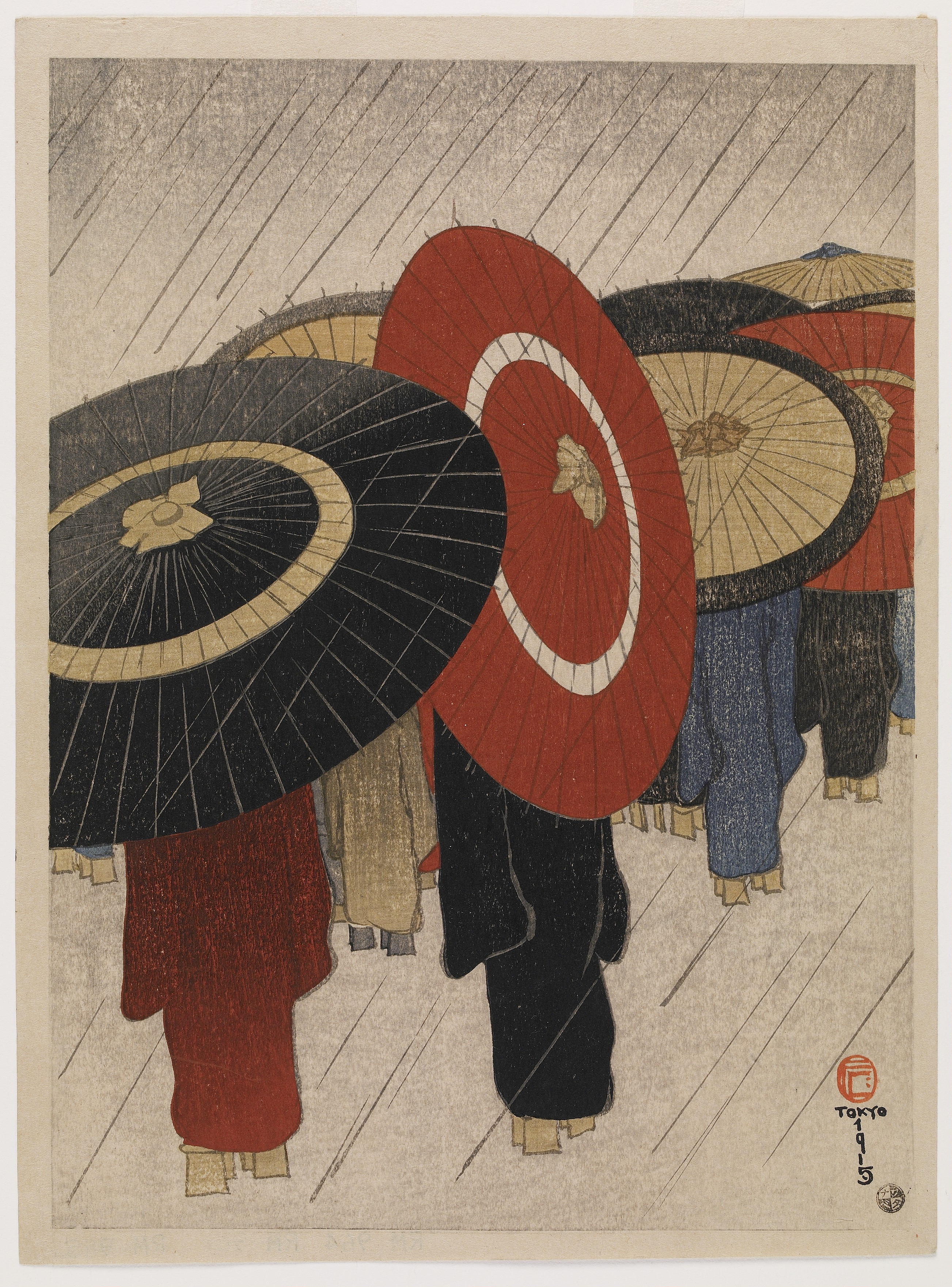
The rain is drawn as speed. Long diagonal strokes cross the sheet, but the downpour is not the first thing to seize the eye. That role belongs to the umbrellas: a red disk at the center, a black one pushing forward from the left, and a compressed procession of black, ocher and red shapes behind them.
Faces have almost disappeared. We see hems, sandals and a few lowered hands, enough evidence to understand that people are walking but not enough to turn the scene into portraiture. The Smithsonian title identifies them as student girls returning home. The image itself gives priority to collective movement over individual biography.
A street scene approaching abstraction
Capelari organizes the umbrellas as circles, arcs and radial spokes. The rain answers with parallel diagonals. Those systems of line collide across the surface: shelter is round and enclosing; weather is sharp and directional. The contrast creates motion without any figure needing to run.
The palette is equally disciplined. Red and black establish the principal rhythm, while ocher and the warm tone of the paper soften the transitions. The central red umbrella is not merely an accessory. It becomes a field of color large enough to divide the composition, conceal a body and pull the viewer into the procession.
At lower right, “TOKYO 1915” appears beside seals. The Smithsonian catalog credits Capelari as artist and S. Watanabe Color Print Co. as publisher. It does not identify the carver or printer responsible for translating the design into blocks, pigments and impressions.
An Austrian artist inside a Japanese workshop system
Japanese institutional records provide the historical frame. The Agency for Cultural Affairs’ Cultural Heritage Online, drawing on a Tokyo National Museum record, describes Capelari as an Austrian artist who came to Japan in 1911. It says Watanabe Shozaburo noticed his work in 1915 and that Capelari produced more than ten prints, becoming the first artist in the emerging shin-hanga project.
Watanabe’s own firm gives the larger sequence. Founded in 1909, it says its founder wanted to create original modern art through the techniques of ukiyo-e woodblock printing rather than simply reproduce existing paintings. In 1915, Watanabe began trial work with Capelari and Hashiguchi Goyo. Ito Shinsui, Kawase Hasui and other artists joined later.
This was not solitary printmaking. The Museum of Art, Kochi, describes shin-hanga as a revival and transformation of the traditional division of labor among designer, carver and printer, directed by the publisher and supported by carefully chosen materials and increasingly complex printing. Capelari supplied the pictorial proposition; a Japanese production network turned it into a reproducible color print.
What “the birth of shin-hanga” should—and should not—mean
Calling Capelari an artist “at the birth” of shin-hanga is justified by the Japanese museum and publisher records. Calling him its lone inventor would not be. The movement did not appear fully formed in one sheet, and the label itself was applied to the activity later, according to Watanabe’s firm.
Capelari is better understood as an early experimental partner. His position mattered because the publisher was searching for a contemporary picture that could pass through the inherited workshop process without becoming either an Edo-period imitation or a mechanical copy of a painting. The friction between a foreign designer’s eye and Japanese carving and printing practice was part of the result.
A related complication appears in museum records. Tokyo National Museum’s 1915 Capelari print titled Umbrellas is listed at 28.5 × 21.4 centimeters, while the Smithsonian sheet measures 26.7 × 19.7. The imagery appears closely related, but the available records do not establish whether these are the same impression, separate impressions from one set of blocks, or differently cataloged versions. This report does not collapse them into one object.
The image is open; the history remains unfinished
The Smithsonian holds this impression in the Arthur M. Sackler Gallery as part of the Robert O. Muller Collection, accession S2003.8.75. It records the medium as ink and color on paper and classifies the object as a woodblock print. The work is not currently on view, and its provenance research remains underway.
The museum marks the digital image CC0. Under the Smithsonian’s Open Access policy, it may be copied, modified and distributed without requesting permission. CC0 does not erase the value of accurate attribution, so Japan.co.jp retains the artist, publisher, collection and accession information and presents the complete vertical sheet rather than a decorative crop.
That open image makes the print newly mobile. More than a century after it was made, its field of umbrellas can travel far beyond a portfolio or museum store room. What remains compelling is not simply Taisho nostalgia. It is the decision to withhold faces, reduce a crowd to repeated geometry and make weather the force that binds everyone together.
Reporting note: This report is based on collection and institutional material available through 1:30 p.m. JST on August 29. No primary statement by Capelari explaining this composition was located, and the Smithsonian record does not name its carver or printer. Formal observations about color, geometry and movement are Japan.co.jp analysis.
- Smithsonian National Museum of Asian Art — title, makers, date, medium, dimensions, collection, accession, provenance and CC0 notice
- Smithsonian Open Access — reuse policy for CC0 digital assets
- Cultural Heritage Online / Tokyo National Museum — Capelari’s Umbrellas, his 1911 arrival and early shin-hanga role
- Watanabe Mokuhan Bijutsu Gaho — company history and the 1915 experiments
- The Museum of Art, Kochi — Watanabe Shozaburo and the designer-carver-printer workshop system
- The National Museum of Modern Art, Tokyo — Capelari artist record and life dates