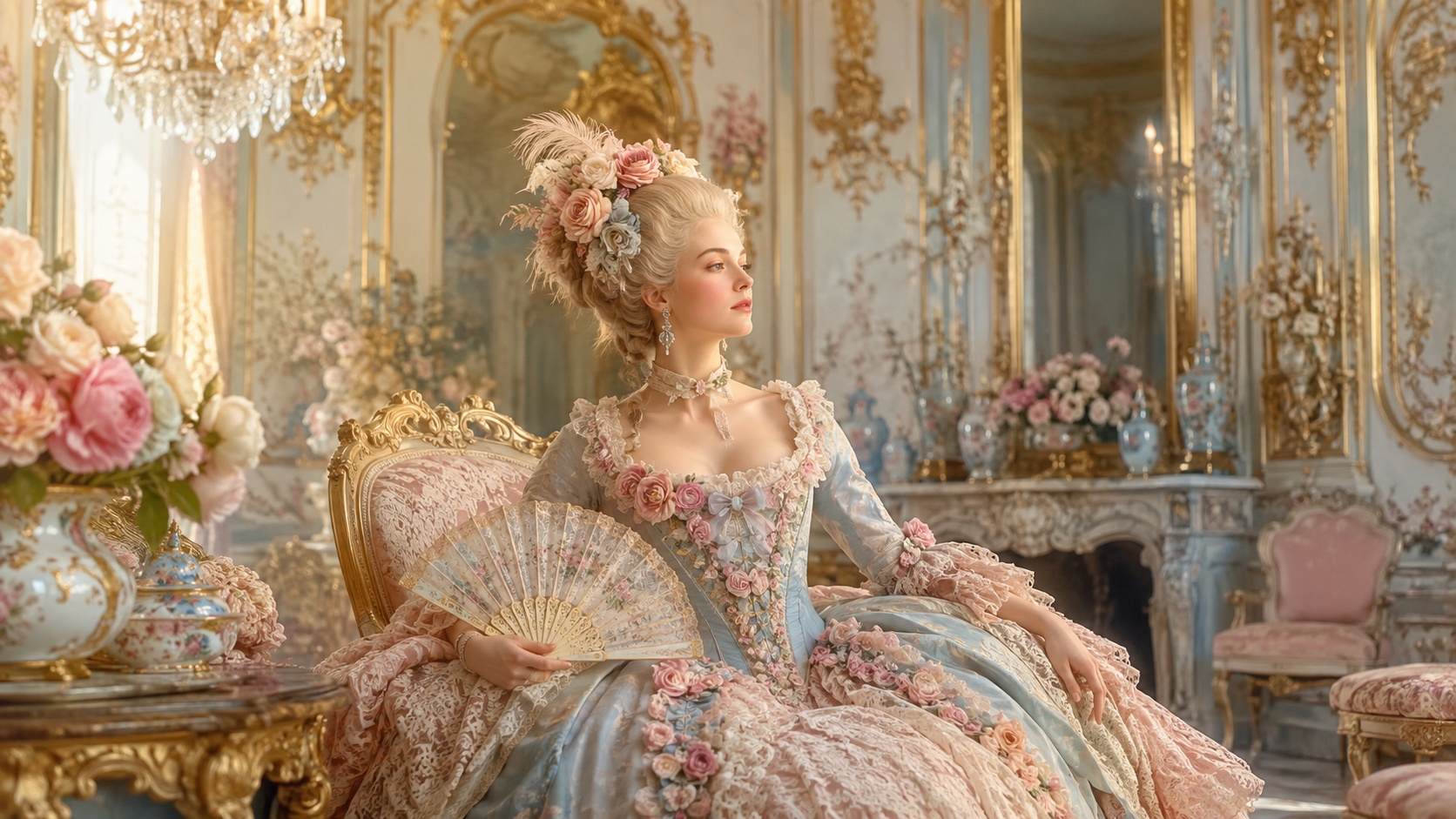
A gilded curve runs across the wall and loosens around the edge of a mirror like a shell opening in water. Rose, powder blue, ivory and gold replace the heavy drama of royal state rooms. Conversation, music, gardens, silk, porcelain and reflected light become the subjects of an entire environment. French Rococo turned art away from the monumental image of the state and toward the intimate world a person could inhabit, touch and wear.
The word “Rococo” is often accompanied by judgments: frivolous, sweet, excessive, decadent. It summons powdered hair, enormous dresses, aristocratic gardens and mythological lovers. Yet those surfaces alone cannot explain why the style has returned for nearly three centuries in furniture, fashion, cinema, photography, theater and advertising.
Rococo was not simply decoration added to art. It was a method for binding room, body and story into one continuous experience. Painting, chair, clock, fan, porcelain, embroidery and wall panel could share the same rhythm. The boundary between “fine art” and the designed object became unusually thin. That is why Rococo has repeatedly escaped the museum wall and reappeared on the body and the stage.
Rococo emerged inside the architecture of absolute monarchy
Seventeenth-century French court art had made royal authority visible. Versailles, the Hall of Mirrors, ordered gardens and mythological images of Louis XIV presented the monarch and the state as a single, monumental system. Architecture, painting and sculpture performed power on an immense scale.
After Louis XIV died in 1715, the center of elite social life temporarily shifted back toward Paris. Aristocrats increasingly favored private hôtels, salons and smaller rooms over the vast ceremonial spaces of Versailles. In those interiors, designers loosened strict symmetry and linked walls, mirrors and furniture through curling ornament. The term rocaille, one source of the word Rococo, referred to rock and shell work used in grottoes and fountains. Nature was not copied literally; it was translated into movement.
In a Rococo room, mirrors seem to open walls, gilded carving climbs toward the ceiling, and flowers cross the boundary of the frame. Furniture bends toward the posture of the body. Ornament does not merely cover an object. It makes the entire room flow.
Watteau painted stories that never quite arrive
Antoine Watteau is essential to the beginnings of Rococo painting. His fêtes galantes show elegant figures gathering in gardens with music, theatrical costume, distant boats and uncertain farewells. The narrative is never fixed. Have the lovers just arrived, or are they preparing to leave? Pleasure carries the knowledge that time is passing.
That ambiguity is central to Rococo. The surface is light and the palette soft, but happiness is never secure. Silk, foliage, cloud and gesture appear ready to change in the next instant. Beneath Rococo elegance lies the sensitivity of people who know that the scene cannot last.
Boucher and Fragonard: the theater of body and fantasy
François Boucher extended the bright palette, mythology, pastoral fantasy and sensual figure across painting, tapestry and decorative design. Supported by influential patrons including Madame de Pompadour, he helped make Rococo an integrated language of court culture.
In Jean-Honoré Fragonard’s art, a moving swing, airborne fabric, overgrown garden and concealed glance become one continuous motion. Love is presented less as moral instruction than as a game of seeing and being hidden. Modern viewers can enjoy the theatrical delight while also recognizing structures of class, gender and possession embedded in the scene.
Rococo treated the body not as a heavy monument but as a relationship among gesture, cloth, furniture and gaze. That principle survives in fashion photography and production design. Clothing does not merely cover the figure; it creates emotion and controls the speed of a scene.
More than painting: furniture, porcelain, clocks and fans
Rococo reaches its fullest expression not in an isolated canvas but in an interior where many crafts work together. Curving commodes, gilded-bronze mounts, marquetry, Sèvres porcelain, writing desks, clocks and painted fans turned use into performance.
Eighteenth-century French production depended on highly specialized artisans. Cabinetmakers, metalworkers, porcelain painters, textile makers and ornamental designers collaborated to complete a room. Rococo cannot easily be reduced to a single artistic genius. It was a total art created by many hands, urban workshops, commercial networks and court patronage.
| Rococo element | Visual character | Cultural function |
|---|---|---|
| Rocaille ornament | Shells, rocks, asymmetrical curves | Links wall, mirror and furniture into one environment |
| Pastel color | Rose, pale blue, cream and gold | Softens authority and intensifies light and intimacy |
| Garden and fête | Music, love, nature and theatrical gesture | Images ideal sociability and its fragility |
| Decorative arts | Porcelain, furniture, clocks, fans and textiles | Connects art to bodily movement and daily ritual |
Marie Antoinette arrived near the end of Rococo
When Marie Antoinette reached the French court in 1770, high Rococo was already giving way to another aesthetic. Archaeological discoveries at Herculaneum and Pompeii, Enlightenment ideals and renewed interest in antiquity encouraged a straighter, more moralizing Neoclassicism. The Petit Trianon itself is not a Rococo palace but a landmark of Neoclassical architecture designed by Ange-Jacques Gabriel.
Why, then, are the queen and Rococo so tightly joined in popular memory? Her clothing and interiors became the most vivid shorthand for eighteenth-century French court culture: roses, ribbons, porcelain, pastel color, elaborate hair and expanding skirts. Later film and fashion compressed several historical styles into one recognizably “Antoinette” universe.
The queen also moved between ceremonial magnificence and an ideal of private naturalness. From formal court dress to the white muslin chemise à la reine; from Versailles protocol to the Petit Trianon and the Queen’s Hamlet. This was not a simple journey from luxury to simplicity. Simplicity itself was carefully staged by privilege.
Beauty cannot escape politics
To celebrate Rococo pleasure is not to forget inequality before the French Revolution. These rooms and clothes were achievements of skill and imagination, but they were also products of concentrated wealth and status. Marie Antoinette’s spending did not create France’s fiscal crisis by itself, yet her appearance became a convenient image onto which a complex national failure could be projected.
There are two lessons. It is possible to admire a beautiful object while critically examining the system that made it possible. It is also necessary to see how political criticism of the queen often merged with misogyny. Clothing was treated as evidence of her power and as a reason to judge her entire character.
To dismiss Rococo only as decadence destroyed by revolution erases artisanship, women’s consumption, sociable interiors and new representations of the body. To regard it only as a beautiful dream erases class and politics. A mature viewing holds both truths at once.
After the Revolution, Rococo returned again and again
The Revolution and the rise of Neoclassicism pushed Rococo aside as the taste of the old regime. During the nineteenth century, however, Rococo Revival transformed the eighteenth century into a theater of lost elegance. Furniture, decoration, portraiture and costume were recreated for a new age.
Cinema later carried that fantasy around the world: rooms overflowing with dresses, cakes, mirrors and music, all moving toward collapse. Contemporary fashion has reused panniers, corsets, ribbons, pastel color and exaggerated ornament not simply as historical reconstruction but as tools of rebellion, camp, gender performance and criticism of consumption.
Each revival changes the meaning. The intimate luxury of royal society becomes nostalgia in one century, tragic spectacle in film, and a device for magnifying the body and social rules on the runway. A style does not survive unchanged. It survives through translation.
Japan’s own visual language of Versailles
Japanese engagement with Rococo and Marie Antoinette cannot be explained only through Western art-history textbooks. Roses, gold, lace and palace interiors have acquired their own emotional vocabulary through manga, Takarazuka theater, anime, wedding spaces, Lolita fashion and commercial design.
The Rose of Versailles was especially important in turning prerevolutionary France into a familiar historical imagination for Japanese audiences. Its world included magnificence, but also class, gender, loyalty, freedom and death. Japan’s Rococo is not simply an imitation of Europe. It is a cultural translation rebuilt inside different media and different social questions.
Five ways to look at Rococo
- Follow the curve: See where ornament begins and how it travels through wall, furniture and mirror.
- Watch the material: Notice how gilding, porcelain, silk, wood and metal change light.
- Read the body: Ask how chair, clothing and fan produce posture and gesture.
- Remember labor: Imagine the artisans, workshops and trade behind the luxury.
- Ask about access: Who could enter this room, and who carried its cost?
What lies beyond the surface
The Rococo surface is almost impossibly seductive: roses, gold, pale color and soft cloth. That is why viewing so often stops there. Yet great ornament does not end inquiry. It leads deeper. Why this curve? Who made it? Who wore it? Who was excluded from the room? Why did the style remain desirable after the political world that produced it collapsed?
The world of Marie Antoinette was never one room that existed exactly as later culture remembers it. It is a vast image assembled from court life, portraiture, craftsmanship, political attack, revolution, cinema and fashion. Fact and fantasy occupy it together.
Today’s Art Choice is therefore not an escape into the past. It is a window onto the way beauty can wrap power, narrative can manufacture a person, and ornament can outlive a regime. Beyond the golden curve lie labor, desire, criticism and memory.
Research notes and sources
Japan.co.jp reviewed major museum and cultural-institution resources on French Rococo, decorative arts, Versailles court culture, Marie Antoinette and the style’s later reception through August 3, 2026, 3:27 a.m. Japan time.