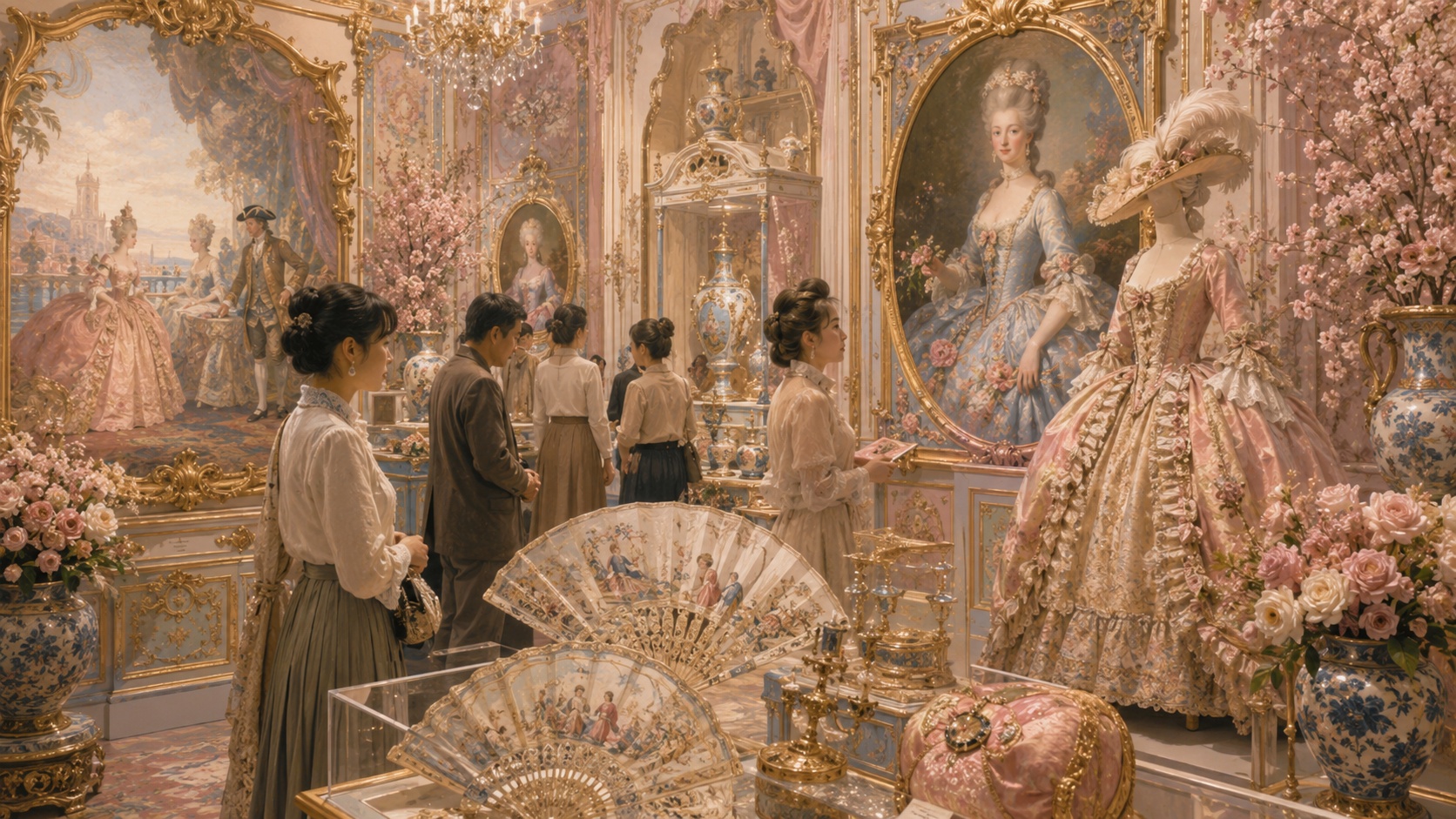
More than two centuries have passed since a queen was executed, yet a cluster of visual signs can still summon her before her name is spoken: powder blue, pearls, ribbons, roses, towering hair and a skirt spreading across a room. Marie Antoinette, symbol of the French monarchy’s collapse, also became one of the most endlessly reproduced styles in modern culture.
“Marie Antoinette Style” at the Yokohama Museum of Art is therefore more than a parade of beautiful dresses. Its deeper question is why her image survived revolution, execution and political disgrace. Clothing adorns the body, but at court it made power visible. Portraits recorded a face, but for a queen they were instruments of state performance. After her death, theater, cinema, advertising and haute couture transformed a historical person into a cultural sign whose meaning could be rewritten by every generation.
Before she was a queen, she was diplomacy
Born Maria Antonia in Vienna in 1755, she was a daughter of the Habsburg imperial family. At fourteen she married the French dauphin, Louis-Auguste, in 1770. The union was not a private romance but a diplomatic mechanism intended to secure an alliance between Austria and France after generations of rivalry. Her body, accent, manners, hair and clothing were therefore part of international politics.
At Versailles, court dress was not merely personal taste. Who could attend the queen’s dressing, how close each rank might approach, which fabrics and ornaments were appropriate—these rules made hierarchy visible. For a young queen to command attention through clothing was to inhabit power. It was also to become a target.
Rose Bertin and the invention of the fashion icon
One of the figures most closely associated with Marie Antoinette was the marchande de modes Rose Bertin. Bertin was more than a dressmaker. She coordinated fabrics, trimmings, trends and elite clients, functioning much like a creative director and producer. Her relationship with the queen helped carry court fashion into the expanding consumer culture of Paris.
Elaborate hairstyles and spectacular court gowns became media events transmitted through engravings, rumor, fashion plates and imitation. Long before photography or social media, the queen’s appearance was copied and debated at a distance. She became not only someone who wore clothes, but someone watched, discussed and reproduced.
The simple white dress that caused a scandal
Her influence cannot be explained by luxury alone. In 1783, Élisabeth Louise Vigée Le Brun exhibited a portrait of the queen wearing a loose white muslin gown resembling a chemise. Critics considered it shockingly informal, almost like underwear, and some saw the imported cotton as an insult to France’s silk industry.
Yet that simplicity proved enormously influential. Soft fabric, a more natural body and an air of private intimacy offered an alternative to rigid court display. The Petit Trianon and the queen’s hamlet embodied the same contradiction. They presented escape into nature, but it was nature carefully designed and financed by royal privilege.
How clothing became politics
France’s late-eighteenth-century fiscal crisis was not created by one queen’s shopping. War debts, an unequal tax system, state borrowing and failed reform were structural problems. But a foreign-born queen became an efficient target for public anger. Amid bread shortages and hardship, jewels, hairstyles, balls and palaces turned a complicated national balance sheet into a vivid, emotionally useful image.
In the Affair of the Diamond Necklace, Marie Antoinette was not a participant in the fraud, yet her established reputation for extravagance shaped public belief. Her clothing did not prove that she controlled policy. It did influence what people were prepared to believe about her.
| Element of style | Meaning in the eighteenth century | Later reinterpretation |
|---|---|---|
| Court dress and jewelry | Rank, ritual, monarchy and diplomacy | Luxury, fantasy and excess |
| The white chemise-style gown | Naturalness, privacy and a breach of court convention | Romance, freedom and softness |
| Towering hairstyles | Fashion rivalry and the court as visual theater | Theatricality, camp and fashion imagery |
| The Petit Trianon | A private retreat from ceremony | Pastoral fantasy, escape and the contradiction of privilege |
Revolution did not erase her; it changed her image
After 1789, Marie Antoinette’s body was recoded from a symbol of monarchy into an enemy of the nation. She was executed on October 16, 1793. Political death, however, did not end the image. Royalists made her a martyr; revolutionaries used her as the embodiment of the old regime; nineteenth-century popular culture recast her as a tragic heroine.
By the Victorian period, pre-revolutionary France could be staged as a lost world of elegance. Art, theater, costume and decoration gradually detached “Marie Antoinette style” from its political setting and turned it into an independent aesthetic language. In the twentieth century, Jeanne Lanvin’s robes de style, Georges Barbier’s prints, film costume and fashion photography repeatedly modernized that language.
Cinema and couture created an eternally new queen
Cinema expanded Marie Antoinette into a global image. Historical films recreated court costume while projecting their own period’s ideas of femininity and celebrity. The queen was never simply reconstructed from evidence; she was edited into the figure each era wanted—a tragic wife, a lonely girl, a reckless spender, a rebellious youth or a creative fashion genius.
Modern designers continue to quote panniers, corsetry, ribbons, ruffles, pastel colors and ruined grandeur. Such quotation is not necessarily nostalgia. Designers including Vivienne Westwood transformed historical dress into rebellion, while others translated court spectacle into runway narrative. Marie Antoinette became less an object to reproduce correctly than a visual archive that could be dismantled and rebuilt.
Why Yokohama matters
Since its port opened in 1859, Yokohama has served as a gateway through which foreign material culture entered Japan and Japanese art and design traveled outward. Seeing the legacy of a French queen through the collections of London’s V&A and Japanese lenders in a museum at Minatomirai resonates with that history of exchange.
No account of Marie Antoinette’s place in Japan can ignore Riyoko Ikeda’s manga The Rose of Versailles. Since the 1970s, revolutionary France has become part of Japan’s emotional memory through manga, the Takarazuka Revue and animation. Marie Antoinette remains central, but the fictional Oscar reorganizes the history around gender, class, loyalty and freedom. This was not simple imitation of Europe. It was the creative translation of a foreign past into a distinctly Japanese cultural language.
Seeing beauty and responsibility together
Visitors need not reject beautiful dresses on moral grounds. But if beauty turns the queen into a harmless icon, the exhibition risks losing the political tension of her life, the reality of privilege and the relentless misogyny directed at her.
Marie Antoinette remains compelling because she cannot be reduced to hero or villain. She was a girl sent abroad in a diplomatic marriage and a queen at the center of extraordinary privilege. She shaped fashion and was judged through fashion. Clothing gave her power, and it became a cage.
What confronts visitors in Yokohama is not only a fashion history from 250 years ago. Contemporary societies still judge women through appearance, consume luxury images, compress politics into photographs and rewrite historical people into stories that satisfy the present. Marie Antoinette style endures not only because pearls and roses are beautiful, but because we remain entangled in the politics of images.
Reporting notes and sources
Exhibition details were checked through August 3, 2026, 3:27 a.m. JST against the Yokohama Museum of Art, the official exhibition site and material relating to the V&A presentation. Historical interpretation follows widely established scholarship and primary-source chronology.