Three departures, one question
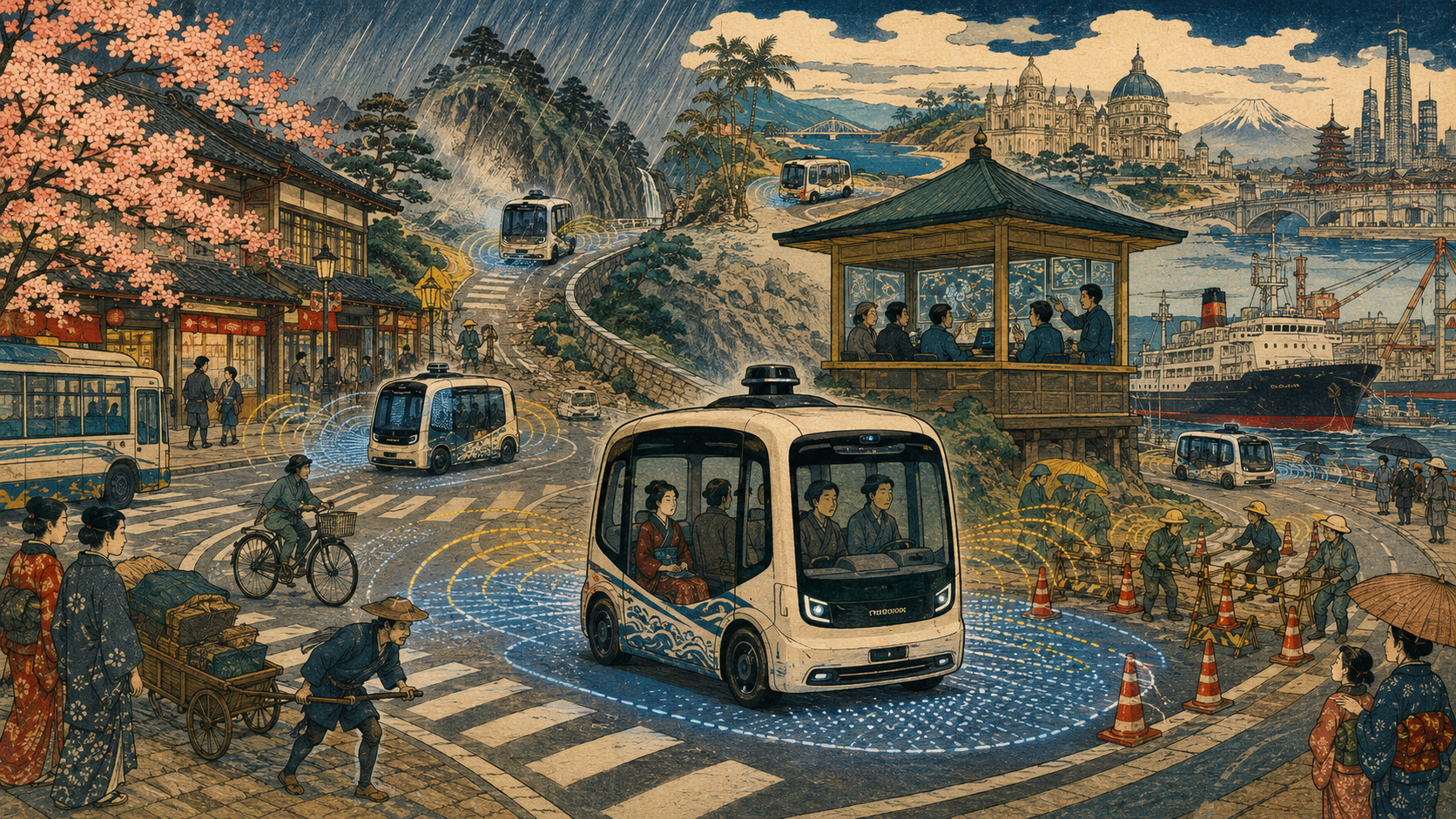
Imagine three clocks beginning together. In Tokyo, a black Toyota JPN TAXI leaves one urban hub for another, built for the curbside rhythm of Japan’s capital. In Pittsburgh, a Hyundai IONIQ 5 heads into the city that raised some of the earliest computer-controlled road vehicles, with an airport-to-Carnegie Mellon journey among the intended robotaxi routes. In Munich, a Volkswagen T7 Multivan meets European streets under the eye of the Technical University of Munich.
The vehicles do not share a badge, body, computing package or sensor layout. They drive on different sides of the road and through different visual languages. TIER IV says that is the point. On March 16, 2026, the Tokyo company published new data-centric AI software stacks through the Autoware repositories and announced validation work with the University of Tokyo, Carnegie Mellon University and the Technical University of Munich.
Each run is designed to last roughly an hour. Safety personnel remain aboard as required locally. TIER IV says intervention is not expected when the system is operating normally. Those carefully chosen words describe a demanding experiment; they do not report its score. No route-by-route disengagement log, collision record, edge-case catalogue, mileage total or independent comparison had been published with the announcement.
The scene inside the 2026 Trade White Paper
Japan’s Ministry of Economy, Trade and Industry made TIER IV a two-page case study in the 2026 White Paper on International Economy and Trade. The placement is revealing. This is not a transport ministry certification document. It is a trade-policy book asking how a Japanese technology company can create value abroad in a world of geopolitical friction.
The white paper traces a ladder: commercial work first in controlled factory and construction spaces; then buses for communities with weak transport access; later taxis, trucks, construction and agricultural machinery; eventually personal cars. It identifies three businesses—providing Level 4 vehicles and deployment support, supplying advanced systems to automakers and developers, and consulting around Autoware.
METI also presents Japanese autonomous-driving technology as a potentially “neutral” choice in markets wary of geopolitical dependence, and describes interest in consulting and training. That is the government’s strategic reading, not evidence that foreign buyers have standardized on Autoware. The white paper’s most concrete 2026 claim is narrower: TIER IV released new AI software in March, had begun Level 4 testing in three world regions and planned phased implementation from 2027.
What Level 4 actually promises
The ladder from Level 0 to Level 5 is often treated as a score of intelligence. It is better understood as an allocation of responsibility. At Level 2, the human still drives and monitors even when steering and speed assistance are active. At Level 3, the system drives under defined conditions but may ask a fallback-ready human to take over. At Level 4, the automated driving system performs the entire dynamic driving task and fallback within its specified operational design domain, or ODD. A passenger need not be the fallback driver.
The boundary matters more than the numeral. A Level 4 system may be limited to a mapped route, certain speeds, weather, road types, lighting or traffic conditions. Outside that envelope it need not drive; it must instead avoid entering the situation or reach a minimal-risk condition. Level 5 would cover all road conditions that a human could manage. TIER IV’s “Level 4+” is its own development concept, not an additional SAE level. The company says human responsibility remains Level 4 while the system borrows Level 5-like flexibility to enlarge the ODD over time.
A test feature is not a licensed driverless service
Japan illustrates the difference. The amended Road Traffic Act, effective in April 2023, created a permit system for “specified automated operation” corresponding to driverless Level 4. The vehicle and automated-driving device must satisfy requirements under the Road Transport Vehicle Act; the operator also needs a route- and operation-specific permit from the prefectural public safety commission, with plans for supervision and incident response.
TIER IV has crossed parts of that bridge elsewhere. Its AI Pilot system received Level 4 certification for a bus route between Shiojiri Station and city hall in 2024, and a Komatsu bus received vehicle certification in 2025 before the separate road-operation permit. Those accomplishments show deployment experience. They do not automatically authorize a JPN TAXI test vehicle to run as an empty robotaxi anywhere in Tokyo.
The March 2026 program explicitly keeps safety personnel aboard. In the United States, federal vehicle oversight and state road-testing rules divide authority; in Europe, vehicle regulation and local test permissions create their own pathway. TIER IV says each program follows local law and safety standards. Until permissions and operating terms are disclosed, “Level 4-function testing” is the accurate description.
Autoware begins with a professor and a public repository
Shinpei Kato came to autonomous driving through computer systems. At Nagoya University, his group assembled perception, localization, planning and control into a ROS-based package that researchers could download. The first release arrived in August 2015. It was called Autoware.AI and ran on ROS 1, the Robot Operating System middleware already familiar to robotics laboratories.
Before that release, many research teams built the same plumbing repeatedly: sensor drivers, coordinate transforms, maps, visualization and interfaces between algorithms. Autoware offered an all-in-one starting point. A graduate student could focus on a planner instead of first constructing an entire vehicle software stack. An automaker or supplier could inspect how the pieces connected. The code did not make a car safe by itself, but it made the problem shared.
Kato founded TIER IV in December 2015. The company turned the open project into a commercial thesis: if the base software remained visible and collaboratively improved, TIER IV could sell the engineering around it—reference designs, sensors, computers, vehicle integration, cloud tools, validation, operations and support.
Why Pittsburgh completes a historical circle
Pittsburgh is more than a convenient U.S. test site. Carnegie Mellon’s autonomous-vehicle work began in the mid-1980s. Navlab 1, built in 1986 from a blue Chevrolet van, carried racks of computers and moved at a walking pace. In 1995, Navlab 5 steered itself for more than 98% of a 2,850-mile journey from Pittsburgh to San Diego, while humans still controlled throttle and braking.
The old van and the new IONIQ 5 express the same experimental instinct with radically different tools. Navlab asked whether computer vision could hold a lane across a continent. TIER IV and CMU now ask whether a data-centric AI system can handle perception, prediction, planning and control within a Level 4 design—and whether lessons from a difficult city can flow back into an open global platform.
There is also a Japanese thread. Takeo Kanade, the Hyogo-born computer-vision pioneer who led the Navlab era, moved from Kyoto University to Carnegie Mellon. The 2026 Pittsburgh test reconnects Japanese engineering and CMU robotics in a city where autonomous driving has been a lived research subject for four decades.
From rules to data
Traditional autonomous-driving software is modular. One component detects objects; another predicts their motion; another decides whether to yield; another generates a trajectory; a controller turns that path into steering, braking and acceleration. Engineers write explicit rules around traffic laws and known situations. The design is inspectable: when the vehicle stops, one can often identify the module and rule that caused it.
That approach becomes laborious in the “long tail.” A delivery truck blocks half a lane. A cyclist gestures around a pothole. Snow hides paint. A pedestrian looks ready to cross but steps back. Engineers can keep adding cases, yet roads create combinations faster than teams can enumerate them.
Data-centric AI reverses some of the emphasis. Instead of treating a trained model as a finished component, the organization treats data selection, quality, labeling, evaluation and repeated retraining as the product’s learning machinery. TIER IV’s MLOps system checks quality, anonymizes people, tags and annotates data, uses active learning to find informative examples, and combines real and synthetic scenes for evaluation. The three-city program is therefore not only a road test; it is a test of the improvement loop.
Two AI paths, not one black box
TIER IV’s release offers two configurations. The first is a hybrid: separate machine-learning models perceive the environment, while a planning AI uses diffusion models to represent possible changes over time and generate decisions and trajectories. “Diffusion” here describes a generative method that begins with noisy candidate behavior and progressively shapes plausible paths; it is not a promise that every generated path is safe.
The second is an end-to-end, or E2E, system. It converts surroundings and vehicle state into vector representations and uses a world-model concept to learn perception, planning and control as a more unified process. In principle, reducing hand-built boundaries can help information flow and allow training objectives closer to the final driving task. In practice, the very integration that gives E2E systems power can make a mistake harder to explain, isolate and certify.
TIER IV’s 2025 architecture deliberately retained rule-based elements for interpretability and operational stability. Its collaboration with CMU also emphasizes intermediate representations, traceability and a minimum-risk maneuver when the system reaches an unfamiliar situation. The company is not simply replacing every rule with one neural network; it is experimenting along a spectrum from modular hybrid to more unified E2E learning.
“Hardware-agnostic” has a practical meaning—and a limit
The March stack is designed to support different systems-on-chip and sensor arrangements without locking an automaker to one hardware vendor. That abstraction is strategically important. A manufacturer can keep the higher-level architecture while choosing cameras, lidar, compute or a vehicle platform that suits cost, supply and performance.
It does not mean the identical binary can be dropped into any car. Every platform still needs drive-by-wire interfaces, time synchronization, coordinate frames, camera and lidar calibration, vehicle dimensions and dynamics, compute and thermal budgets, failure detection, cybersecurity and safety validation. TIER IV’s own starter-kit literature advertises pre-synchronized computers and sensors precisely because integration work is normally real.
A Toyota taxi, Hyundai EV and Volkswagen van differ in wheelbase, braking response, sightlines, power architecture and passenger use. Their cities differ more. Portability means reusable interfaces, models and tools reduce the work. It does not abolish vehicle engineering or the need to validate each configuration.
What each city is meant to teach
| Hub | Vehicle and partner | Publicly stated test | Evidence still needed |
|---|---|---|---|
| Tokyo | Toyota JPN TAXI; University of Tokyo | User experience between urban hubs in Japan’s dense capital | Exact ODD, route, traffic exposure, interventions, ride quality and accessibility results |
| Pittsburgh | Hyundai IONIQ 5; Carnegie Mellon University | Urban robotaxi work, including travel between the airport and CMU | Route conditions, weather coverage, safety-driver actions and repeat-run performance |
| Munich | Volkswagen T7 Multivan; Technical University of Munich | Safety evaluation across urban scenarios in and around the city | Scenario catalogue, acceptance criteria, regulatory scope and comparative results |
The diversity is scientifically useful only if the measurements are comparable. A sunny hour in one city and a wet rush hour in another do not create a fair ranking. The partners need common definitions for an intervention, route completion, traffic-law compliance, passenger comfort, false braking, vulnerable-road-user handling and minimum-risk behavior, while preserving local context.
An hour can reveal a bug; it cannot establish a rare-event rate
A one-hour run is long enough to encounter intersections, lane changes, occlusion and imperfect human behavior. It is excellent for integration testing and demonstration. It is far too short, by itself, to estimate the frequency of rare severe failures. If an event is expected once in hundreds of thousands or millions of driving hours, a clean hour says almost nothing about its rate.
That does not make the tests theatrical. It places them in a larger validation system: simulation, closed-course work, software-in-the-loop and hardware-in-the-loop testing, adversarial scenario generation, replay of recorded data, structured public-road exposure and a documented safety case. TIER IV’s use of synthetic data and MLOps belongs to that system. Public confidence will depend on what metrics and failure analyses emerge from it.
The geography problem inside AI
An AI model learns the statistical world represented in its data. Move the model and the distribution moves. Signs, signals, lane markings, vehicles, uniforms, emergency procedures, curb behavior and even the social meaning of a cautious gap differ by country. Weather changes sensor physics. Architecture changes multipath reflections. A locally ordinary scene can be foreign to a globally trained model.
That is why TIER IV speaks of “environment-specific additional datasets.” The point is not to collect three postcards. It is to discover where a shared model fails and then decide whether to retrain, add a regional adapter, change a rule, alter sensors or narrow the ODD. If every city requires an entirely separate stack, the portability thesis weakens. If one model is forced across all cities without local adaptation, safety weakens. The valuable engineering lies between those extremes.
Open source changes who can inspect the road
In 2018, stewardship of Autoware moved into the newly created Autoware Foundation, a nonprofit industry alliance. The project later evolved beyond the original ROS 1-based Autoware.AI toward ROS 2 and today’s Core and Universe structure. Core is intended for rigorously reviewed functionality aimed at defined ODDs; Universe provides a wider space for experimental and advanced packages that may mature toward Core.
Open code lowers the cost of entry for universities, vehicle makers, cities and startups. Bugs can be reproduced across organizations. A university contribution can become industry infrastructure. Countries without a giant proprietary robotaxi company can train engineers on a common platform.
But open source does not transfer liability to a crowd. Someone must select a version, secure the supply chain, integrate hardware, prove the configuration, monitor operation and maintain updates. Public visibility helps auditability; it does not certify safety. The product that carries passengers is a controlled build and operational system, not “whatever is on GitHub today.”
The Linux analogy—and where it breaks
TIER IV’s commercial logic resembles companies built around Linux: give the ecosystem a shared base, then earn revenue from integration, tested distributions, hardware, tooling, support and services. The 2026 Trade White Paper describes exactly that range, from vehicles and systems to consulting and training.
The analogy is attractive because automakers fear lock-in. A common platform could let them retain vehicle design and data while sourcing multiple chips and sensors. It could also make Japanese technology an exportable layer even when the finished vehicle is Korean or German.
Yet a server crash and a road crash have different consequences. Automotive software is tied to physical tolerances, certification, maintenance and an ODD. Open development must therefore coexist with frozen releases, configuration management, traceable requirements, redundant safety mechanisms and long validation cycles. The winning business may be less “download an app” than “operate an accountable engineering institution around shared code.”
Data is the fuel—and a governance obligation
The MLOps loop needs large volumes of real driving data. TIER IV and Nihon Kotsu began collecting Tokyo taxi data with five instrumented vehicles in February 2025 and planned to expand to about 20. The company’s collaboration platform also combines data from partners and synthetic generation.
Scale creates questions. Who owns a street recording? How are faces and license plates anonymized? Can a partner train a commercial model on another fleet’s data? How are errors in labels corrected? Can regulators reproduce a version of the model after an incident? How does a Japanese dataset travel into Europe without violating privacy rules?
TIER IV says its platform performs anonymization, tagging and quality checks. The three-continent program will test whether those controls work across legal systems as well as traffic systems. A globally portable stack requires globally credible data provenance.
Safety must survive the update loop
Continuous improvement sounds obviously beneficial: find a failure, add data, retrain, deploy a better model. In a safety-critical system, every improvement can also change behavior elsewhere. A model tuned to pass cyclists with greater comfort might become too hesitant in dense traffic. A synthetic snow scene might help one sensor configuration and harm another.
That means the update process needs gates: versioned data, reproducible training, predefined scenario suites, regression tests, hardware-specific evaluation, security review, operational monitoring and a rollback plan. “The model learned” is not a safety argument. The organization must show what changed, why, against which hazards and with what residual risk.
The hybrid architecture may help by keeping some interpretable boundaries and deterministic safeguards. The E2E architecture may help by learning interactions that hand-written modules miss. Neither advantage is free. The three-city program is valuable because it exposes both architectures to mismatch; its credibility will rise if TIER IV publishes failures as carefully as successes.
A ledger of the March 2026 claim
| Claim | Evidence available by August 7, 2026 | Status |
|---|---|---|
| AI Level 4 stacks are public | TIER IV announcement and code in Autoware Foundation repositories | Release confirmed |
| Tests span Tokyo, Pittsburgh and Munich | Named universities, vehicles and use cases in the March announcement | Program confirmed |
| Runs are driverless services | Safety personnel are aboard; no three-city commercial service announcement | No |
| No intervention is needed | TIER IV says intervention is not expected in normal operation; no aggregate logs disclosed | Test design, not published outcome |
| The stack is hardware-agnostic | Designed for multiple SoCs and sensor configurations | Architecture goal; integration still required |
| “Level 4+” is an official SAE level | TIER IV defines it as its own concept within Level 4 human roles | No |
| Commercial AI rollout begins in 2027 | Stated as a plan in the 2026 Trade White Paper | Forward-looking |
Eleven years from repository to three-continent test
1984–1986 Carnegie Mellon begins Navlab work and builds its first self-contained test van.
1995 Navlab 5 steers itself for more than 98% of a Pittsburgh-to-San Diego trip.
August 2015 Shinpei Kato’s Nagoya University team releases Autoware.AI on ROS 1.
December 2015 Kato founds TIER IV.
2017 TIER IV records its first public-road autonomous test in its corporate history.
December 2018 The Autoware Foundation is formed to govern the open project.
2020 TIER IV begins Nishi-Shinjuku robotaxi trials; Japan legalizes Level 3 automated-driving systems.
April 2023 Japan’s driverless Level 4 “specified automated operation” permit system takes effect.
October 2023 TIER IV’s AI Pilot receives Level 4 vehicle approval at a controlled Sagamihara logistics site.
October 2024 Its Shiojiri bus system receives Level 4 certification for a public-road route shared with traffic.
April–July 2025 TIER IV launches its Level 4+ work with CMU and publishes an E2E architecture.
March 16, 2026 The company releases the two AI stack configurations and announces tests in three global hubs.
June 30, 2026 METI releases the 2026 Trade White Paper, profiling TIER IV and its 2027 implementation plan.
What would turn the demonstration into evidence
- Define each ODD: mapped roads, speed, weather, time, construction, traffic and fallback limits.
- Report exposure: kilometres, hours, repeat runs and the share driven in genuinely complex traffic.
- Publish intervention rules: what counts as a takeover, precautionary brake, remote assist or route abort.
- Use common metrics: law compliance, comfort, false positives, near conflicts, minimum-risk maneuvers and mission completion.
- Separate configurations: hybrid versus E2E results, and performance by vehicle, SoC and sensor suite.
- Show the update trail: which local examples changed a model and whether regressions appeared elsewhere.
- Invite independent scrutiny: university methods, reproducible scenario tests and regulator-ready safety cases.
- State deployment status plainly: test, certification, road permit, paid service and unsupervised operation are different milestones.
The business test behind the driving test
TIER IV employs more than 400 people and reports substantial financing across multiple rounds. It is no longer a laboratory side project. Yet open-source strategy creates an enduring commercial question: how much value remains with the integrator when the base code is public?
The answer may be the accumulation around the code. A vehicle maker needs a safe architecture, reference hardware, calibrated sensors, cloud pipelines, validation tools, operational support and trained engineers. A local government needs routes, permits, remote supervision and maintenance. An overseas partner needs adaptation without surrendering every technical decision to a foreign black box.
Three successful demonstrations would not settle that model, but they would make it legible. If the same architecture shortens deployment across three vehicle brands and regulatory cultures, TIER IV has something more scalable than one bespoke robotaxi. If every project becomes a one-off engineering effort, the open platform may grow while margins and schedules remain difficult.
The geopolitical appeal of visible code
METI’s “neutral option” language connects software architecture to economic security. Governments worry about dependence on foreign AI, cloud services, mapping and vehicle-control systems. An open foundation can make interfaces visible, let domestic engineers build expertise and reduce reliance on a single closed vendor.
Visibility does not remove geopolitical risk. Chips, lidar, cloud infrastructure and training accelerators still have supply chains. A fork can fragment the community. Export controls, privacy rules and cybersecurity requirements can divide deployments. But a transparent common platform gives countries more room to inspect, adapt and negotiate than an opaque turnkey system.
That is why the training described in the Trade White Paper matters. Autoware’s export may be not only code but capability: engineers who can understand a stack, operate it and improve it locally. The durable unit of trade could be an ecosystem.
Three cities are the beginning, not the verdict
The most photogenic reading of TIER IV’s announcement is a Japanese AI driver conquering three continents. The more interesting reading is harder. A small company founded around university software is testing whether open governance, two competing AI architectures, multiple hardware configurations and a continuous-data loop can coexist with the discipline of automotive safety.
Tokyo asks whether the system can become a considerate urban taxi. Pittsburgh asks it to enter the birthplace of road robotics and carry a lineage forward. Munich asks whether the architecture can withstand European urban scenarios and regulatory expectations. None of those questions can be answered by one clean hour.
A fair verdict in August 2026
TIER IV has delivered a real software release, not a concept slide. It has named vehicles, research partners and use cases. The stack supports two AI strategies and is designed for multiple chips and sensor arrangements. Autoware has an eleven-year history, a nonprofit foundation and deployments that extend beyond laboratory demos. Japan’s trade ministry is justified in treating it as an important example of open-source industrial strategy.
What TIER IV has not yet delivered is equally important. The announcement contains no standardized three-city results, no public intervention dataset, no proof that the hardware abstraction eliminates costly integration, and no evidence that these specific vehicles may operate as commercial driverless services. “Level 4+” remains TIER IV’s roadmap, not a new regulatory class.
The honest story is better than the inflated one. Autoware began by making the machinery of autonomous driving visible. In 2026, TIER IV is asking whether that openness can scale across three road cultures just as AI makes the machinery of decision-making less visible. Solving that contradiction—open code, learned behavior, auditable safety—is the test that matters.
Reporting notes and principal sources
Public information was checked through August 7, 2026, 9:02 a.m. JST. TIER IV’s releases are treated as interested-party claims. “Level 4-function testing” is distinguished from driverless commercial operation; “hardware-agnostic” is interpreted as portability across supported configurations, not zero integration; and “Level 4+” is identified as TIER IV’s concept rather than an SAE category. The Trade White Paper’s 2027 date is a plan, not a completed deployment.
- TIER IV: March 2026 AI Level 4 stack release and three-hub testing program
- TIER IV: Japanese release, technical configurations and local test descriptions
- METI: 2026 White Paper on International Economy and Trade, pp. 452–453
- METI: English release and purpose of the 2026 Trade White Paper
- TIER IV: 2025 E2E architecture for Level 4+
- TIER IV: open datasets, AI evaluation and Japanese government project
- TIER IV and CMU: Level 4+ definition, traceability and minimum-risk work
- Autoware Foundation: project architecture, Core, Universe and deployment scope
- Autoware Foundation: history of Autoware.AI, ROS 1 and the 2018 foundation
- Autoware Foundation: public source repositories and documentation
- TIER IV: corporate history, funding, headcount and company profile
- TIER IV Services: deployment, development and consulting model
- U.S. NHTSA: automation levels and Level 4’s limited service domain
- Japan National Police Agency: 2022 Road Traffic Act amendment and April 2023 Level 4 permit system
- TIER IV: Shiojiri Level 4 certification
- TIER IV: Komatsu certification and separate road-operation permit
- TIER IV and Nihon Kotsu: Tokyo taxi data-collection project
- TIER IV: test-vehicle kit and the realities of sensor/ECU integration
- Carnegie Mellon: Navlab 5 and the 1995 No Hands Across America journey
- Carnegie Mellon: Navlab 1 and the 1986 autonomous-vehicle archive