- A city turns lunch into a public decision
- Five tastings, one consequential vote
- Why wheat mattered before spaghetti did
- How an Italian dish became recognizably Takasaki
- A contest born in 2009
- Eighteen menus, and many different Japans
- Who is competing?
- The business value—and its limits
- A useful visitor guide
- The real prize is a living regional cuisine
A city turns lunch into a public decision
On November 15, a square in central Takasaki is set to become a tasting room for a city-sized argument: which restaurant makes the best pasta? Eighteen entrants will offer small portions of inventive dishes, and ticket holders will choose a single favorite. The 18th King of Pasta competition is a food festival, but it is also a compact demonstration of how a Japanese regional identity can be built from an imported cuisine.
The 2026 event is scheduled for 10 a.m. to 3:30 p.m. at Motenashi Square. The city bulletin confirms 18 restaurants and a public vote. The winner has not yet been established at the time of this report.
Five tastings, one consequential vote
The official format is deliberately simple: one ticket permits five tastings selected from the participating stalls, together amounting to roughly an ordinary serving of pasta. Each ticket also provides one vote for one restaurant. Visitors cannot simply buy individual dishes directly at each booth under the ordinary festival system.
The format means restaurants must make an impression quickly. Sauce, texture, serving temperature and recognizability may all shape a diner’s preference, though no study supplied by organizers isolates which factors determine votes. This is a popular-choice competition, not a controlled blind tasting or a professional culinary certification.
Why wheat mattered before spaghetti did
Gunma’s relationship with flour predates modern Italian restaurants. The region has long embraced wheat-based foods such as udon noodles and yakimanju, the grilled buns coated with a sweet-savory miso glaze. Takasaki City itself explicitly links the popularity of pasta to this broader local flour-food tradition.
In the Ministry of Agriculture’s 2025 prefectural wheat figures, Gunma harvested 23,200 metric tons from 5,270 hectares, ranking seventh nationally by output. That is a measurable agricultural foundation, not proof that every contest noodle uses Gunma wheat. Local toppings, regional sauces and the origins of the wheat in the pasta should be examined separately.
How an Italian dish became recognizably Takasaki
According to Gunma’s restaurant trade association, pasta gained popularity in Takasaki in the late 1960s and 1970s, when Italian-style restaurants were still relatively unusual in much of Japan. Generous portions and distinctive, hearty sauces became part of the area’s reputation. Over time, individual establishments helped transform a foreign restaurant dish into something residents came to regard as local.
The association credits the long-established Shango restaurant with developing a clam-broth-based soup pasta that it began selling in 1972. The account is valuable local culinary history, but it does not independently prove that Takasaki invented every form of soup spaghetti. Historical origin claims deserve narrower wording than promotional slogans.
A contest born in 2009
King of Pasta began in 2009. The organizing committee says its purpose is to renew appreciation of the food culture nurtured by wheat and other agricultural products around Takasaki. Rather than asking judges alone to pick a technical winner, it gives ordinary diners a vote—and potentially a reason to explore restaurants beyond the festival.
The organizers’ archives show Bambina Nakaimachi winning in 2023, 2024 and 2025. Earlier champions include Sorriso in 2022 and Caro in both 2020 and 2021. This year’s field combines established competitors with first-time participants, creating a genuine question about whether a familiar winner or a newcomer will attract the most votes.
Eighteen menus, and many different Japans
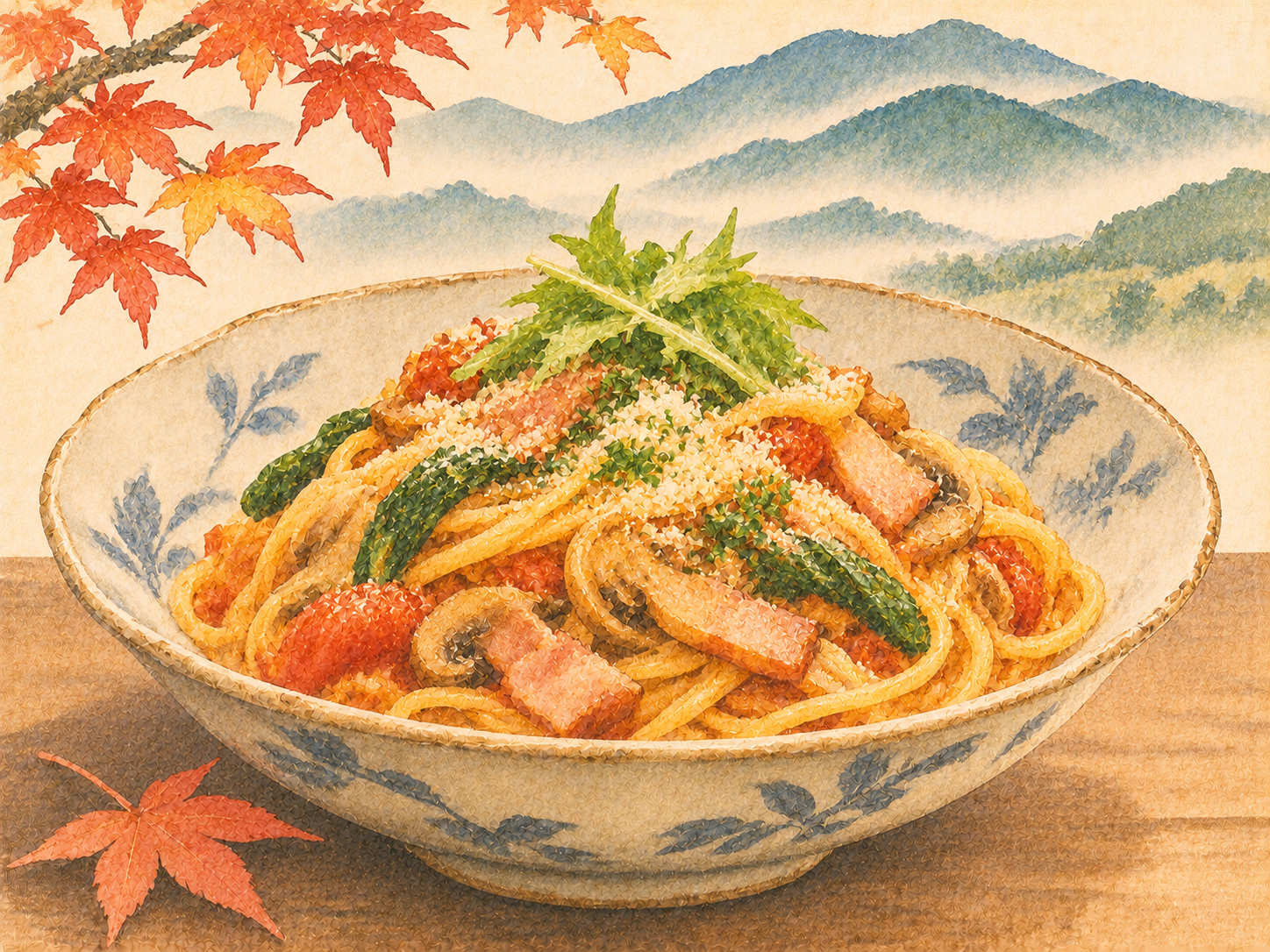
The 2026 official menu reads like an inventory of regional ingredients filtered through global technique. One dish features Jōshū beef in red wine sauce; another pairs Jōshū barley-fed pork with a miso-tomato cream. Entrants propose Haruna-grown zucchini with shrimp flavor, chicken-based cacciatora, mushrooms with Japanese broth, and a seafood lemon-cream soup pasta with Japanese accents.
A gluten-free penne entry and dishes invoking regional pork, chicken, mushrooms and local history broaden the range. These combinations make the event more interesting than a generic Italian-food contest. Still, menu titles are descriptions provided by entrants, not independent audits of ingredient sourcing or preparation.
Who is competing?
The official roster lists バンビーナ 中居店 (Bambina Nakaimachi), 洋麺亭 高崎店, メゾン・ド・ラ・クール, シトラスタイム, イスウ, 歌宝, ボンジョルノ 本店, 高崎カメレオン and シルクロード 石原店. The remaining entrants are マチエール, マカロニ, スウィングンマ, はまゆう山荘, すみ香, リンレン, スナガ, いっちょう 高崎中居店 and ミッサマリーナ. Japanese names are preserved where an official English spelling could not be verified.
These are not all the same type of business. The field includes neighborhood establishments and a hot-spring accommodation operator. A temporary high-volume festival stall tests different abilities from a full restaurant meal, making the result a useful public preference signal rather than a complete ranking of Takasaki’s dining scene.
The business value—and its limits
For a restaurant, the competition can produce attention, first-time customers and a menu that travels through social media. But food festivals also have hard operational constraints: preparing ingredients in advance, managing temperature and allergens, keeping lines moving and serving food consistently throughout the day.
It would be an overstatement to assign economic returns to this year’s contest without participating restaurants’ sales figures. A richer question is whether exposure converts into visits months later, whether growers build repeat supply relationships, and whether competing dishes survive as regular menu items.
A useful visitor guide
Admission to the square is free, but the organizers require a five-tasting ticket for the pasta. Their FAQ says the event normally runs in rain, although severe weather may cause cancellation. There is no dedicated event parking, crowds may trigger admission controls, and wheelchair users and families with strollers may enter.
Ticket categories and availability should be checked against the latest organizer information before travel. Those with food allergies should ask participating businesses directly about ingredients. The five-tasting format is particularly suited to comparing contrasting flavors, not necessarily to ordering a full meal from a favorite stall.
The real prize is a living regional cuisine
One restaurant is expected to be named King of Pasta after the November 15 vote. Yet the larger success of the event lies in how it brings together wheat farming, postwar restaurant history, local meat and vegetables, independent businesses and the preferences of ordinary residents.
The official winner and vote totals must be added when independently confirmed after the event. Until then, the story is about a competition preparing to take place—and the distinctive culinary culture that made it possible.
Primary sources and verification limitations
Results and vote totals for November 15, 2026 were not available for confirmation. Historical origin narratives are attributed to local institutions and are not independent proof of culinary invention.
- King of Pasta official event overview
- Official 2026 participating restaurants and dishes
- Official visitor FAQ and voting rules
- Takasaki City tourism: Pasta City Takasaki
- Takasaki City November 2026 public bulletin
- Ministry of Agriculture, Forestry and Fisheries: 2025 wheat production by prefecture
- Gunma Restaurant Association: Pasta culture and history
- Official contest history and previous champions
- Takasaki Tourism Association 2026 event information